

BaaS vs Custom Blockchain: Which Fits Your Business in 2026?
You are staring at a blank screen, trying to decide how to build your next supply chain tracker or digital identity system. Do you rent the infrastructure from a giant like AWS or Microsoft, or do you build the engine from scratch? It is a classic dilemma, but in 2026, the stakes are higher than ever. The wrong choice can cost you millions in compliance fines or leave you stuck with a platform that cannot scale when your business booms.
Blockchain as a Service (BaaS) is a cloud-based model where third-party providers host and manage blockchain infrastructure, allowing businesses to deploy applications without handling underlying technical complexities. In contrast, Custom Blockchain Development is the process of creating a bespoke blockchain solution from scratch, tailored specifically to an organization's unique requirements and regulatory needs.
According to Gartner’s 2024 report, 68% of enterprises evaluating blockchain initially look at BaaS because the entry barrier is lower. Only 22% jump straight into custom development. But does that mean BaaS is always the right answer? Not necessarily. While BaaS offers speed, it often comes with hidden constraints. Let’s break down exactly what you need to know to make this decision correctly.
Key Takeaways
- BaaS reduces initial investment by 65-80% compared to custom builds, making it ideal for rapid prototyping and non-critical applications.
- Custom blockchains offer 30-40% better performance for domain-specific use cases but require 6-9 months of development time.
- Healthcare and finance sectors overwhelmingly prefer custom solutions due to strict data sovereignty and HIPAA/GDPR compliance requirements.
- Vendor lock-in is a major risk with BaaS, with 58% of enterprises reporting significant challenges when switching providers.
- By 2027, Gartner predicts 55% of enterprise implementations will use hybrid models, blending BaaS infrastructure with custom application layers.
The Speed vs. Control Trade-off
When you choose BaaS, you are buying time. Providers like AWS Managed Blockchain and Azure Blockchain Service have pre-built consensus mechanisms and smart contract environments ready to go. BitGo’s 2023 case study showed that companies using BaaS hit the market 70% faster than those building in-house. If you need a proof of concept running next month, BaaS is hard to beat.
However, speed has a price. You are limited to what the provider allows. A FinTech developer on Reddit named 'FinTechDev2023' spent 18 months on Azure before realizing they couldn't modify the consensus algorithm for their high-frequency trading platform. That limitation forced a painful migration to a custom solution. Custom blockchain development gives you total control over architecture, enabling features like proprietary consensus mechanisms that can achieve 15,000 transactions per second (TPS), far exceeding the standard 5,000 TPS limit on many BaaS Hyperledger Fabric networks.
| Attribute | BaaS | Custom Blockchain |
|---|---|---|
| Initial Cost | $8,500/month average (medium implementation) | $150,000 - $500,000 upfront |
| Deployment Time | 1-3 months | 6-9 months |
| Max TPS (Standard) | 5,000 - 10,000 | 15,000+ (custom optimized) |
| Security Responsibility | Shared (Provider handles core infra) | Solely Organization |
| Compliance Flexibility | Limited (Standard protocols) | High (Tailored to regulations) |
Cost Analysis: Upfront Savings vs. Long-term Expenses
On paper, BaaS looks cheaper. Debut Infotech’s 2024 analysis confirms that BaaS cuts initial investment by up to 80%. For a medium-sized retail company, the operational expense averages around $8,500 monthly. This predictable cost structure makes budgeting easy. You pay for what you use, and if your traffic spikes during the holidays, the platform scales automatically.
But the long-term math changes when you factor in customization limits. A European bank saved $2.1 million in Year 1 using BaaS for document verification. However, when regulatory requirements changed, they incurred an extra $450,000 because the BaaS platform couldn't implement the necessary modifications quickly. Custom development costs more upfront-Rapid Innovation’s 2025 data puts the average between $150,000 and $500,000-but it pays off in highly regulated industries. A healthcare consortium spent $380,000 on a custom blockchain but saved $1.2 million annually in compliance costs through tailored HIPAA-compliant data handling protocols.
If you are in a less regulated sector like retail logistics, stick with BaaS. Cisin’s 2024 survey found that 82% of retail companies chose BaaS for supply chain applications specifically for its elastic scaling capabilities. But if you are in finance or healthcare, calculate the cost of non-compliance. It might be cheaper to build custom than to fight the platform later.

Technical Requirements and Team Skills
BaaS is designed for developers who already know cloud services. AWS reports that 85% of developers become productive within three weeks using their Blockchain Templates. You don’t need to worry about node management, hardware specs, or low-level cryptography. Just write your smart contracts in Solidity or Chaincode and deploy via API.
Custom development is a different beast. You need specialized skills in cryptography, distributed systems architecture, and consensus algorithm design. The Consortium Blockchain Network survey from Q4 2024 found that 73% of failed custom implementations were traced to insufficient expertise. You are looking at minimum hardware requirements of 32GB RAM and 8-core processors per node. Plus, you need dedicated DevOps resources to keep the lights on.
Documentation quality also favors BaaS. Azure Blockchain Service received a 4.6/5 rating for clarity in developer surveys, while custom frameworks averaged just 3.2/5. Support structures differ dramatically too. BaaS customers get SLA-guaranteed response times, typically four hours for critical issues on premium plans. Custom implementations rely on internal teams or external consultants charging $150-$250 per hour. If your team is small, BaaS removes a massive operational burden.
Security and Compliance Risks
This is where the debate gets heated. Microsoft claims their BaaS platform undergoes 37% more security audits than typical custom implementations. They argue that centralized management means consistent patching and monitoring. CertiK’s 2024 report disagrees, finding that custom blockchains had 22% fewer critical vulnerabilities when properly implemented by experienced teams.
The real risk with custom builds isn't just code bugs; it's documentation. BitGo’s Infrastructure-as-a-Service report warned that 43% of custom implementations failed regulatory audits in 2024 due to inadequate documentation practices. If you build custom, you must treat documentation as seriously as the code itself. GDPR compliance was a major driver for this, pushing 72% of European enterprises toward custom solutions in 2024 to ensure full data sovereignty.
BaaS providers like Kaleido implement FIPS 140-2 compliant encryption and undergo SOC 2 Type II audits annually. This gives you a baseline of trust. But if your industry has specific data handling rules that don't fit standard templates, you might find yourself fighting the platform. Always check if the BaaS provider supports the specific consensus mechanism or encryption protocol your regulator requires.
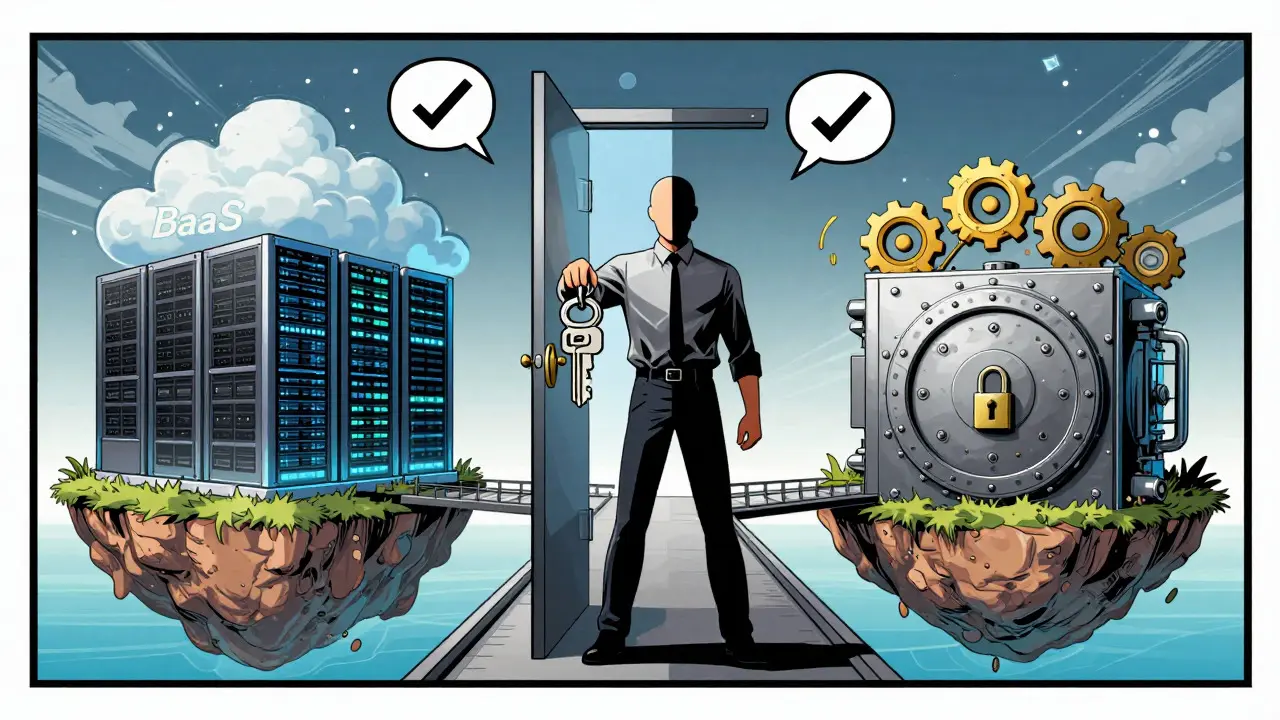
Market Trends and the Rise of Hybrid Models
The line between BaaS and custom is blurring. In March 2025, Microsoft announced Azure Blockchain Service 3.0 with "customizable consensus layers." AWS introduced a "Hybrid Blockchain Framework" in Q1 2025, allowing partial customization of BaaS offerings. Gartner predicts that by 2027, 55% of enterprise blockchain implementations will use these hybrid models, up from just 18% in 2024.
This trend suggests that you no longer have to pick one extreme. You can start with BaaS to validate your idea, then migrate critical components to a custom layer as you grow. Deloitte’s 2025 Blockchain Survey shows that 67% of Fortune 500 companies use BaaS for experimental applications, while 41% maintain custom blockchains for mission-critical systems. This dual approach lets you balance speed and control.
However, be wary of vendor lock-in. Capterra’s 2024 review cited lock-in as a concern for 61% of BaaS users. Before signing a contract, ask about exit strategies. Can you export your data easily? Are your smart contracts portable? If the answer is vague, negotiate harder or consider a custom build.
Frequently Asked Questions
Is BaaS secure enough for financial transactions?
Yes, for most standard transactions. Major providers like AWS and Azure use FIPS 140-2 compliant encryption and undergo annual SOC 2 Type II audits. However, if you require proprietary consensus mechanisms or specific data sovereignty controls for high-frequency trading, a custom solution may be necessary.
How much does it cost to switch from BaaS to a custom blockchain?
There is no fixed price, but expect to pay the full custom development cost ($150,000-$500,000) plus migration engineering fees. 58% of enterprises report significant challenges during this process, so budget for potential downtime and data re-entry costs.
Which industries should avoid BaaS?
Healthcare and heavily regulated finance sectors should be cautious. 92% of healthcare blockchain implementations analyzed by BitGo in 2024 were custom-built to meet HIPAA compliance requirements through specialized data handling protocols that are difficult to implement on standard BaaS offerings.
What is the biggest risk of using BaaS?
Vendor lock-in and limited customization. 61% of users cite lock-in as a primary concern. If your business requirements change significantly, you may find that the BaaS platform cannot support new features without forcing a complete rebuild or migration.
Can I combine BaaS with custom development?
Yes, this is known as a hybrid model. Gartner predicts 55% of enterprise implementations will use this approach by 2027. You can use BaaS for infrastructure and storage while developing custom application layers or consensus logic for specific critical functions.