
Why the Genesis Block is Special in Cryptocurrency: History, Tech, and Symbolism
Imagine finding the very first brick laid in a building that now houses trillions of dollars. That’s essentially what the Genesis Block is to the world of digital money. It isn’t just code; it is the absolute beginning of the Bitcoin network, mined by the mysterious Satoshi Nakamoto on January 3, 2009:15 AM UTC. This single block anchors the entire history of cryptocurrency. Without it, there is no chain, no trust, and no Bitcoin.
You might wonder why this specific block gets so much attention compared to the millions that follow. The answer lies in its unique mix of technical necessity and bold political statement. It contains hardcoded rules that define how Bitcoin works today, including the 21 million coin supply cap. But more importantly, it carries a hidden message from its creator that explains exactly why Bitcoin was built in the first place. Let’s break down why this digital artifact remains the most important piece of data in the crypto world.
The Hidden Message in the Code
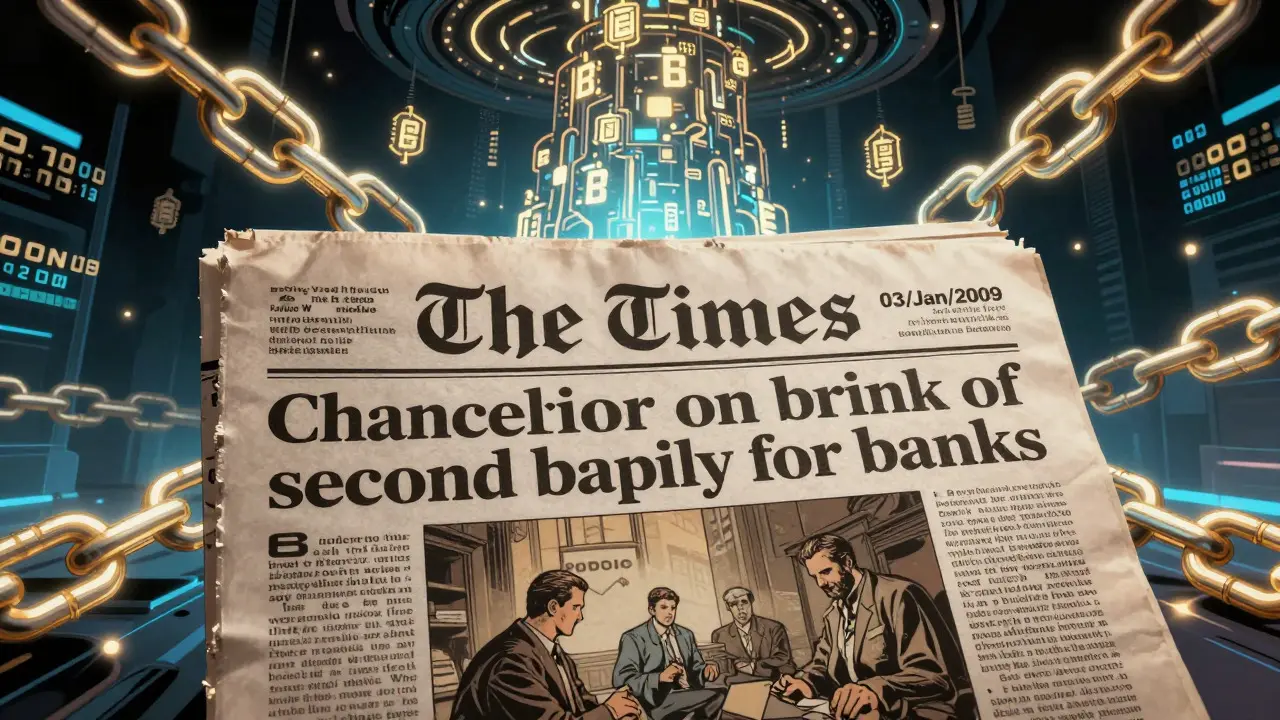
The most famous feature of the Genesis Block is not its cryptographic hash or its mining difficulty. It is a headline from a newspaper embedded directly into the block’s data field. When you look at the raw code of Block 0, you find these words: "The Times 03/Jan/2009 Chancellor on brink of second bailout for banks."
This wasn’t an accident. Satoshi included this headline to serve two purposes. First, it acts as a timestamp, proving that the block could not have been created before January 3, 2009. Second, it serves as a manifesto. By referencing the global financial crisis and government bailouts, Satoshi highlighted the fragility of traditional banking systems. It was a clear signal that Bitcoin was designed as an alternative to centralized financial control. This embedded commentary turns the Genesis Block into more than just software-it is a historical document capturing a moment of economic uncertainty.
Technical Uniqueness: The Anchor of Trust
From a technical standpoint, the Genesis Block is fundamentally different from every other block in the blockchain. Every subsequent block links back to the one before it using a complex mathematical formula called a hash. This creates an unbreakable chain. However, the Genesis Block has no predecessor. It points to nothing but itself, establishing the starting point for all future verification.
Here are the key technical attributes that make it special:
- No Previous Hash: Unlike all other blocks, it does not reference a prior block because none existed.
- Hardcoded Parameters: It sets the initial difficulty target (1) and establishes the protocol rules for proof-of-work.
- Unspendable Reward: The block includes a transaction sending 50 BTC to an address, but due to a quirk in the early code, these coins can never be spent. They are permanently locked.
- Extra Zeros: The block’s hash starts with eight zeros (00000000...), which is more than required at the time, showing extra effort by the miner.
This immutability is crucial. If anyone tried to change the data in the Genesis Block, the hash would change, breaking the link to every block that came after it. This would invalidate the entire Bitcoin network. Therefore, the security of billions of dollars in assets relies on the integrity of this single, original block.
The Mystery of the Locked Coins
One of the most debated aspects of the Genesis Block is the 50 BTC reward sent to the address 1A1zP1eP5QGefi2DMPTfTL5SLmv7DivfNa. In normal Bitcoin operations, miners receive new coins as a reward for securing the network. These coins are immediately spendable. However, the Genesis Block’s coins are stuck.
Experts disagree on whether this was intentional. Some argue it was a bug in the early version of the Bitcoin software, where the output script was formatted incorrectly. Others believe Satoshi deliberately made them unspendable to show that he didn’t care about personal profit. Instead, he wanted to create a fair system where no single entity controlled the initial supply. Regardless of the reason, those 50 BTC remain untouched, serving as a monument rather than currency. As of 2026, their value would be astronomical, yet they sit forever in a digital vault.
| Cryptocurrency | Launch Date | Initial Distribution | Founder Control |
|---|---|---|---|
| Bitcoin | Jan 3, 2009 | Mined (Proof-of-Work) | None (Coins Locked) |
| Ethereum | July 30, 2015 | Pre-sale & Mining | Significant (Foundation Holds Supply) |
| Ripple (XRP) | 2012 | Pre-mined (100 Billion) | High (Company Controls Reserve) |
As shown above, Bitcoin’s approach stands out. Most modern cryptocurrencies distribute tokens through sales or pre-mine them for founders. Bitcoin’s decentralized start, with no central authority controlling the initial supply, reinforces its ethos of neutrality and resistance to censorship.
Why the Six-Day Gap Matters
After mining the Genesis Block, Satoshi did not mine another block for six days. Block 1 appeared on January 9, 2009. This gap is unusual because Bitcoin aims to produce a block every 10 minutes. Why the delay?
Some theorists suggest this was a deliberate nod to the biblical story of creation, where God rested on the seventh day. While likely coincidental, this pause adds to the mystique surrounding Satoshi. It also gave the network time to stabilize before adding more complexity. During this week, Satoshi was likely testing the software, ensuring that the basic consensus mechanism worked correctly before inviting others to join. This careful pacing helped prevent early bugs from compromising the network’s foundation.

The Cultural and Historical Impact
Beyond code and coins, the Genesis Block has become a cultural symbol. It represents the birth of a new asset class. In 2024, the Computer History Museum added a physical representation of the Genesis Block’s hash to its permanent collection, recognizing it as a significant technological artifact. For many investors and developers, understanding the Genesis Block is the first step in grasping why decentralization matters.
It reminds us that Bitcoin was born out of distrust in traditional institutions. Every time you send or receive Bitcoin, you are participating in a system anchored by that 2009 headline. The block’s enduring relevance proves that good design combines robust engineering with a compelling narrative. It is not just a record of transactions; it is a statement of intent that continues to inspire innovation in finance today.
Common Questions About the Genesis Block
Who mined the Genesis Block?
The Genesis Block was mined by Satoshi Nakamoto, the pseudonymous creator of Bitcoin. To this day, no one knows Satoshi's true identity, adding to the legend of the first block.
Can the 50 BTC in the Genesis Block be spent?
No, the 50 BTC reward in the Genesis Block is permanently unspendable. Due to a specific coding structure in the early Bitcoin client, these coins cannot be referenced in valid transactions, effectively locking them forever.
What does the newspaper headline mean?
The headline "Chancellor on brink of second bailout for banks" references the 2008 financial crisis. It serves as both a timestamp and a critique of traditional banking, explaining Bitcoin's motivation as a decentralized alternative.
Why is the Genesis Block immutable?
The Genesis Block is immutable because it is the root of the blockchain. Changing any data in it would alter its hash, breaking the cryptographic link to all subsequent blocks and invalidating the entire network history.
Is the Genesis Block the same for all cryptocurrencies?
Every blockchain has a genesis block, but they differ significantly. Bitcoin's was mined publicly with no founder control, while others like Ethereum or Ripple had pre-distributed tokens or founder allocations.