
Crypto Tax Rates by Country: Where You Pay the Most and Least in 2026
Want to know where your crypto gains are taxed the most - or not at all? By early 2026, the global landscape for crypto taxes has become more split than ever. Some countries treat your Bitcoin like cash in your pocket and tax it as income. Others act like it’s your personal savings account - no tax if you hold it long enough. And a handful? They don’t care at all. Your tax bill doesn’t depend on how smart you are with trading. It depends on where you live - or where you’re legally considered a resident.
Where Crypto Taxes Are the Highest
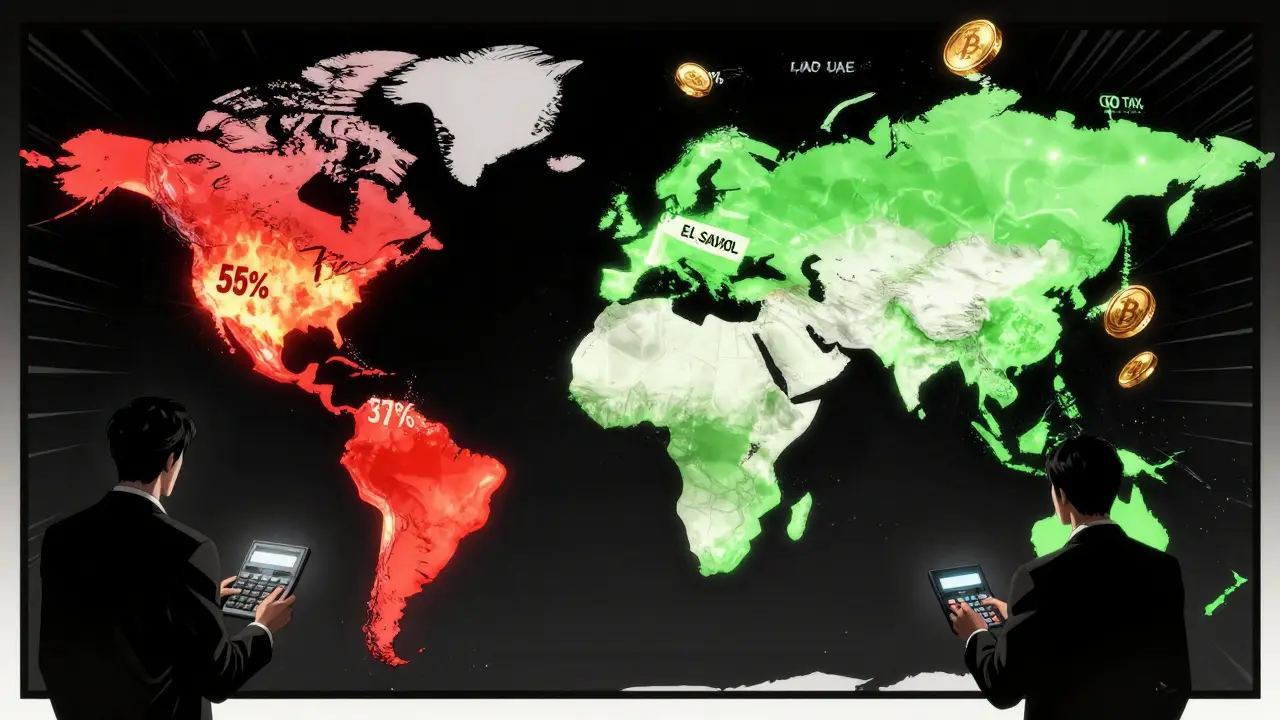
If you’re looking to minimize your crypto tax bill, avoid Japan. It’s the toughest market in the world for crypto investors. The Japanese tax system treats crypto gains as part of your overall income. That means if you earn ¥10 million or more a year, your crypto profits can be taxed at up to 55%. That’s not a flat rate - it’s progressive, just like your salary. Sell Bitcoin for a profit? It gets added to your income, and you pay the top marginal rate. Denmark is almost as harsh, with rates between 37% and 52%, depending on your income bracket. France isn’t far behind with a flat 30% on crypto-to-fiat sales, plus extra social charges that push the real cost higher.
Germany’s system is tricky. If you sell crypto after holding it for more than a year, you pay 0%. But if you cash out within 12 months? You’re taxed at your personal income tax rate - up to 45%. That’s why so many German investors wait. It’s not about market timing. It’s about timing your sale to beat the clock.
The United States is another high-tax zone for active traders. If you hold crypto for less than a year, your gains are taxed as ordinary income - between 10% and 37%, depending on your total earnings. Long-term holds (over one year) get better rates: 0%, 15%, or 20%. But here’s the catch: if you mine Bitcoin, earn staking rewards, or get an airdrop, that’s treated as income the moment you receive it. No waiting. No holding period. Just tax.
Where You Pay Nothing - And Why
Twelve countries currently have zero tax on crypto transactions for private investors. That’s not a loophole. It’s policy. El Salvador made Bitcoin legal tender in 2021, and it’s stayed that way. No capital gains tax. No reporting. Just use it like pesos. Brunei, Oman, and Saudi Arabia don’t tax any personal income - crypto included. The UAE and Cayman Islands don’t have income taxes at all, so crypto gains slip through the cracks. Switzerland lets you hold crypto indefinitely without paying tax, as long as you’re not trading it as a business.
Portugal used to be the go-to for crypto tax-free living. Now, it’s a bit more complicated. If you hold crypto for over a year, you pay 0%. But if you sell within a year? You pay 28%. And here’s the catch: you need to be a tax resident - meaning you live there for at least 183 days a year. Non-residents? They don’t pay anything. That’s why so many crypto investors set up temporary residency in Portugal without fully moving there.
Malaysia and Hong Kong don’t tax personal crypto investments - but they do tax business activity. If you’re trading crypto like a day trader running a company, you’re taxed. If you’re buying and holding Bitcoin like a regular person? You’re fine. That’s a big difference. Most people don’t realize it’s not about the asset. It’s about how you use it.
Europe’s Patchwork of Rules
There’s no such thing as a “European crypto tax.” Each country writes its own rules. The EU has tried to coordinate, but it hasn’t worked. France taxes every crypto-to-fiat trade at 30%. Germany waits a year. The UK gives you a £3,000 tax-free allowance for capital gains in 2026. Beyond that, basic-rate taxpayers pay 10%, higher-rate payers pay 20%. And if you forget to report? You could owe up to 200% of the tax you skipped.
Germany’s system is the most detailed. You have to report every single transaction to the Federal Central Tax Office (BZSt). Even small trades between crypto assets count. They use blockchain analytics to cross-check exchange data. If you sold 0.01 BTC for ETH and then cashed out? They know. And if you didn’t report it? Fines start at €500 and go up fast.
The UK requires you to file a Self-Assessment Tax Return every year. No matter how small your gains. Even if you only made £100 profit? You still have to report it. Most people think “it’s too small to matter.” But HMRC’s system flags tiny transactions over time. They look at patterns. One year, you made £50. Next year, £120. Then £800. That’s a red flag.
What Counts as a Taxable Event?
Not every crypto action triggers a tax. But many do - and people get caught because they assume the opposite.
- Selling crypto for fiat (USD, EUR, etc.) - Always taxable in most countries.
- Trading one crypto for another - Taxable in the US, UK, France, Germany. Not taxed in Malaysia or Hong Kong if it’s personal.
- Using crypto to buy goods or services - Treated like selling crypto. Taxable in the US, EU, Australia.
- Receiving crypto as payment for work - Taxed as income at the fair market value when you receive it.
- Staking rewards, mining, airdrops - Taxed as income the moment you get them - even if you don’t sell.
- Gifting crypto to family - Usually not taxable for the giver in most places, but the recipient may owe tax when they sell.
Many people think “I didn’t cash out, so I didn’t owe tax.” That’s wrong. Buying a coffee with Bitcoin? In the US, that’s a taxable event. You’ve sold crypto. You’ve triggered capital gains. The IRS knows because exchanges report to them. You can’t hide it.
Residency Rules Matter More Than You Think
You don’t have to be a citizen to get tax benefits. You just have to be a tax resident. Most countries define that as living there for 183 days or more in a year. That’s why people move to Portugal, the UAE, or Switzerland - not because they’re cheaper to live in, but because their tax laws don’t touch personal crypto gains.
Non-residents? Usually exempt. If you’re a U.S. citizen living in Dubai, you still owe U.S. taxes on your crypto. But if you’re a Canadian living in Panama for 200 days a year? Panama doesn’t tax you. And Canada doesn’t tax foreign-sourced income unless you’re a resident. So you pay nothing - legally.
But here’s the risk: tax authorities are getting better at tracking. The OECD’s Common Reporting Standard now shares financial data between 115 countries. If you have a wallet linked to a regulated exchange in the UK, and you’re a tax resident in Germany? They’ll find out. Even if you never filed a return.
What You Should Do Right Now
If you hold crypto and live in a country with high taxes, your best move isn’t to gamble on tax evasion. It’s to plan.
- Hold for over a year if your country offers long-term discounts (like the U.S. or Germany).
- Use tax-free jurisdictions for residency if you can - Portugal, UAE, or Malaysia.
- Track every transaction. Use software like Koinly or CoinTracker. Don’t rely on exchange summaries - they’re often incomplete.
- Know the difference between personal holding and business trading. If you’re buying and selling daily, you might be running a business - and that changes everything.
- Don’t ignore small gains. HMRC and the IRS are watching. Even $50 in profit can add up over time.
There’s no magic trick. No secret tax code. Just rules - and they’re different everywhere. Your crypto portfolio might be global. But your tax bill? That’s local.
Is crypto taxed in the United States?
Yes. Crypto is treated as property by the IRS. Selling, trading, or spending it triggers capital gains tax. Short-term gains (held less than a year) are taxed as ordinary income - between 10% and 37%. Long-term gains (held over a year) are taxed at 0%, 15%, or 20%, depending on your income. Earnings from mining, staking, or airdrops are taxed as income at your regular rate when received.
Which countries have 0% crypto tax?
As of 2026, the following countries do not tax personal crypto holdings: Brunei, Cyprus, El Salvador, Georgia, Germany (if held over one year), Hong Kong, Malaysia, Oman, Panama, Saudi Arabia, Switzerland, and the United Arab Emirates. Portugal exempts long-term holdings (over one year) but taxes short-term trades at 28%. Always check residency rules - non-residents often pay nothing even in high-tax countries.
Do I pay tax if I trade Bitcoin for Ethereum?
In most countries, yes. Trading one cryptocurrency for another is treated as a sale of the first asset. You calculate the gain or loss based on the value when you bought it versus when you traded it. The U.S., UK, France, and Germany all tax this. Malaysia and Hong Kong do not - if it’s a personal investment, not a business activity.
What happens if I don’t report my crypto gains?
Penalties vary by country. In the UK, you could owe up to 200% of the unpaid tax. In France, fines start at €750 per unreported account. Germany audits crypto transactions and can impose criminal charges for repeated non-compliance. Even in countries with low enforcement, tax authorities now share data globally through the OECD’s Common Reporting Standard. Exchanges report to governments. Hiding gains is risky and getting harder.
Can I avoid crypto tax by moving to another country?
Yes - if you legally become a tax resident in a zero-tax country like the UAE, Portugal, or Malaysia. But you must meet residency rules (usually 183+ days per year). Simply owning property or having a bank account isn’t enough. Also, U.S. citizens and some others still owe taxes to their home country no matter where they live. Always consult a cross-border tax professional before relocating.
Do I need to report crypto if I didn’t sell it?
You don’t owe tax if you just bought and held. But you may still need to report it. In the UK and Germany, you must report all crypto holdings annually. In the U.S., you only report gains - but you must answer a question on your tax form about whether you traded, sold, or received crypto. Lying on that form is tax fraud.





This is why I left India for Dubai. No taxes, no questions, just crypto. People back home still think Bitcoin is a scam. Lol. I made more in 3 months here than I would in 5 years back there. Taxation is theft, and Japan? They’re just trying to control you.
so like… if i just hold btc and never sell, i dont owe anything? even if its worth 10mil now? that sounds too good to be true. i think i’ll just keep it under my mattress. 🤔
Bro, you can’t just ‘not sell’ and call it a day. The IRS doesn’t care if you’re holding. If you got airdrops or staking rewards, boom - taxable event. And don’t even get me started on trading BTC for ETH. That’s a sale. They track it. You think you’re slick? They’ve got bots for this.
Portugal’s 0% tax for long-term holds? That’s why I’ve been living in Lisbon for 180 days every year. I fly in, set up a local bank account, buy a SIM card, and pretend I’m a local. They don’t even ask. Just don’t tell anyone you’re doing it. 😎
Man, I just bought my first 0.02 BTC last week. Didn’t even think about taxes. Now I’m sweating. 😅 Any free tools to track this? I’m broke but not dumb.
Koinly saved my life. I used to just guess my gains and pray. Now I upload my exchange CSVs and it auto-calculates everything. Even flags if you forgot to report a tiny trade. Worth every penny. 💪
Wait-so if I trade Dogecoin for Shiba Inu, and then cash out… I’m taxed TWICE? On the trade AND the cash-out? That’s insane. And Germany? They’re watching every single transaction? Even 0.0001 BTC? That’s not tax policy, that’s surveillance. I’m moving to Malaysia. No more. Done.
Y’all are overcomplicating this. Crypto’s just digital gold. If you hold it like gold, you don’t pay tax. If you trade it like a casino dealer, you’re a business. Simple. The government doesn’t care if you’re rich. They care if you’re *active*. Stop overthinking. Just chill. And if you’re scared? Move to the UAE. They don’t care what you do as long as you don’t cause drama. 🌴
It is deeply unfortunate that Western nations have become so financially irresponsible that they must tax innovation. In India, we understand the sanctity of property rights. We do not punish those who build wealth. Instead, we honor them. Your tax systems are a reflection of your moral decay.
Of course they’re not taxing crypto in the UAE. That’s where all the money laundering happens. The CIA and Mossad are probably using it to fund covert ops. You think you’re clever? They’re watching you. Every wallet. Every transaction. You’re already flagged.
Germany’s system isn’t ‘tricky’-it’s the only sane one. You report every transaction, or you’re a criminal. The rest of the world is in denial. If you’re not tracking your 0.003 BTC trade from 2023, you’re not an investor-you’re a tax evader with delusions of grandeur.
USA is the real villain here. We tax everything. Even your dreams. Meanwhile, Switzerland lets you chill with your crypto and savor cheese. I’m done with American greed. I’m moving to Portugal next year. Bring your passport, your wallet, and your chill.
But what if you’re not rich? What if you just bought $200 of crypto and it went to $1,000? Do you really have to pay tax on that? I’m just trying to survive. I work two jobs. I don’t have time for this. I just want to be left alone. 😔
Guys, don’t stress. Tax laws change every year. But crypto doesn’t. It’s decentralized for a reason. If you’re worried, just hold. Don’t trade. Don’t spend. Just HODL. And if you’re lucky, by 2030, governments will realize they can’t tax the internet. Until then? Keep it quiet. Stay low. And don’t brag about your gains. Ever.
You people are amateurs. If you think residency rules are the key, you’ve never read the OECD’s CRS guidelines. Tax authorities now have access to your bank, your exchange, your IP address, and your wallet history. The only way to be truly safe? Don’t use regulated exchanges. Don’t link your real identity. And don’t be stupid enough to think ‘I’m just a small investor.’ They don’t care how much you have. They care that you exist.