Legal Status of Cryptocurrencies in India: Rules, Taxes & Restrictions Explained
Is it legal to buy Bitcoin in India? The short answer is yes. But if you think that means you can trade freely like you would with stocks or gold, you are in for a shock. As of mid-2026, the landscape for cryptocurrencies in India operates under a complex framework where digital assets are legally recognized as Virtual Digital Assets (VDAs) but face heavy taxation and strict regulatory oversight without being accepted as legal tender. is far from simple. You can own them, trade them, and even pay someone with them if they agree-but the government views them with suspicion, taxes them aggressively, and keeps changing the rules.
If you are an Indian resident looking to invest, or a business trying to navigate compliance, understanding this "gray zone" is critical. One wrong move regarding tax reporting or using an unregistered exchange could land you in serious trouble. Let’s break down exactly where things stand right now, what the laws actually say, and how to stay on the right side of the regulator.
The Shift from Ban to "Virtual Digital Asset"
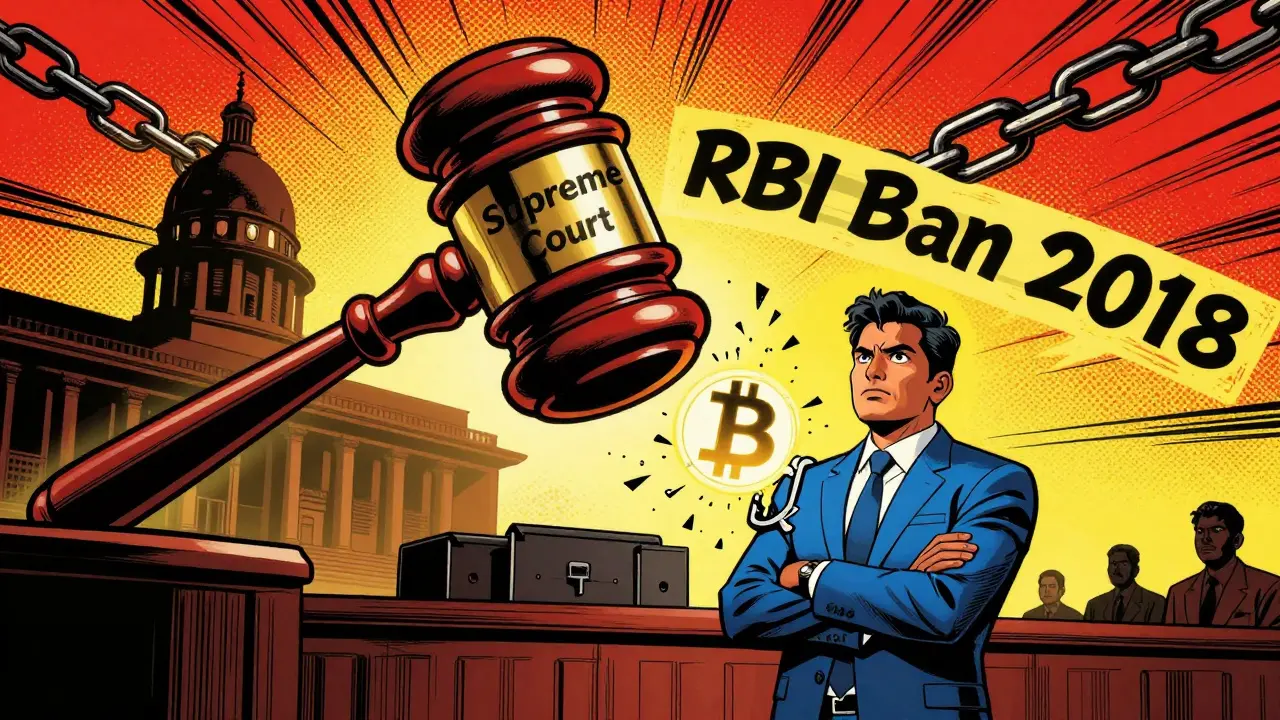
To understand today’s rules, you have to look at the rollercoaster ride India has been on since 2013. For years, the Reserve Bank of India (RBI) was openly hostile to crypto. In April 2018, the RBI issued a circular banning all banks and financial institutions from serving crypto businesses. This effectively killed the industry overnight because exchanges couldn’t process fiat deposits or withdrawals.
Then came the turning point. In March 2020, the Supreme Court of India struck down that RBI ban in the landmark case Internet and Mobile Association of India v. Reserve Bank of India. The court ruled that the central bank did not have the authority to prohibit banking services for crypto entities without specific legislation. Trading exploded again.
However, the government didn’t embrace crypto; it regulated it into submission. Instead of calling them "cryptocurrencies," the law now refers to them as Virtual Digital Assets (VDAs). VDAs are defined under the Income Tax Act, 1961, as any information, code, number, or token generated through cryptographic means or otherwise, used by parties for consideration. This definition is broad. It covers Bitcoin, Ethereum, NFTs, and even stablecoins. Crucially, while VDAs are legal to own, they are explicitly not legal tender. Only the Indian Rupee (and the upcoming Digital Rupee) holds that status.
The Heavy Hand of Taxation: 30% + TDS + GST
If there is one thing Indian regulators want to discourage, it’s casual speculation. To achieve this, they implemented one of the harshest tax regimes in the world starting in the 2022-23 financial year. Here is what hits your wallet:
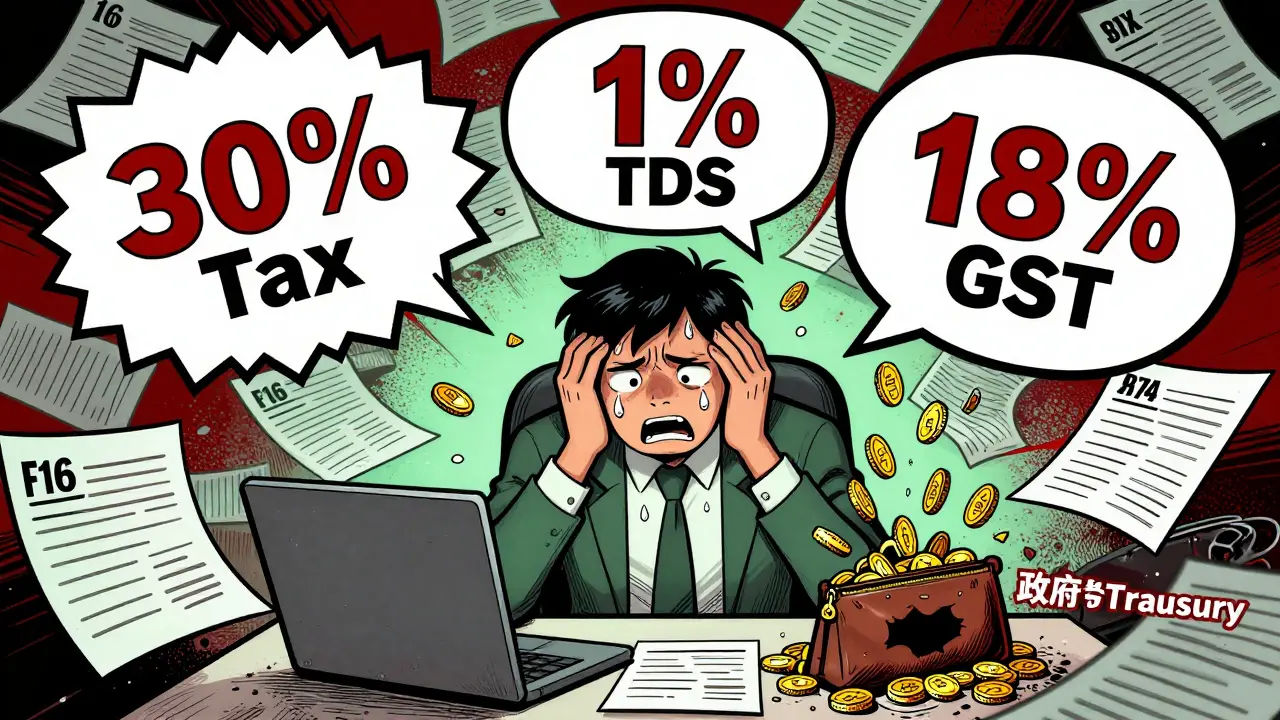
- Flat 30% Tax on Gains: Any profit you make from selling a VDA is taxed at a flat 30%. There is no benefit for holding long-term. If you bought Bitcoin in 2021 and sold it in 2026, you still pay 30% on the gain.
- No Deductions Allowed: You cannot offset losses from one coin against profits from another. If you made $10,000 on Ethereum but lost $5,000 on Solana, you pay tax on the full $10,000. The only deduction allowed is the cost of acquisition (what you originally paid).
- 1% TDS on Transfers: A 1% Tax Deducted at Source applies to every transfer above certain thresholds. This is deducted by the exchange before you receive your funds. For high-frequency traders, this can eat up significant capital, sometimes exceeding actual profits.
- 18% GST on Services: As of July 2025, major exchanges like Bybit began charging 18% Goods and Services Tax on trading fees, withdrawals, and staking rewards. When you combine the 30% income tax, 1% TDS, and 18% GST, the effective tax burden on active traders can exceed 49%.
This structure makes India one of the most expensive places in the world to trade crypto. It pushes many users toward peer-to-peer (P2P) platforms or decentralized exchanges (DEXs) to avoid these deductions, though doing so carries its own legal risks regarding tax evasion.
| Country | Tax on Gains | Deductions Allowed? | TDS/Withholding |
|---|---|---|---|
| India | Flat 30% | No (except cost basis) | Yes (1%) |
| USA | Capital Gains (0-20%) | Yes | No |
| UK | Capital Gains (10-20%) | Yes | No |
| Singapore | 0% (for individuals) | N/A | No |
Who Is Watching? The Multi-Agency Regulatory Web
You might think the RBI is the only boss here, but the regulatory space is crowded. Different agencies handle different parts of the ecosystem, creating a web of compliance requirements.
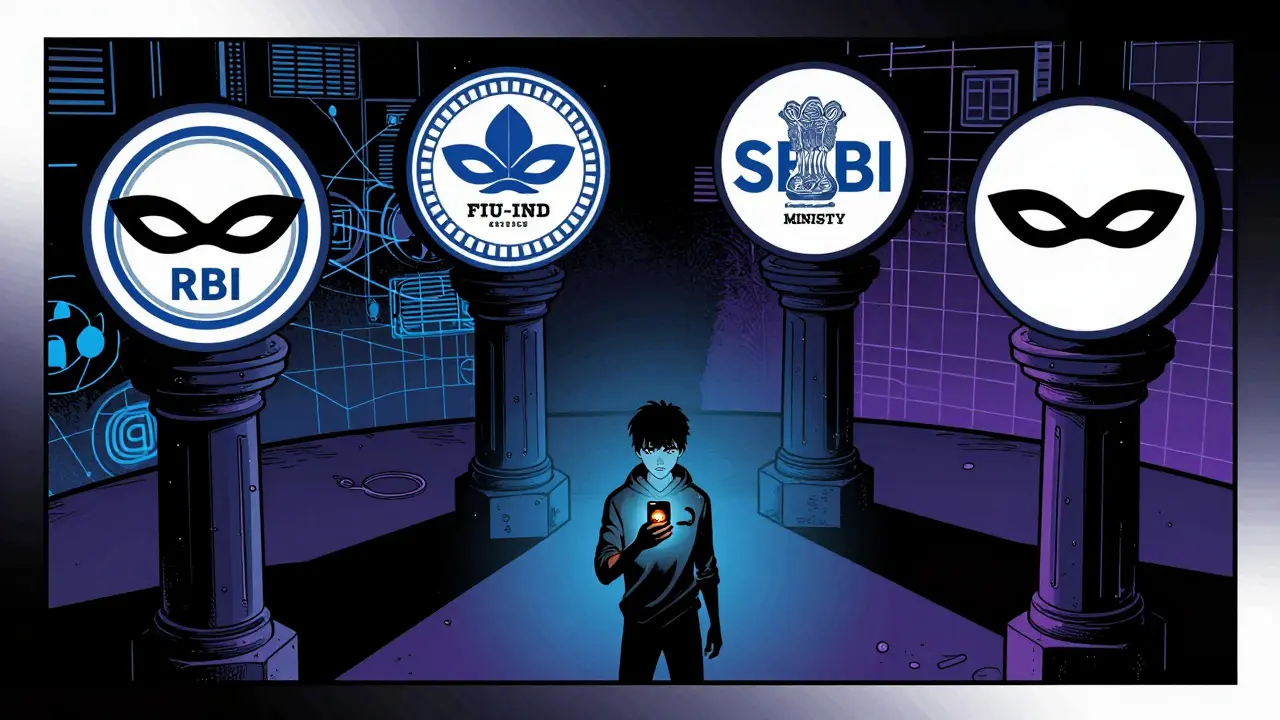
Reserve Bank of India (RBI) The central bank of India maintains monetary policy oversight and remains skeptical of private cryptocurrencies, focusing instead on promoting the Digital Rupee (CBDC) as the preferred digital payment method. While they can no longer ban banking access, they monitor systemic risks closely. They view private crypto as a threat to monetary sovereignty.
Financial Intelligence Unit-India (FIU-IND) FIU-IND enforces anti-money laundering (AML) laws. Since March 2023, all VDA service providers must register with FIU-IND and comply with the Prevention of Money Laundering Act (PMLA). This means exchanges must implement strict Know Your Customer (KYC) checks, monitor transactions for suspicious activity, and report to authorities. Many international exchanges exited India because they couldn’t meet these costly compliance standards.
Securities and Exchange Board of India (SEBI) SEBI began overseeing crypto tokens with security characteristics on April 1, 2025. Tokens deemed to be investment contracts or securities fall under SEBI’s jurisdiction, similar to stocks. This creates a bifurcated system: some tokens are treated as commodities/assets, while others are regulated as securities. This adds another layer of complexity for investors who need to determine which category their holdings fall into.
Ministry of Finance Handles the taxation framework and policy structure, including the implementation of the 30% tax rate and TDS mechanisms under the Income Tax Act. They are also responsible for releasing discussion papers on future regulations, though progress has been slow.
Can You Use Crypto to Pay for Things?
Technically, yes. Legally, it’s messy. Because VDAs are not legal tender, no merchant is obligated to accept them. If you try to pay for groceries with Bitcoin, the shopkeeper can refuse. More importantly, if you use crypto to settle a debt, that transaction may not hold up in court as a valid discharge of liability.
However, private contracts are generally enforceable. If two parties agree to a transaction in crypto, it is not illegal. But be aware that such transactions are still subject to the 30% tax on gains if the value has appreciated. Using crypto for everyday payments in India is rare due to volatility, tax implications, and lack of merchant adoption. Most usage remains speculative trading or cross-border remittances.
Risks for Traders and Businesses in 2026
Navigating this environment requires vigilance. Here are the biggest pitfalls to avoid:
- Using Unregistered Exchanges: After the PMLA enforcement, many offshore exchanges blocked Indian users. Using platforms that do not comply with FIU-IND regulations can lead to frozen accounts and difficulty withdrawing funds to Indian bank accounts.
- Tax Evasion via P2P: While Peer-to-Peer trading avoids TDS at the source, it does not exempt you from income tax. The Income Tax Department uses data analytics to track large bank transfers linked to crypto activities. Underreporting income is a criminal offense.
- Ignoring NFT Tax Changes: The 2025 amendment explicitly included Non-Fungible Tokens (NFTs) under the VDA umbrella. Profits from selling digital art or collectibles are taxed at the same 30% rate as Bitcoin.
- Confusing CBDC with Crypto: The Digital Rupee is issued by the RBI and is legal tender. Private cryptocurrencies are not. Do not confuse the two when planning your portfolio or payments.
What Comes Next? Future Outlook
The government is slowly moving toward a more comprehensive framework rather than ad-hoc bans. In June 2025, plans were announced for a discussion paper to formalize regulations, though it had not been released by late 2025. Expect clearer guidelines on Decentralized Finance (DeFi), staking rewards, and custody services.
India is also preparing for a Financial Stability Board (FSB) peer review in October 2025. This will likely push India to align its AML/KYC standards with global norms set by the Financial Action Task Force (FATF). For users, this means stricter surveillance but potentially more legitimacy for compliant businesses.
Will crypto become mainstream in India? Probably not as a payment method. But as an asset class, it remains popular. With over 107 million users, demand is resilient despite the taxes. The key is to treat it as a high-risk, high-tax investment, keep meticulous records, and consult a tax professional familiar with VDA laws.
Is it illegal to hold cryptocurrency in India?
No, it is not illegal. Indian citizens can legally own, buy, sell, and trade Virtual Digital Assets (VDAs). However, they are not recognized as legal tender, meaning you cannot force anyone to accept them as payment for goods or debts.
What is the tax rate on crypto gains in India?
The government imposes a flat 30% tax on all gains from VDA transactions. Additionally, a 1% Tax Deducted at Source (TDS) is applied to transfers above specified thresholds. No deductions for losses are allowed, except for the original cost of acquisition.
Do I need to register my crypto exchange with FIU-IND?
If you are operating a VDA service provider (exchange, wallet, etc.) in India, yes. Since March 2023, mandatory registration with the Financial Intelligence Unit-India (FIU-IND) is required under the Prevention of Money Laundering Act (PMLA). Failure to register can result in severe penalties and blocking of operations.
Does SEBI regulate all cryptocurrencies?
Not all. As of April 2025, SEBI regulates crypto tokens that exhibit characteristics of securities, such as initial coin offerings (ICOs) that promise returns based on managerial efforts. Other tokens may be treated as commodities or general assets under different regulatory frameworks.
Can I use Bitcoin to pay for groceries in India?
You can if the merchant agrees, but it is not legal tender. Merchants are not obligated to accept it. Furthermore, such transactions may trigger tax liabilities if the value of the crypto has increased since you acquired it. It is not recommended for everyday purchases due to volatility and tax complexity.
Are NFTs taxed differently than Bitcoin in India?
No. The 2025 VDA Income Tax Amendment Bill explicitly included NFTs under the definition of Virtual Digital Assets. Therefore, profits from selling NFTs are subject to the same 30% flat tax rate and 1% TDS as other cryptocurrencies.