
Livecoin Crypto Exchange Review: Fees, Altcoins, and Why Users Are Leaving
Livecoin has been around since 2013 - longer than most crypto exchanges still operating today. It doesn’t have the brand recognition of Binance or Coinbase, but it carved out a niche: helping international traders buy and sell obscure altcoins with real money like USD, EUR, and Russian Rubles. If you’ve ever struggled to find a trading pair for a lesser-known token, Livecoin might have been your go-to. But here’s the catch: what once felt like a hidden gem now feels like a sinking ship. User complaints are piling up, trading volumes are thin, and support is inconsistent. This isn’t a review of a startup. This is a review of an exchange that’s holding on - but barely.
What Livecoin Actually Offers
Livecoin isn’t trying to be everything. It’s focused on one thing: altcoin-to-fiat trading. While most exchanges limit fiat deposits to Bitcoin, Ethereum, and maybe Litecoin, Livecoin supports over 100 cryptocurrency/fiat pairs. You can deposit euros and immediately trade them for Shiba Inu, Dogecoin, or even obscure tokens like DibCoin (DIBC) - something you won’t find on Coinbase or Kraken.
It’s not just about variety. It’s about accessibility. If you’re in Europe or Russia, Livecoin lets you deposit and withdraw in EUR or RUR directly. No need to convert to USD first. That’s a real advantage for users outside the U.S. who want to avoid extra fees and delays.
But there’s a trade-off. The platform doesn’t support U.S. customers at all. If you’re in America, you can’t sign up. That’s not a bug - it’s a deliberate choice. Livecoin operates outside strict regulatory frameworks, which lets it offer more tokens but also makes it riskier.
Fees: Lower Than Average - But Not by Much
Livecoin charges a flat fee of 0.18% per trade for both makers and takers. That’s slightly below the industry average of 0.25%. For high-volume traders, fees drop as low as 0.02% - a solid incentive if you’re active.
Withdrawal fees are also competitive. To send Bitcoin, you pay 0.0005 BTC. That’s lower than what Binance and Kraken charge. But here’s the problem: deposits can be slow. Bitcoin deposits sometimes take up to an hour to reflect in your account. That’s not unusual, but when you’re trying to jump on a price move, every minute counts.
There’s no fee for depositing fiat via bank transfer or card - but only if you’re in a supported region. If you’re outside Europe or Russia, your options shrink fast.
The Altcoin Advantage - And Its Dark Side
Livecoin’s biggest strength is its selection. It lists hundreds of cryptocurrencies - many you won’t find anywhere else. If you’re into early-stage tokens or niche projects, this is one of the few places where you can trade them with real money.
But that’s also its biggest weakness.
Low trading volume. That’s the phrase users repeat over and over. Even for popular coins like Litecoin or Chainlink, order books are thin. You might see a bid at $50, but the next one is at $48. If you try to sell 100 coins, you’ll get filled at a much lower price than expected. That’s called slippage - and it’s a nightmare for anyone trading more than a few hundred dollars at a time.
One user on G2 reported: “The not so nice thing about Livecoin is the volume of trading. It is often quite low, even for more popular currencies.” That’s not an outlier. It’s the norm.
And then there’s the DibCoin incident. In 2023, a user had over $200 locked in DIBC because Livecoin froze trading and didn’t communicate why. For two weeks, there was no update. No apology. No timeline. Just silence. That’s the kind of thing that erodes trust - fast.
Interface and Experience: Simple? Not Really
Livecoin claims its interface is simple. But if you’re new to crypto, you’ll hit walls fast. The platform has advanced charting tools, API access, and margin trading - but none of it’s well explained. There’s no guided onboarding. No tutorial videos. No clear path from “I just bought my first Bitcoin” to “I’m trading altcoins daily.”
Even experienced traders report confusion. The layout feels outdated. Buttons are buried. The mobile app is basic and clunky. Compared to Binance’s clean design or Kraken’s intuitive layout, Livecoin feels like it’s stuck in 2017.
And verification? It’s messy. To increase withdrawal limits, you need to submit ID and proof of address. But there’s no clear checklist. Users report being asked for the same documents multiple times. One reviewer on Reviews.io said it took weeks to reactivate their old account - and even then, they only got their money back after multiple emails.
Customer Support: Helpful… Sometimes
Livecoin offers 24/7 support in English, Russian, and Chinese. That’s a plus. But response times vary wildly. Simple questions about deposits? Usually answered within a few hours. Complex issues? Forget it.
Users report that when a problem involves a specific token - like a frozen wallet or a failed withdrawal - support often says, “We can’t help with third-party blockchain issues.” That’s not a helpful answer. It’s a cop-out. Especially when Livecoin chose to list that token in the first place.
The Trustpilot rating as of January 2026 is 2.2 out of 5, based on 56 reviews. That’s a sharp drop from earlier years. People aren’t just unhappy - they’re angry. And they’re leaving.
Why People Still Use It
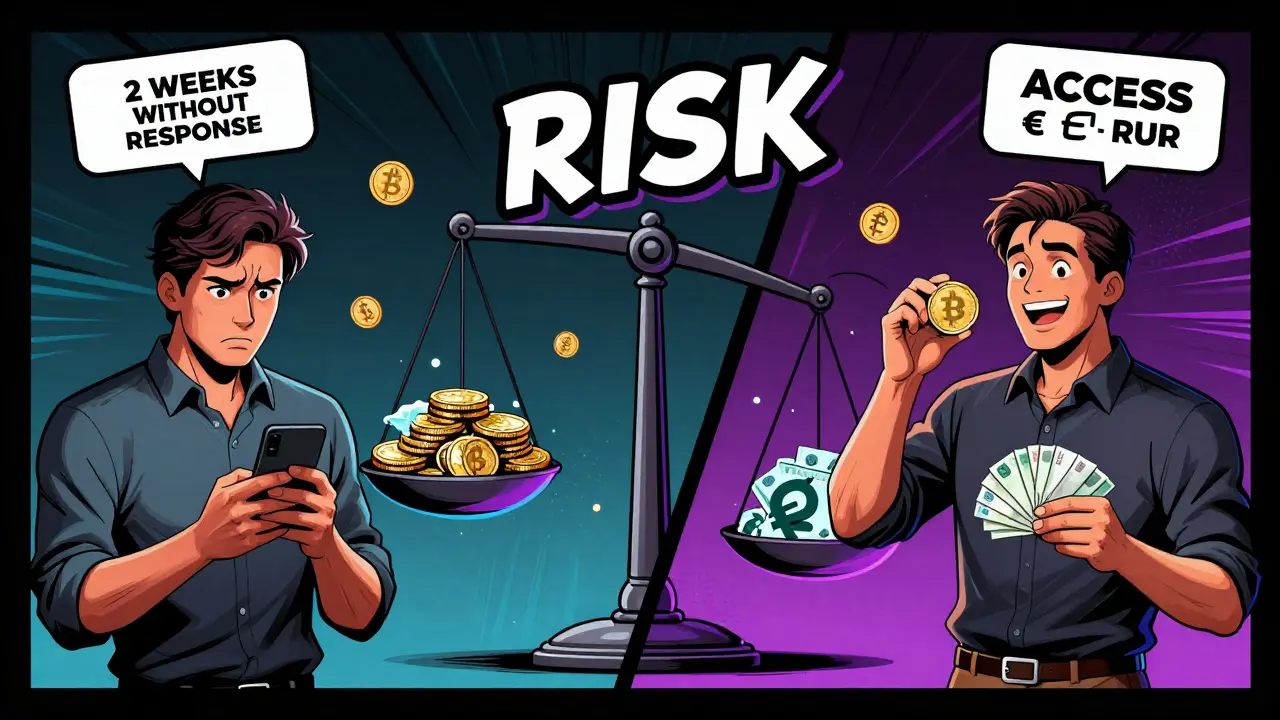
Despite all this, some users stick with Livecoin. Why?
- You need to trade a token that’s not listed anywhere else.
- You’re in Europe or Russia and want direct EUR/RUR deposits.
- You’re comfortable with low liquidity and slow support because you’re only trading small amounts.
One user who’s been trading on Livecoin for months said: “I like Livecoin and I happily use them 4 or 5 times a week for altcoin trades.” But they also admitted deposits are slow and support is hit-or-miss. That’s the trade-off.
The Bigger Picture: Is Livecoin Still Viable?
Livecoin has survived since 2013. That’s impressive. Most exchanges that launched around the same time are gone. It didn’t get hacked. It didn’t collapse in the 2022 bear market. It kept operating when others failed.
But survival isn’t success. The market has moved on. Binance, Kraken, and even smaller players like Gate.io now offer dozens of altcoin/fiat pairs. The edge Livecoin once had is fading.
And now, with Trustpilot ratings sinking, user complaints rising, and trading volume stagnating, the platform looks less like a reliable exchange and more like a relic.
If you’re a casual trader with small amounts and you need a specific token - maybe it’s still worth a try. But if you’re serious about crypto, if you want fast execution, clear support, or reliable deposits - look elsewhere.
Who Should Avoid Livecoin
- U.S. residents - you can’t even sign up.
- Anyone trading more than $500 at a time - slippage will eat your profits.
- People who need fast customer service - you’ll be waiting.
- Traders who value transparency - Livecoin doesn’t explain why tokens get delisted or frozen.
There are better options. Kraken supports 100+ cryptocurrencies and fiat in USD, EUR, CAD, and more. Coinbase has expanded its altcoin offerings. Even Bitfinex offers better liquidity and clearer support.
Livecoin’s model - niche, low-volume, regulatory-avoiding - worked in 2015. In 2026, it’s a liability.
Is Livecoin safe to use in 2026?
Livecoin hasn’t been hacked since 2013, which is a good sign. But safety isn’t just about security - it’s about reliability. With low trading volume, slow support, and unexplained asset freezes (like the DIBC incident), the platform carries real risk. If you’re trading small amounts and accept the delays, it’s usable. If you’re serious about your funds, it’s not the safest choice.
Can I deposit USD on Livecoin?
No. Livecoin does not support USD deposits. It only allows direct fiat deposits in EUR (Euro), RUR (Russian Ruble), and a few other currencies. If you’re in the U.S. or want to use USD, you’ll need to convert your money to EUR first using another service - adding extra fees and delays.
Why is Livecoin’s trading volume so low?
Livecoin’s volume is low because most traders have moved to bigger exchanges that offer better liquidity, faster execution, and clearer support. Livecoin still lists obscure tokens, but without enough buyers and sellers, those tokens can’t be traded efficiently. This creates a vicious cycle: low volume scares away users, and fewer users mean even lower volume.
Does Livecoin have a mobile app?
Yes, Livecoin has mobile apps for iOS and Android. But they’re basic. You can check balances, place orders, and view charts - but the interface is clunky, slow, and lacks features like advanced order types or real-time alerts. Most active traders avoid the app and stick to the desktop site.
What should I do if my funds are frozen on Livecoin?
If your funds are frozen - especially for a specific token - contact support immediately via email and chat. Document everything. Many users report that delays happen when the token’s blockchain has issues, and Livecoin often blames third-party networks. If support doesn’t respond within 48 hours, escalate by posting on Trustpilot or Reddit. Some users got their funds back only after public pressure.




Livecoin ain't dead it's just sleeping on a pile of altcoins no one wants anymore
Most of these 'obscure tokens' are rug pulls disguised as investments
You think you're getting early access but you're just the last guy holding the bag
The whole model is a graveyard with a trading interface
Low volume? That's not a bug it's the feature
They don't need liquidity because they're not here to serve traders they're here to collect fees from the desperate
U.S. users can't even sign up? Good.
Why would we waste time on some sketchy foreign platform when we have Kraken and Coinbase?
Livecoin is why crypto gets a bad name in America.
Stay away. 🙄
While Livecoin's interface and support are indeed subpar, it's worth acknowledging that regulatory arbitrage allowed it to serve a real need: non-USD fiat access for non-Western traders.
Many users in India, Southeast Asia, and parts of Africa relied on this when mainstream exchanges blocked them.
It's not perfect but dismissing it entirely ignores the global inequities in crypto infrastructure.
Perhaps the real failure is not Livecoin's decline but the lack of legitimate alternatives for these users.
I get why people are frustrated but I still use Livecoin for a couple of obscure tokens I can't find anywhere else.
Yeah the deposits are slow and support is hit or miss.
But if you're only trading small amounts and you're patient, it still works.
It's like using a rusty old bike when the car dealership is 200 miles away.
Not ideal but it gets you there.
Of course Livecoin is dying. It's a relic built on regulatory evasion and user exploitation.
People who still use it are either naive or desperate.
They're not traders they're gambling addicts with a terminal case of FOMO.
And now they're mad because the casino is closing.
Pathetic.
Let me break this down for you. Livecoin never cared about you. It never cared about security. It never cared about compliance.
It cared about one thing: collecting fees from people too lazy or too dumb to find better options.
The DibCoin freeze? That wasn't an accident. That was a profit center.
They froze the asset. No one could trade it. They bought it cheap. Then they let it trade again.
That's not incompetence. That's predation.
And you're still using it? You deserve to lose everything.
I've been on Livecoin since 2018. It's clunky. Support is slow. But I use it for one token: $WAVES.
It's the only place I can trade it for EUR directly.
I don't trade big. I just hold and move small amounts.
It's not glamorous. But it works for me.
Maybe that's all it was ever meant to be.
I remember when Livecoin was the only place I could buy $DIBCOIN back in 2021. I didn't know it was a rug pull. I just saw a token with a weird name and a chart going up.
Now I'm stuck with $300 in it and no way to move it.
And I still feel bad for them. I mean, they're just trying to survive too.
Maybe they're not evil. Maybe they're just old.
And maybe the whole crypto space is just too fast for anyone to keep up.
It makes me sad.
I still check their site once a week. Hoping for a message.
It's been 14 months.
I still haven't given up.
Not because I'm stupid.
But because I'm human.
It's important to recognize that Livecoin filled a critical gap in global crypto access during a time when major exchanges excluded entire regions.
While its operational practices may be outdated and its customer service inconsistent, its existence provided a lifeline for users who otherwise had no legal or practical means to enter the market.
Its decline reflects not just its own shortcomings but the broader failure of the industry to build inclusive infrastructure.
Perhaps rather than vilifying Livecoin, we should be asking why so few alternatives emerged to serve these communities with integrity and sustainability.
Look I'm not gonna lie - Livecoin's UI is a mess. I've tried to use the app twice and both times I ended up rage-quitting.
But I still use the desktop version because I can trade $SOLAR and $ZENITH in EUR and that's it.
Every other exchange wants me to convert to USD first.
That's two fees. Two delays. Two chances to get screwed.
So yeah. I'm stuck.
But I'm not stupid.
I only trade $50 at a time.
And I keep my funds in cold storage.
It's not perfect.
But it's the least bad option.
And honestly? That's all most of us need.
livecoin is still alive? i thought it died in 2021 lol
used it once back in the day
deposits took 3 hours
support said 'check your wallet address' like i dont know what a wallet is
never went back
but i guess if you got no other choice...
lol
Livecoin's real value was in fiat on-ramps for emerging markets.
Today, that need still exists.
But no one built on it.
Instead, exchanges chased U.S. compliance and abandoned the rest.
That's the real failure.
Not Livecoin's decline.
But the industry's indifference.
I just want to scream.
Livecoin gave me my first real crypto experience.
I bought $DIBCOIN because I believed in the team.
They vanished.
The token vanished.
My money vanished.
And now everyone's acting like it was my fault.
Like I should've known.
Like I wasn't just trying to get in early.
Like I didn't think it was real.
It was real to me.
And now I'm the fool.
But I'm not alone.
And I'm not giving up.
Not yet.
One thing I’ve noticed: every time someone says ‘Livecoin is dead,’ someone else replies with ‘But I still use it for $X.’
That’s not a contradiction - that’s a pattern.
Livecoin didn’t die because it was bad.
It died because the world moved on.
But for a small group of people - scattered across Europe, Russia, India - it’s still the only bridge they have.
And if you’ve ever been locked out of a system because of where you live…
You don’t judge the bridge.
You just walk across it.
Even if it’s creaky.
Even if it’s rusty.
Even if it’s the only one left.