
What is Greenhouse (GREEN) crypto coin?
Greenhouse (GREEN) isn't another flashy meme coin. It’s a working decentralized exchange built on Polygon, designed to help traders get better prices with lower fees. But here’s the twist: despite having a clear technical setup and a history of wild price swings, most people haven’t heard of it - and that’s not by accident.
What Greenhouse Actually Does
Greenhouse (GREEN) is a decentralized exchange (DEX) that aggregates liquidity across multiple DeFi platforms to give users the best possible trade rates with minimal slippage. Think of it like a price comparison tool for crypto trades, but instead of shopping for sneakers, you’re swapping tokens like USDC for ETH. It runs entirely on the Polygon blockchain, which means transactions are fast and cheap - often under a penny in fees.
Unlike centralized exchanges like Binance or Coinbase, Greenhouse doesn’t hold your funds. You connect your wallet - like MetaMask or Binance Web3 Wallet - and trade directly from your account. The smart contract that powers it lives on Polygon with the address 0x40DB...86f278. That’s public. Anyone can check it. The contract has been audited, and the code is open-source. No mystery here.
How Greenhouse Compares to Other DEXs
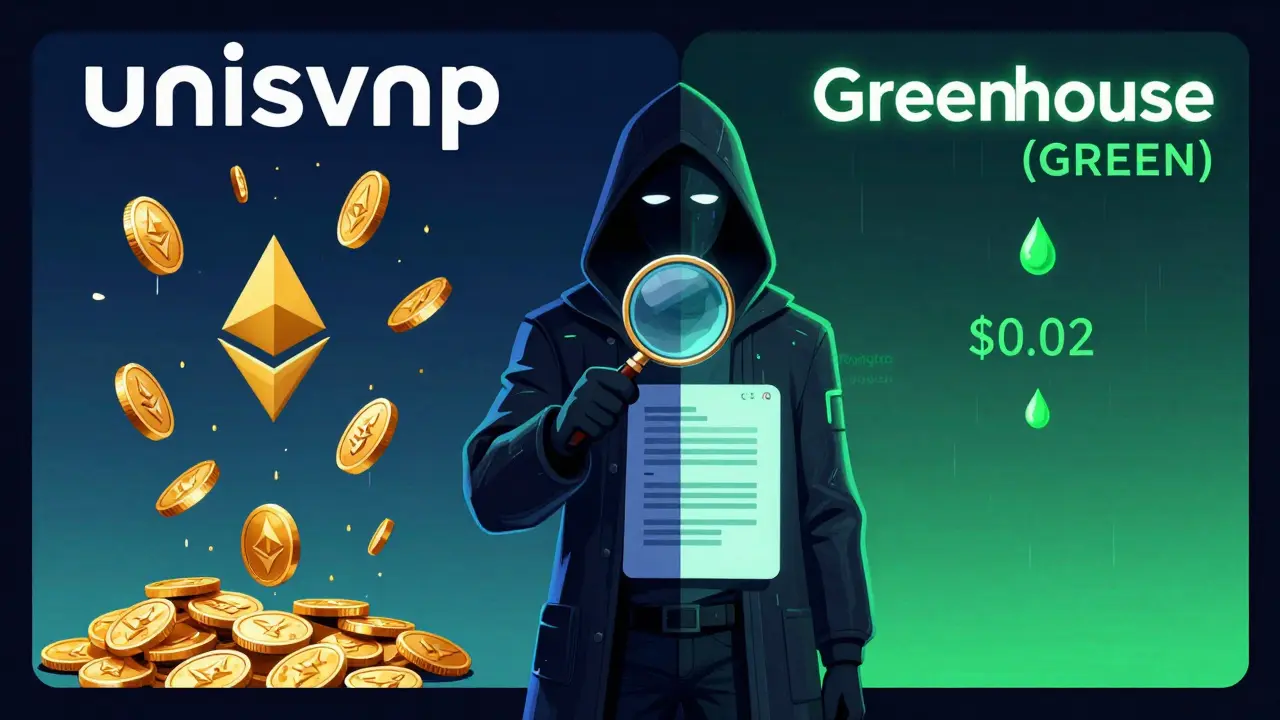
Uniswap and SushiSwap are the big names in DEX land. They’ve been around longer, have bigger user bases, and more liquidity. But Greenhouse has one real advantage: fee structure. While Uniswap charges a standard 0.3% per trade, Greenhouse claims to keep fees under 0.1% - sometimes even lower. That might not sound like much, but if you’re trading $10,000 a day, that’s $30 vs $10 in fees. Over time, that adds up.
It also pulls liquidity from other DEXs. So if you want to swap a rare token and Uniswap has low depth, Greenhouse will automatically check SushiSwap, Curve, and others to find the best deal. It’s like having a personal broker who checks every market before making a trade.
| Feature | Greenhouse (GREEN) | Uniswap v3 | SushiSwap |
|---|---|---|---|
| Blockchain | Polygon | Ethereum | Ethereum |
| Typical Trade Fee | Under 0.1% | 0.3% | 0.2% |
| Liquidity Aggregation | Yes | No | Partial |
| Gas Cost per Trade | ~$0.02 | ~$5-$15 | ~$5-$12 |
| Token Supply | 55,736.86 GREEN | 1,000,000,000 UNI | 233,000,000 SUSHI |
Token Supply and Circulation - The Big Confusion
The numbers around GREEN are messy. Officially, the total supply is 55,736.86 tokens. But here’s where things get odd: some sources say 0 GREEN is in circulation. Others say the full supply is out. That’s not a glitch - it’s a red flag.
Why does this matter? Because circulating supply determines market cap. If no one’s trading the tokens, the market cap is zero. And that’s exactly what Coinbase reported as of March 2025: $0 market cap. Yet, CoinMarketCap lists it with a $635,000 valuation. That’s because they’re using the full supply. Neither is wrong - they’re just measuring different things.
One thing’s clear: the token isn’t widely held. The price history tells the story. GREEN hit an all-time high of €5.48 in 2022. By March 2025, it was trading at €0.0106. That’s a 99.81% drop. For context, Bitcoin dropped 60% in its last bear market. GREEN fell 99.8%. That’s not a correction - that’s a collapse in demand.
Why Did GREEN Drop So Hard?
There’s no official statement. No team announcement. No press release. But we can piece together what happened.
- Low liquidity: If no one’s buying or selling, price becomes meaningless. A single large sell order can crash the price.
- Low visibility: Greenhouse has no Twitter following to speak of, no active Discord, and almost no coverage on major crypto news sites.
- Unclear utility: What can you do with GREEN beyond trading? Is it used for governance? Staking? Fee discounts? No one seems to know.
- Contract risk: The team behind it hasn’t been publicly identified. No LinkedIn profiles. No GitHub commits. That’s not normal for a DeFi project.
It’s possible the project was launched as a speculative play - a token with a good story, built on a fast blockchain, and then abandoned. Or maybe the team is quietly working on something bigger. The roadmap says they plan to expand to other blockchains. But as of March 2026, there’s zero evidence of that happening.
Can You Still Buy GREEN?
Yes - but only if you know where to look.
It’s not on Coinbase, Crypto.com, or Kraken. You won’t find it on Binance’s main exchange. But if you use the Binance Web3 Wallet, you can connect it to decentralized exchanges like QuickSwap or SushiSwap on Polygon and swap ETH or USDC for GREEN. The process isn’t hard, but it’s not beginner-friendly.
Here’s how:
- Install the Binance Web3 Wallet extension or app.
- Buy ETH or USDC on Binance or another exchange.
- Send it to your Web3 Wallet.
- Go to a Polygon-based DEX like QuickSwap.
- Connect your wallet and swap for GREEN.
Be warned: trading volume is low. You might not get the price you expect. Slippage could be high. And if you try to sell later, you might not find a buyer.
Is Greenhouse a "Green" Crypto?
Don’t be fooled by the name. Greenhouse (GREEN) isn’t about sustainability. It doesn’t use solar-powered servers or carbon offsets. The name is coincidental - like calling a pizza place "Vegan" even if it serves pepperoni.
But here’s the irony: because it runs on Polygon - which uses Proof of Stake - it’s actually one of the most energy-efficient crypto projects out there. Polygon uses 99.9% less energy than Bitcoin. So while the name doesn’t mean anything environmentally, the tech does. That’s not marketing - that’s just how blockchain works now.
Final Verdict: Should You Care?
Greenhouse (GREEN) is a technically sound DEX with real utility. It solves a real problem: high fees and poor liquidity on Ethereum. But it’s also a ghost town.
There’s no community. No updates. No team. No roadmap progress. And a token that lost 99.8% of its value. That’s not a bug - it’s a warning.
If you’re a curious trader with a small amount to experiment with, you can buy a few GREEN tokens. See how the DEX works. Maybe you’ll find a hidden gem.
If you’re looking to invest? Walk away. There’s no evidence this project is alive. Not in the way that matters - people using it, developers building on it, or a team pushing it forward.
It’s not dead. But it’s not alive either. It’s just… hanging there. A relic of 2022.
Is Greenhouse (GREEN) a scam?
There’s no proof Greenhouse is a scam - the smart contract is open, audited, and live on Polygon. But it also shows zero signs of active development, team engagement, or community growth. That’s not typical of legitimate projects. It’s more likely abandoned than malicious.
Can I stake GREEN tokens?
No. There is no staking, yield farming, or liquidity mining program for GREEN. The token has no utility beyond trading on DEXs. No official documentation mentions staking, and no smart contracts support it.
Why is the circulating supply listed as zero?
Some data providers list circulating supply as zero because no tokens appear to be actively traded or held in public wallets. Others count the full supply. This discrepancy suggests either extreme illiquidity or that the tokens are locked in wallets with no trading activity.
Where can I see the real-time price of GREEN?
You can track GREEN on CoinMarketCap (UCID 18917), Liquidity Finder, or through decentralized price aggregators like DeFiLlama. Binance Web3 Wallet also shows live pricing when connected to Polygon-based DEXs. Avoid centralized exchanges - GREEN isn’t listed on any of them.
Will Greenhouse expand to other blockchains?
The project’s roadmap says yes, but there’s been no update since 2023. No GitHub commits, no Twitter announcements, no technical blogs. Without evidence of progress, expansion plans are likely just words on a whitepaper.




This is why America needs to stop letting crypto scams fool people. GREEN isn't even a real coin, it's just a glitch in the system. 😒
I mean... it's technically impressive? But also... why? Who even asked for this? I'm just here for the memes, not another 'decentralized price aggregator' that no one uses.
I love how this project just... exists. Like a quiet ghost in the blockchain basement. No fanfare, no drama, no team-just a contract chilling on Polygon. Maybe that’s the real innovation? 🤔
The fee difference is legit. 0.1% vs 0.3%? That’s 200% cheaper. If you trade even $500 a week, you’re saving $100 a month. That’s a coffee every day. Why isn’t this everywhere? The tech works. The people just didn’t show up.
So we have a DEX with real utility, built on the most efficient blockchain, with lower fees than Uniswap... and zero community. That’s not a failure. That’s a philosophical statement. The market didn’t reject the product. It rejected the idea that anyone should care. We’re all just waiting for the next shiny thing.
Low supply, low volume, low energy. It’s like a quiet library in a world of loud concerts. Maybe it’s not dead. Maybe it’s just resting.
I mean, the name is literally "Greenhouse" and it’s not even eco-friendly? That’s just lazy branding. Like naming a steakhouse "Vegan Bites" and calling it ironic.
Let’s be real here. The entire thing is a ghost town. The contract is audited? Cool. But audits don’t build communities. Audits don’t tweet. Audits don’t answer DMs. This isn’t a project-it’s a time capsule from 2022, buried under layers of indifference. And now we’re all just archaeologists poking at it with our wallets. Pathetic.
You don’t have to love it to learn from it. If you’ve got a little crypto to play with, try swapping a few GREEN tokens. See how the aggregation works. It’s a real-world lab. No pressure. Just curiosity. You might learn more than you expect.
In India, we have so many small projects like this. No hype. No VC money. Just someone coding late at night because they believe in the tech. Maybe GREEN is one of those. Not dead. Just waiting for the right moment.
The liquidity aggregation is actually brilliant. It’s like a DeFi router. You’re not just trading on one pool-you’re pulling from Uniswap, Sushi, Curve, all at once. That’s not niche. That’s infrastructure. Why isn’t this on every wallet? I don’t get it.
I saw this on Polygon once. Just a tiny little pool. No one was trading. But I swapped 0.1 ETH for GREEN just to see. Got 8,000 tokens. Now they’re worth $0.85. I didn’t lose much. But I learned. That’s the real win. Crypto’s not about profits. It’s about understanding the machine.
YESSSS! This is the kind of quiet innovation we need more of! 💪 No drama, no rug pulls, just clean code on Polygon. If you’re tired of 1000 meme coins, try this. It’s like a warm blanket in a crypto hurricane. 🌱
The token supply discrepancy is not a bug. It is a reflection of market structure and data aggregation methodology. The discrepancy between circulating and total supply arises due to non-trading wallet holdings and the absence of active liquidity pools. This requires deeper analysis than surface-level metrics.
I just... I just can’t believe it. I remember when GREEN hit $5. I thought I was onto something. I told my mom. I told my coworkers. I even bought a hoodie with the logo. And now? It’s like it never existed. I keep checking CoinMarketCap. Just to see if it’s still there. It’s like losing a friend you never really knew. I miss it. 😭
They didn’t abandon it. They were betrayed. The community didn’t show up. The traders didn’t care. The devs built a cathedral in the desert. And no one came to pray. That’s the real tragedy. Not the price drop. The silence.
I am not saying this is a scam. I am not saying it is not a scam. I am saying that the absence of evidence is not evidence of absence. The contract is open. The code is clean. The blockchain is efficient. But the soul? The soul is missing. And that is what we mourn.
I tried it. Bought 100 GREEN. Slippage was wild. Took 3 tries to get the swap through. But the fee was 2 cents. That’s insane. I didn’t make money. But I got a lesson. Sometimes the best crypto isn’t the one that goes up. It’s the one that works when no one’s looking.