Major BaaS Providers in 2025: Backend, Banking, and Blockchain
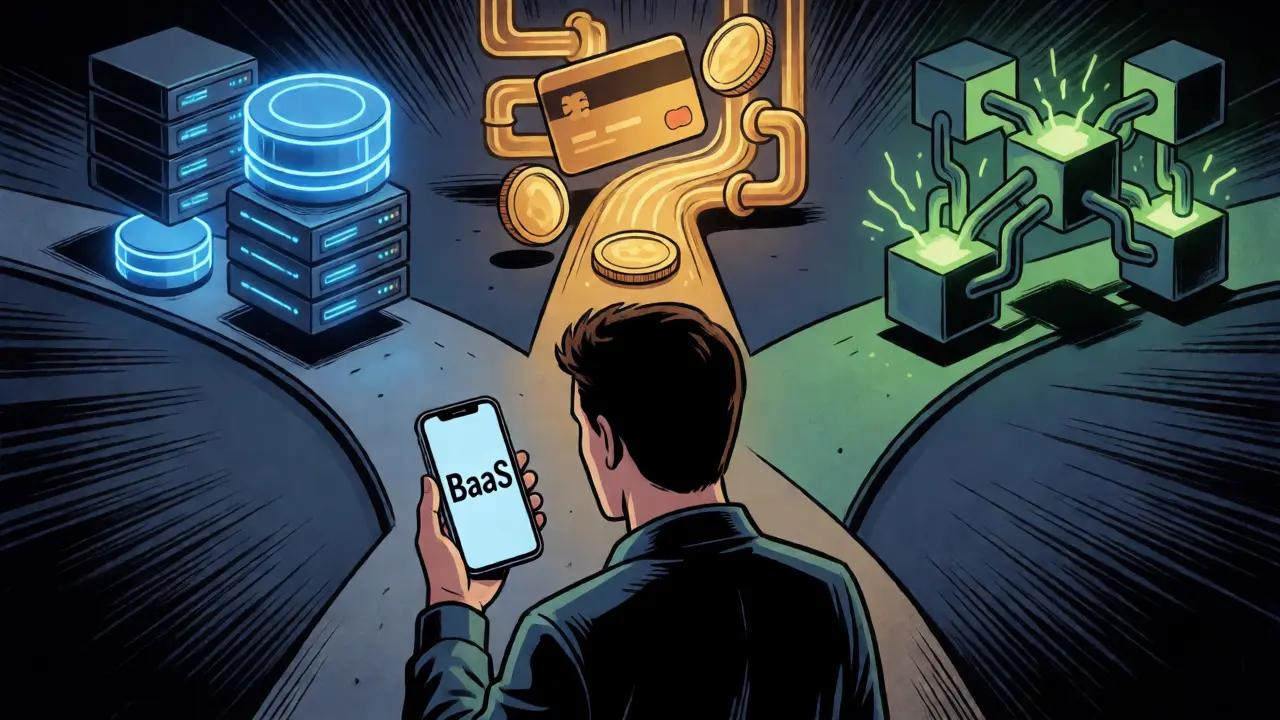
You type "BaaS" into a search bar, and suddenly you're drowning in three different worlds. Are you looking for serverless backends for your mobile app? Do you need to embed banking features into your e-commerce platform? Or are you trying to deploy enterprise blockchain nodes without hiring a DevOps team? The acronym is the same, but the problems it solves are wildly different. In 2025, the market has matured, separating these three distinct services-Backend as a Service, a cloud computing model that provides pre-built backend functionality like databases and user management via APIs, Banking as a Service, a technology solution that allows non-banks to integrate financial products into their platforms through APIs, and Blockchain as a Service, a managed cloud service that lets enterprises develop and host blockchain applications without managing underlying infrastructure-into specialized niches.
If you are building a product today, choosing the wrong provider can cost you months of development time or leave you with compliance headaches you didn't anticipate. This guide cuts through the noise. We will look at who actually leads each sector right now, what makes them stand out, and how to pick the one that fits your specific technical and business needs.
The Quick Verdict: Key Takeaways
- Backend: If you want speed and scale, go with Firebase or AWS Amplify. For control and open-source flexibility, Supabase and Appwrite are the top contenders in 2025.
- Banking: European markets favor licensed players like Solarisbank and Treezor for regulatory safety. Global innovators often lean on Itexus or Railsr for custom API integration.
- Blockchain: Rapid Innovation stands out for fast deployment and AI integration, while Kaleido offers the most robust multi-protocol support for large enterprises.
- Trend Alert: The lines are blurring. Modern apps often need all three. A fintech app might use Firebase for user data, Treezor for payments, and BlockApps for audit trails.
Backend as a Service: Who Actually Delivers?
Let's start with the most common confusion point. When developers say BaaS, they usually mean the plumbing behind their app. You don't want to write code for user authentication every time you launch a new feature. You want it done. In 2025, the market has split into two camps: the closed ecosystems and the open-source challengers.
Firebase remains the heavyweight champion here. Google’s platform offers real-time databases, hosting, and analytics in a freemium model that starts at $0. It’s perfect for startups because the setup takes minutes, not weeks. But there is a catch. Once you are deep in the Firebase ecosystem, migrating away is painful. Vendor lock-in is real. If you care about owning your data structure, you might look at Supabase, an open-source alternative to Firebase that uses PostgreSQL and offers transparent pricing. Supabase gives you the power of a traditional SQL database with the convenience of a BaaS. You get real-time subscriptions and edge functions, but you keep your data portable.
Then there is AWS Amplify, Amazon's full-stack development platform offering authentication, APIs, storage, and hosting. If your company already lives in the Amazon Web Services environment, Amplify is a no-brainer. It integrates seamlessly with other AWS services like Lambda and DynamoDB. However, the learning curve is steeper than Firebase. You need to understand IAM roles and CloudFormation templates to really make it sing.
For those who hate vendor lock-ins entirely, Appwrite, an open-source backend server that supports multiple programming languages and frameworks and Back4App, a comprehensive platform providing Parse Server hosting and database management are strong options. Appwrite allows you to self-host, meaning you run the backend on your own servers if you want total control. Back4App keeps the legacy of Facebook’s original Parse alive, which is great if you have older codebases that rely on that specific architecture.
Banking as a Service: Embedding Finance Without the License
Now, let’s talk money. Not your money, but the infrastructure that moves it. Banking as a Service (BaaS) allows tech companies to offer bank accounts, cards, and loans without becoming a bank themselves. They plug into a licensed provider via APIs. This sector is heavily regulated, so trust and licensing are more important than flashy UIs.
In Europe, Solarisbank, a fully-licensed platform for digital banking services across Europe is a dominant force. They hold the necessary licenses to issue IBANs and process SEPA transactions directly. If you are launching a neobank in Germany or France, Solaris is often the first call. Their strength lies in compliance tools that handle KYC (Know Your Customer) automatically, saving you from manual document checks.
Across the channel in the UK, ClearBank, a UK-based banking infrastructure provider built to catalyze innovation in financial services and Railsr, an embedded finance platform delivering BaaS and Cards-as-a-Service via APIs compete fiercely. ClearBank positions itself as an infrastructure layer, focusing on speed and reliability for high-volume transaction processing. Railsr, after its recapitalization in 2023, focuses on modular solutions. You can buy just the card issuance module or the whole lending suite. This modularity is crucial for businesses that only need one specific financial feature, like instant payouts for gig workers.
For global reach, Itexus, a leading global BaaS provider specializing in custom-built solutions and payment gateways offers a different value proposition. They don’t just provide an API; they help build the entire financial stack. If you are a mid-sized enterprise trying to launch a white-label banking product, Itexus handles the heavy lifting of custom development and security-first design. Meanwhile, Treezor, a Paris-based banking platform operating under Societe Generale with EMI license coverage across 25 European countries leverages its parent company’s stability to offer robust e-wallet and card issuance solutions.

Blockchain as a Service: Enterprise Nodes Without the Headache
This is where things get interesting for our audience. Blockchain as a Service removes the pain of setting up and maintaining blockchain nodes. You don’t need to worry about syncing ledgers or managing hardware failures. The provider handles the infrastructure, and you focus on smart contracts and application logic.
Kaleido, a comprehensive blockchain business cloud platform supporting multiple protocols and consensus mechanisms is widely regarded as the enterprise standard. Why? Because it supports Ethereum, Hyperledger Fabric, and Corda in one interface. Large corporations with complex supply chains use Kaleido because it abstracts away the complexity of different consensus mechanisms. You get monitoring, logging, and identity management out of the box.
On the faster, more agile side, Rapid Innovation, a top blockchain-as-a-service provider known for affordable rates and 90-day deployment guarantees has gained traction by combining blockchain with AI and Web3 development. Their appeal is speed. They promise deployment within 90 days, which is critical in a market where technology shifts monthly. If you are a startup needing to prove a concept quickly, this speed-to-market advantage is worth paying for.
Specialized players also exist. BlockApps, a provider of enterprise Ethereum solutions with smart contract development tools focuses strictly on Ethereum compatibility, making it ideal for teams familiar with Solidity. Bloq, a provider of enterprise blockchain tools and infrastructure for large-scale implementations caters to institutions that need secure key management and transaction signing services. And if you are specifically interested in Bitcoin infrastructure, Blockstream, a specialist in Bitcoin-focused financial services and satellite API solutions offers unique connectivity options via satellite, ensuring uptime even when internet connections fail.
Comparison: Choosing the Right Provider
Selecting a provider isn't just about features; it's about fit. Here is a breakdown of how these leaders compare across key decision criteria.
| Provider | Category | Best For | Key Strength | Potential Drawback |
|---|---|---|---|---|
| Firebase | Backend | Startups & Mobile Apps | Real-time DB & Ease of Use | Vendor Lock-in |
| Supabase | Backend | Data-Intensive Apps | Open Source & PostgreSQL | Smaller Community Support |
| Solarisbank | Banking | European Neobanks | Licensed Infrastructure | EU-Centric Focus |
| Itexus | Banking | Custom FinTech Solutions | Full-Stack Development | Higher Entry Cost |
| Kaleido | Blockchain | Large Enterprises | Multi-Protocol Support | Complex Pricing Models |
| Rapid Innovation | Blockchain | Agile Startups | Speed & AI Integration | Newer Market Presence |

Pitfalls to Avoid When Selecting a BaaS
Don't fall for the marketing fluff. Every provider claims to be "scalable" and "secure." Here is what you should actually check before signing a contract.
First, scrutinize the exit strategy. With Backend providers like Firebase, ask yourself: "How hard is it to move my data to Postgres?" If the answer involves writing custom scripts to migrate JSON blobs, you might regret it later. Open-source options like Supabase or Appwrite make this easier, but require more maintenance effort on your part.
Second, check the regulatory footprint for Banking BaaS. If you plan to expand beyond your home country, does your provider have the licenses to operate there? Treezor covers 25 European countries thanks to its passporting rights, but moving to Asia or North America might require a different partner entirely. Don't assume global coverage unless it is explicitly written in the SLA.
Third, evaluate developer experience for Blockchain BaaS. Setting up a node is easy; debugging a failed transaction on a private chain is hard. Does the provider offer good logging and tracing tools? Kaleido excels here, but smaller providers might leave you staring at raw logs with no context.
Final Thoughts: Where the Market is Heading
The BaaS landscape in 2025 is consolidating. We see big banks acquiring tech platforms (like Societe Generale with Treezor) and cloud giants refining their offerings. The trend is clear: specialization wins. Generic "do-it-all" platforms are losing ground to niche experts who solve one problem exceptionally well.
If you are building a modern app, expect to use a hybrid approach. You might use Supabase for your user profiles, Treezor for your wallet balances, and BlockApps for your transaction receipts. The key is to choose providers with clean APIs that play well together. Don't try to find one magic bullet. Build a stack.
What is the main difference between Backend, Banking, and Blockchain as a Service?
Backend as a Service (BaaS) provides server-side functionality like databases and authentication for apps. Banking as a Service (BaaS) allows non-banks to offer financial products like accounts and payments via APIs. Blockchain as a Service (BaaS) offers managed infrastructure for deploying and running blockchain networks without handling the underlying hardware and node management.
Is Firebase still a good choice for BaaS in 2025?
Yes, Firebase remains a top choice for rapid prototyping and mobile-first applications due to its ease of use and integrated tools. However, for projects requiring complex relational data or strict data portability, open-source alternatives like Supabase or Appwrite are often preferred to avoid vendor lock-in.
Which BaaS provider is best for European fintech startups?
Solarisbank and Treezor are leading choices for European fintechs. Solarisbank offers comprehensive licensed banking infrastructure across Europe, while Treezor, backed by Societe Generale, provides robust API-driven payments and e-wallet solutions with extensive regulatory coverage in 25 countries.
Why should enterprises use Blockchain as a Service instead of building their own?
Building and maintaining blockchain infrastructure requires specialized DevOps skills and significant resources for node management, upgrades, and security patches. BaaS providers like Kaleido or Bloq handle this operational burden, allowing enterprises to focus on developing smart contracts and business logic while benefiting from guaranteed uptime and scalability.
Can I switch BaaS providers easily?
Switching depends on the provider's architecture. Open-source Backend BaaS providers like Supabase allow easier data migration since they use standard technologies like PostgreSQL. Closed ecosystems like Firebase may require significant refactoring. For Banking BaaS, switching is complex due to regulatory requirements and customer account migrations, so choosing a long-term partner is critical.