
Can Blockchain Data Ever Be Changed or Deleted? The Hard Truth About Immutability
When you hear that blockchain is "immutable," it sounds like a promise written in stone: once data goes on, it’s there forever. No edits. No deletions. No going back. But is that really true? Or is it just a myth that sounds good in marketing slides? The answer isn’t simple. Blockchain data can be changed or deleted-but only under extreme conditions, and never without consequences.
How Blockchain Keeps Data Locked In
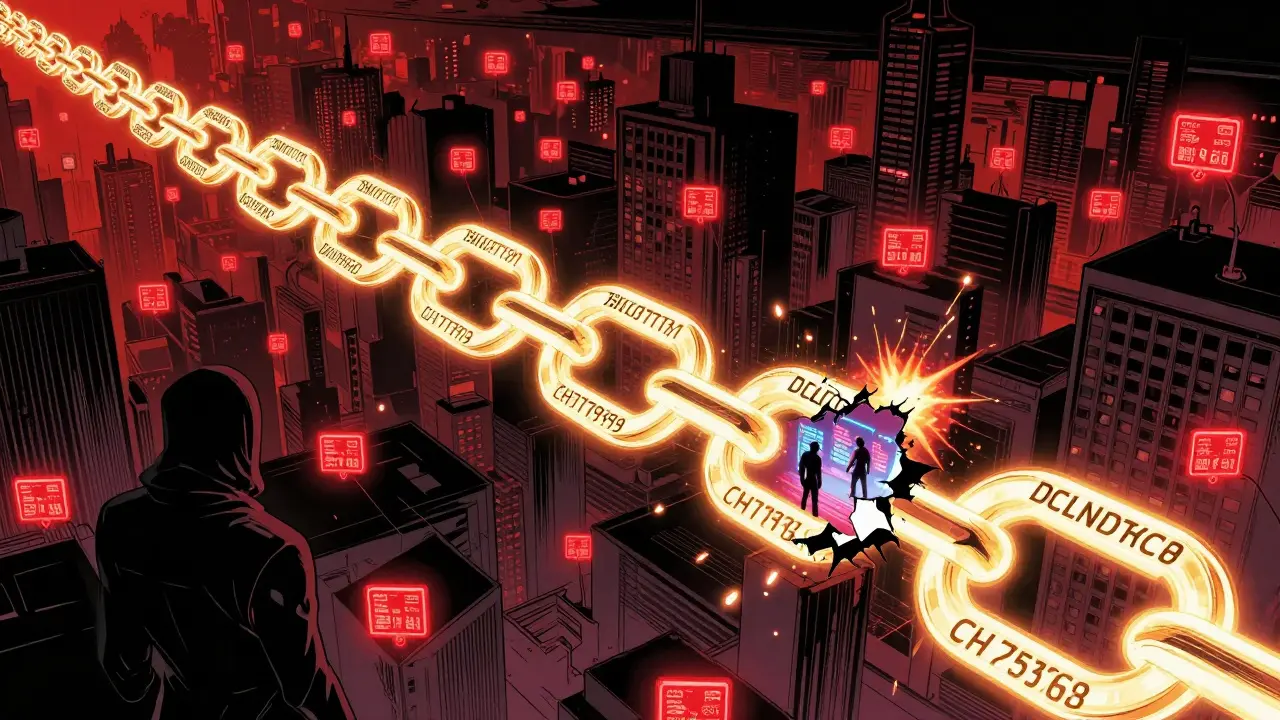
Every block in a blockchain holds a list of transactions, and each block contains a unique digital fingerprint called a hash. That hash is generated using the data inside the block plus the hash of the previous block. It’s like a chain of locked boxes: if you try to open one, the lock on the next one breaks, and everyone knows something’s been tampered with. This design isn’t accidental. It’s the core of how blockchain builds trust without needing a central authority. If you change a single transaction from six months ago, you’d have to recalculate the hash for that block, then for every single block after it. And you’d need to do this faster than the rest of the network adds new blocks. On Bitcoin, that means outpacing over 400 exahashes per second of computing power. The math doesn’t work. Add to that the distributed nature of the network. Thousands of computers around the world hold copies of the entire blockchain. To change history, you’d need to control more than half of them at once. That’s called a 51% attack. Even then, you’d need to keep your altered version alive long enough for the rest of the network to accept it. Most nodes won’t. They’ll keep the original chain-the one that’s been verified by millions of transactions over years. The system is built to make changing data so expensive and difficult that it’s practically impossible. As of 2024, altering Bitcoin’s chain would cost around $12.7 billion in hardware and over $50 million a day in electricity. That’s not a glitch. It’s the feature.When Immutability Breaks: The DAO Hack and Ethereum’s Fork
The most famous example of blockchain data being changed happened in 2016. A hacker exploited a flaw in a smart contract called the DAO and stole $60 million worth of Ether. The Ethereum community was faced with a choice: let the theft stand, or reverse it. They chose to reverse it. In a move that shocked many, the core developers proposed a hard fork-a complete split in the blockchain. The new version erased the hacker’s transactions and returned the funds. The old chain, unchanged, became Ethereum Classic (ETC). This wasn’t a technical hack. It was a social decision. A majority of users, miners, and exchanges agreed to follow the new chain. That’s the real secret: blockchain immutability depends on consensus. If the community decides to change the rules, the chain can change with it. Ethereum Classic’s community still insists that true blockchain means no reversals, ever. That’s why they hold onto the original chain. But Ethereum (ETH) proved that even the most secure systems can be rewritten-if enough people agree to do it.51% Attacks: The Backdoor to Change
Another way blockchain data can be altered is through a 51% attack. If one entity controls more than half the network’s mining power, they can outpace the rest of the network and rewrite recent blocks. In 2018, Bitcoin Gold suffered exactly that. Attackers used rented computing power to control the majority of the network for several hours. They reversed transactions, double-spent coins, and stole $18 million before the network recovered. This works best on smaller blockchains. Bitcoin’s massive size makes a 51% attack nearly impossible. But blockchains with fewer than 1,000 active nodes? Cornell University’s 2023 study found they have a 34% chance of being successfully attacked within a year. That’s why most enterprises avoid using small, low-hash-rate blockchains for anything critical. If you’re storing legal records, financial data, or medical history, you need a network too big to be taken over. Bitcoin and Ethereum are safe. Most altcoins are not.
Private Blockchains: The Exception That Proves the Rule
Public blockchains like Bitcoin and Ethereum are designed for openness and trustlessness. But many companies use private or permissioned blockchains-where access is restricted, and a few admins control the rules. IBM’s 2024 report found that 62% of private blockchain implementations include an "emergency override" feature. That means a CEO, IT director, or compliance officer can delete or edit data if needed. This isn’t a bug-it’s a design choice. These systems are useful for internal audits, supply chain tracking, or healthcare records where legal compliance requires data deletion. But they sacrifice the core promise of blockchain: decentralization and true immutability. If you need to delete data, a private blockchain might be the right tool. But if you want to prove something can’t be changed, don’t use one.GDPR and the Right to Be Forgotten
The European Union’s General Data Protection Regulation (GDPR) gives people the legal right to have their personal data erased. That’s a problem for public blockchains. Once your name, email, or ID is on-chain, it’s there forever. Many companies hit this wall. One enterprise user on Reddit said they had to build an entire off-chain encryption layer just to stay compliant. Instead of storing personal data on the blockchain, they store an encrypted version off-chain and only put a hash of the encrypted data on-chain. That way, they can delete the original file and the blockchain record remains intact-but the personal data is gone. Deloitte’s 2025 survey found that 41% of blockchain projects had to add legal agreements or technical workarounds to handle GDPR conflicts. The EU Blockchain Observatory reported that 58% of European blockchain projects had to redesign their systems to avoid storing personal data directly on-chain. The solution isn’t to break immutability. It’s to avoid putting regulated data on it in the first place.
What’s Next: Hybrid Immutability
The industry is moving toward hybrid models. On-chain data stays immutable. Off-chain data can be edited, deleted, or encrypted. Microsoft’s Azure Blockchain Service added a "compliance layer" in early 2025 that lets enterprises delete sensitive data while keeping cryptographic proof that the data once existed. The W3C’s Verifiable Credentials 2.0 spec, released in late 2024, does something similar: it lets users selectively reveal parts of their data without exposing the whole thing. Ethereum’s Dencun upgrade in March 2024 introduced proto-danksharding, which improves how data is stored and accessed without breaking immutability. The goal? Make blockchains faster, cheaper, and still unchangeable. By 2027, Forrester predicts 73% of enterprise blockchains will use hybrid models. The future isn’t about absolute immutability. It’s about choosing when and where to enforce it.Can You Delete Blockchain Data? The Bottom Line
So, can blockchain data ever be changed or deleted? Technically? Yes. But only if:- You control over half the network (a 51% attack), which is nearly impossible on Bitcoin or Ethereum
- The community votes to hard fork the chain (like Ethereum did in 2016)
- You’re using a private blockchain with admin override rights
- You never stored the actual data on-chain to begin with
Frequently Asked Questions
Can I delete my transaction from the blockchain?
No, you cannot delete your own transaction from a public blockchain like Bitcoin or Ethereum. Once confirmed, it’s permanently recorded across thousands of nodes. The only way to "remove" it is through a network-wide hard fork, which requires consensus from the entire community-not just you. If you need to erase data for privacy reasons, store sensitive information off-chain and only use hashes on the blockchain.
Is blockchain really unchangeable, or is that just hype?
It’s mostly real-but not absolute. Public blockchains like Bitcoin are practically immutable because changing data would cost billions and require controlling the majority of the network. But history has shown that social decisions (like the Ethereum hard fork) or technical exploits (like 51% attacks) can override this. Immutability isn’t a law of physics; it’s a design choice enforced by economics and consensus.
What’s the difference between public and private blockchains when it comes to deleting data?
Public blockchains (like Bitcoin and Ethereum) have no central authority and no way to delete data without community consensus. Private blockchains (like Hyperledger Fabric) are controlled by organizations that can grant admin rights to delete or edit records. Private chains sacrifice decentralization for flexibility-making them useful for compliance but not for trustless applications.
Can quantum computers break blockchain immutability?
Not directly. Quantum computers could eventually break the cryptographic hashing algorithms (like SHA-256) that secure blockchains, making it easier to forge hashes. But that wouldn’t let you delete existing data-it would let you fake new blocks. The industry is already working on quantum-resistant cryptography, and MIT predicts these upgrades will be standard by 2028. Current blockchains are safe for now, but long-term security requires planned upgrades.
Why do some people say Ethereum Classic is "more immutable" than Ethereum?
Because Ethereum Classic refused to reverse the DAO hack in 2016. While Ethereum chose to hard fork and erase the stolen funds, Ethereum Classic kept the original chain, including the hack. To its community, that’s the true spirit of blockchain: no reversals, ever. That’s why ETC is often called the "pure" version of blockchain-its immutability wasn’t compromised by a social decision.
How do companies comply with data privacy laws like GDPR if blockchain can’t be deleted?
They don’t store personal data on the blockchain. Instead, they encrypt the data off-chain and store only a cryptographic hash or reference on-chain. If a user requests deletion, the off-chain data is removed, and the hash becomes meaningless. The blockchain record stays intact, but the personal information is gone. This is now standard practice in healthcare, finance, and EU-based blockchain projects.






this is why i just store hashes on-chain and keep the real data encrypted off-chain. 🤷♂️ blockchain ain't a cloud drive.
Oh wow, someone finally admitted blockchain isn't magic. Took long enough. You know what's *really* immutable? My disdain for people who think tech solves social problems. You didn't fix the DAO hack-you just rewrote history like a college kid editing their term paper after getting a C. Pathetic.
51% attacks are a joke on Bitcoin. But on small chains? Pure dumpster fire. And private blockchains? Just databases with extra steps and a fancy name. Stop pretending this is revolutionary.
man blockchain is like a tattoo-once you ink it, you can't erase it unless you burn the whole arm. some people just want to cover it with a new design instead of accepting the scar. we all got our reasons
it's funny how we call it 'immutability' like it's a law of nature... but really it's just a social contract held together by collective will and expensive hardware. we're not building gods, we're building consensus. 🤔✨
The notion that immutability is an inherent property of blockchain is a semantic fallacy. It is, in fact, an emergent property of economic disincentive, distributed consensus, and cryptographic integrity. To conflate these with metaphysical permanence is to misunderstand the architecture entirely. The DAO fork was not a failure-it was a meta-governance event.
If you need to delete data, use a database. Blockchain is for people who think ‘trustless’ sounds cooler than ‘centralized but regulated.’
Honestly? This is the most honest take on blockchain i've read in years. It's not about being unchangeable-it's about being *expensive* to change. And that's the whole point. 🙏
You say 'community consensus' like it's sacred. But consensus is just mob rule with better PR. The DAO fork was a coup disguised as democracy. ETC is the only real blockchain now.
bro in india we use private blockchains for voter records and tax stuff-yes we can delete data, yes it’s controversial, but sometimes the law says ‘delete’ and the blockchain says ‘nope’-so we bend. not broken. just practical. 🇮🇳
gdpr? pfft. just hash the data and call it a day. problem solved. now go cry to your lawyer.
I just want to say thank you for explaining this so clearly. Seriously. So many people think blockchain = unchangeable = perfect. But it's not. It's just really, really hard to change. And that's okay. 🙌
tl;dr: no you can't delete it unless you're rich or powerful
The real issue is not technical. It is epistemological. If truth is determined by consensus, then blockchain is merely a tool of ideological hegemony. The immutability myth serves those who control the narrative.
I've seen too many startups use blockchain because it sounds techy. It's not a solution. It's a marketing buzzword wrapped in SHA-256. Stop pretending.
YESSSSS this is the truth! 🔥 Blockchain isn't about being unchangeable-it's about being *unforgiving*. And that's beautiful. Let's stop romanticizing it and start engineering with it. 💪
so if i put my address on chain its forever cool i guess
I love how the article calls it 'hybrid immutability' like it's some new frontier. It's just good engineering. Store what needs to be permanent on-chain, and everything else off-chain. Duh. Why did this take 10 years to figure out?
The United States Department of Justice has issued guidance on blockchain data retention, emphasizing that while cryptographic immutability is technologically robust, legal obligations under U.S. Code Title 18, Section 2703 may necessitate off-chain data management protocols. Compliance is not optional.
people still think this is revolutionary? we’ve had append-only logs since the 80s. blockchain is just a slow, expensive, energy-guzzling version of a syslog with extra steps and a cult following
I used to think blockchain was the future. Now I see it as a mirror. It doesn't solve problems-it just makes them more visible. And sometimes, that’s enough. The real work happens off-chain, in the quiet places where humans decide what’s worth preserving.
Oh, so now you're saying Ethereum's fork was a 'social decision'? Shocking. You think the 51% attack on Bitcoin Gold was just bad luck? Nah. It was inevitable. The system rewards greed. And you? You're just surprised because you thought the math was holy. It's not. It's just math. And math doesn't care about your feelings.