
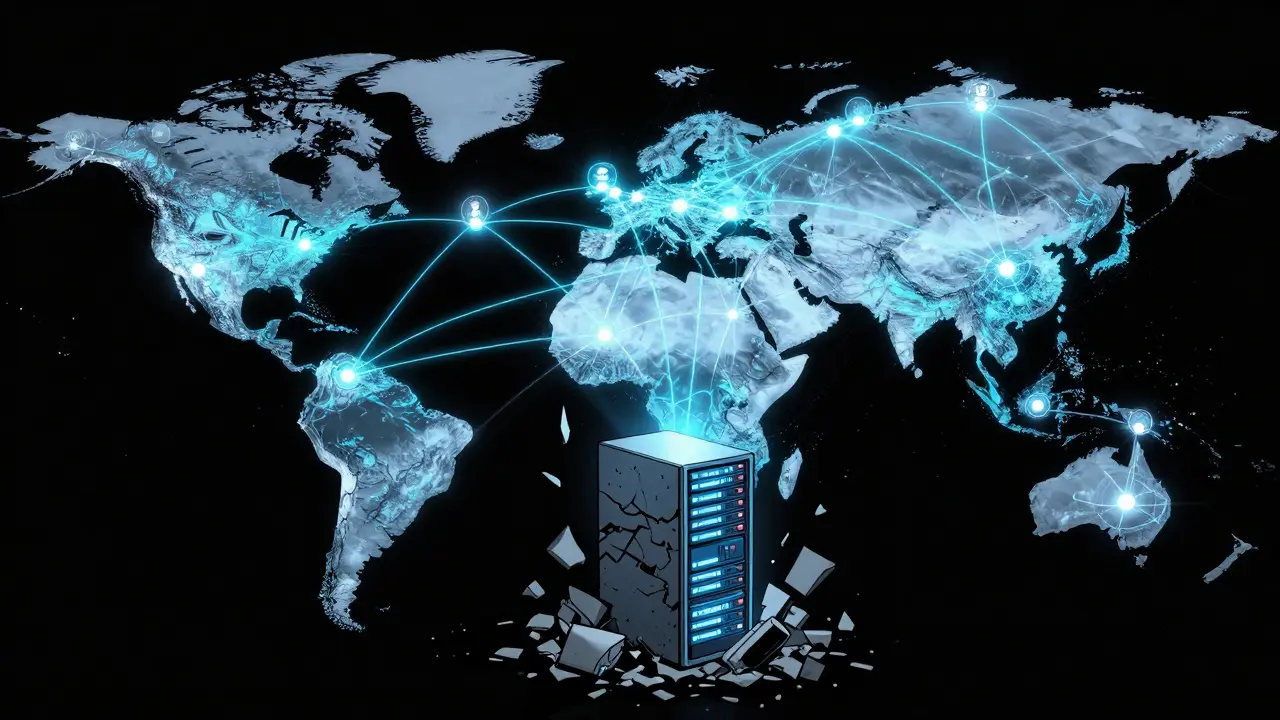
P2P vs Client-Server: Why Blockchain Uses P2P
Imagine a bank that doesn’t need buildings, tellers, or a CEO. What if every user in the system held a copy of the ledger, verified every transaction, and refused to let any single person control the rules? That’s not science fiction-it’s blockchain. And at its core, it runs on a network type most people don’t think about: peer-to-peer (P2P). But why? Why not just use the same client-server model that powers websites, email, and online banking? The answer isn’t about speed or cost. It’s about control, trust, and survival.
How Client-Server Works (and Why It’s Fragile)
Client-server is the backbone of the internet as we know it. You open your browser, type in a website, and your device (the client) asks a distant server for data. The server responds. Simple. Reliable. But here’s the catch: if that server goes down-poof-everything stops. No server, no service. That’s a single point of failure.
Think of it like a highway with one toll booth. If the booth breaks, traffic halts. If the operator gets hacked, they can block your payment. If the company decides to shut you out, you’re stuck. That’s how traditional systems work: centralized control. Servers store data, manage access, and enforce rules. Clients just ask and wait.
This model is efficient for companies. One team manages one server. One budget covers maintenance. But it’s also a bullseye for attacks. Hackers don’t need to break into thousands of devices-they just target one server. Governments can shut it down with a single order. Corporations can censor transactions, freeze accounts, or erase records. And if the server gets overloaded? Everyone waits.
What Is Peer-to-Peer? (No Bosses, No Middlemen)
P2P is the opposite. No central server. No boss. Every device on the network is equal. Each one is both a client and a server. Need data? Ask your neighbor. Have data? Send it to someone else. No middleman. No single point of control.
In a P2P network like BitTorrent, if you download a movie, you’re not just getting it from one server-you’re downloading pieces from dozens of other people who already have it. And once you have it, you start sharing it with others. The more people join, the faster and more resilient the network becomes.
This isn’t just about file sharing. It’s about distribution. Data isn’t stored in one place. It’s copied everywhere. If one node disappears, the data lives on elsewhere. If someone tries to block a transaction, the network just routes around it. There’s no single switch to flip.
Why Blockchain Chose P2P Over Client-Server
Blockchain doesn’t just use P2P-it depends on it. Here’s why:
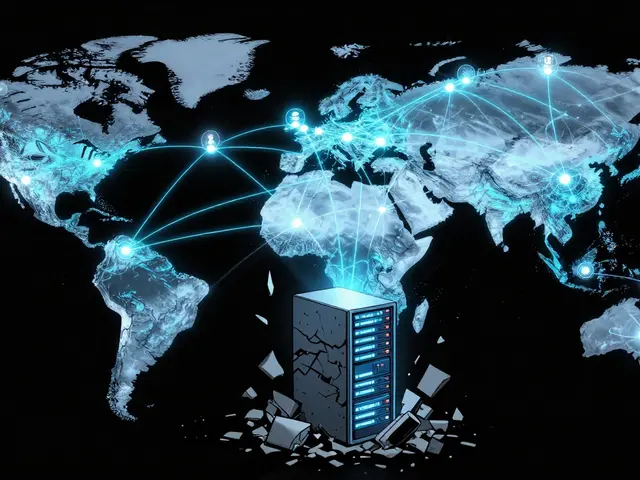
- No single point of failure: In Bitcoin, over 15,000 nodes spread across the globe hold a full copy of the blockchain. Take down 1,000? The rest keep running. Shut down a country’s nodes? Others in Switzerland, Japan, or Brazil keep the chain alive.
- Censorship resistance: A bank can refuse to process your payment. A government can freeze your crypto wallet. But in a P2P blockchain, no one has the power to say ‘no.’ Transactions are validated by the network, not a single authority.
- Decentralized trust: You don’t need to trust a company or a government. You trust the math. The rules are written in code. Every node checks every transaction. If one node lies, the others reject it. It’s like having 15,000 auditors, all watching each other.
- Lower cost, higher access: Running a client-server network means paying for servers, bandwidth, security teams, and data centers. P2P shifts that cost to users. Anyone with a laptop and internet can run a node. No corporate infrastructure needed.
- Self-healing: If a node goes offline, the network redistributes its data. If a new node joins, it downloads the full chain and starts helping. The system adapts without anyone in charge.
Compare that to a traditional payment system. Visa processes 5 billion transactions a day-but it’s run by one company, with one data center, one set of rules, and one CEO. If that system fails, the whole global economy feels it. Bitcoin? It’s been running nonstop since 2009, even through wars, blackouts, and bans.
The Hidden Cost of P2P (And How Blockchain Fixes It)
P2P isn’t perfect. Early P2P networks like Napster or Skype struggled when they grew too big. Too many nodes meant slow sync times, inconsistent data, and wasted bandwidth. So why didn’t blockchain collapse under its own weight?
The answer: consensus.
Traditional P2P networks just share files. Blockchain P2P networks share state. They must agree on what the truth is. Did Alice send Bob 2 BTC? Is that block valid? How do you make 10,000 strangers agree on one answer without a boss?
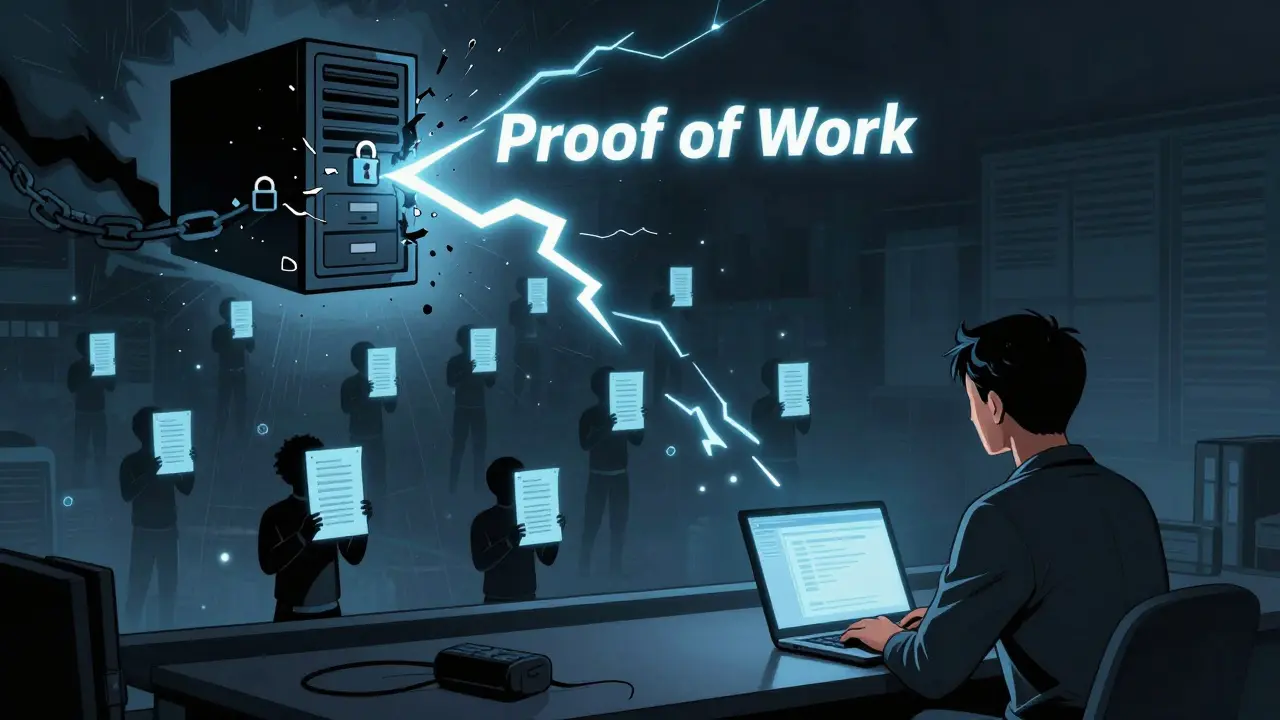
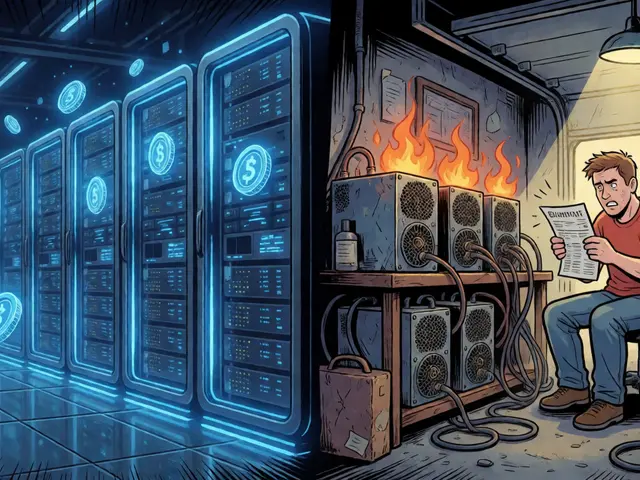
That’s where Proof of Work and Proof of Stake come in. These aren’t just buzzwords-they’re the glue holding P2P blockchain together. Proof of Work (used by Bitcoin) makes it expensive to lie. You need real electricity and real hardware to add a block. Proof of Stake (used by Ethereum) makes it costly to cheat-you have to lock up real money to participate. If you lie, you lose it.
These mechanisms turn P2P from a messy, unreliable network into a secure, synchronized system. It’s like having 15,000 people playing a game where cheating costs you $10,000. No one tries.
Real-World Proof: Bitcoin and Ethereum
Bitcoin processes over $10 billion in transactions daily, with no central server. Every transaction is broadcast to every node. Every node checks it. Every node stores it. And every node helps propagate it. No Amazon Web Services. No Google Cloud. Just computers-yours, mine, and millions of others.
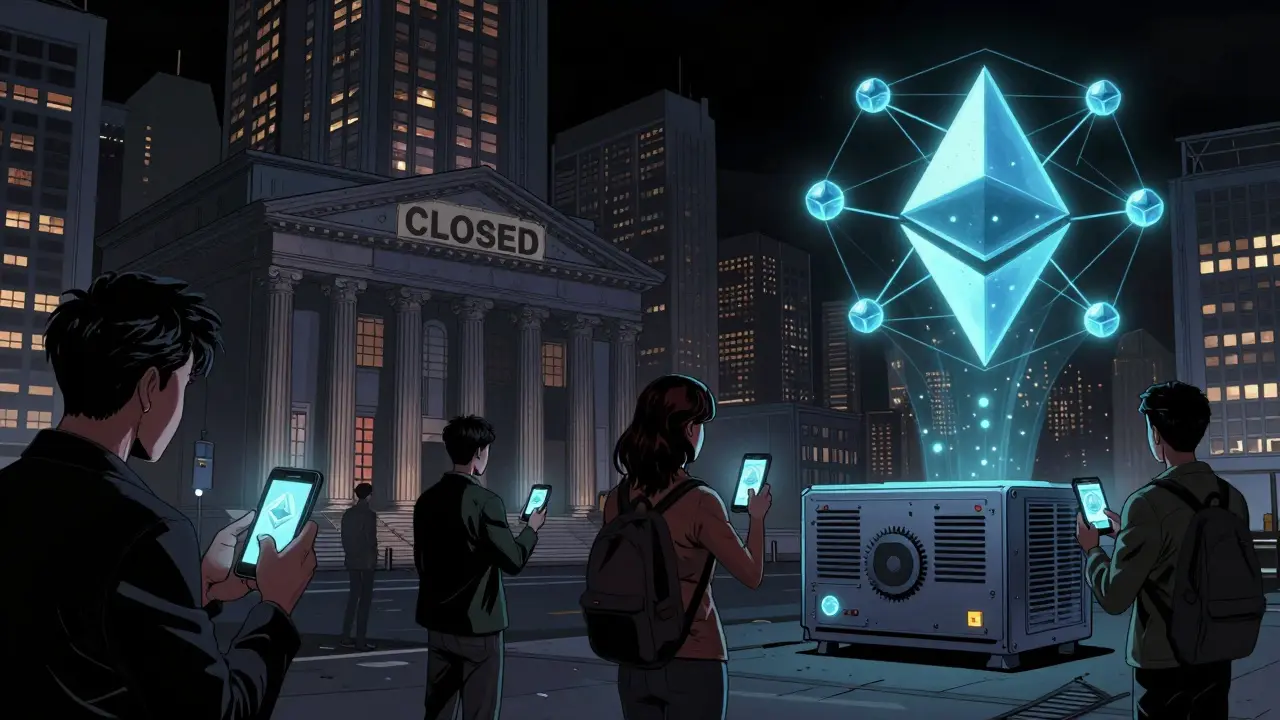
Ethereum does the same, but for smart contracts. Thousands of decentralized apps (dApps) run on it-DeFi platforms, NFT marketplaces, prediction markets. None of them rely on a central company. They rely on a P2P network that refuses to shut down.
When Iran blocked access to Ethereum in 2022, users connected through VPNs and kept running nodes. When Ukraine’s power grid was attacked in 2023, crypto miners in the country kept mining using backup generators. The network didn’t blink.
What’s Next? Scaling P2P Without Losing Decentralization
Blockchain P2P isn’t done evolving. The challenge now isn’t whether P2P works-it’s whether it can handle millions of transactions per second without becoming slow or expensive.
That’s why layer-2 solutions like the Lightning Network (for Bitcoin) and rollups (for Ethereum) exist. They don’t replace P2P-they build on top of it. The base layer stays decentralized. The fast transactions happen off-chain, then get settled back on the P2P network.
Sharding, another innovation, splits the blockchain into smaller pieces. Each node doesn’t need to store the whole thing anymore. It only stores a part. But the P2P structure remains. Nodes still talk to each other. Still validate. Still enforce rules.
Even AI is starting to join. Some blockchain projects now use machine learning to predict network congestion or detect malicious nodes. But the core? Still P2P.
Final Thought: It’s Not About Tech-It’s About Power
Client-server works fine if you’re okay with someone else holding the keys. If you trust banks, governments, or tech giants to manage your money, data, and identity-then stick with it.
But if you believe no one should have that kind of control? If you think systems should survive even when leaders fail? If you want to own your data, not rent it? Then P2P isn’t just a technical choice-it’s a political one.
Blockchain didn’t choose P2P because it was trendy. It chose it because it’s the only architecture that can truly be unstoppable.
Can blockchain work without P2P?
Technically, yes-but it wouldn’t be blockchain. If you replace P2P with client-server, you get a private, permissioned database. It’s still distributed, but it’s controlled by a central authority. That’s not decentralized. That’s just a database with a fancy name. Blockchain’s whole purpose is to remove central control. Without P2P, you lose censorship resistance, trustlessness, and resilience. You get something that looks like blockchain but acts like a corporate server.
Is P2P slower than client-server?
For simple tasks, yes. Downloading a file from one server is usually faster than pulling pieces from 50 random people. But blockchain isn’t about speed-it’s about reliability. A client-server system might load a webpage in 0.2 seconds, but if the server dies, it’s gone forever. A P2P blockchain might take 10 seconds to sync a new block, but it keeps running even if half the nodes vanish. The trade-off isn’t speed-it’s survival.
Do I need to run a node to use blockchain?
No. Most users interact with blockchain through wallets and apps-like MetaMask or a cryptocurrency exchange. These apps connect to public nodes run by others. But if you want full control, privacy, and to help secure the network, running your own node is the best way. It takes a few hundred GB of storage and a decent internet connection. It’s not hard. And it’s how you truly own your crypto.
Why don’t banks use P2P for payments?
Because they can’t. Banks need to freeze accounts, reverse transactions, and comply with government rules. P2P blockchain doesn’t let them do that. It’s designed to be permissionless. Banks want control. Blockchain gives power to users. That’s why banks build private, centralized ledgers that look like blockchain but aren’t. They call them ‘blockchain solutions’-but they’re just client-server with a blockchain-shaped logo.
Is P2P more secure than client-server?
It’s not about being ‘more secure’-it’s about being harder to kill. A client-server system can be hacked at the server. A P2P system has no single target. To break a blockchain, you’d need to control over 51% of all nodes globally at once. That’s astronomically expensive and nearly impossible. Plus, every transaction is cryptographically signed and verified by everyone. There’s no backdoor. No admin panel. No ‘reset’ button. That’s why it’s more secure-not because it’s bulletproof, but because it has no weak spot to exploit.



This is so beautifully explained. I’ve been using crypto for years but never really understood why P2P matters until now. It’s not about tech-it’s about freedom. <3
Oh please. 'Self-healing'? More like 'self-sabotaging'. Every time I try to sync a node, my laptop sounds like a jet engine. And don't get me started on 'decentralized trust'-it's just trust in math that 15,000 strangers didn't collude. Good luck with that.
I appreciate how you framed this. The real win isn’t the tech-it’s the shift in power. I used to think blockchain was just for speculators. Now I see it as infrastructure for dignity.
P2P isn't magic. It's just redundancy baked into the protocol. The genius is making it *economically rational* for nodes to stay honest. That’s the real innovation.
You say 'no single point of failure' like it's a virtue. But what about the 51% attack? What about miners in China? What about the fact that 80% of Bitcoin hash power is concentrated in three countries? You're romanticizing a system that's *technically* decentralized but *practically* controlled by a handful of oligarchs with ASICs and cheap electricity. Wake up.
i just want to say i love how you talked about the network being self-healing. like, imagine if your car could fix itself when it broke down? that’s wild. and the part where u said ‘no boss’? yes. i’m so tired of bosses. even in crypto, people act like they’re the boss of the blockchain. nope. it’s us. we’re the network.
In India, we see this every day. When the government shuts down internet in some regions, crypto still moves. People use mesh networks, SMS, even Bluetooth to send value. P2P isn’t theoretical here-it’s survival.
Honestly? The best part is that you don’t need to understand the math to benefit from it. Just like you don’t need to know how your phone works to use WhatsApp. Just run a wallet. Let the network do the heavy lifting.
P2P is cool but why do people act like it’s the only way? Banks have been running for 300 years. They’re not perfect but they work. This whole ‘no central authority’ thing feels like a cry for attention.
I ran a node for a week. My电费 went up $30. My wife said I was 'dating a server'. I quit. 😅
i dont get why people think p2p is faster like no its not its slower but its more resilent like if one node dies it just reroutes like the internet but for money
The consensus mechanisms are what make P2P viable. Without PoW or PoS, you’d have chaos. It’s not about trust-it’s about economic disincentives. That’s the quiet genius.
i think you overestemated the number of nodes. like 15000? i checked and like 3000 are actully active. the rest are ghost nodes. its not as decentralize as you think
Let’s be real. P2P is just a way for tech bros to feel like rebels while they’re still using AWS-hosted wallets and centralized exchanges. You think you’re free? You’re just using a different kind of cage.
To suggest that blockchain is ‘unstoppable’ is not merely naive-it is dangerously naive. The energy consumption alone should disqualify it from moral consideration. We are not building the future-we are burning the planet for the illusion of autonomy.
I commend your passion for decentralization. But let’s not pretend that a 15,000-node network is somehow immune to state intervention. The U.S. government has the legal, technical, and financial capacity to de-anonymize, tax, and regulate every single node. This isn’t rebellion-it’s a tax haven with a blockchain-shaped logo.