
Copyright Registration on Blockchain: Speed, Proof, and Legal Reality
Imagine you just finished a track that’s going to blow up. You upload it to Spotify, but three months later, someone else claims they wrote it first. In the traditional world, you’re stuck waiting for a government office to process your paperwork while your money drains away. But what if you could prove you created that work in under two minutes for less than a dollar? That is the promise of Copyright Registration on Blockchain. It sounds like magic, but it’s actually a mix of cryptography, smart contracts, and legal nuance that every digital creator needs to understand before they hit "publish."
The Core Problem with Traditional Copyright
Let’s be real: the current system for protecting creative work is slow, expensive, and bureaucratic. If you live in the US and want official registration from the US Copyright Office, you are looking at fees between $45 and $125 per work. Worse, the processing time ranges from three to nine months. For a musician releasing weekly singles or a graphic designer posting daily assets, this lag is unacceptable. You need proof of creation now, not next quarter.
This gap has driven creators toward alternative methods. Enter blockchain technology. Originally conceptualized by Satoshi Nakamoto in 2008 for Bitcoin, the distributed ledger concept was adapted around 2016-2017 for intellectual property. The idea is simple: instead of trusting a central government agency to hold your record, you trust a decentralized network of computers. When you register a work, you create an immutable, time-stamped entry that cannot be altered or deleted. This provides immediate verification of who owned the file at a specific moment in time.
How It Actually Works (Without the Jargon)
You might think you need to upload your entire 4K video file to the blockchain. You don’t. Storing large files on-chain is prohibitively expensive and inefficient. Instead, most systems use a cryptographic hash. Think of a hash as a unique digital fingerprint generated from your file. Even a single pixel change in an image results in a completely different hash.
The process typically looks like this:
- Generate a Hash: Software takes your creative work (image, audio, code) and runs it through an algorithm like SHA-256 to create a unique string of characters.
- Store Metadata: Details about the work-author name, title, date-are often stored off-chain using decentralized storage solutions like IPFS (InterPlanetary File System).
- Register on Chain: The hash and a pointer to the metadata are written into a block on a public blockchain, usually Ethereum or Hyperledger frameworks.
- Receive Proof: You get a transaction ID and timestamp. This serves as your "proof of existence."
Platforms like Po.et, Bernstein, and Verisart have built user-friendly interfaces around this technical backbone. They handle the wallet connections and gas fees so you don’t have to worry about managing private keys manually unless you want to.
| Feature | Traditional (USCO) | Blockchain Timestamping |
|---|---|---|
| Cost | $45 - $125+ | < $1.00 (typically) |
| Time to Confirmation | 3 - 9 Months | Minutes |
| Legal Status | Statutory damages eligible | Evidence of existence only |
| Central Authority | Government Agency | Decentralized Network |
| Mutability | Can be amended/corrected | Immutable (cannot be changed) |
Does It Hold Up in Court?
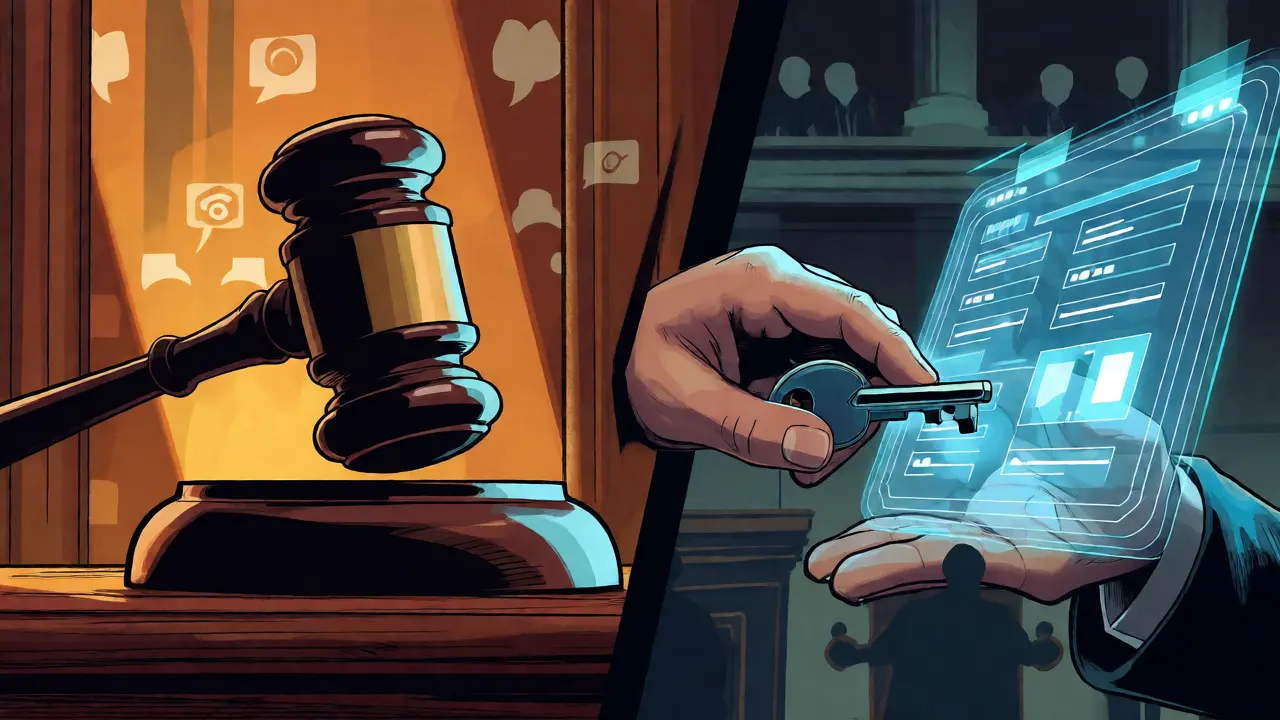
Here is the critical question everyone asks: Can I sue someone based solely on my blockchain record? The short answer is: probably not, at least not yet. While blockchain provides undeniable proof that a file existed at a certain time, it does not automatically grant you the same legal standing as a registered certificate from a national copyright office.
In the United States, for example, you generally need an official registration from the US Copyright Office to claim statutory damages and attorney’s fees in an infringement lawsuit. A blockchain timestamp can serve as corroborating evidence-showing you had the file before the alleged infringer-but it rarely replaces the formal registration. PhotoShelter and other industry bodies have clarified that blockchain doesn't replace copyright registration; it supplements it.
However, the landscape is shifting. Jurisdictions like Switzerland and the UAE are beginning to recognize electronic records and blockchain evidence more explicitly. The European Union Intellectual Property Office launched pilot programs in 2023 to explore integrating blockchain data with official registries. If you are creating content primarily for social media attribution disputes (like Instagram or TikTok), blockchain proof is incredibly effective because these platforms prioritize quick resolution over lengthy litigation. One photographer noted on Reddit that proving authorship via Ethereum took two minutes and cost $0.32, successfully resolving a dispute without lawyers.

Technical Implementation and Smart Contracts
If you are a developer or tech-savvy creator, you might look beyond consumer apps. Advanced implementations use Smart Contracts to automate rights management. These are self-executing contracts with the terms of the agreement directly written into code.
A typical architecture involves two main components:
- Registry Contract: Handles the addition of new works. It verifies the signature of the uploader to ensure the person registering the work owns the private key associated with the address.
- Authentication Contract: Allows third parties to verify ownership claims by checking the blockchain state against the provided hash.
Some newer systems incorporate perceptual hashing (pHash). Unlike standard cryptographic hashes, which change entirely if one bit changes, pHash algorithms identify similar images or videos even if they are resized, cropped, or slightly edited. A 2023 study demonstrated a system using pHash with a 50% similarity threshold to detect potential infringements automatically. This moves beyond simple timestamping toward active monitoring, though it requires significant computational resources.
Risks and Limitations You Should Know
It’s not all sunshine and decentralization. There are distinct pitfalls to avoid.
The Garbage-In-Garbage-Out Problem: Once a record is on the blockchain, it is immutable. If you accidentally register a draft version of your song, or if someone else registers a stolen copy of your work before you do, correcting it is difficult. You can add new entries, but the old incorrect ones remain forever visible. TechnoLlama experts warn that verifying the identity of the registrant is crucial; the blockchain proves who held the private key, not necessarily who legally authored the work.
Technical Barriers: A 2023 survey found that 63% of negative reviews for blockchain copyright services cited the learning curve. Non-technical users struggle with digital wallets, gas fees, and understanding why their file isn’t actually stored on the chain. Platforms like Copyrobo are trying to solve this with one-click interfaces, but the underlying complexity remains.
Regulatory Fragmentation: Laws vary wildly by country. What works in New Zealand or the US might not carry weight in China or India. Always consult local IP laws if you plan to enforce rights internationally.
Who Should Use Blockchain for Copyright?
So, should you switch? It depends on your role.
Digital Artists and Musicians: Yes. If you release high-volume content online, blockchain timestamping is cheap insurance against casual theft and attribution errors on social media.
Software Developers: Maybe. Code repositories already have git history, but blockchain can provide a neutral, third-party audit trail for open-source projects or proprietary algorithms shared with clients.
High-Value Asset Owners: No, not exclusively. If you are selling a patent or a major film script, rely on traditional registration. The legal certainty is worth the wait and cost. Use blockchain as a backup layer, not the primary shield.
Future Outlook
We are currently in a transitional phase. Gartner predicted that by 2025, 20% of major media companies would use blockchain as supplementary proof. As of 2026, we are seeing steady adoption rather than explosive replacement. The goal isn’t to burn down the copyright offices but to integrate them. Imagine a future where your USCO registration is automatically synced to a public ledger, allowing instant verification worldwide without calling a lawyer.
For now, treat blockchain registration as a tool for speed and transparency. It won’t win you a million-dollar lawsuit on its own, but it will stop a thief dead in their tracks when they try to claim your work on Twitter.
Is blockchain copyright registration legally binding?
In most jurisdictions, including the US and EU, blockchain registration is not legally binding in the same way as official government registration. It serves as strong evidence of the date of creation and ownership but does not grant the right to claim statutory damages in court without prior official registration.
How much does it cost to register copyright on blockchain?
Costs are significantly lower than traditional methods. Depending on the platform and network congestion, fees typically range from free to under $1.00 USD for basic timestamping services, compared to $45-$125 for US Copyright Office registrations.
Do I need to upload my full file to the blockchain?
No. Most systems store a cryptographic hash of the file on the blockchain. The actual file is usually stored off-chain, often on decentralized storage networks like IPFS, to save space and reduce costs.
Can someone steal my copyright by registering it on blockchain first?
Yes, anyone can register a hash. However, ownership is tied to the digital signature of the wallet used. If you can prove you held the original file earlier (via metadata or other proofs), you can challenge the claim. Blockchain prevents alteration but not fraudulent initial registration.
Which blockchain is best for copyright registration?
Ethereum is the most common due to its robust ecosystem and smart contract capabilities. Other options include Hyperledger for enterprise privacy-focused solutions and Polygon for lower transaction fees. The choice depends on your budget and need for public verifiability.