Cloud Mining vs Home Mining: Which Pays More in 2026?
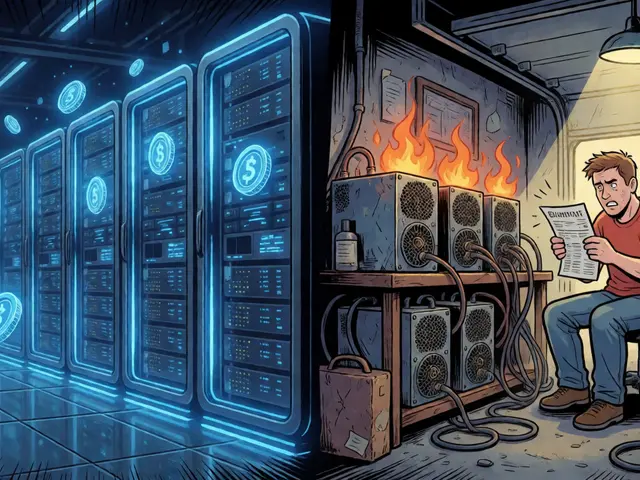
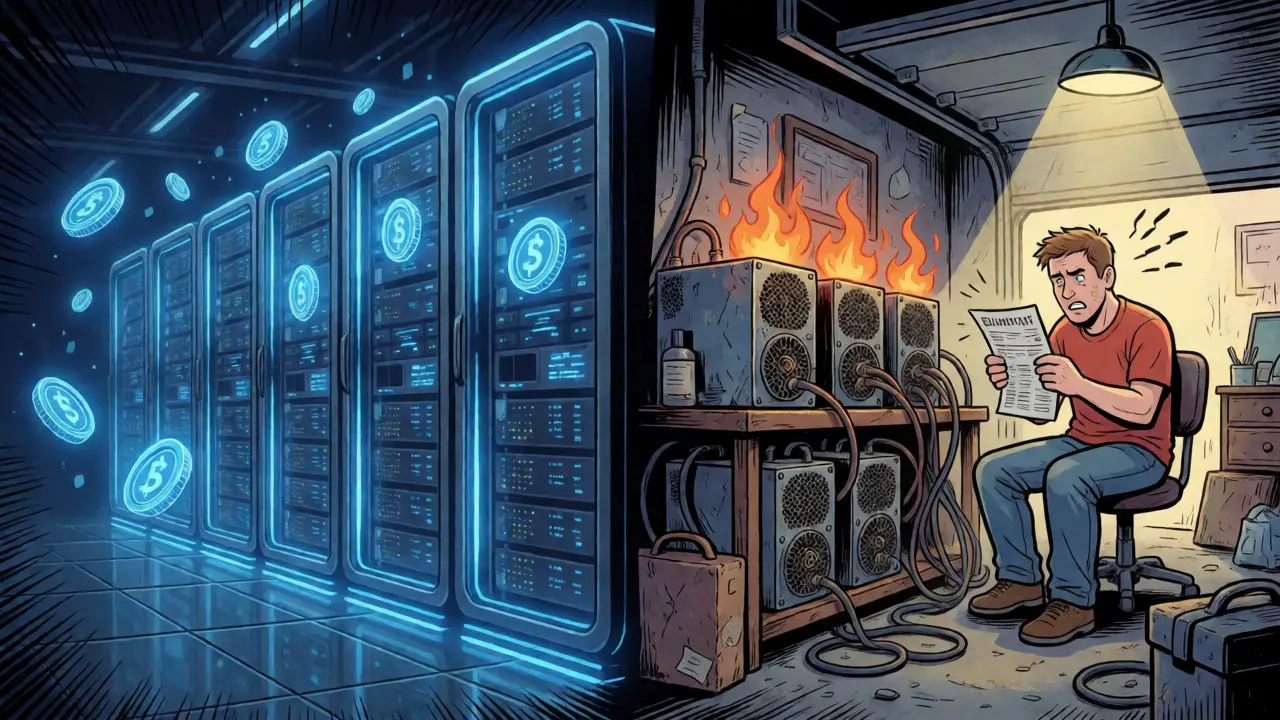
You stare at your electricity bill, then at the price of Bitcoin. The math is tempting. If you could just plug in a machine and print money while you sleep, why wouldn't you? But the reality of mining cryptocurrency isn't that simple. It’s a tug-of-war between upfront cash, technical headaches, and hidden fees. In 2026, the choice generally splits into two camps: renting power from someone else (cloud mining) or buying the noisy, hot hardware yourself (home mining).
Neither option is universally "better." It depends entirely on where you live, how much cash you have, and whether you enjoy fixing electronics at 2 AM. Let's break down exactly what each path looks like today, so you can decide which risk profile fits your wallet.
The Core Difference: Ownership vs. Rental
Cloud mining is essentially a service model. You pay a provider to rent hashing power from their data centers. You never touch a wire, never hear a fan scream, and never worry about dust clogging a heat sink. Providers like Bitdeer or ViaBTC handle the heavy lifting: they buy the rigs, secure the facility, and manage the cooling. You get a contract for a fixed period-usually 30 to 360 days-and receive a share of the rewards based on the hash rate you bought.
Home mining, often called self-mining, is hands-on. You purchase an ASIC miner (Application-Specific Integrated Circuit) or a GPU rig and run it in your garage, basement, or spare room. You own the asset. This means you control every setting, from the pool you join to the firmware updates. But it also means you are responsible for the noise, the heat, and the inevitable hardware failures.
Think of it this way: Cloud mining is like taking a taxi. You pay for the ride, but you don't own the car or fix the flat tire. Home mining is like buying a used sports car. It’s cheaper per mile if you drive enough, but you’re stuck with maintenance costs and depreciation.
The Financial Reality: Upfront Costs and ROI
Money talks, and here the numbers diverge sharply. As of late 2024 and early 2025 trends continuing into 2026, a single modern ASIC unit, such as the Bitmain Antminer S21, costs between $2,500 and $3,800 USD. Add a proper power supply, cables, and basic ventilation gear, and you are looking at roughly $4,200 to get started. That’s real capital leaving your bank account immediately.
Cloud mining requires less upfront cash for the hardware itself because you aren't buying it. However, you pay a premium for convenience. Contracts typically charge $0.08 to $0.15 per terahash per day, plus maintenance fees of $0.04 to $0.08 per terahash per day. A $4,000 investment in a cloud contract might yield slightly lower net returns than owning the hardware, especially if you have cheap electricity. According to analysis by ViaBTC, if your home electricity rate is below $0.10/kWh, home mining often outperforms cloud mining by 15-20% over the life of the hardware.
| Feature | Cloud Mining | Home Mining |
|---|---|---|
| Upfront Investment | Low (Contract fee only) | High ($2,500+ per rig) |
| Maintenance Effort | Zero (Provider handles it) | High (You fix it) |
| Electricity Cost Impact | Baked into contract rates | Direct hit to profits |
| Control Over Hardware | None | Total |
| Risk of Scam | High (Counterparty risk) | Low (Physical asset ownership) |
The Electricity Equation
This is the single biggest factor deciding who wins. Mining rigs are hungry. A modern ASIC draws 3,000 to 3,500 watts continuously. That’s equivalent to running three space heaters non-stop, 24/7.
If you live in Washington State, where residential rates might hover around $0.04-$0.06/kWh, home mining is incredibly profitable. Your break-even point on an Antminer S21 could be under 300 days. But if you live in Hawaii or parts of Europe where rates exceed $0.20/kWh, home mining becomes a money pit. You’ll likely spend more on power than you earn in Bitcoin.
Cloud providers operate industrial-scale farms. They negotiate bulk utility contracts and locate facilities near renewable energy sources or stranded gas. The Cambridge Centre for Alternative Finance notes that these operations achieve 30-35% lower electricity costs than typical residential users. So, if your local grid is expensive, cloud mining effectively lets you "borrow" those industrial rates, though you still pay a markup for the service.
Technical Barriers and Lifestyle Impact
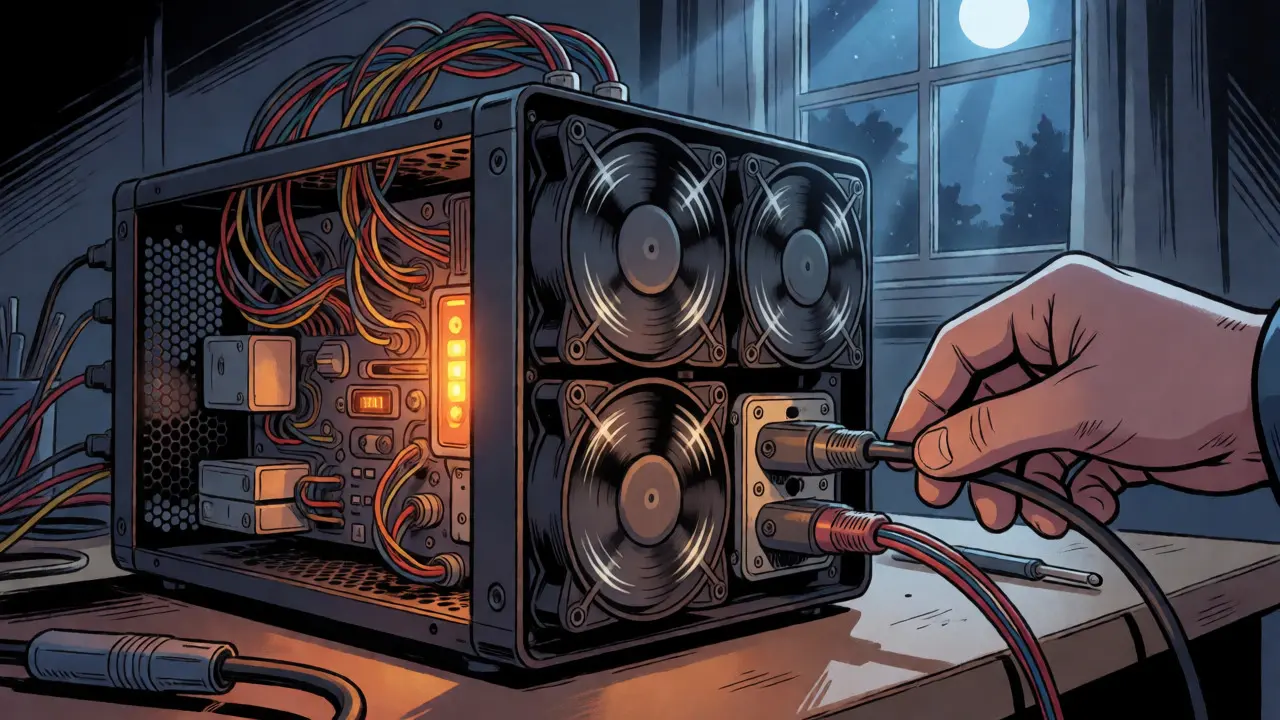
Do you want to learn about static IP configuration and undervolting? Home miners need technical proficiency. Setting up a rig involves configuring networking settings, updating firmware (like BBPWM or stock Bitmain OS), and troubleshooting thermal throttling. A survey by ViaBTC found that new home miners spend 40-60 hours learning the ropes before getting smooth operation. If a PSU fails, you have to diagnose it. If the internet drops, you lose revenue until you reconnect.
Then there’s the noise. An older ASIC sounds like a jet engine idling in your house. While newer models like Canaan’s Avalon series have reduced noise to around 45 dB, many popular units still blast at 75 dB. Unless you have a detached garage or soundproofed basement, home mining disrupts daily life. Cloud mining has zero lifestyle impact. You check an app, see your earnings, and move on with your day.
The Trust Factor: Counterparty Risk
Here is the dirty secret of cloud mining: trust issues. Because you don’t own the hardware, you are relying on the provider to actually mine for you. History is littered with failed platforms. Data from the Internet Crime Complaint Center (IC3) suggests that a significant portion of fraudulent crypto schemes in recent years masqueraded as cloud mining services. Users lost an average of $1,850 when these platforms vanished or stopped paying.
Legitimate providers like Bitdeer or NiceHash offer transparency reports and proof-of-reserves, but risks remain. Contracts can be terminated unexpectedly, hash rates can drop due to difficulty spikes without proportional reward adjustments, and withdrawal processes can become sluggish. Home mining eliminates counterparty risk. If you hold the Bitcoin in your own wallet, no third party can freeze your assets or disappear overnight. You answer only to the blockchain network itself.
Regulatory Headwinds in 2026
Governments are watching. In the US, the SEC has scrutinized certain cloud mining contracts, classifying some as unregistered securities. This regulatory uncertainty caused several platforms to halt US operations recently. For home miners, the threat is different: energy regulations. Some jurisdictions, like California, are introducing fees for high residential electricity usage, which directly squeezes mining margins.
Before you sign a cloud contract, check the fine print regarding jurisdiction. If you are a home miner, verify local zoning laws. Some neighborhoods prohibit commercial-style electrical loads in residential zones, meaning your noisy neighbor complaint could lead to fines or forced shutdowns.
Verdict: Who Should Choose What?
Choose Cloud Mining if:
- You have limited upfront capital but want exposure to Bitcoin mining rewards.
- Your local electricity rates are high (above $0.15/kWh).
- You lack the space, technical skill, or tolerance for noise.
- You prefer a passive income stream and don't mind lower margins for convenience.
Choose Home Mining if:
- You have access to cheap electricity (below $0.10/kWh).
- You have $3,000+ to invest in hardware upfront.
- You enjoy tinkering with tech and solving problems.
- You want full control over your mining strategy and assets.
- You have a suitable location (garage/basement) with good ventilation.
In 2026, the gap is narrowing as technology improves, but the fundamental trade-off remains: pay for convenience with lower returns, or pay for control with higher effort and risk. Analyze your specific electricity cost and technical comfort level before deploying capital.
Is cloud mining still profitable in 2026?
It depends on the contract terms and Bitcoin's price. Generally, cloud mining yields lower net returns than home mining with cheap electricity because providers take a cut for overhead and profit. It is most profitable for users with very high residential electricity costs who cannot compete with industrial rates.
How much does it cost to start home mining?
For a competitive setup using a modern ASIC like the Antminer S21, expect to spend between $2,500 and $4,200 including the miner, power supply, and necessary accessories. Older, less efficient models can be cheaper but may not cover their electricity costs.
What is the biggest risk of cloud mining?
Counterparty risk. Since you do not own the hardware, you rely on the provider's honesty and solvency. Many cloud mining platforms have historically failed or been scams, resulting in total loss of invested funds.
Can I turn off my home miner if prices drop?
Yes, that is a major advantage of home mining. You can shut down your rigs during periods of low profitability to save on electricity, whereas cloud mining contracts usually require you to pay fees regardless of market conditions for the duration of the term.
Which is better for beginners?
Cloud mining is significantly easier for beginners. It requires no technical knowledge of networking, electrical safety, or hardware maintenance. Home mining has a steep learning curve involving hardware setup, software configuration, and ongoing troubleshooting.