Dystopia Exchange Review: Risks, Fees, and Missing Data
Imagine finding a new trading platform that promises lower fees and better swaps for both stablecoins and volatile assets. It sounds like the perfect upgrade from your current exchange. But then you try to find out who runs it, where they are based, or if their code has been checked by security experts-and you hit a wall. This is exactly what happens when you look into Dystopia exchange. While platforms like KuCoin or Binance have thousands of reviews, detailed fee schedules, and public leadership teams, Dystopia operates in the shadows of the decentralized finance (DeFi) world.
In this review, we aren't just listing features; we are digging into the silence surrounding this protocol. We will look at what little data exists, how it compares to established players, and whether the lack of information is a sign of privacy or a major red flag. If you are considering moving funds to Dystopia, understanding these gaps is just as important as knowing the potential returns.
What Is Dystopia Exchange?
Dystopia Exchange is a decentralized trading platform (DEX) focused on efficient swaps with minimal fees and slippage for both stable and volatile assets. Unlike centralized exchanges that hold your money, Dystopia operates on-chain through smart contracts, allowing users to trade directly against liquidity pools.
The primary source of information about Dystopia comes from third-party aggregators like Criffy. These sites list Dystopia not just as a place to swap tokens, but also as part of an "Earn" ecosystem. This means you can likely provide liquidity to earn yield, similar to how Uniswap or PancakeSwap work. However, the description stops there. There is no whitepaper link in the main search results, no GitHub repository cited, and no clear explanation of the underlying technology stack.
Because it is classified as a decentralized exchange, it likely uses an Automated Market Maker (AMM) model. This means prices are determined by mathematical formulas rather than an order book. For stablecoin pairs, it probably uses a specialized bonding curve to reduce slippage, while volatile pairs might use the standard constant-product formula. Without official documentation, however, this remains an educated guess based on industry standards.
The Information Black Hole: Who Runs Dystopia?
When you sign up for a traditional bank or even a regulated crypto exchange, you know who is responsible for your funds. With Dystopia, that person does not exist in the public record. Across multiple search results and review sites, there are zero mentions of a CEO, CTO, or founding team. There is no headquarters address, no registration jurisdiction, and no launch date.
- Leadership: Anonymous or undisclosed.
- Company Structure: Unknown (could be a DAO, a private entity, or an anonymous dev group).
- Regulatory Status: No licenses or compliance statements found.
This opacity is common in early-stage DeFi projects, but it carries significant risk. If something goes wrong-say, a bug in the smart contract drains the liquidity pool-who do you contact? In a centralized system, you file a support ticket. In a decentralized one, you rely on the developers to fix the code or insurance funds to cover losses. With no known entity behind Dystopia, recourse is virtually non-existent.
Fees and Trading Costs
One of the selling points mentioned by aggregators is "minimal fees." In the world of DeFi, this usually means low protocol fees compared to centralized exchanges. Typical AMM fees range from 0.01% to 0.30% per trade. Dystopia claims to be competitive here, which is attractive for high-frequency traders or those moving large amounts of capital.
However, "minimal fees" is a vague marketing term. It does not account for gas fees-the cost of processing transactions on the blockchain. If Dystopia runs on Ethereum Mainnet, gas fees during peak times can exceed the savings from low trading fees. If it runs on a Layer-2 solution like Arbitrum or Optimism, costs are lower, but this has not been confirmed in available data. You also need to consider slippage, especially when trading volatile assets with deep liquidity pools. Without specific data on pool depth, you cannot guarantee that your execution price will be close to the market price.
Security and Audits: The Critical Gap
This is the most concerning aspect of the Dystopia review. In the crypto space, smart contract audits are the baseline for trust. Firms like CertiK, Trail of Bits, or OpenZeppelin review code for vulnerabilities before a protocol launches. A search for Dystopia yields zero mentions of any audit reports, bug bounty programs, or formal verification certificates.
Running unaudited code is akin to driving a car without brakes because the manufacturer says it's "lighter and faster." Even experienced developers make mistakes. History is littered with examples of reputable protocols suffering multi-million dollar hacks due to simple coding errors. Without an audit, you have no independent verification that the math works correctly or that there are no backdoors allowing the developers to steal funds.
Furthermore, governance structures are unclear. Does Dystopia use a multi-signature wallet for upgrades? Can token holders vote on changes? Or do anonymous admins hold the keys to pause the protocol? These details are missing, leaving users exposed to governance risk.
Comparison: Dystopia vs. Established Exchanges
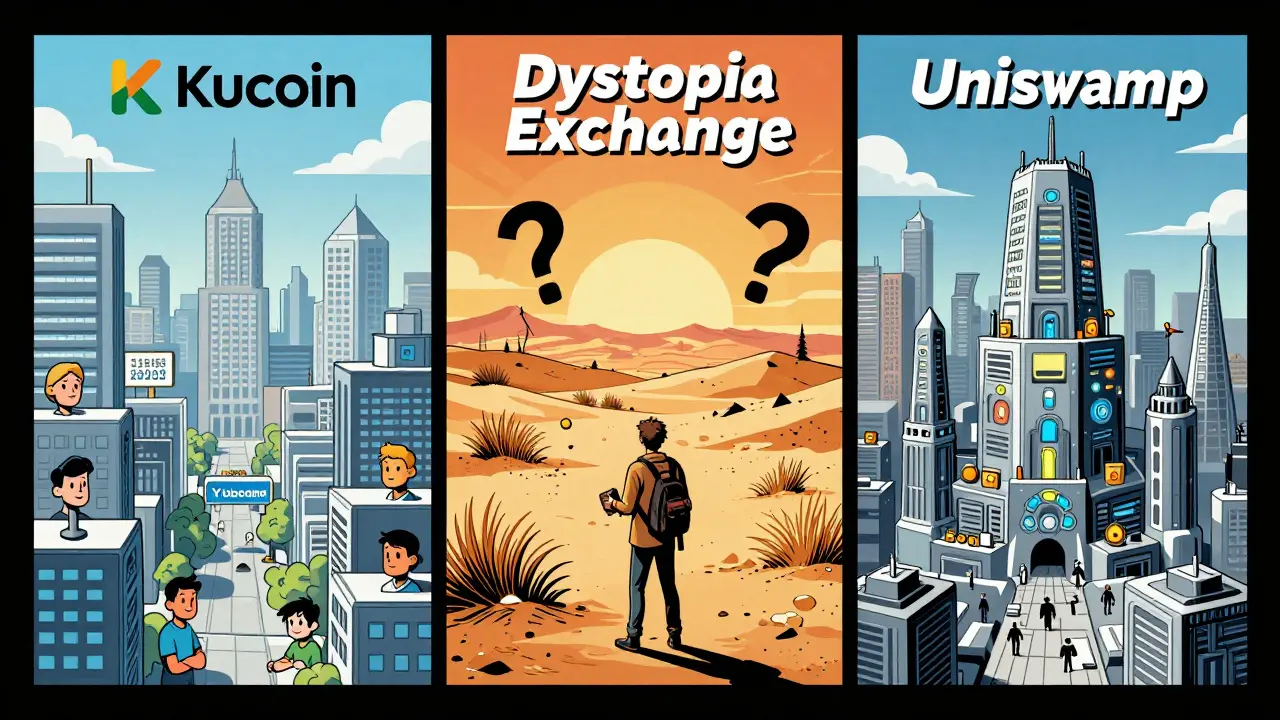
To understand where Dystopia stands, let's compare it to a well-known centralized exchange like KuCoin and a major decentralized competitor like Uniswap. This comparison highlights the trade-offs between transparency, convenience, and risk.
| Feature | Dystopia Exchange | KuCoin (Centralized) | Uniswap (Decentralized) |
|---|---|---|---|
| Type | Decentralized (DEX) | Centralized (CEX) | Decentralized (DEX) |
| Team Transparency | Anonymous/Unknown | Public Leadership | Open Source/Community |
| Audits | None Found | Regular Security Reviews | Extensively Audited |
| Regulation | Unclear | Licensed in Multiple Jurisdictions | Non-Custodial (User Responsibility) |
| User Reviews | Zero Public Feedback | Thousands on Trustpilot | High Community Engagement |
| Best For | High-Risk Tolerance Traders | Beginners & Fiat On-Ramps | Experienced DeFi Users |
As the table shows, Dystopia lacks the foundational trust signals that protect users on other platforms. KuCoin offers customer support and regulatory compliance, while Uniswap offers battle-tested code and a massive community. Dystopia offers neither, positioning it as a high-risk experimental project.
User Experience and Community
Another telling sign of a project's health is its community. Popular exchanges have active Discord servers, Telegram groups, and Reddit threads where users discuss strategies, report bugs, and share news. For Dystopia, these channels appear non-existent or invisible to public search engines. There are no user reviews on Trustpilot, no discussions on Crypto Twitter, and no educational content from influencers.
This silence suggests two possibilities: either the project is brand new and hasn't built a following yet, or it is failing to attract users due to poor usability or lack of trust. Without a community to advocate for the protocol or help newcomers, the learning curve is steep. You are expected to know how to connect a Web3 wallet, approve token spending, and manage gas limits without guidance.
Is Dystopia Exchange Safe to Use?
Based on the available evidence, Dystopia Exchange should be treated as a high-risk asset. The combination of anonymous developers, unaudited smart contracts, and zero user feedback creates a dangerous environment for capital. While the promise of low fees and efficient swaps is appealing, the potential downside-a hacked protocol or a rug pull-is catastrophic.
If you decide to interact with Dystopia, follow these strict safety rules:
- Use a Burner Wallet: Never connect your main wallet holding significant assets. Create a separate wallet with only the funds you are willing to lose completely.
- Revoke Permissions: After interacting with the contract, immediately revoke token approvals using tools like Revoke.cash to prevent future unauthorized access.
- Start Small: Test with a tiny amount first to verify that withdrawals work as expected.
- Verify Contracts: If possible, check the contract address on Etherscan or BscScan to see if it is verified. If the code is hidden, do not proceed.
For most users, sticking to established platforms with proven track records is a safer bet. The marginal savings in fees on Dystopia rarely outweigh the existential risk of losing everything.
Final Thoughts on Dystopia
Dystopia Exchange represents the wild west side of cryptocurrency innovation. It offers the theoretical benefits of decentralization and efficiency but strips away the safeguards that make trading safe for the average person. Until the project publishes audits, reveals its team, and builds a transparent community, it remains a speculative experiment rather than a reliable financial tool. Proceed with extreme caution, or better yet, wait for more data to emerge.
Is Dystopia Exchange a scam?
There is no definitive proof that Dystopia is a scam, but it exhibits many red flags associated with fraudulent projects, such as anonymity, lack of audits, and zero user reviews. Until verified information emerges, it should be treated with high suspicion.
Does Dystopia require KYC?
As a decentralized exchange (DEX), Dystopia likely does not require Know Your Customer (KYC) verification. Users connect via Web3 wallets, preserving anonymity. However, this also means there is no identity verification to recover funds if stolen.
What blockchains does Dystopia support?
The specific blockchains supported by Dystopia are not publicly documented. Most DEXs operate on Ethereum-compatible chains like Polygon, BNB Chain, or Arbitrum. Users must check the platform interface directly to confirm compatibility.
Are there any security audits for Dystopia?
No security audits have been found in public records. This is a significant risk factor, as unaudited smart contracts are more vulnerable to exploits and hacks.
How do I earn yield on Dystopia?
Criffy lists Dystopia under "Earn Offers," suggesting users can provide liquidity to pools to earn fees or rewards. Specific APY rates and reward mechanisms are not disclosed in public data.