
SushiSwap on Polygon Review: Fees, Features, and Risks (2026)
Trading crypto on Ethereum mainnet used to mean paying $10 or even $50 just to swap one token for another. That era is largely behind us, thanks to Layer 2 solutions like Polygon, a scaling solution that processes transactions with near-zero fees and lightning speed. When you combine this infrastructure with a battle-tested protocol like SushiSwap, originally launched as a fork of Uniswap in 2020, you get a powerful tool for decentralized finance. But does SushiSwap actually deliver value on Polygon, or is it just another crowded option in the DeFi space?
This review cuts through the hype. We’ll look at how much you actually pay in fees, what features set it apart from competitors like QuickSwap or Uniswap V3, and whether the governance model holds up under scrutiny. If you are looking to move assets, provide liquidity, or simply understand where your money sits in the current market, this guide covers the essentials without the fluff.
What Is SushiSwap on Polygon?
SushiSwap is an automated market maker (AMM) decentralized exchange. Unlike traditional exchanges where buyers and sellers meet via an order book, AMMs use liquidity pools. You trade against a pool of tokens provided by other users. Smart contracts handle the math and execution instantly.
Originally built on Ethereum, SushiSwap expanded to Polygon in May 2021. This move was strategic. Polygon offers significantly lower gas fees and faster block times compared to Ethereum’s congested mainnet. By operating on Polygon, SushiSwap allows users to swap tokens, earn yields, and participate in governance without the prohibitive costs associated with Ethereum.
The platform isn’t just a simple swap interface. It has evolved into a comprehensive DeFi ecosystem. You can lend, borrow, stack yields, and leverage funds-all while maintaining full custody of your assets. No middleman, no bank account required, just your wallet.
Costs and Speed: The Real Numbers
Let’s talk about what matters most to traders: cost and time. On Ethereum mainnet, during peak congestion, a simple swap could cost upwards of $50 and take minutes to confirm. On Polygon, the landscape is different.
| Metric | Ethereum Mainnet | Polygon (via SushiSwap) |
|---|---|---|
| Average Swap Fee | $10 - $50+ | $0.01 - $0.10 |
| Confirmation Time | 15+ seconds | 2-3 seconds |
| Network Congestion Impact | High (fees spike drastically) | Low (stable low fees) |
These numbers matter. If you are a high-frequency trader or someone who likes to rebalance their portfolio often, the difference between $50 and $0.05 per transaction adds up quickly. Polygon’s architecture ensures that these low fees remain stable even when network activity increases, making it a reliable environment for daily DeFi interactions.
Features Beyond Swapping
Many decentralized exchanges focus solely on trading efficiency. SushiSwap takes a broader approach. It aims to be a one-stop shop for various DeFi activities.
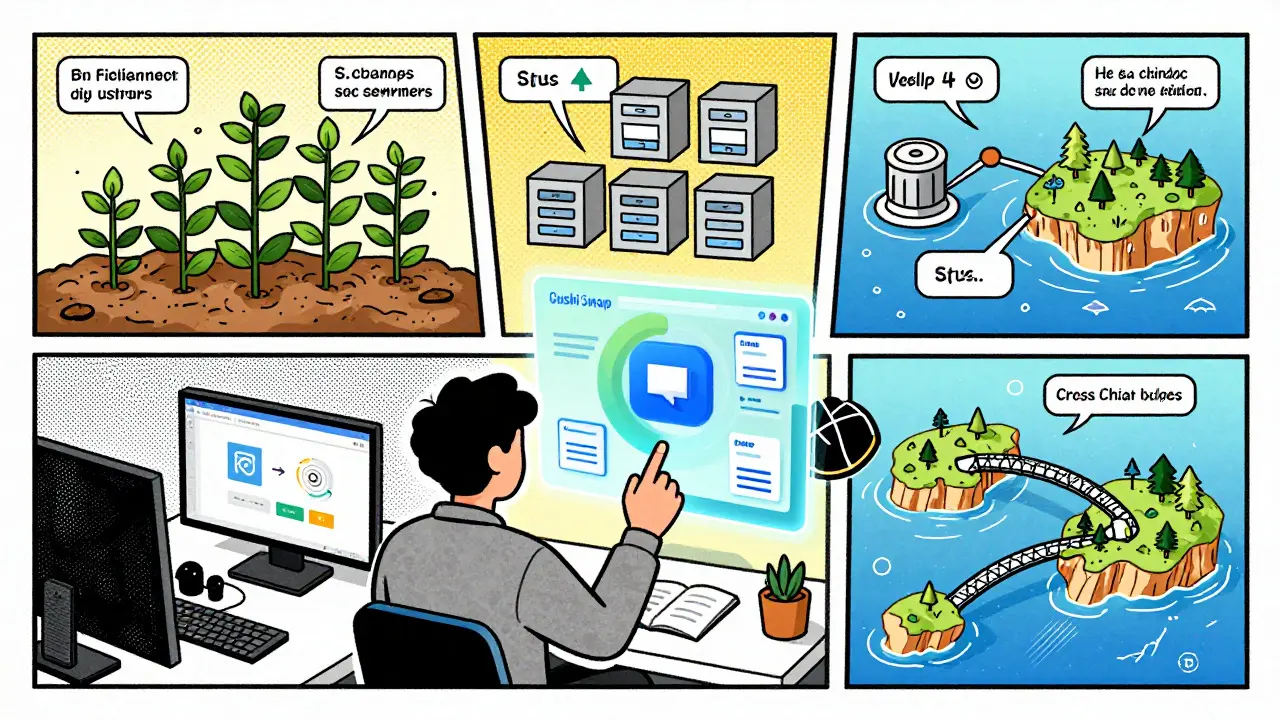
- Yield Farming: Provide liquidity to pools and earn rewards in SUSHI tokens or other incentive structures. This is how many users generate passive income, though it comes with risks like impermanent loss.
- Lending and Borrowing: Through integrations with protocols like Aave (often accessible via Sushi’s interface), you can lend your idle assets to earn interest or borrow against them without selling.
- Staking: Stake your SUSHI tokens to receive xSUSHI, which grants voting power and additional yield benefits. This aligns user incentives with the health of the protocol.
- Cross-Chain Bridges: Move assets seamlessly between Ethereum and Polygon. While bridge transactions typically require a waiting period for security (often around 7 days for certain bridges), the functionality reduces friction in managing multi-chain portfolios.
This holistic approach distinguishes SushiSwap from competitors like Uniswap V3, which focuses heavily on concentrated liquidity and trading mechanics. If you want a platform that lets you trade, farm, and govern all in one place, SushiSwap delivers that breadth.
How Does It Compare to Competitors?
The Polygon DeFi ecosystem is crowded. You have native players like QuickSwap and giants like Uniswap expanding onto the network. So, why choose SushiSwap?
QuickSwap, being native to Polygon, often boasts a more optimized user experience specifically tailored to that network. It holds a larger market share (approximately 15-20%) compared to SushiSwap’s 5-8% on Polygon. However, SushiSwap’s advantage lies in its multi-chain heritage and comprehensive feature set. It supports over six blockchains, including Binance Smart Chain, Avalanche, and Arbitrum One. This cross-chain capability means you aren’t locked into a single ecosystem.
Uniswap V3 dominates overall volume with 25-30% market share on Polygon due to its superior capital efficiency through concentrated liquidity. Yet, Uniswap lacks the integrated lending, borrowing, and extensive yield farming options that SushiSwap provides out of the box. For users who view DeFi as a suite of financial tools rather than just a trading venue, SushiSwap’s ecosystem offers more utility.
Governance and Tokenomics
SushiSwap operates as a Decentralized Autonomous Organization (DAO). This means decisions about the platform’s future-from fee structures to new chain deployments-are made by voters holding the SUSHI token. This community-driven approach is a core part of its identity, contrasting with more centralized decision-making processes seen in some newer protocols.
However, tokenomics can be complex. The SUSHI token has experienced significant volatility, dropping from an all-time high of $23.38 in March 2021 to lows below $0.50 in mid-2024. As of late 2025, it trades around $2.19. This volatility impacts stakers and farmers alike. Critics point out concerns about token concentration among large holders, which could theoretically skew governance outcomes. Before participating in governance or staking, it pays to research the current distribution and recent proposals.

User Experience and Setup
Getting started requires a Web3 wallet, with MetaMask being the standard choice. Connecting to SushiSwap on Polygon involves switching your wallet network to Polygon and ensuring you have some MATIC (now POL) for gas fees, although these are negligible.
The learning curve varies. Basic swapping is intuitive: select your input token, choose your output token, adjust slippage tolerance if necessary, and click swap. Most new users grasp this within an hour. Advanced features like providing liquidity or yield farming require a deeper understanding of concepts like impermanent loss and smart contract risk. SushiSwap offers documentation through its Sushi Academy, but much of it assumes prior DeFi knowledge. Community support via Discord is active, with over 50,000 members ready to help, though resolution times for complex issues can vary.
Risks to Consider
No DeFi platform is without risk. Here are the primary concerns for SushiSwap users on Polygon:
- Smart Contract Risk: Although audited, smart contracts can contain bugs. Historical incidents in 2021-2022 led to temporary fund locks, resolved through governance votes. Always verify contract addresses before interacting.
- Impermanent Loss: Providing liquidity exposes you to impermanent loss, especially during volatile markets. If the price ratio of your deposited tokens changes significantly, you might end up with less value than if you had just held the tokens.
- Regulatory Uncertainty: DeFi regulations are evolving. Potential rules regarding anonymous governance or cross-chain operations could impact platforms like SushiSwap in the future.
- Token Volatility: Earning rewards in SUSHI doesn’t guarantee profit if the token’s price drops faster than your rewards accumulate.
Is SushiSwap on Polygon Right for You?
If you prioritize low fees, fast transactions, and a diverse set of DeFi tools beyond simple swapping, SushiSwap on Polygon is a strong contender. Its multi-chain support and established governance model offer stability and flexibility. However, if you are a beginner unfamiliar with wallets, gas fees, or impermanent loss, proceed with caution and start small. For advanced traders seeking maximum capital efficiency, Uniswap V3 might still hold an edge, but for those wanting a broader financial toolkit, SushiSwap remains a top-tier choice in the Polygon ecosystem.
Is SushiSwap safe to use on Polygon?
SushiSwap is generally considered safe, having undergone multiple audits and operating since 2020. However, like all DeFi platforms, it carries smart contract risk. Users should always interact directly with official URLs and verify contract addresses. The platform has resolved past security incidents through transparent governance processes.
How much does it cost to swap tokens on SushiSwap Polygon?
Transaction fees on Polygon are extremely low, typically ranging from $0.01 to $0.10 per swap. This is significantly cheaper than Ethereum mainnet, where fees can exceed $50 during congestion. The exact cost depends on network activity and the specific transaction complexity.
What is the difference between SushiSwap and QuickSwap?
QuickSwap is native to Polygon and often has higher liquidity and market share on that specific network. SushiSwap is a multi-chain protocol that offers a wider range of services including lending, borrowing, and yield farming across several blockchains. Choose QuickSwap for pure Polygon trading efficiency, or SushiSwap for a broader DeFi ecosystem.
Do I need ETH or MATIC to use SushiSwap on Polygon?
You need a small amount of MATIC (or POL, depending on the latest branding) on the Polygon network to pay for gas fees. These fees are minimal. You do not need ETH unless you are bridging assets from Ethereum mainnet to Polygon.
Can I lose money providing liquidity on SushiSwap?
Yes, through impermanent loss. If the price of the tokens in your liquidity pool diverges significantly from when you deposited them, you may end up with less value than if you had simply held the tokens. Additionally, smart contract risks and token volatility affect potential returns.