

Is There a Minter Ethereum Exchange? The Truth About Ethereum Trading
If you've been searching for a "Minter" exchange to trade or mine Ethereum, you might have noticed something strange: you can't actually find one. Before you spend any more time hunting for a login page or a fee schedule, here is the bottom line: Minter Ethereum exchange does not exist. Whether you are seeing this name in an old forum post or a suspicious ad, it's a misunderstanding of how the network works in 2026.
Confusion usually stems from two things. First, there is the Minter Network is a standalone blockchain platform launched in 2018 by Alexander Minin that allows users to create custom tokens . It has nothing to do with trading Ethereum. Second, people often confuse the word "minter" with the act of mining. But here is the kicker: you cannot mine Ethereum anymore. That ship sailed back in September 2022.
The End of Ethereum Mining
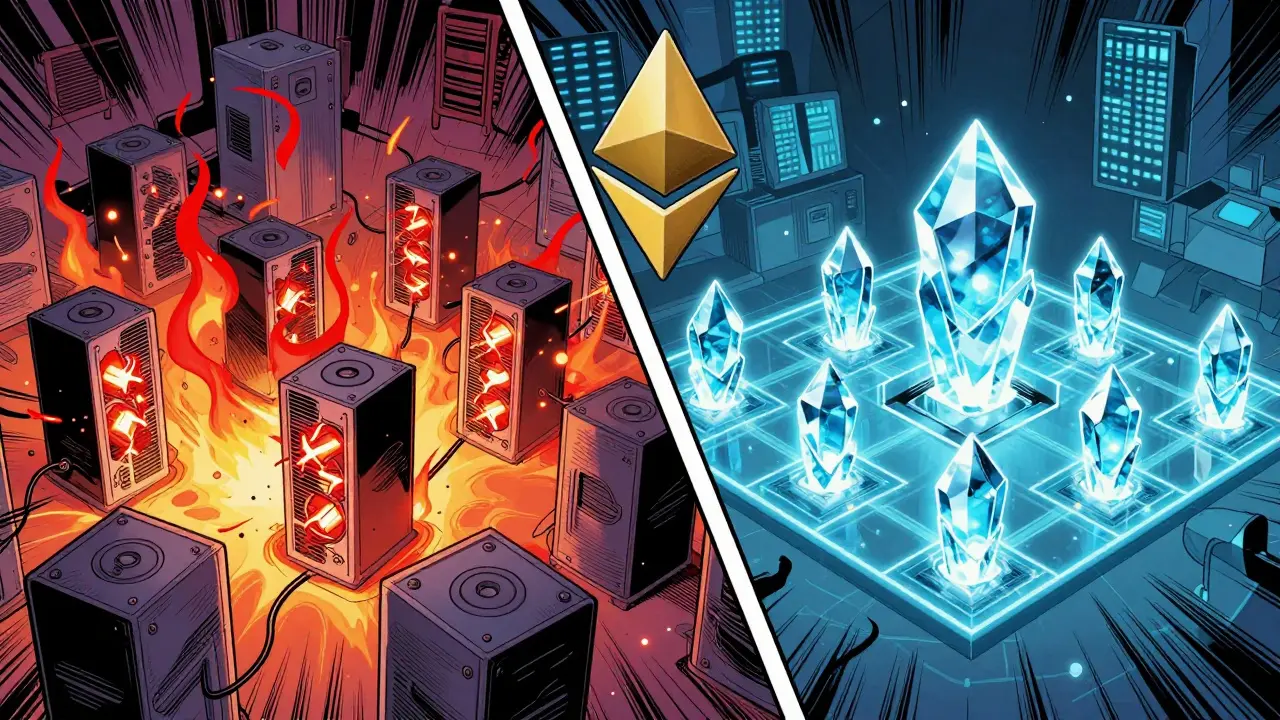
You might remember the days of loud GPU rigs and massive electricity bills. That era ended with the The Merge is the historic upgrade that transitioned Ethereum from Proof-of-Work to Proof-of-Stake . When this happened on September 15, 2022, the network permanently stopped using miners to secure the blockchain.
If you see a site claiming to be a "Minter" platform that lets you mine ETH today, run the other way. It is technically impossible to mine Ethereum on the mainnet. Any software or exchange promising "cloud mining" for ETH in 2026 is almost certainly a scam. According to audits by the Crypto Integrity Project, the vast majority of "how to mine Ethereum" results online are either outdated or actively misleading.
Trading Ethereum: Real Alternatives
Since there is no "Minter" exchange, where should you actually go to trade? Depending on whether you want simplicity, low fees, or high security, your choice will change. Most people stick to the big names because they offer the liquidity needed to move large amounts of ETH without crashing the price.
| Exchange | Trading Fees | Key Strength | Security Level |
|---|---|---|---|
| Coinbase | 0.5% - 4% | Beginner Friendly | SOC 2 Type II / Insured |
| Binance | 0.1% - 0.2% | Deep Liquidity | Selective Proof-of-Reserves |
| Kraken | 0.16% (Maker) | Advanced Security | Mandatory 2FA / Audited |
| Uphold | Variable | Real-time Reserves | High Transparency |
If you are just starting, Coinbase is usually the easiest path. They support instant ACH purchases and have a high satisfaction rate for novices. However, if you are a high-volume trader, the fees there will eat your profits. In that case, Kraken or Binance make more sense due to their lower fee structures, though Binance faces more regulatory hurdles in certain regions like the US.
From Mining to Staking: How to Earn Now
Since you can't mine, the current way to earn "new" ETH is through Staking is the process of locking up cryptocurrency to support a Proof-of-Stake network and earn rewards . Instead of buying expensive hardware, you provide the network with capital.
To run a full validator node, the standard requirement is 32 ETH. At a price of roughly $2,700 per coin, that's a steep entry fee of about $86,400. Most regular people don't have that sitting around, so they use "liquid staking" or exchange-based staking. This lets you earn a piece of the annual returns-usually between 3.5% and 5.2%-without needing to manage the technical side of a node.
There is some good news on the horizon. The upcoming Prague upgrade in Q2 2026 is expected to implement EIP-7251, which aims to reduce the minimum staking requirement to just 1 ETH. This will make it way easier for the average person to participate in securing the network directly.

Decentralized Options and Layer 2s
You don't actually have to use a centralized company at all. A huge chunk of Ethereum trading happens on Decentralized Exchanges (DEXs) are peer-to-peer marketplaces where trades occur directly between wallets via smart contracts . Platforms like Uniswap allow you to swap tokens without ever handing your coins over to a corporate entity.
Furthermore, trading directly on the Ethereum mainnet can be slow and expensive. That's why most developers and savvy traders have moved to Layer 2 solutions. These are networks that sit on top of Ethereum to make things faster and cheaper. If you're looking for efficiency, look into Arbitrum or Optimism. These solutions handle the bulk of the traffic, leaving the main Ethereum chain as the final settlement layer.
Avoiding the "Mining" Trap
If you still have a powerful GPU and really want to mine something, you can't do it with ETH, but you can try Ethereum Classic (ETC) is a legacy version of the Ethereum blockchain that still uses Proof-of-Work mining . Unlike the main Ethereum chain, ETC still allows you to use mining hardware to secure the network.
Just be careful. The profitability of ETC is a fraction of what original Ethereum mining used to be. You'll need to use a calculator like NiceHash to see if the electricity cost of running your rig is actually lower than the coins you're earning. For most people, the cost of power makes ETC mining a losing game compared to simply buying and staking ETH.
Can I still mine Ethereum in 2026?
No. Ethereum transitioned to Proof-of-Stake in September 2022. Mining is no longer possible on the main Ethereum network. Any site claiming otherwise is likely a scam.
What is the Minter Network?
Minter Network (now Bip Network) is a separate blockchain project created by Alexander Minin. It is not an Ethereum exchange and does not facilitate Ethereum mining.
What is the best exchange for trading ETH?
It depends on your needs. Coinbase is best for beginners, Kraken is highly regarded for security, and Binance offers the lowest fees for experienced traders.
How does staking differ from mining?
Mining used hardware (GPUs) and electricity to solve puzzles. Staking uses the coin itself as collateral to verify transactions. Staking is significantly more energy-efficient.
Is it safe to use centralized exchanges?
Generally yes, but only if they provide Proof-of-Reserves and regular third-party audits. Platforms like Coinbase, Kraken, and Gemini are considered more transparent than those with selective verification.






It is really crucial to emphasize the difference between L1 and L2 for anyone reading this. While the mainnet is the gold standard for security, the gas fees can be absolutely brutal for a retail trader trying to swap small amounts. Moving your ETH to Arbitrum or Optimism isn't just a suggestion, it's practically a requirement if you want to actually interact with the ecosystem without losing half your portfolio to the network every time you click a button.
Love the heads up on the scams! 🌟 Stay safe everyone! ✨
Oh, look at all these people still trying to "mine" Ethereum in 2026. It is honestly impressive how some folks can ignore a global technical transition for four straight years. Maybe if we build a bigger GPU in the sky, the magic internet money will just appear? Truly a masterpiece of cognitive dissonance.
The lack of basic research is appalling and it is honestly a moral failure to trust random ads without verifying the protocol change
Actually, the explanation regarding EIP-7251 is slightly oversimplified. While the reduction to 1 ETH is the primary goal, the structural implications for validator efficiency and the potential for increased centralization-due to a higher volume of smaller nodes-are nuances that simply cannot be ignored if one wishes to have a comprehensive understanding of the network's evolution.
stakers just need to be careful with where they keep their keys man. if you go the exchange route you're trusting them with your funds so definitely look into hardware wallets for long term holds
The transition to Proof-of-Stake is such a paradigm shift!!! I'm absolutely thrilled about the liquidity provision potential in the DeFi space, even with the current slippage issues on some DEXs... it's just so empowering to be part of a green-energy consensus mechanism!!!
It's honestly hilarious that people still think Coinbase is "beginner friendly" when their fee structure is basically a daylight robbery operation designed to bleed out retail investors who don't know how to use a limit order, and don't even get me started on the "customer support" which is basically a wall of automated bots that tell you to read the FAQ while your account is locked for no reason :( 🙄
I remember feeling so overwhelmed when the Merge happened. It's okay if you're still confused about all this. Just take it slow and don't put money anywhere you don't understand.
just bought a ledger for my eth... definitely safer than leavin it on an exchange tho i keep forgetting my seed phrase password lol
this whole mining chase is just a ghost in the machine lol just vibe with the staking and let the coins grow in the garden
If anyone is looking for the easiest way to get into staking without the 32 ETH requirement, look into Rocket Pool. It's a great way to participate in the network's security while staying decentralized, and the community is really welcoming to newcomers.
The shift from the physical exertion of mining to the passive commitment of staking reflects a broader societal move toward abstraction. We no longer value the heat and noise of the machine, but rather the silent alignment of financial incentives. It makes me wonder if we are losing something visceral by removing the tangible hardware aspect of the blockchain, or if we are simply evolving into a more streamlined version of digital trust. The energy efficiency is a win, certainly, but there is a poetic irony in replacing a loud GPU rig with a quiet digital contract. Perhaps the noise was just a distraction from the actual value being created. In the end, the network remains, but the ritual of participation has changed completely. It's a fascinating transition from industrial-style computation to a more corporate-style governance model. We've traded the electricity bill for a staking yield, and in doing so, shifted the barrier to entry from technical skill to capital ownership. It is a mirror of the traditional financial world we claimed to be replacing. Still, the move toward 1 ETH minimums is a necessary step for true accessibility. Without it, the network risks becoming an oligarchy of whales.