

Legal Status of DAOs: How Different Countries Are Regulating Decentralized Organizations
Decentralized Autonomous Organizations (DAOs) are leaderless organizations governed by smart contracts on blockchain networks. Unlike traditional companies, DAOs have no central authority-members vote using governance tokens to make decisions. However, this structure creates major legal challenges because existing laws weren't built for entities without clear human leaders.
In February 2026, over 500 DAOs have registered under new legal frameworks-but many still operate in a gray zone. For example, when a DAO signs a contract with a vendor or gets sued, courts don't know who to hold accountable. This uncertainty is why jurisdictions worldwide are racing to define DAO legal status.
US State Approaches to DAO Regulation
Wyoming took the lead in 2024 with its Decentralized Unincorporated Nonprofit Association (DUNA) statute. DUNA allows DAOs to become legal entities with limited liability protections, but only if they're nonprofit. This means DAOs can own property, sue, and be sued-but they can't distribute profits to members. Over 200 DAOs have registered under DUNA, though some founders criticize the nonprofit requirement for profit-driven projects.
New Hampshire passed its DAO Act in 2024, effective July 2025. The law lets DAOs register as a separate legal entity, similar to LLCs. Unlike Wyoming, New Hampshire allows for-profit DAOs. However, the state is still developing its registry system. As of early 2026, DAOs must navigate a manual registration process while the Secretary of State finalizes digital tools. Experts like those at McLane Middleton say this framework fills a critical gap for digital asset businesses.
Virginia proposed legislation in late 2025 to let DAOs register as Limited Liability Companies (LLCs) under the Virginia Limited Liability Company Act. This approach would give DAOs corporate-style liability protection while allowing profit distribution. If passed, Virginia could become a major hub for blockchain startups. Tennessee and Vermont also passed DAO-friendly laws, with Vermont's Blockchain-Based LLC (BBLLC) model offering clear liability shields.
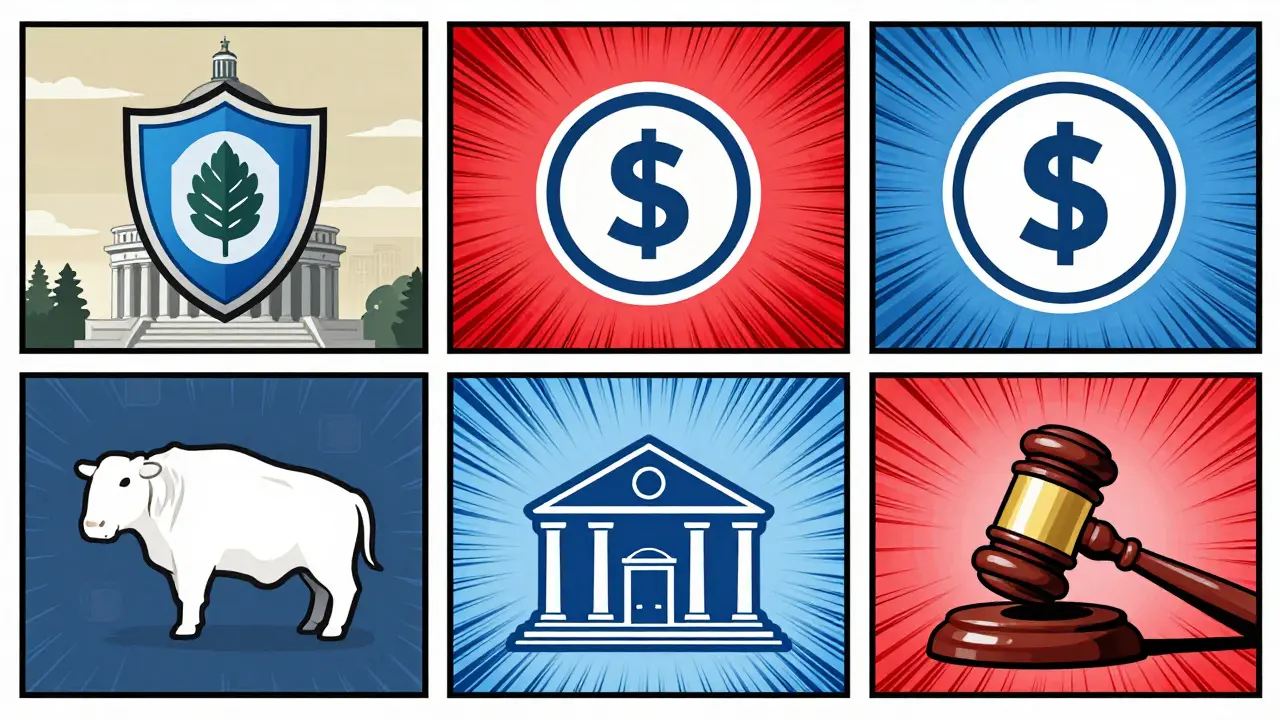
Comparing DAO Legal Frameworks in 2026
| Jurisdiction | Legal Status | Key Features | Limited Liability | Profit Distribution |
|---|---|---|---|---|
| Wyoming | Decentralized Unincorporated Nonprofit Association (DUNA) | Requires 100+ members; nonprofit focus | Yes | No |
| New Hampshire | DAO Act (2025) | For-profit or nonprofit; registry in development | Yes | Yes |
| Virginia | Proposed LLC Registration | LLC structure; liability protection | Yes | Yes |
| Malta | ITAS Act Certification | EU-wide recognition; MDIA oversight | Yes | Yes |
| Vermont | Blockchain-Based LLC (BBLLC) | LLC structure; specific blockchain rules | Yes | Yes |
Critical Challenges and Risks
Even with new laws, DAOs face serious legal risks. In 2024, the Commodity Futures Trading Commission (CFTC) sued Ooki DAO, arguing it operated as an unincorporated association without proper registration. This case set a precedent-courts may treat unregistered DAOs as general partnerships, making all members personally liable for debts or legal issues. Legal experts at Cardinal News warn this could wipe out personal assets for DAO members who don't understand their exposure.
Another issue is tax compliance. The Internal Revenue Service (IRS) hasn't issued clear guidance on DAO taxation. Some DAOs file as partnerships, others as corporations-but without official rules, mistakes are common. For example, a DAO in Vermont recently paid $200,000 in penalties after misclassifying token sales as equity instead of taxable income. Smart contracts also create contract enforcement problems. If a DAO's code automatically executes a payment, but the recipient sues for breach of contract, courts may struggle to determine who is responsible.
Physical address requirements also create friction. Malta's ITAS Act requires a local representative in Malta, while Wyoming mandates a registered agent. Many DAO members see this as contradictory to decentralization. "We built a DAO to escape centralized control," one founder told Blockchain News. "Now we have to hire a lawyer just to comply with regulations."

What's Next for DAO Legal Status?
Experts predict more states will follow Wyoming and New Hampshire's lead. Virginia's proposed LLC model could become a national standard if passed. Internationally, the EU is working on harmonizing DAO regulations under Malta's ITAS Act framework. However, the lack of federal laws in the US creates a patchwork system that complicates cross-state operations. A 2025 Cambridge Law Journal study found that 78% of DAO founders avoid operating in states without clear laws due to liability risks.
The next big step? Federal legislation. The SEC and CFTC are both pushing for clearer rules, but political gridlock has stalled progress. Meanwhile, DAOs must choose jurisdictions carefully. As one Wyoming-based DAO founder put it: "We chose DUNA for liability protection, but we're still worried about future tax changes. Every decision is a gamble."
Frequently Asked Questions
Can a DAO be sued?
Yes, but the answer depends on jurisdiction. In states like Wyoming or New Hampshire, a registered DAO can be sued as a legal entity, protecting members' personal assets. However, unregistered DAOs are often treated as general partnerships-meaning each member could be personally liable. The CFTC's lawsuit against Ooki DAO in 2024 demonstrated this risk, where members faced personal liability because the DAO wasn't legally registered.
Do DAOs pay taxes?
Tax treatment varies widely. In Wyoming, DUNA DAOs are taxed as nonprofits, but this doesn't apply to for-profit DAOs. New Hampshire treats DAOs as corporations or partnerships depending on structure. The IRS has not issued clear guidelines, leading to inconsistent filings. A Vermont DAO recently paid $200,000 in penalties after incorrectly classifying token sales as equity instead of taxable income. Experts recommend consulting a tax attorney familiar with blockchain before filing.
Can DAOs own property?
Yes, but only in jurisdictions that recognize DAOs as legal entities. Wyoming's DUNA statute explicitly allows DAOs to hold assets. New Hampshire's DAO Act also permits property ownership. However, in states without specific laws, DAOs may need to use a traditional LLC or trust to hold assets, which adds complexity and costs. For example, a DAO in California recently had to create an LLC to purchase real estate because the state doesn't recognize DAOs as legal entities.
What happens if a DAO member acts illegally?
In registered DAOs, liability is typically limited to the organization itself. For example, if a Wyoming DUNA DAO's smart contract executes a fraudulent transaction, only the DAO's assets are at risk-not members' personal funds. However, unregistered DAOs or those in states without clear laws may expose members to personal liability. The CFTC's Ooki DAO case showed that individuals can be held personally responsible for illegal activities, even if they didn't directly participate.
How do DAOs sign contracts?
Registered DAOs sign contracts using their legal entity status. For example, a New Hampshire DAO can sign as "DAO Name LLC" with a representative's signature. Unregistered DAOs often use a single member to sign on behalf of the group, but this risks personal liability. Some DAOs create a separate legal entity (like an LLC) to handle contracts, while others rely on smart contracts that automatically execute agreements-though courts may not recognize these as legally binding without human oversight.
Is there a global standard for DAOs?
No. Each country has its own approach. Malta's ITAS Act offers EU-wide recognition, but other EU countries haven't fully adopted it. The US has state-by-state laws with no federal framework. International efforts like the EU's MiCA regulation don't specifically address DAOs. Experts agree that global coordination is needed, but political differences make it unlikely in the near term. For now, DAOs must navigate each jurisdiction's rules individually.









This is all a government ploy to control crypto. They'll tax us into oblivion soon.
Wyoming's DUNA statute has no member count requirement. This is basic legal knowledge.
As a seasoned blockchain expert, with years of experience in decentralized governance systems, I must point out, that the current regulatory landscape is fragmented, and lacks coherence. The US states are playing a game of regulatory catch-up, but this approach is inherently flawed because it fails to address the global nature of DAOs. For instance the EU's MiCA regulation is far more comprehensive than anything proposed in the US, yet US policymakers seem oblivious to this fact. Moreover the notion that a single state's legislation can adequately regulate a decentralized entity is fundamentally misguided. DAOs operate across borders, and the patchwork of state laws creates unnecessary complexity. In my professional opinion, a federal framework is essential, but given the current political climate, this is unlikely to happen soon. This situation is ripe for exploitation by bad actors who will take advantage of the regulatory gray areas. We need a unified approach that considers international standards, but alas, the US is stuck in its bureaucratic inertia.
Ugh, this is so pretentious. Who even cares about EU regulations? DAOs are just a fad. They'll never work. Stop overcomplicating things.
DAOs are the future! 🌍 But the government will crush them. 💀 #WakeUp
Great overview! It's important to see how different regions are handling this. Looking forward to more collaboration.
Wow, this is awesome! Let's keep pushing for clear regulations! 🤝
Solid info! DAOs need clear legal frameworks to thrive. Keep up the good work! 😄
It is evident that the United States' regulatory approach is inadequate. India has established superior frameworks for such entities. It is imperative that we do not emulate this flawed model.
Well, this is interesting. But honestly, who cares? It's all just noise until the government actually does something.
This is all a scam. DAOs are just a way for rich people to avoid taxes. 💅
From the streets of Mumbai to Silicon Valley, DAOs are changing the game! 🌍✨
DAOs are the future! Let's build it! 💪
This is really important, information, DAOs need clear laws, to protect members, let's all work together to make it happen!
DAOs are doomed without proper oversight. This is just a facade for chaos.
Hmm, DAOs are interesting. They're like a new kind of organization, but I wonder if they'll last. Time will tell.
Interesting points. Need more clarity on tax issues.
This is great! Let's support DAOs globally. Unity is key! 🌟
The legal framework for DAOs must be standardized. This is critical for adoption.
Governments are trying to control DAOs. They fear the people. We must stay vigilant. 🔒
This is a pivotal moment for DAOs! Let's keep learning and adapting. 💡
This is a mess. DAOs are a joke. They can't even handle basic compliance. 😒
DAOs are just a fad. Who cares? 😴