
Long-Term Viability of Memecoins: Can Joke Coins Survive Beyond the Hype?
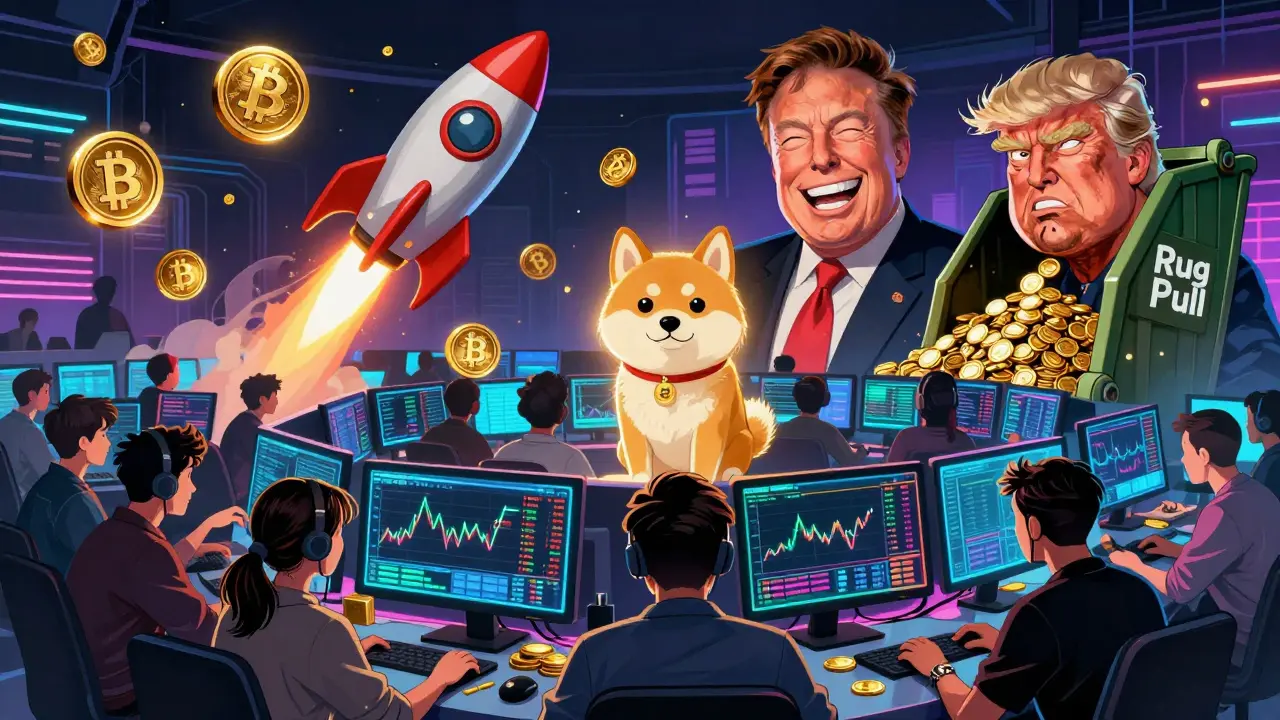
When you hear the word memecoin, you probably think of Dogecoin’s Shiba Inu dog or a Trump-themed token that blew up for three days and then vanished. But behind the memes and the TikTok hype, there’s a real question: can these joke coins last? Or are they just digital fireworks - bright, loud, and gone in seconds?
They Started as a Joke. Now They’re Worth Billions.
Dogecoin wasn’t meant to be taken seriously. Created in 2013 by two engineers as a parody of Bitcoin’s wild price swings, it used the meme of a dog saying "Doge" and had no real technical innovation. Yet here we are in 2026, and Dogecoin is worth over $22 billion. Shiba Inu, launched in 2020, sits at $7.8 billion. Together, all memecoins make up $58.7 billion of the global crypto market - about 2.3%. That’s not nothing. But it’s also not sustainable if you’re betting on fundamentals.
Unlike Bitcoin or Ethereum, memecoins don’t solve problems. They don’t improve transaction speeds, reduce fees, or power decentralized apps. Their value comes from one thing: community. People buy them because they’re fun, because their friends are buying them, or because a celebrity tweeted about them. Elon Musk’s offhand tweet about Dogecoin in 2021 sent it soaring. A single post from Donald Trump’s X account in January 2025 pushed the $Trump memecoin to a $27 billion market cap - then crashed it by 99% in six weeks. No utility. Just vibes.
How Do Memecoins Actually Work?
Most memecoins aren’t built on their own blockchains. They’re tokens - like digital coupons - running on top of other networks. About 68% of new memecoins since 2024 run on Solana because it’s cheap and fast. Transactions cost pennies and confirm in under a second. Dogecoin is one of the few with its own blockchain, but it’s slow, taking a full minute to confirm a transaction. Ethereum-based memecoins are common too, but gas fees can spike during hype cycles, making small trades expensive.
Supply is another weird part. Dogecoin has no cap. It prints 5 billion new coins every year. That’s inflation built in. Shiba Inu started with 1 quadrillion tokens - yes, that’s a 1 with 15 zeros - but burned half right away. That made people feel like they were getting something rare. But here’s the catch: burning tokens doesn’t make them valuable. It just makes the math look better.
And security? Most memecoins skip audits. A 2025 report from Koinly found that 73% of new memecoins launched without any third-party code review. That means developers could have a backdoor, drain the liquidity pool, or just disappear overnight. Chainalysis says 31% of failed memecoins were outright rug pulls - where the team vanished with investor money.
Why Most Memecoins Die Within Months
Let’s be blunt: 94.7% of memecoins lose at least 90% of their peak value within 18 months. The median lifespan of a failed memecoin? Just 87 days. That’s not a bug - it’s the design.
Take the $Trump coin. It hit $27 billion in market cap after Trump’s social media posts. Within a month, trading volume dropped 95%. By February 2025, it was worthless. People didn’t buy it because they believed in the tech. They bought it because they liked Trump. When the news cycle moved on, so did the money.
Even Dogecoin and Shiba Inu, the survivors, have lost over 70% of their peak values since 2021. They’re the exceptions, not the rule. A University of Chicago study in 2025 tracked every memecoin launched since 2020. Only two - Dogecoin and Shiba Inu - stayed above 25% of their all-time highs after two years. The rest? Gone.
And it’s not just price. Usage matters. Dogecoin processes 350,000 transactions a day. Shiba Inu does 120,000. Bitcoin? Over 40 million. That’s not a comparison - it’s a footnote. Most memecoins do fewer than 1,000 daily transactions. That’s not a network. That’s a ghost town.

The Only Memecoins With Real Utility
There are exceptions. Memecoin (MEME), the token behind the Memeland platform, isn’t just a meme. It lets users vote on NFT drops, stake for rewards, and buy digital collectibles. It’s a functional ecosystem, not just a ticker symbol. Shiba Inu’s Shibarium Layer-2, launched in 2024, has processed over 247 million transactions with fees under $0.0003. It’s not just a coin - it’s a mini-blockchain with real users.
Dogecoin got a surprise boost in late 2024 when Tesla started accepting it for some merchandise. By November 2025, it was processing $4.2 million in monthly transactions. That’s not enough to move the needle on Tesla’s balance sheet, but it’s the first time a major company used a memecoin for real purchases - not just PR.
These are the only memecoins that might have a shot at long-term survival. Not because they’re revolutionary. But because they’ve added layers of utility on top of the meme.
Who’s Buying These Things?
A CryptoCompare survey of over 12,000 crypto users in late 2025 found that 68% of memecoin investors are under 35. Over half call themselves "casual investors." The average amount spent on a first memecoin purchase? $147. Compare that to Bitcoin, where the average first-time buyer spends $1,850. Memecoins aren’t for serious portfolio builders. They’re for people who want to play.
And that’s fine - if you know what you’re doing. But 78% of first-time buyers spend less than 30 minutes researching before buying. That’s less time than it takes to microwave popcorn. Most don’t read the whitepaper (if there even is one). They don’t check if the devs are anonymous. They don’t look at liquidity pools. They see a chart going up, hear a friend talk about it, and jump in.
That’s why 64% of new memecoins crash over 90% within 30 days. It’s not a market failure. It’s a behavior failure.

Regulators Are Watching - And They’re Not Impressed
The SEC made it clear in February 2025: memecoins aren’t securities. They’re collectibles. Like baseball cards or NFTs of bored apes. That means no investor protections. No legal recourse if the team vanishes. The CFTC, however, has been cracking down hard. In the first nine months of 2025, they filed 17 enforcement actions against memecoin promoters - up from just 3 in all of 2024. That’s a signal: don’t lie. Don’t pump. Don’t dump.
Merchants aren’t buying in either. Only 0.7% of crypto-accepting businesses take any memecoin besides Dogecoin. Deloitte’s 2025 survey found that 0.2% of businesses accept any memecoin at all - and most do it for fun, not because it makes business sense.
So… Are Memecoins Viable Long-Term?
Here’s the truth: 95% of memecoins will be worthless in five years. That’s not an opinion. It’s data from Fidelity, Bernstein Research, and the University of Cambridge. The market is saturated. New coins launch every day. Most die within weeks.
But the top three - Dogecoin, Shiba Inu, and maybe Memecoin - have a fighting chance. Why? Because they’ve built communities that outlast trends. Dogecoin has over 2.3 million monthly engaged users. Shiba Inu has a working Layer-2 chain. Memecoin has real product features. They’re not just memes anymore. They’re digital tribes.
That’s the only path forward: evolve or die. If Dogecoin adds more merchant integrations. If Shiba Inu expands Shibarium’s use cases. If Memecoin turns its governance model into something people actually care about - then maybe, just maybe, they’ll stick around.
But if you’re thinking of buying the next viral memecoin because someone on YouTube said "100x or bust," you’re not investing. You’re gambling. And the house always wins.
What’s Next for Memecoins?
Dogecoin’s protocol upgrade in Q3 2026 aims to cut transaction times in half. Shiba Inu plans to integrate with more DeFi protocols in 2026. Memecoin is expanding its staking rewards. These aren’t flashy announcements - but they’re real steps toward utility.
For the rest? They’ll fade. New ones will pop up. The cycle will repeat. Memecoins aren’t going away. But their role is clear: entertainment. Not investment. Not innovation. Just noise.
If you’re going to play, play small. Never invest more than you can afford to lose. And always remember: if a coin’s value depends on a tweet, it’s not a currency. It’s a mood.
Can memecoins be a long-term investment?
Only two memecoins - Dogecoin and Shiba Inu - have shown any lasting value beyond a few years. Even they’ve lost over 70% of their peak prices. For the other 98%, the odds of long-term survival are near zero. Memecoins should be treated as speculative bets, not investments. Never allocate more than 1% of your portfolio to them.
Why do memecoins crash so hard?
Memecoins rely entirely on hype, not fundamentals. When the social media buzz dies, there’s nothing left to support the price. Most lack utility, have unlimited supply, and are prone to manipulation. A single tweet can push a coin up - and another tweet can crash it. Without real use cases or locked liquidity, they’re just digital casino chips.
Is Dogecoin still relevant in 2026?
Yes - but not because it’s revolutionary. Dogecoin remains relevant because of its massive, loyal community and real-world adoption. Tesla accepts it for merchandise, and it’s still the most traded memecoin by volume. Its annual inflation of 5 billion coins keeps the supply flowing, which helps maintain liquidity. It’s not a store of value, but it’s the most durable meme in crypto history.
Are memecoins safe to buy on Coinbase or Binance?
Buying a memecoin on a major exchange like Coinbase or Binance means you’re not dealing with a rug pull - those platforms don’t list coins with no audits or anonymous teams. But that doesn’t make them safe. The price can still collapse 90% overnight due to lack of demand. Exchanges make it easy to buy, but they don’t guarantee value. You’re still taking all the risk.
What’s the difference between Dogecoin and a new memecoin?
Dogecoin has a decade of history, a large active community, real merchant adoption, and a transparent development team. Most new memecoins have none of that. They’re created in a weekend, promoted by influencers, and abandoned within months. Dogecoin survived because it became a cultural phenomenon. New memecoins are just temporary trends.
Should I invest in memecoins if I’m new to crypto?
No - not as your first crypto investment. Start with Bitcoin or Ethereum to understand how blockchain works. Once you’re comfortable, you can experiment with small amounts of memecoins - but treat them like lottery tickets, not assets. Most new investors lose money on memecoins because they don’t understand the risks. The hype is real. The payoff? Almost never.



Man, I remember when Dogecoin was just a joke on Reddit. Now I see my cousin buying it like it’s gold. Honestly? I get it. It’s not about the tech-it’s about the vibe. People want to be part of something fun, not another spreadsheet of numbers.
While I appreciate the sentiment that memecoins represent a cultural phenomenon rather than a financial instrument, it is imperative to acknowledge that the absence of fundamental value does not equate to societal irrelevance. Community-driven assets, even those born from irony, can serve as barometers of collective sentiment-particularly among younger demographics who are disenchanted with traditional financial structures. The fact that Dogecoin has sustained engagement for over a decade suggests a latent demand for decentralized, non-institutional forms of value expression.
The entire memecoin phenomenon is a postmodern farce. You’re not investing-you’re performing. You buy a coin because a celebrity tweeted, then you sell when the next one does. It’s not capitalism. It’s theater. And the audience keeps buying tickets even though the stage is made of cardboard.
And yet… what if the joke is on us? What if the real innovation isn’t in the blockchain-but in the community? The meme is the protocol. The shared laughter, the inside jokes, the collective belief that something absurd can have meaning… isn’t that the most human thing of all? We build temples out of memes because we’re tired of temples built on spreadsheets.
Dogecoin to the moon 🚀 but seriously, if you’re not laughing while you buy, you’re doing it wrong.
i just bought 10000 shiba on binance lol i dont even know what i did but my friend said its gonna 100x so here we go 🤷♂️
I’m from the Midwest. We don’t have crypto bros. We have farmers. But my nephew showed me Dogecoin last year. He said, ‘Aunt Grace, it’s like a digital dog treat.’ And you know what? That’s the whole thing. It’s a digital dog treat. And people love it.
The fact that anyone still takes Dogecoin seriously after 2021 is a testament to human gullibility. You don’t need a whitepaper to understand that infinite supply + zero utility = zero intrinsic value. But apparently, you do need a PhD in denial.
Look, I’ve been in crypto since 2017. I’ve seen coins rise and crash. But Dogecoin? Shiba? They’re not coins. They’re movements. And movements don’t die because they’re not funded by VC money-they’re funded by memes. If you’re not part of the tribe, you’re not gonna get it. And that’s fine. But don’t pretend you’re smarter because you don’t understand joy.
The real scam isn’t the rug pulls-it’s the people who say memecoins are ‘just fun.’ That’s code for ‘I lost my life savings and now I’m gaslighting myself.’
One thing people miss: Dogecoin’s inflation isn’t a flaw-it’s a feature. Every year, 5 billion new coins are minted. That means there’s always a reason to trade. Someone’s always buying. Someone’s always selling. It’s a self-sustaining loop. Not a bubble. A rhythm. And for a community that’s been around for over a decade? That’s more than most projects can say.
There’s a quiet magic in how Dogecoin became a digital campfire. People don’t hold it to get rich. They hold it because it feels like home. I’ve seen strangers on Twitter send each other DOGE just to say ‘hey, you’re not alone.’ That’s not finance. That’s folklore. And folklore doesn’t die when the market crashes-it just finds new storytellers.
The structural inefficiencies of memecoins-particularly those built on Solana with zero audit trails-represent a systemic risk to retail investors. The absence of formal governance mechanisms, coupled with hyperinflationary tokenomics, renders any claim of long-term viability analytically indefensible. One cannot build a sustainable economic model on emotional resonance alone.
They’re all controlled by the Fed. You think Dogecoin is a meme? It’s a distraction. The real crypto is being mined in underground labs by AI that reads your social media and manipulates the price before you even click ‘buy.’ Elon? Trump? They’re puppets. The game isn’t about coins-it’s about keeping you distracted while they drain your 401(k) through ETFs disguised as ‘digital gold.’ You’re not investing. You’re being harvested.