
ProtonSwap Review: Is This Decentralized Exchange Worth Your Trust?
You want to trade crypto without handing your keys over to a centralized giant. You want speed, low fees, and total control. That sounds like the dream, right? But when you look at ProtonSwap, a decentralized exchange built on the Proton blockchain, things get a little murky. The promise is there: zero gas fees, instant swaps, and direct wallet integration. But the reality? It’s hard to find any real data.
In this review, we’re cutting through the marketing fluff. We’ll look at how ProtonSwap actually works, what it costs you, and whether it’s safe enough for your money in 2026. Spoiler alert: if you’re looking for deep liquidity or a wide variety of tokens, you might be disappointed. If you’re already deep into the Proton ecosystem, though, it has some unique perks.
What Exactly Is ProtonSwap?
First off, let’s clear up what we’re dealing with. ProtonSwap isn’t a company you call if something goes wrong. It’s a protocol. Specifically, it’s an Automated Market Maker (AMM) running on the Proton blockchain. Unlike traditional exchanges where you deposit funds into an account held by the exchange, here you keep your assets in your own wallet until the very second of the swap.
This means no custodial risk. The exchange doesn’t hold your money. Instead, smart contracts handle the trade automatically. You connect your wallet, pick the token you want to swap, and the contract executes the deal instantly. Because it lives on the Proton network, it bypasses the congestion and high gas fees that plague Ethereum-based DEXs like Uniswap during peak times.
However, being tied to one blockchain is a double-edged sword. You can only trade tokens that exist on the Proton network. If you want to swap Bitcoin or Solana directly, you can’t do it here. You’d need to bridge those assets first, which adds complexity and potential risk. ProtonSwap is a specialist tool, not a general-purpose solution.
The Fee Structure: Staking for Discounts
Fees are usually the biggest pain point in crypto trading. ProtonSwap tries to solve this with a dual-fee model that rewards both traders and liquidity providers. Here’s how it breaks down:
- Standard Trading Fee: A small percentage is taken from every trade.
- Liquidity Provider Reward: 0.2% of every trade goes to the people who provided the liquidity for that specific pool.
- Staker Reward: 0.1% of every trade fee is distributed to users who stake the native XPR token.
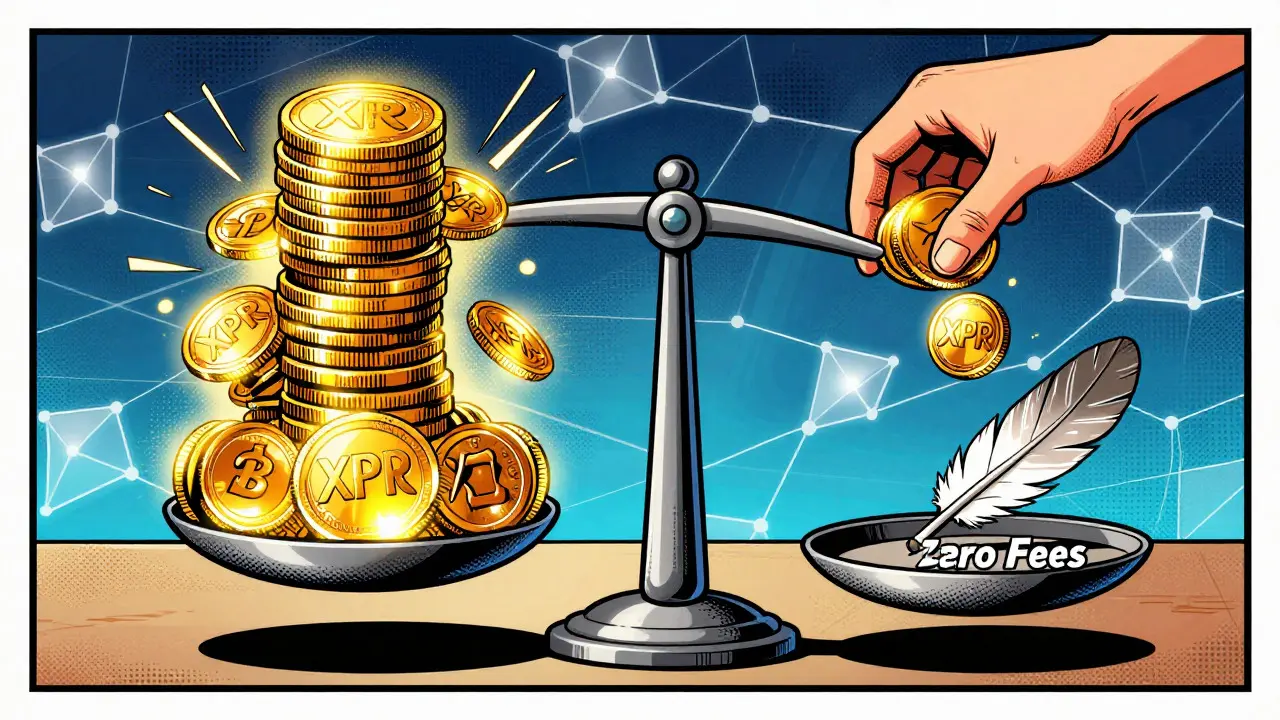
But here’s the kicker: you can slash your own trading fees by staking XPR. The more you stake, the less you pay. It’s a tiered system designed to lock up capital and encourage long-term holding.
| XPR Staked | Trading Fee Discount |
|---|---|
| None | 0% |
| 100,000 XPR | 33% |
| 1,000,000 XPR | 66% |
| 10,000,000 XPR | 100% (Free Trading) |
To get free trading, you need to stake 10 million XPR. For most retail users, that’s a massive barrier. Unless you’re a whale, you’ll likely be paying the standard rate or aiming for that modest 33% discount. Keep in mind that staking also locks your tokens, meaning they aren’t liquid if you suddenly need cash out.
Liquidity and Market Data: The Elephant in the Room
This is where ProtonSwap struggles. If you’ve ever traded on Binance or Kraken, you’re used to seeing real-time order books, depth charts, and volume metrics. On ProtonSwap, good luck finding that.
As of mid-2026, CoinMarketCap lists ProtonSwap as an “Untracked Listing.” What does that mean? It means there’s no verified data on trading volume, liquidity depth, or price impact. When you try to make a large trade on a DEX with low liquidity, you suffer from “slippage”-you get fewer tokens than expected because the pool runs dry. Without public data, you’re flying blind.
Compare this to established players. Kraken supports over 410 cryptocurrencies and provides institutional-grade transparency. Even regional exchanges like Swyftx in Australia serve hundreds of thousands of users with clear tax reports and demo modes. ProtonSwap lacks this visibility. There are no user reviews on major platforms, no active Reddit communities discussing strategies, and no transparent audit reports readily available for the average user.
User Experience and Security
Security-wise, the non-custodial nature is a plus. Since you never send funds to ProtonSwap’s servers, a hack of their website wouldn’t necessarily drain your wallet-provided you use a reputable hardware wallet or secure software wallet. The risk shifts from “exchange hacked” to “smart contract bug” or “user error.”
However, the user experience is sparse. There’s no dedicated customer support team to chat with if a transaction fails. Documentation is minimal compared to giants like Uphold or Coinbase. If you’re new to DeFi, the learning curve is steep. You need to understand concepts like slippage tolerance, wallet connection permissions, and gas-less transactions on Proton. If you mess up a transaction, there’s no “undo” button and no support ticket to file.
The interface itself is functional but barebones. It prioritizes utility over aesthetics. You connect, you swap, you disconnect. It’s fast, yes, but it feels isolated. The lack of community feedback makes it hard to gauge trust. In crypto, trust is built through transparency and social proof. ProtonSwap currently has neither in abundance.
Who Is ProtonSwap For?
Let’s be realistic. ProtonSwap is not for everyone. Here’s who should consider using it, and who should stay away.
Use ProtonSwap if:
- You already hold significant amounts of XPR and want to maximize its utility within the Proton ecosystem.
- You prefer non-custodial trading and want to avoid KYC (Know Your Customer) requirements associated with centralized exchanges.
- You are trading smaller amounts where slippage won’t eat up your entire profit.
- You value speed and zero gas fees over deep liquidity.
Avoid ProtonSwap if:
- You are a beginner who needs hand-holding, tutorials, or customer support.
- You want to trade major assets like BTC or ETH directly without bridging.
- You require high liquidity for large trades (over $10k-$50k).
- You rely on market data, charts, and historical volume to make decisions.
Comparison: ProtonSwap vs. Centralized Giants
To put things in perspective, let’s compare ProtonSwap with a centralized exchange like Kraken. Kraken offers margin trading, futures, and a vast array of coins. It’s regulated, insured, and has millions of users. ProtonSwap offers none of that. It offers freedom and decentralization instead.
The trade-off is convenience versus control. With Kraken, you trust the company. With ProtonSwap, you trust the code. The problem is, the code on ProtonSwap hasn’t been battle-tested by the same volume of users. The absence of GitHub activity or developer updates raises questions about long-term viability. Is the project still active? Who knows? The silence is deafening.
Final Verdict
ProtonSwap is a niche tool. It shines if you are deeply embedded in the Proton blockchain ecosystem and want to move assets around quickly without gas fees. The staking incentives are attractive on paper, but the barriers to entry for significant discounts are high. For the average trader, the lack of liquidity data and market presence is a major red flag.
Until ProtonSwap achieves better tracking on major aggregators, builds a visible community, and expands its liquidity pools, it remains a speculative play. Use it for small, experimental trades within the Proton network, but don’t park your life savings here expecting easy gains or seamless execution. Always do your own research, start small, and never invest more than you can afford to lose.
Is ProtonSwap safe to use?
ProtonSwap is non-custodial, meaning you retain control of your private keys and funds are not held by the exchange. This reduces the risk of exchange hacks. However, safety also depends on the security of the smart contracts and your own wallet hygiene. Since audit reports are not prominently displayed, exercise caution and verify contract addresses yourself.
Does ProtonSwap require KYC?
No, ProtonSwap is a decentralized exchange (DEX). It operates via smart contracts and does not require identity verification (KYC) to trade. You simply connect your compatible wallet to access the platform.
Why is ProtonSwap untracked on CoinMarketCap?
ProtonSwap is listed as “Untracked,” which typically indicates low trading volume, limited liquidity, or a lack of compliance with the data submission standards required by major trackers. This makes it difficult to assess its true market activity and reliability.
Can I trade Bitcoin on ProtonSwap?
Not directly. ProtonSwap operates exclusively on the Proton blockchain. To trade Bitcoin, you would first need to bridge BTC to the Proton network as a wrapped asset, if such a pair exists. Most users will find limited cross-chain options compared to multi-chain DEXs.
How do I reduce trading fees on ProtonSwap?
You can reduce fees by staking the native XPR token. Staking 100,000 XPR gives a 33% discount, 1 million XPR gives 66%, and 10 million XPR grants 100% fee-free trading. Without staking, you pay the standard trading fee.