
How Flash Loans Work Without Collateral in DeFi
Imagine borrowing $10 million to buy an asset, selling it for a profit, and paying back the loan-all before you finish your coffee. No credit check. No collateral locked up. Just pure code doing its job. This isn't science fiction; it's how Flash Loans work in decentralized finance (DeFi). They are one of the most unique financial primitives we have, existing solely because blockchains can execute multiple actions as a single, indivisible unit.
If you've ever tried to get a bank loan, you know the pain: paperwork, waiting days, and putting up your house or car as security. Flash loans flip this model on its head. They allow you to borrow massive amounts of cryptocurrency without putting any money down upfront. The catch? You must pay it back within the same transaction block. If you fail, the entire deal vanishes as if it never happened. It’s risk-free for the lender but requires precision from the borrower. Let's break down exactly how this magic trick works, why it matters, and what you need to know before trying it yourself.
The Core Mechanism: Atomicity is King
To understand flash loans, you first need to grasp transaction atomicity. In traditional banking, steps happen sequentially. You apply, they approve, they send money, you spend it. If something breaks halfway, you might end up with debt but no goods. On a blockchain like Ethereum, a transaction is atomic. This means all operations inside that transaction either succeed completely or fail completely. There is no "halfway."
When you request a flash loan, the smart contract lends you the assets. Then, it forces your custom contract to use those assets immediately-perhaps to buy a token on Uniswap and sell it on Sushiswap for a higher price. Finally, your contract must return the original amount plus a small fee. If your contract tries to run away with the money or fails to repay, the blockchain reverts the entire state change. The lender gets their tokens back instantly, and you lose only the gas fees used to attempt the trade. This guarantee eliminates counterparty risk for the lender, which is why they don't require collateral.
Who Pioneered This? A Brief History
While the concept feels new, it has roots going back a few years. The idea was technically introduced by the Marble protocol in 2018, but it didn't gain mainstream traction until Aave integrated it into their V2 release in January 2020. Aave made it accessible and standardized, turning it into a cornerstone of DeFi strategies. Today, major protocols like Uniswap V3 and Balancer also offer similar mechanisms, often called "flash swaps" or "flash borrows," depending on the specific implementation.
Aave currently dominates this space, processing about 62% of all flash loan volume as of late 2023. Uniswap follows closely behind at 28%, leveraging its massive liquidity pools to allow users to borrow tokens directly from trading pairs. These platforms charge tiny fees-typically around 0.09% on Aave and 0.3% on Uniswap-for the privilege of using their capital for just a few seconds.
Why Borrow Without Collateral? Use Cases That Actually Make Sense
You might ask, "If I have to pay it back instantly, what's the point?" The power lies in arbitrage and liquidation. Here are the three main jobs flash loans help you complete:
- Arbitrage: Prices for the same asset often differ across exchanges. With a flash loan, you can buy Bitcoin cheaply on Exchange A, sell it dearly on Exchange B, and repay the loan, pocketing the difference. You don't need to own the Bitcoin beforehand; you just need the code to execute the trades fast enough.
- Liquidations: When a borrower on a platform like Compound defaults, their collateral is sold off. Flash loans allow anyone to jump in, borrow the needed funds to pay off the default, seize the discounted collateral, and repay the loan. This keeps the lending system healthy without requiring every user to keep huge cash reserves idle.
- Self-Liquidation: If you're over-leveraged and facing liquidation penalties, you can use a flash loan to pay off your debt, withdraw your collateral, swap it, and repay the flash loan. This saves you from harsher penalties imposed by the protocol.
Flash Loans vs. Traditional DeFi Lending
It helps to compare flash loans to standard DeFi loans to see where they fit. Standard loans, like those on Aave's regular markets, require you to deposit collateral worth 110-150% of what you borrow. You can hold that loan for weeks or months. Flash loans, conversely, require 0% collateral but last less than a minute.
| Feature | Flash Loan | Standard DeFi Loan |
|---|---|---|
| Collateral Required | None (0%) | High (110-150%) |
| Duration | One Transaction Block (~12-15s) | Days, Weeks, or Months |
| Risk to Lender | Near Zero (Atomic Revert) | Variable (Liquidation Risk) |
| Primary Use Case | Arbitrage, Liquidation | Leverage, Yield Farming |
| Technical Skill Needed | Advanced (Smart Contract Dev) | Low (User Interface) |
The Hidden Costs and Risks
Just because there's no collateral doesn't mean it's free or safe. First, you pay gas fees. Even if your trade fails and reverts, you still paid the network to process the attempt. During times of high congestion, these costs can eat into your profits quickly. Second, there's the learning curve. Writing a secure flash loan contract isn't trivial. You need to handle edge cases, such as slippage (when the price moves against you mid-trade) and reentrancy attacks.
Security researchers have documented significant losses due to flawed implementations. For instance, in 2022 alone, there were 17 successful flash loan attacks totaling $327 million in losses. These weren't failures of the flash loan mechanism itself, but exploits of vulnerabilities in other protocols being manipulated via flash loans. If you're building a strategy, assume attackers are watching. Front-running bots may try to copy your transaction or manipulate oracle prices right before your trade executes.
Getting Started: What Do You Need?
If you want to try this, you aren't clicking a button on a website. You're writing code. Specifically, you'll likely use Solidity. To interact with Aave, you must implement the `IFlashLoanReceiver` interface. For Uniswap, you'll need to handle the `uniswapV3FlashCallback`. Beginners typically spend 40-60 hours studying smart contract patterns before safely deploying a basic script.
Here is a simplified logical flow of a flash loan execution:
- Borrow: Your contract calls the lender protocol (e.g., Aave) requesting X amount of USDC.
- Execute: The lender sends USDC to your contract and triggers your `executeOperation` function.
- Trade: Inside that function, you swap USDC for ETH on DEX A, then swap ETH back to USDC on DEX B at a better rate.
- Repay: You transfer the initial USDC amount plus the fee back to the lender.
- Profit: Any remaining USDC stays in your contract/wallet.
The Future of Instant Capital
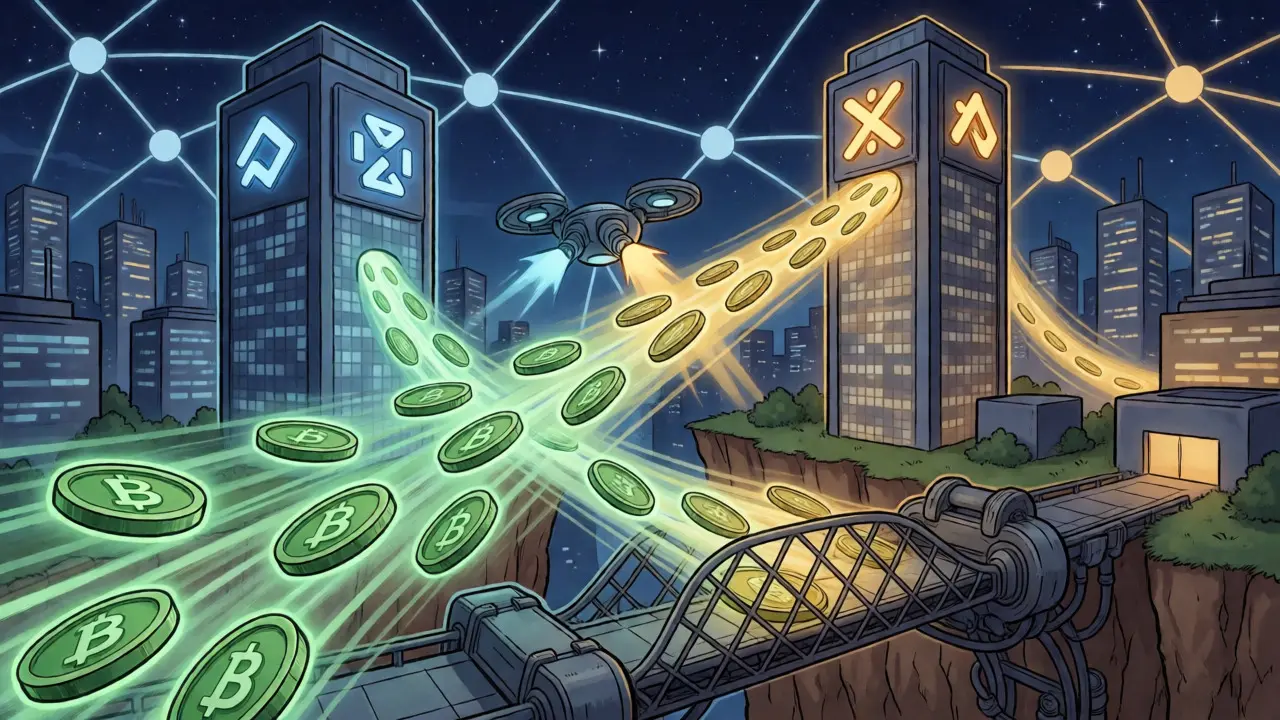
Flash loans are evolving. We are seeing more cross-chain compatibility, meaning you could potentially borrow on Ethereum and repay on Arbitrum, though this adds complexity. Institutional players are increasingly adopting them; quantitative trading firms now account for a growing share of volume, using them for sophisticated cross-exchange arbitrage that retail traders miss.
Regulators are also taking notice. The Financial Stability Board has flagged flash loans as potential shock transmitters in crypto markets. However, for developers and savvy traders, they remain one of the most powerful tools for capital efficiency. They democratize access to large sums of money, letting a solo developer compete with hedge funds that have millions sitting idle in accounts.
Do I need to own any crypto to take out a flash loan?
Technically, no. You do not need to own the asset you are borrowing. However, you do need some cryptocurrency (like ETH) to pay for the gas fees required to execute the transaction on the blockchain. If the transaction fails, you lose those gas fees.
What happens if I cannot repay the flash loan?
The entire transaction reverts. This means the borrowed assets are returned to the lender automatically, and any intermediate trades are undone. You simply lose the gas fees spent on the failed attempt. The lender suffers no loss.
Are flash loans available on all blockchains?
No, they require a blockchain that supports complex smart contracts and atomic transactions. They are prominent on Ethereum, Polygon, Avalanche, and Binance Smart Chain. They are generally not available on simpler chains like Bitcoin (without layer-2 solutions) or Solana in the same native way, though similar concepts exist.
How much does a flash loan cost?
The interest rate is effectively zero since the duration is so short. Instead, you pay a flat fee set by the protocol. For example, Aave charges 0.09% of the loan amount, while Uniswap charges 0.3%. You also pay network gas fees, which vary based on network congestion.
Can non-developers use flash loans?
Directly, no. You need to write and deploy a smart contract. However, third-party platforms and bots have emerged that wrap this complexity, allowing users to select pre-built strategies (like arbitrage bots) without writing code themselves. These services usually take a cut of the profits.