
Uniswap v2 (Blast) Crypto Exchange Review: Limited but Low-Cost DeFi Option
Uniswap v2 on Blast isn’t what you’d call a full-featured crypto exchange. It’s not even close to the bustling markets you’ll find on Uniswap v3 on Ethereum or PancakeSwap on BNB Chain. Right now, it supports one trading pair. That’s it. If you’re looking to swap between dozens of tokens, find deep liquidity, or trade with advanced order types - you won’t find that here. But if you’re already in the Blast ecosystem and want to make a simple, ultra-cheap swap with near-zero fees, then Uniswap v2 (Blast) might just be the quiet tool you didn’t know you needed.
What Is Uniswap v2 (Blast)?
Uniswap v2 (Blast) is a version of the original Uniswap decentralized exchange protocol, deployed specifically on the Blast Layer 2 blockchain. Blast launched in 2023 as an Ethereum scaling solution that gives users native yield on their idle ETH and stablecoins - something no other major L2 does. In late 2024, Uniswap v2 was brought over to Blast as one of its first DeFi integrations. Unlike Uniswap v3, which lets liquidity providers pin their capital to specific price ranges, v2 uses a simple formula: x * y = k. This means liquidity is spread evenly across all possible prices, which works fine when you have tons of capital - but not so well when you have barely any.
As of December 2025, the only trading pair available on Uniswap v2 (Blast) is WETH/USDbC. That’s Wrapped Ether and USD-backed stablecoin. No other tokens. No altcoins. No meme coins. Just these two. That’s not a bug - it’s a feature of the early stage. Blast itself is still growing, and most of its TVL ($1.2 billion as of late 2024) comes from users depositing ETH just to earn yield, not from active DeFi trading. Uniswap v2 (Blast) is essentially a placeholder until more tokens arrive.
How It Works: Simple, But Barebones
Using Uniswap v2 (Blast) is dead simple - if you’ve ever used Uniswap before. You connect your wallet (MetaMask, Trust Wallet, or Coinbase Wallet), click ‘Swap’, pick your token (you only have one option), enter the amount, and hit confirm. The whole thing takes under a minute. There’s no slippage settings to tweak, no limit orders, no advanced charts. It’s stripped down to the essentials.
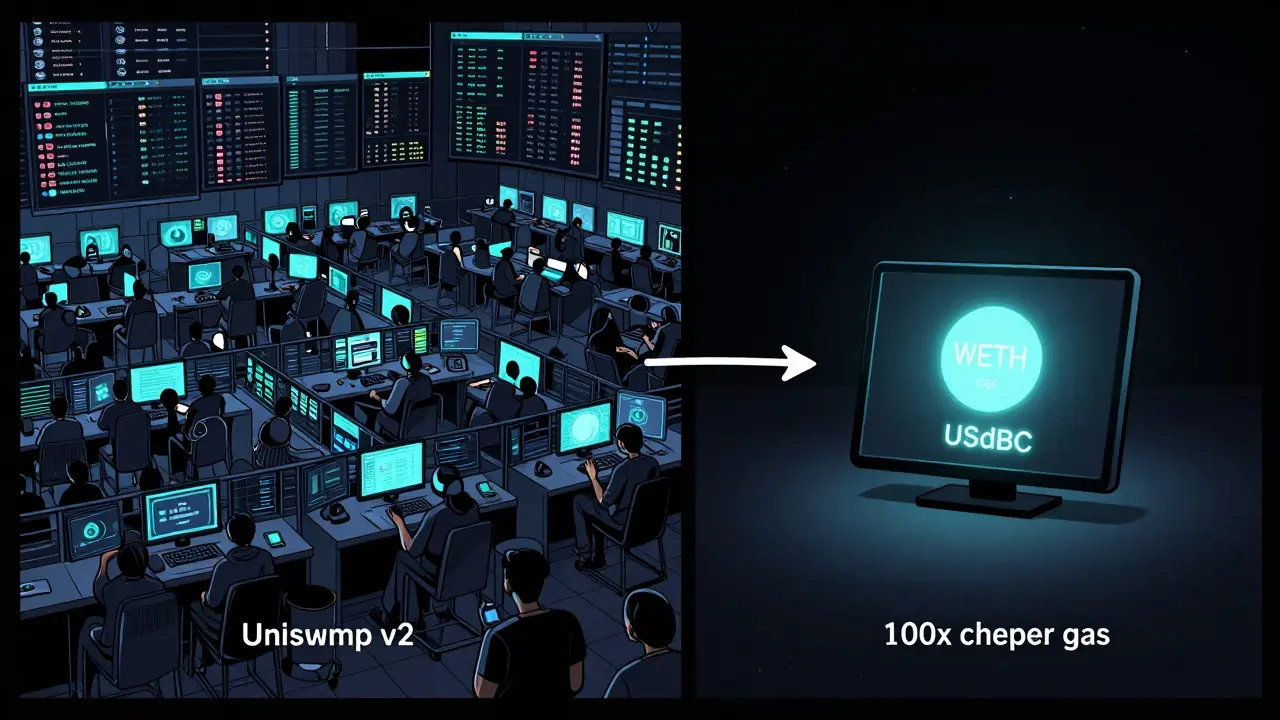
The fee is 0.30% per trade - the same as every other Uniswap v2 deployment. But here’s the kicker: because Blast is a Layer 2, your transaction costs are around $0.01 to $0.05. On Ethereum mainnet, that same swap could cost you $5 to $15 during normal times. That’s a 100x difference. For small swaps, especially if you’re just moving ETH to USDbC to earn yield on Blast, this makes sense.
Why It’s Not Great (Yet)
Let’s be honest: Uniswap v2 (Blast) is underwhelming. With only one trading pair, it’s not a real exchange - it’s a gateway. If you want to trade anything else, you’ll need to go elsewhere. Even on other Layer 2s like Arbitrum or Optimism, Uniswap v2 supports hundreds of tokens. Here? One. That’s not a technical limitation - it’s a lack of adoption.
Liquidity is thin. That means even a $100 swap can cause noticeable slippage. If you’re trading more than $500, you’re likely to get a worse price than expected. This is worse than on Uniswap v3, where concentrated liquidity keeps prices stable even with low capital. On v2, your $10,000 in liquidity is spread across every possible price from $1000 to $10,000 per ETH - meaning almost none of it is actually available when someone wants to trade.
And there’s no upgrade path in sight. Uniswap Labs is focused on v3 and the upcoming v4. There are no official plans to bring v3 to Blast anytime soon. That means this version could stay stuck in low-liquidity purgatory for months - maybe longer. Some developers call it a ‘strategic placeholder’. Others say it’s an afterthought.
Who Is This For?
Uniswap v2 (Blast) isn’t for traders. It’s not for investors looking to diversify. It’s not for DeFi power users. It’s for one specific group: people already using Blast to earn yield on their ETH or stablecoins who need to swap between those two assets.
Imagine this: You deposited 5 ETH into Blast to earn 10% APY. Now you want to convert 1 ETH to USDbC to pay for something. You could use a centralized exchange, but that means sending your ETH off-chain, paying withdrawal fees, and waiting hours. Or you could use Uniswap v2 (Blast) - do the swap in 2 seconds, pay $0.02 in fees, and keep everything on-chain. That’s the only real use case.
If you’re new to DeFi, don’t start here. The interface is easy, but the lack of options will confuse you. If you’re a professional trader, skip it. The slippage and low volume make it unusable for anything beyond tiny swaps.
How to Get Started
Here’s how to use Uniswap v2 (Blast) if you’re ready:
- Install a wallet that supports Blast: MetaMask, Trust Wallet, or Coinbase Wallet.
- Add the Blast network manually. Go to your wallet’s network settings and enter the RPC URL:
https://rpc.blast.io, Chain ID:81457, Symbol:ETH, Block Explorer:https://blastscan.io. - Send ETH or USDbC to your wallet on Blast. You can bridge from Ethereum using Blast’s official bridge or buy directly via supported on-ramps.
- Go to the Uniswap v2 interface on Blast:
https://app.uniswap.org/#/swap?chain=blast. - Connect your wallet. Select WETH or USDbC as your input. The output will auto-fill as the other token.
- Confirm the swap. You’ll pay 0.30% fee and $0.01-$0.05 in gas.
Pro tip: If your transaction keeps failing, increase the gas multiplier in your wallet to 1.2x. That fixes 90% of failed swaps on Blast.
How It Compares to Other DEXes
| Feature | Uniswap v2 (Blast) | Uniswap v3 (Ethereum) | PancakeSwap (BNB Chain) | Radiant Capital (Blast) |
|---|---|---|---|---|
| Trading Pairs | 1 | 1,200+ | 1,200+ | 15+ |
| Daily Volume | <$100K | $193M | $1.2B | $80M |
| Trading Fee | 0.30% | 0.05%-1.00% | 0.20% | Varies |
| Avg. Gas Fee | $0.01-$0.05 | $1.50-$15 | $0.10-$0.50 | $0.02-$0.10 |
| Liquidity Model | Constant Product (v2) | Concentrated Liquidity (v3) | Constant Product | Concentrated |
| Native Yield on LP | Yes | No | No | Yes |
| Best For | Simple ETH/USDbC swaps | Professional trading | Altcoin trading | Blast-native lending |
As you can see, Uniswap v2 (Blast) doesn’t compete with the big players. It doesn’t try to. Its only real edge is the combination of ultra-low fees and native yield - something even PancakeSwap and Arbitrum can’t offer. But without more tokens, it’s not a real alternative to anything.
Future Outlook
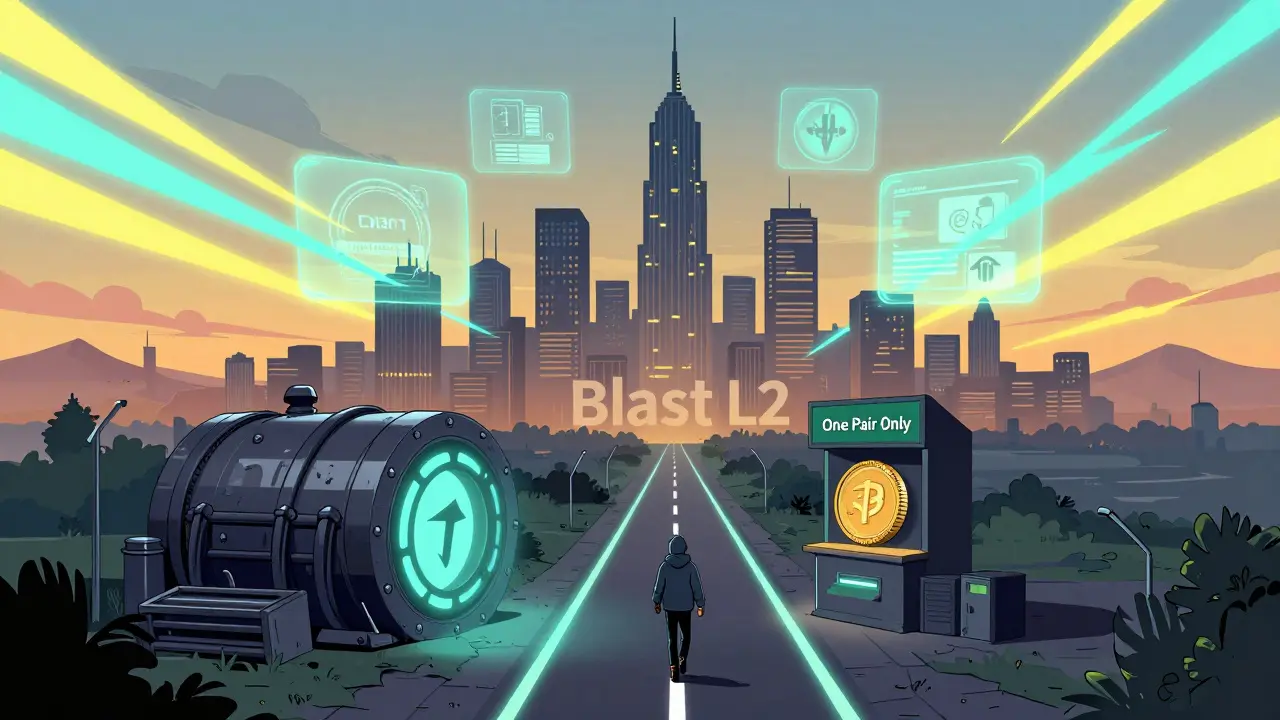
Will Uniswap v2 (Blast) grow? Maybe. But not because of its own strength. It’ll grow if Blast’s ecosystem expands. If more projects launch on Blast, if more tokens get listed, if liquidity incentives kick in - then Uniswap v2 could become useful. Right now, it’s like a single-lane road in a city that’s still being built.
There are rumors that Uniswap governance might vote to upgrade Blast to v3 in 2025. But there’s no official timeline. Until then, this version will remain a curiosity - not a cornerstone.
For now, treat it like a utility, not a platform. Use it to swap ETH to USDbC and back. Don’t expect to trade Solana tokens, Dogecoin, or any new meme coin. If you do, you’ll be disappointed. But if you’re already on Blast and need to move between those two assets - it’s the cheapest, fastest way to do it.
Frequently Asked Questions
Is Uniswap v2 (Blast) safe to use?
Yes, it’s as safe as any audited DeFi protocol. The smart contracts are the same ones used on Ethereum mainnet since 2020, reviewed by Trail of Bits, OpenZeppelin, and Certora. The only risk is the one inherent to all DeFi: smart contract bugs or network-level attacks. But Blast has been stable since launch, and no exploits have been reported on Uniswap v2 (Blast) to date.
Can I provide liquidity on Uniswap v2 (Blast)?
Yes, but only for the WETH/USDbC pair. You’ll need to deposit equal values of both tokens. Once you do, you’ll earn 0.30% of every trade in that pair - plus native yield from Blast’s system. That means your liquidity earns interest even when no one’s trading. It’s the only DEX on Blast that does this.
Why is there only one trading pair?
Because Blast is still new. Most users are depositing ETH just to earn yield, not trading tokens. Developers haven’t launched enough projects yet to create demand for other pairs. Uniswap v2 (Blast) is waiting for the ecosystem to grow. Once more tokens are added - especially stablecoins and major assets - more pairs will follow.
Is Uniswap v2 (Blast) better than Uniswap v3?
No, not in terms of features. Uniswap v3 offers concentrated liquidity, multiple fee tiers, and better capital efficiency. But v2 on Blast is better for one thing: simplicity and low cost. If you only need to swap ETH and USDbC, v2 is easier and cheaper than trying to set up a v3 position on Ethereum. But if you want flexibility, v3 is superior - just not on Blast yet.
Will Uniswap v2 (Blast) be upgraded to v3?
It’s likely, but not guaranteed. Uniswap Labs has focused on v3 and v4 for all major chains. There are proposals in the Uniswap governance forum to deploy v3 on Blast, but no timeline. Until then, v2 remains the only option. If you’re planning to lock up capital, assume this version will stay for at least 6-12 months.




omg i just tried this and it worked?? i was scared to swap on blast but like... $0.02?? i feel like i won the lottery 🥹
this is honestly the only reason i stay on blast. i dont trade anything else, just swap eth to usdbc to earn yield and back. no drama, no fees, no stress. why fix what ain't broke? 🤷♀️
people still use this? lmao. if you're not trading at least 5 tokens you're not in DeFi. this is like using a flip phone in 2025. get with the program or leave.
the beauty of this is in its limitation. we think more is better but sometimes less is the only thing that lets you see clearly. one pair. one purpose. no noise. no distractions. just movement. that’s rare now
oh wow so this is what ‘strategic placeholder’ means? a glorified calculator for people too scared to leave their yield farm? congratulations, you turned a DEX into a vending machine. 🙄
i thought i was the only one using this 😅 my husband and i just swap back n forth when we wanna pay for gas or food on blast. its like digital cash now. also typoed usdbc as usdcb like 3 times but it still worked lol
if you're new to blast, don't overthink it. just connect your wallet, swap eth for usdbc, and let it sit. the yield is real, the fees are dirt cheap, and the simplicity is kinda beautiful. you don't need to trade 20 coins to be smart
usa still thinking they invented finance. in india we had hundis for centuries. this is just crypto hundi with gas fees. 🇮🇳
The operational efficiency of Uniswap v2 on Blast, while functionally rudimentary, represents a compelling case study in minimal viable DeFi architecture. The marginal cost of transaction execution, coupled with native yield accrual, constitutes an economically rational utility function for users engaged in micro-liquidity arbitrage between ETH and USDbC.
I use this every week. No frills. No hype. Just swap. Blast is quiet but it works. The fact that no one talks about it is why I like it
this is my favorite little tool on blast. super easy and the gas is nothing. i feel like a wizard when i swap in 3 seconds 😊
i keep forgetting its usdbc not usdt but it still works lol. also why is the interface so clean?? its like a breath of fresh air after pancakeswap
dont give up on blast yet! its still early. one pair now but soon more will come. i believe in it 💪
i came here because i saw the gas fee was $0.01 and thought i was dreaming. then i did the swap and it was real. i just wanted to say thanks. this is what web3 should feel like
this isn't a DEX. it's a digital handshake between ETH and USDbC. a silent pact in a noisy world. i love it. it's the anti-DeFi. the quiet rebel. the monk of the blockchain. 🙏
you guys are underestimating this. yes it's one pair. yes it's simple. but the native yield on liquidity? that's the real magic. i'm not just swapping-I'm earning while i sleep. this is the first time i've ever felt like my capital was actually working for me. and the fact that blast lets you do it without some sketchy yield aggregator? chef's kiss. 🤌