

How AI Detects Blockchain Fraud: A Guide to Smart Security in 2026
Imagine sending a life savings worth of cryptocurrency, only to watch it vanish into a digital black hole within seconds. For years, this was the terrifying reality for many users. The promise of blockchain was immutability-once a transaction is recorded, it cannot be changed. But that same feature makes recovery impossible if you send funds to a scammer. Traditional security measures, built on static rules and manual reviews, simply couldn’t keep up with the speed and complexity of modern crypto fraud.
Enter artificial intelligence. In 2026, AI for blockchain security is no longer a futuristic concept; it is the backbone of institutional and individual protection. By combining the immutable ledger of blockchain with the predictive power of machine learning, we have moved from reactive damage control to proactive prevention. This shift isn't just about catching thieves after they strike; it's about stopping them before the transaction even confirms.
The Shift from Rules to Real-Time Intelligence
To understand why AI is necessary, you first need to look at how fraud detection used to work. Older systems relied on rule-based engines. If a transaction exceeded $10,000, flag it. If a user logged in from a new country, block it. These rules were easy to write but terrible at catching sophisticated crime. Scammers quickly learned to game these systems by breaking large transfers into smaller chunks-a technique known as "smurfing"-or using multiple accounts to appear legitimate.
AI changes the game entirely by focusing on behavior rather than rigid thresholds. Machine learning models, such as XGBoost and Random Forest classifiers, analyze historical data to establish a baseline of "normal" activity. They don't just look at the amount sent; they examine the timing, the device used, the typing speed, and the network topology. When an address that typically moves small amounts suddenly initiates a large transfer, or when a cluster of newly created wallets interacts with a victim, the AI flags the anomaly instantly.
This capability allows for continuous, round-the-clock monitoring across multiple blockchains. Unlike traditional banks that might process fraud alerts in batches overnight, AI systems scan transactions in real time. This immediacy is critical in the crypto world, where funds can move across borders and chains in minutes. The goal is to create a feedback loop that transforms fraud detection from documentation into intervention.
How Multi-Layered Data Fusion Works
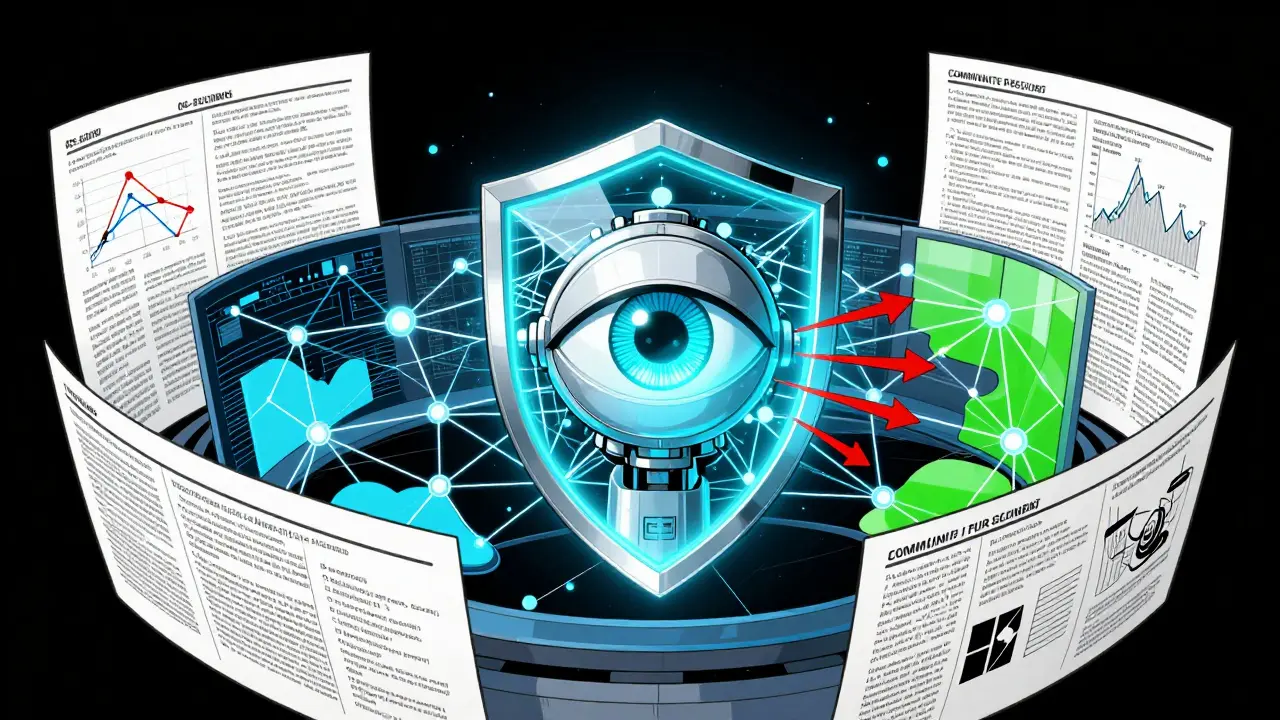
One of the biggest challenges in blockchain security is that on-chain data alone often tells an incomplete story. A wallet address is pseudonymous; without context, it’s just a string of characters. To build a complete picture, leading platforms like TRM Labs is a blockchain intelligence platform that uses multi-layered data fusion to detect illicit activity. employ a three-layer approach to data analysis.
- On-Chain Data: This includes transaction graphs, wallet clustering, cross-chain movement patterns, and smart contract interactions. It answers the question: "Where did the money come from, and where is it going?"
- Off-Chain Intelligence: This layer incorporates exchange records, bank reports, sanctions designations, and leaked infrastructure associated with crime groups. It connects the digital world to real-world entities.
- Crowdsourced Community Data: Real-time submissions from users provide early visibility into active scam campaigns, impersonation attempts, and phishing sites. This human element adds a crucial layer of context that algorithms might miss.
By fusing these layers, AI systems can identify patterns that would be invisible otherwise. For example, they can detect coordinated token swaps designed to obfuscate proceeds or trace the cash-out infrastructure of a scam network. This comprehensive risk picture allows institutions to map full scam networks and freeze assets before they disappear into privacy coins or decentralized exchanges.
| Feature | Traditional Rule-Based Systems | AI-Powered Detection |
|---|---|---|
| Detection Method | Static thresholds (e.g., amount limits) | Behavioral profiling and anomaly detection |
| Speed | Batch processing or post-transaction | Real-time, instantaneous scanning |
| False Positives | High, disrupting legitimate users | Low, due to context-aware modeling |
| Adaptability | Manual updates required for new scams | Continuous learning from new patterns |
| Data Sources | Primarily internal transaction logs | On-chain, off-chain, and crowdsourced data |
Protecting DeFi and Institutional Assets
Decentralized Finance (DeFi) has opened up incredible opportunities for lending, borrowing, and trading without intermediaries. However, it has also become a playground for sophisticated attacks. Smart contracts, which automate financial agreements, are only as secure as their code. AI plays a dual role here: it monitors the execution of these contracts for anomalies and analyzes the code itself for vulnerabilities.
For exchanges and fintech companies, AI-driven tools enable proactive withdrawal controls. If a user attempts to send funds to a high-risk wallet linked to a known scam, the system can block or delay the transaction automatically. This is not just about protecting the platform’s reputation; it’s about safeguarding user assets. Institutions can freeze compromised accounts before funds leave the ecosystem, effectively stopping scams in-flight.
Moreover, AI helps reduce the burden of false positives. In the past, compliance teams were overwhelmed with alerts, most of which turned out to be harmless variations in normal behavior. Advanced behavioral modeling differentiates between real threats and benign anomalies. This means fewer manual reviews, a smoother user experience, and more confidence that the system is targeting actual risks rather than legitimate customers.

The Arms Race: AI vs. AI Fraud
As defense mechanisms improve, so do the attackers. We are currently witnessing an arms race where scammers use AI to automate their operations. They deploy AI-generated phishing emails, create deepfake customer service representatives, and use bots to execute flash loans and exploit smart contract bugs at superhuman speeds.
This evolution necessitates equally advanced defensive AI. Fraud detection systems must now identify not just static patterns but dynamic, evolving strategies. Unsupervised anomaly detection becomes crucial here, as it can surface entirely new types of fraud that haven’t been seen before. For instance, if a new type of rug pull emerges with a unique signature, supervised models trained on old data might miss it. Unsupervised models, however, will flag the deviation from normal market behavior immediately.
The integration of behavioral biometrics further tightens security. By analyzing indicators like mouse movements, typing cadence, and device fingerprints, AI builds a unique profile for each user. If a hacker gains access to a wallet but doesn’t mimic the owner’s behavior, the system raises an alert. This adds a layer of identity verification that goes beyond passwords and two-factor authentication.
Future Outlook: Trust Through Transparency
Looking ahead, the combination of AI and blockchain promises a future where trust is programmable and transparent. Blockchain provides the immutable record, while AI ensures that the actions recorded are legitimate. This synergy creates a robust security ecosystem where fraud detection becomes faster, more accurate, and exponentially more effective.
We can expect to see greater adoption of these technologies by regulatory bodies and law enforcement. AI-powered tools already support investigations by tracing illicit funds and mapping criminal networks. As these capabilities mature, they will likely become standard infrastructure for all blockchain applications, from simple wallets to complex enterprise solutions.
Ultimately, the goal is not just to catch bad actors but to restore confidence in the technology. By leveraging machine learning, predictive analysis, and real-time monitoring, we are building a safer digital economy. Users and organizations alike can feel more secure knowing that intelligent systems are watching over their assets 24/7, adapting to new threats as they emerge.
How does AI detect blockchain fraud in real time?
AI detects fraud in real time by using machine learning models to analyze transaction data as it occurs. Instead of relying on static rules, AI establishes a baseline of normal behavior for each user or wallet. When a transaction deviates from this pattern-for example, a sudden large transfer from a low-activity account-the system flags it instantly. This allows for immediate intervention, such as blocking the transaction or alerting the user, before the funds are moved irreversibly.
What is multi-layered data fusion in blockchain security?
Multi-layered data fusion is a method used by platforms like TRM Labs to combine different sources of information for a comprehensive view of risk. It integrates on-chain data (transaction history), off-chain intelligence (sanctions lists, bank records), and crowdsourced community reports. By merging these layers, AI can identify complex fraud patterns that would be invisible if looking at any single data source alone.
Why are traditional rule-based systems insufficient for crypto security?
Traditional rule-based systems rely on fixed criteria, such as transaction limits or geographic blocks. Scammers easily bypass these by splitting transactions (smurfing) or using proxies. Additionally, these systems generate high rates of false positives, annoying legitimate users. AI, on the other hand, adapts to new behaviors and learns from context, making it far more effective against sophisticated and evolving threats.
Can AI prevent smart contract exploits in DeFi?
Yes, AI contributes to DeFi security in two ways. First, it analyzes smart contract code for vulnerabilities before deployment. Second, it monitors live transactions for anomalous behavior indicative of an exploit, such as unexpected drain of liquidity. While AI cannot fix bad code, it can detect and potentially halt malicious interactions in real time, minimizing losses.
How does AI reduce false positives in fraud detection?
AI reduces false positives by using behavioral modeling and context-aware algorithms. Instead of flagging every unusual transaction, AI understands what is "normal" for a specific user based on their history. It distinguishes between a legitimate change in behavior (like traveling abroad) and a fraudulent attempt (like a sudden login from a risky IP). This results in fewer unnecessary blocks and a better user experience.







Great read on the tech side but let's be real about the implementation. These AI models are only as good as the data they're fed, and right now that data is a mess of false positives and regulatory overreach. I've seen too many legitimate transactions flagged by these 'smart' systems because some algorithm decided my wallet behavior looked 'suspicious'. It's not security, it's surveillance with extra steps.
I actually find this perspective quite refreshing in a space that often feels so divided. The idea that we can move from reactive to proactive security is genuinely hopeful for the future of digital trust. We need more dialogue like this rather than just shouting matches about decentralization vs regulation. Technology should serve humanity, not hinder it, and if AI helps protect people's life savings, that's a win for everyone involved.
Don't fall for it. They want you to trust the AI because the AI is controlled by the same banks that stole your money in 2008. Blockchain was supposed to be free from their control but now you're asking them to build the watchdog? Typical. They'll just use the 'fraud detection' to freeze anyone who disagrees with their narrative. Wake up sheeple.
The irony is palpable here. We built a system designed to eliminate intermediaries and now we're inviting the ultimate intermediary back in through the back door. It's a beautiful disaster really. You have all this immutable truth on the chain but you need a black box oracle to tell you what it means. The cognitive dissonance required to believe this is secure is off the charts. It's not security it's just centralized censorship with a fancy machine learning coat of paint.
This is exactly why I stay away from DeFi!!! The risks are far too high when you rely on code that hasn't been properly audited by human experts!! AI might catch some obvious scams but it will never understand the nuanced social engineering tactics that scammers use!! People need to educate themselves instead of relying on magical thinking algorithms!!!
Look I know everyone loves to complain but this is how things work now. If you can't handle a little friction for better security then maybe crypto isn't for you. I'd rather have an AI block a transaction than lose my entire portfolio to a rug pull. Stop whining and start using two-factor authentication and hardware wallets. Basic hygiene matters more than philosophical debates about decentralization.
While I appreciate the detailed breakdown of how multi-layered data fusion works, I do wonder about the privacy implications of collecting such extensive behavioral biometrics. When we start analyzing typing cadence and mouse movements to verify identity, we are essentially creating a digital fingerprint that could be exploited if the database is breached. It is important to consider whether the convenience of automated fraud detection outweighs the potential loss of personal privacy in an increasingly surveilled digital landscape where every click is monitored and analyzed.
Just observing from the sidelines here. Seems like the technology is catching up to the threats which is cool. I don't have strong feelings either way but it's interesting to see how the arms race evolves. Let's see if the unsupervised learning actually works in practice or if it's just hype.
Hey folks! Just wanted to chime in and say that the comparison table in the article was super helpful 😊 It really highlights why the old rule-based systems were so frustrating. I had a friend get locked out of his account because he traveled abroad and the static rules couldn't adapt. Hopefully these new AI tools will make life easier for regular users like us! 🚀
Let's break down the technical side here because there is a lot of misunderstanding. XGBoost and Random Forest classifiers are standard industry tools for a reason. They handle structured data exceptionally well. The key insight here is the feature engineering process. By combining on-chain graph analysis with off-chain intelligence feeds, you create a rich dataset that allows the model to distinguish between organic growth and pump-and-dump schemes. This is not magic, it is rigorous statistical modeling applied at scale. The future is bright for those who understand the math behind the hype.
I must admit, the section on behavioural biometrics raised some eyebrows for me. While grammatically precise arguments for security are compelling, one must ask: who owns this data? If my typing rhythm becomes part of a proprietary dataset used by a third-party vendor, am I truly protected, or merely profiled? The transparency promised by blockchain seems somewhat undermined when the verification layer relies on opaque machine learning models that cannot easily explain their decisions to the end-user.
i think its pretty cool how they use crowdsourced data too. it feels like the community is finally getting a voice in security. usually its just big corps deciding what is safe but having real user reports feed into the ai makes it feel more democratic. hope this keeps growing
You guys are missing the bigger picture! This is a massive step forward for financial inclusion. Imagine a world where grandma doesn't lose her pension to a phishing scam because an AI caught it before it happened. That is progress! Stop being so negative and embrace the innovation. We are building a safer world together and these tools are essential for that mission. Let's keep pushing forward!