
C-CEX Review 2026: Is It Safe? Fees, Scams & Better Alternatives
Imagine logging into your favorite trading platform to find the URL has changed overnight. Your dashboard looks slightly different, but your funds are still there-or so you think. This is the reality for users of C-CEX, a cryptocurrency exchange that has managed to survive since 2013 despite a reputation riddled with red flags. If you are looking at C-CEX in 2026, you need to know one thing immediately: it is not considered a safe or trusted company by major financial analysts.
The crypto market is crowded, and while giants like Coinbase and Binance fight for institutional dominance, smaller platforms like C-CEX operate in the shadows. They promise low fees and ease of use, but often hide critical flaws in transparency and security. In this review, we cut through the marketing noise to answer the real question: is your money safe on C-CEX?
The Identity Crisis: Who Owns C-CEX?
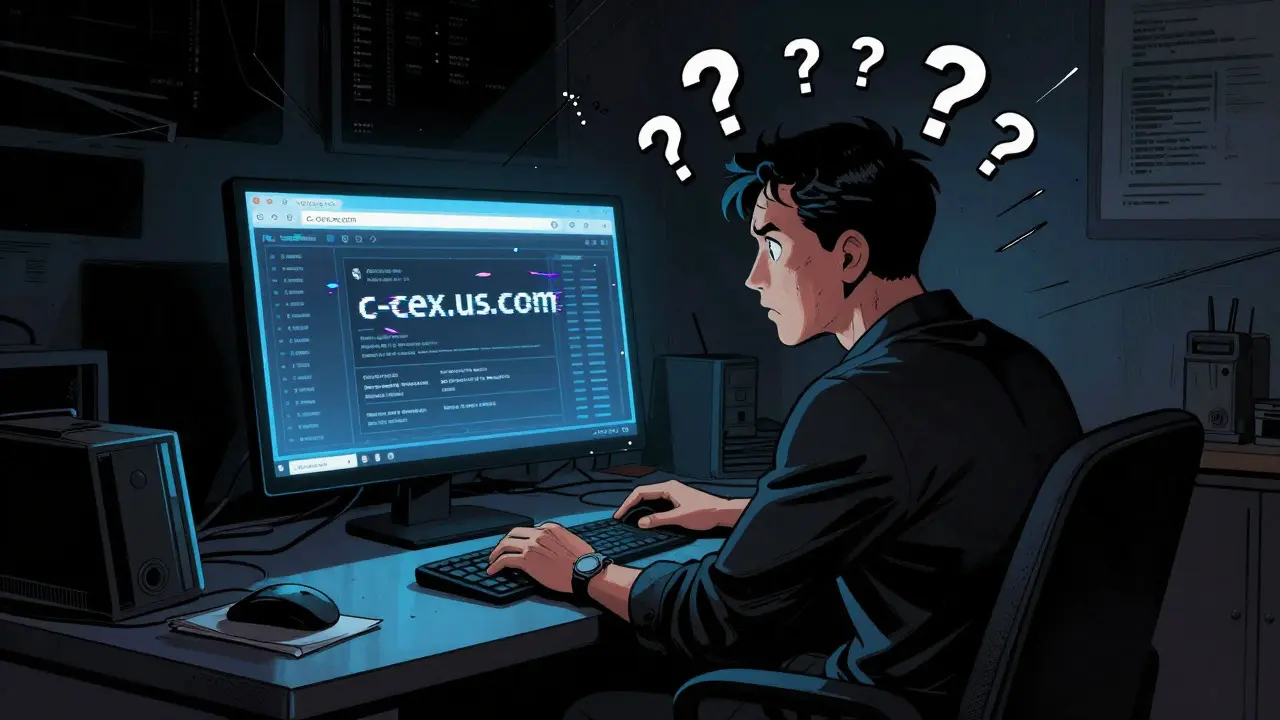
One of the first things you notice about C-CEX is its confusing history. Unlike established exchanges that have a clear corporate structure and public leadership team, C-CEX operates behind a veil of secrecy. The platform has undergone multiple domain changes, shifting from c-cex.com to c-cex.us.com and other variations. For a financial institution handling user assets, frequent domain migrations are a massive warning sign.
According to a comprehensive 2025 analysis by Traders Union, C-CEX scores a dismal 1.2 out of 5 for safety. Senior Analyst Dmitriy Mironov cited "unverified ownership" and "absence of regulatory licenses" as primary concerns. When an exchange cannot clearly state who owns it or where it is legally registered, you have no recourse if things go wrong. There is no customer protection fund, no insurance policy, and no legal entity to sue if your funds disappear.
This contrasts sharply with regulated competitors. CEX.IO, a similarly named but entirely separate platform, holds licenses in over 30 countries, including a US Money Services Business (MSB) license. C-CEX, however, operates in a legal gray area, serving retail investors primarily in regions with fewer regulated options. This lack of oversight means they are not required to prove they actually hold the assets they claim to manage.
Security Risks: More Than Just Hacking
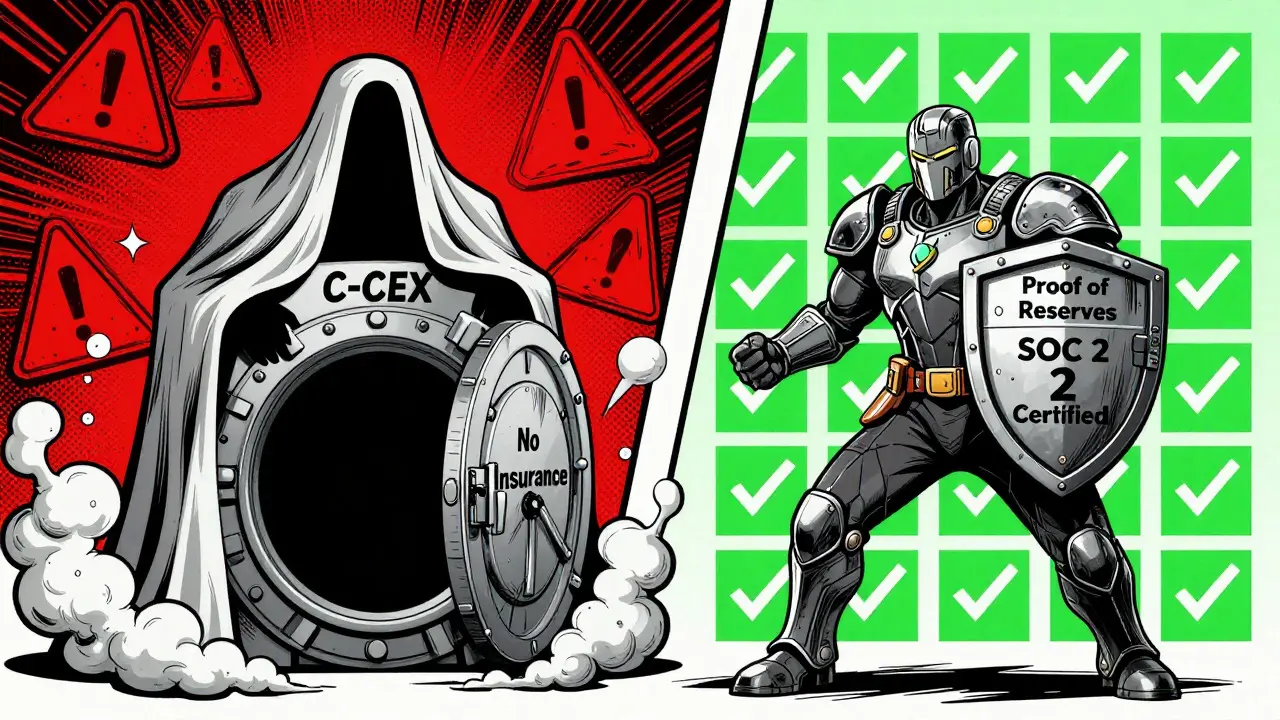
When we talk about exchange security, most people think of hackers stealing data. While that is a risk, the bigger threat with C-CEX is operational opacity. Reputable exchanges undergo regular third-party audits. Kraken and Coinbase publish quarterly proof-of-reserves reports, using cryptographic Merkle trees to prove that user balances match actual assets held in cold storage.
C-CEX provides none of this. Traders Union’s 2025 report specifically noted "inadequate cold storage implementation" and the "absence of mandatory two-factor authentication" (2FA) in earlier iterations, though recent updates claim to have added basic security features. Without independent verification, these claims are just words on a screen.
Consider the difference in insurance coverage. Coinbase maintains $255 million in insurance coverage for digital assets stored in hot wallets. If a breach occurs, users are compensated. C-CEX offers no such guarantee. If the platform goes down or funds are lost due to internal mismanagement, you are left waiting in line with thousands of other creditors, likely recovering pennies on the dollar.
| Feature | C-CEX | Coinbase | Kraken |
|---|---|---|---|
| Regulatory Licenses | None verified | 100+ Countries | Global Compliance |
| Proof of Reserves | No | Yes (Quarterly) | Yes (Quarterly) |
| Insurance Coverage | Unverified | $255M+ (Hot Wallets) | Industry Standard |
| SOC 2 Type II Certified | No | Yes | Yes |
| Mobile App Support | No | iOS & Android | iOS & Android |
Fees and Trading Experience: The Hidden Costs
Why do people still use C-CEX? Often, it comes down to perceived cost savings. User reviews on G2.com mention "low rates" as a key benefit. However, "low" is a relative term without context. Established exchanges like Binance offer maker/taker fees as low as 0.10% (or even lower with volume discounts), while Kraken starts at 0.16%. These fees are transparent and listed clearly on their websites.
C-CEX lacks a published fee schedule. You won’t find a detailed breakdown of spread costs, withdrawal fees, or hidden charges until you execute a trade. This opacity can lead to sticker shock. Furthermore, the platform suffers from poor liquidity compared to major venues. Low liquidity means wider spreads, which effectively acts as a hidden tax on every trade you make.
The user experience is also dated. C-CEX does not have a dedicated mobile application. In 2026, accessing your crypto portfolio via a mobile browser is inconvenient and less secure than using a native app with biometric login. Major competitors update their iOS and Android apps regularly, adding features like staking, futures trading, and instant buy/sell options. C-CEX remains stuck in the past, offering only basic spot trading through a web interface that some users report has compatibility issues with modern browsers like Firefox 115+.
User Sentiment: A Mixed Bag of Reviews
If you search for C-CEX reviews online, you will encounter a polarized landscape. On G2.com, the platform boasts an average rating of 4.1/5 based on 21 reviews. Users praise the "friendly interface" and "fast API." However, context matters. G2 discloses that reviewers were offered nominal gift cards for their feedback, which can skew results toward positivity.
Conversely, forums like Reddit and Bestchange.com tell a darker story. In late 2025, numerous users reported withdrawal delays averaging 7.2 days, compared to the 1-3 business day standard at Coinbase. One user on r/CryptoScams reported losing $3,200 when the platform changed domains and their account vanished. Another thread highlighted technical support response times exceeding 72 hours. When you are trying to move funds during a market crash, a three-day wait for a support ticket reply can be catastrophic.
The sentiment analysis on social media reinforces this concern. Brand24 data from September 2025 showed that 73% of tweets mentioning #CCEX expressed security worries. Positive reviews often reference specific domain variants (like c-cex.us.com), suggesting users might be reviewing different entities under similar names, further muddying the waters.
Better Alternatives for 2026
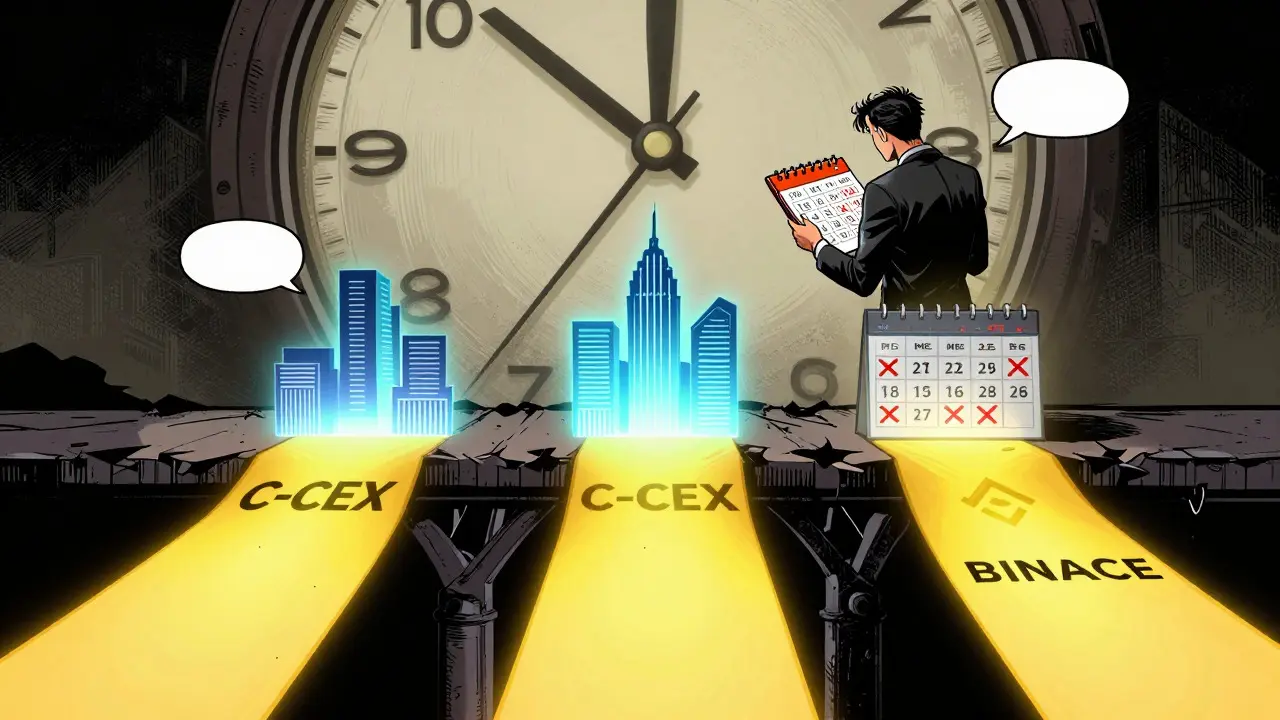
Given the risks associated with C-CEX, most traders would be better served by switching to a regulated, transparent exchange. Here are three top alternatives depending on your needs:
- For Beginners: Coinbase remains the gold standard for ease of use. With regulatory backing in over 100 countries, educational resources, and high liquidity, it is the safest entry point for new investors. Fees are slightly higher for casual users, but the peace of mind is worth it.
- For Low Fees: Kraken is renowned for its competitive fee structure and robust security. It offers deep liquidity, professional-grade tools, and excellent customer support. Kraken’s commitment to transparency with regular proof-of-reserves audits makes it a trustworthy choice for serious traders.
- For Advanced Features: Binance dominates the global market with the widest selection of cryptocurrencies (350+) and advanced trading pairs. While regulatory scrutiny varies by region, its sheer scale and liquidity make it indispensable for active traders.
All three alternatives offer mobile apps, 24/7 live chat support, and clear fee structures. They are integrated with institutional custody solutions and undergo regular security audits-features completely absent from C-CEX.
Final Verdict: Proceed with Extreme Caution
In 2026, the cryptocurrency industry is maturing rapidly. Regulatory pressure is intensifying, with 87 countries implementing or drafting crypto exchange regulations. Unlicensed platforms like C-CEX are increasingly vulnerable to shutdowns, bank freezes, or legal action. Delphi Digital’s 2025 outlook predicts a "high risk of operational discontinuation" for C-CEX within 18 months.
Unless you have a very specific reason to use C-CEX (such as access to a rare token pair not available elsewhere), the risks outweigh the benefits. The lack of regulatory oversight, opaque fee structure, and poor security track record make it a dangerous place to store significant amounts of capital. For most users, sticking to established, audited exchanges like Coinbase, Kraken, or Binance is the smarter, safer play.
Is C-CEX a legitimate exchange?
While C-CEX has operated since 2013, its legitimacy is questionable due to a lack of regulatory licenses, unverified ownership, and frequent domain changes. Major financial analysts rate it as unsafe, and it lacks the transparency required of modern financial institutions.
Does C-CEX have a mobile app?
No, C-CEX does not offer a dedicated mobile application for iOS or Android. Users must access the platform via a web browser, which can be less secure and convenient than native apps offered by competitors like Coinbase or Binance.
How do C-CEX fees compare to Coinbase?
C-CEX claims to have low fees, but its fee structure is not transparently published. Coinbase offers clear tiered fees ranging from 0.00% to 0.60%. Without verifiable data from C-CEX, it is difficult to confirm if their rates are truly lower, especially when considering potential hidden costs like wide spreads.
Is my money insured on C-CEX?
There is no public evidence that C-CEX offers insurance for user funds. In contrast, Coinbase maintains $255 million in insurance coverage for hot wallets. On C-CEX, if funds are lost due to hacks or insolvency, users have little to no protection.
Why did C-CEX change its domain?
C-CEX has shifted between domains like c-cex.com and c-cex.us.com. While the exact reasons are unclear, experts suggest these changes may be related to avoiding regulatory scrutiny or resolving domain seizure issues. Frequent domain changes are generally a red flag for stability and trust.





The fundamentalist obsession with centralized intermediaries is precisely what leads to this level of systemic fragility. One must consider the epistemological void left by the absence of verifiable proof-of-reserves, a concept that has become axiomatic in modern fintech discourse since the FTX debacle. The reliance on opaque corporate structures suggests a deliberate obfuscation of liability, which is antithetical to the transparent nature of distributed ledger technology. It is not merely a matter of 'safety' but of ontological trust; if the entity cannot be defined, it cannot be held accountable. The migration of domains serves as a digital footprint of evasive behavior, indicative of a platform operating outside the normative frameworks of financial regulation. Furthermore, the lack of institutional-grade custody solutions renders user assets vulnerable to both external vectors and internal malfeasance. We are witnessing the collapse of the 'trust us' paradigm in favor of cryptographic verification, and platforms like C-CEX are clinging to an obsolete model of authority. The disparity in security protocols between C-CEX and regulated entities like Coinbase is not just a feature difference; it is a chasm of competence. To engage with such a platform is to accept a counterparty risk that exceeds any rational utility threshold. The market eventually corrects for inefficiency and opacity, and one assumes C-CEX will succumb to this inevitable entropy.
idk seems sketchy tbh
It’s funny how we chase low fees while ignoring the cost of existential risk. The true price of freedom is vigilance, yet most traders are asleep at the wheel. They want the discount without the danger, which is a philosophical contradiction in itself. Simplicity is often the mask for deception. If it looks too good to be true, it usually is, because reality rarely offers free lunches. You pay for safety whether you see the invoice or not.
I’ve been reading through some of these older threads from 2025, and it’s actually quite fascinating to see how the narrative around smaller exchanges has shifted so dramatically over time, especially when you consider that many people were initially drawn in by the promise of lower barriers to entry and a more personalized customer service experience that larger corporations simply couldn’t match due to their sheer scale and bureaucratic inertia, which makes me wonder if there was ever a golden age for mid-tier crypto platforms or if we’re just romanticizing the chaos of the early days now that regulation has tightened its grip across the globe and forced everyone into a more standardized, albeit less exciting, framework of operation that prioritizes compliance over innovation in some cases.
Oh, look at you all playing it safe with your little regulated hand-holders! 🎭 But tell me, does Coinbase hold your soul? Does Kraken whisper sweet nothings into your ear when the market crashes? No! They give you spreadsheets. C-CEX gives you *mystery*. And isn't life worth living only when it's shrouded in a beautiful, terrifying fog? I dipped my toes in back in '19, lost a few bucks, sure, but I gained a story. A tale of woe and domain hopping! It’s art, really. The way they vanish and reappear like a ghost in the machine... it’s poetic. Don’t let the suits kill your spirit with their SOC 2 certifications. Embrace the glitch! 💃🕺
LISTEN UP!!! You need to stop putting your hard-earned cash into black holes!!! Why are you still here??? MOVE TO BINANCE!!! Or Kraken!!! Anywhere else!!! The fees might be a tiny bit higher but your SANITY will be intact!!! Don't let them fool you with those 'low rates'!!! It's a trap!!! A snare!!! Wake up and smell the burning bridges!!! Get out now!!! Before it's too late!!! Your portfolio deserves better!!! Treat yourself with respect!!!
They changed the domain again 🚩🚩🚩 because the SEC is closing in 👮♂️💸 They know the rug pull is coming 📉🔥 Keep your keys or lose your shekels 🗝️👀 The deep state wants your crypto 🏛️👁️ Don't sleep on this 🛌❌ Wake up sheeple 🐑🔔 #CCEXScam #FBIWatchList
One must interrogate the very premise of 'safety' in a decentralized ecosystem. Is it not ironic that the article champions regulatory oversight as the panacea for fraud, thereby validating the centralized hegemony it claims to critique? The contrarian view suggests that C-CEX’s opacity is a feature, not a bug, allowing for agility in a stiflingly bureaucratic landscape. Perhaps the 'scams' are merely the friction of innovation against archaic legal frameworks. Who are we to judge the methods of a platform that survives solely on merit in a dog-eat-dog arena? The jargon of 'proof-of-reserves' is itself a construct designed to pacify the masses with false certainty. True freedom lies in the unknown.
Hey folks! Just wanted to drop some wisdom here cause I've seen a lot of confusion. First off, dont put all ur eggs in one basket, right? Thats the golden rule. If u r using C-CEX, make sure u check the URL every single time cause phishers love these shady sites. Also, hardware wallets r ur best friend. Ledger or Trezor, get one. Its cheap insurance. Dont trust the exchange, trust the math. Hope this helps u stay safe out there! Stay sharp!
Fundamentally flawed architecture!!! Lack of KYC/AML compliance is a death sentence in 2026!!! Regulatory arbitrage is dead!!! Move funds immediately!!! Liquidity depth is non-existent!!! Spread costs will bleed you dry!!! Institutional grade security is mandatory!!! Do not gamble!!! Invest wisely!!! Follow the rules!!!
i mean i used it for a bit and it was fine? maybe im just lucky idk. seems like yall are stressing too much. just keep small amounts there for trading and move the rest to cold storage. chill guys.
Oh wow, another day, another scam alert! 😱 So dramatic! But seriously, who is still using web browsers for crypto in 2026? Are we time travelers from 2015? 📱✨ Get with the program! Apps exist for a reason! Security! Convenience! Style! 🌟 Don't be that guy losing his stash because he didn't update his browser settings! Stay classy, stay safe, and for heaven's sake, download an app! 😉🚀
Trust is a fragile thing. Once broken it is hard to mend. The silence of support teams speaks louder than words. When funds vanish the silence becomes deafening. We seek connection in these digital spaces but find only voids. Be kind to yourselves. Protect your peace. Choose platforms that value your humanity not just your capital. The journey is long. Walk carefully.
yo guys just heard about this place. sounds kinda sus ngl. gonna stick to binance for now cause at least i know where my money is going. hope yall stay safe out there in the wild west of crypto! lets gooo 🔥
my account got locked last week and nobody replied to my emails. i feel so ignored and helpless. why do they do this to us? i just wanted to trade some btc. now i feel like crying. its so unfair. please someone help me understand what went wrong. i miss my money.
THIS IS AN AMERICAN PROBLEM!!! WHY DO WE ALLOW FOREIGN ENTITIES TO STEAL OUR DIGITAL GOLD???!!! THE SYSTEM IS BROKEN!!! WE NEED STRONGER LAWS!!! PROTECT OUR ASSETS!!! MAKE AMERICA SAFE AGAIN!!! SHUT THEM DOWN!!! NOW!!! NO MERCY!!! JUSTICE FOR THE TRADERS!!! USA!!! 🇺🇸🇺🇸🇺🇸