Staking vs Mining Profitability: Which Pays More in 2026?
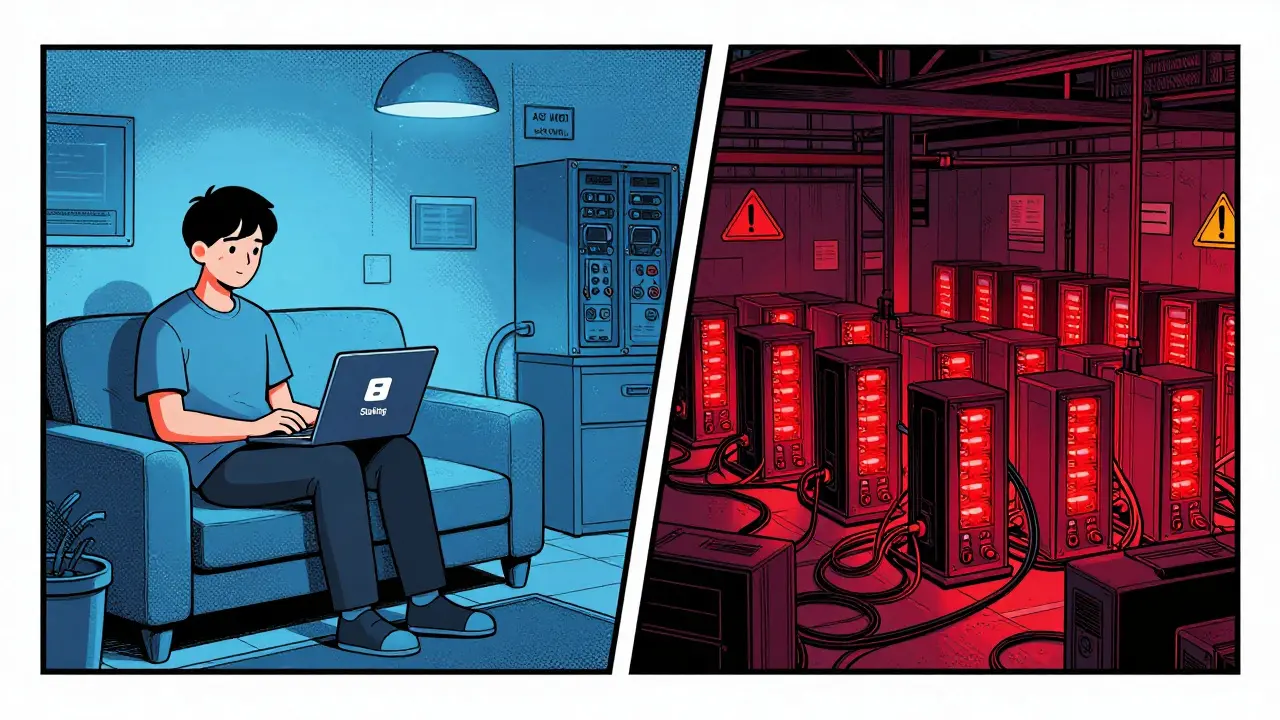
You want to earn passive income from your cryptocurrency holdings. You have two main paths: locking up coins to secure a network (staking) or buying loud, hot machines to solve math puzzles (mining). But which one actually puts more money in your pocket? The answer has changed dramatically since the industry shifted gears.
In 2026, the landscape is clear. For most people, staking profitability beats mining hands down. It’s cheaper, quieter, and far less risky. Mining is now an industrial game played by companies with access to cheap hydroelectric power and warehouses full of ASICs. If you’re reading this from your living room, staking is likely your only viable option for consistent returns.
The Core Difference: Energy vs. Capital
To understand why profits differ, you first need to see what you are paying for. These two methods rely on completely different consensus mechanisms.
Mining is the process of using specialized hardware to solve cryptographic puzzles to validate transactions on Proof-of-Work networks like Bitcoin. It requires massive amounts of electricity and physical infrastructure. Your profit comes from the block reward minus the cost of that electricity and the depreciation of your hardware.
Staking is the act of locking up cryptocurrency tokens to help validate transactions on Proof-of-Stake networks like Ethereum. Instead of burning energy, you put up capital as collateral. Your profit comes from transaction fees and newly minted tokens distributed by the protocol.
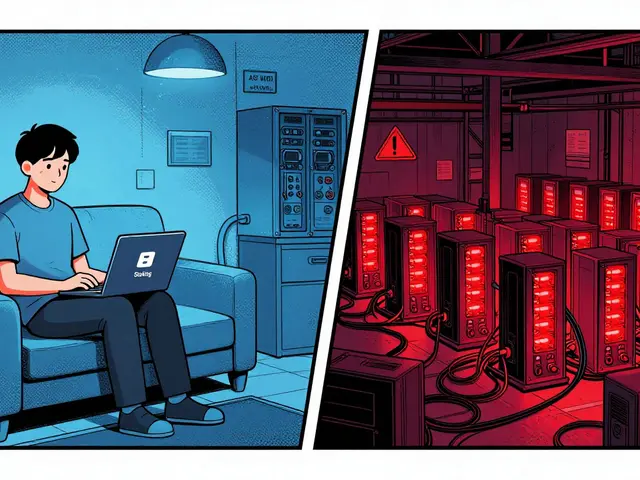
Think of it this way: Mining is like running a factory. You buy expensive machinery, pay huge utility bills, and hope the product price stays high enough to cover costs. Staking is like buying a bond. You lock up cash, wait for interest payments, and get your principal back when you’re done. One is active labor; the other is passive investment.
Profitability Breakdown: What Are the Numbers?
Let’s look at the actual returns you can expect in 2026. I’ve broken this down into realistic scenarios based on current market data.
| Factor | Staking (PoS) | Mining (PoW) |
|---|---|---|
| Average Annual Return (APR) | 3% - 11% | 5% - 25% (Highly Volatile) |
| Upfront Cost | $100 - $50,000+ | $10,000 - $1M+ (Hardware) |
| Ongoing Costs | Near Zero | High (Electricity & Maintenance) |
| Risk Level | Low (Slashing risk exists) | Very High (Obsolescence & Price drops) |
| Best For | Individual Investors | Industrial Operations |
Staking yields are predictable. On major networks like Ethereum, you’ll typically see between 3% and 6% APR. Smaller, newer chains might offer 10% or more, but they carry higher risk. The key here is consistency. Whether the coin price goes up or down, your percentage yield remains relatively stable.
Mining returns are a rollercoaster. In a bull market, if Bitcoin prices surge, your mining operation could easily return 20% or more annually. But in a bear market, those same machines become money pits. Why? Because the network difficulty adjusts upward as more miners join, while your electricity bill stays fixed. If the coin price drops below your break-even point (often around $0.05 per kWh for electricity), you lose money every day the machine runs.
The Hidden Costs That Kill Mining Profits
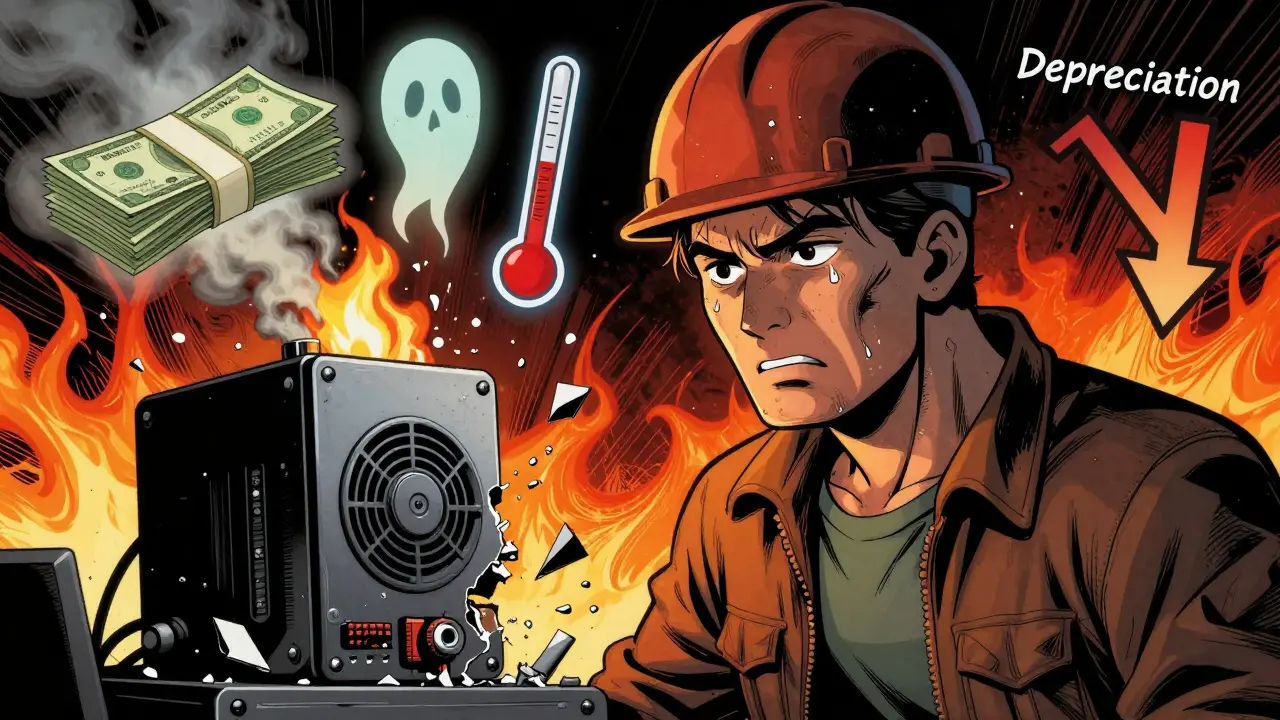
When people calculate mining profitability, they often forget three critical expenses. These are the silent killers of home mining operations.
- Hardware Depreciation: An ASIC miner loses value rapidly. A top-tier machine today might be obsolete in 18 months due to new, more efficient models entering the market. You aren’t just earning against electricity costs; you’re earning against the shrinking resale value of your gear.
- Cooling and Infrastructure: Miners run hot-very hot. In Wellington, where it’s mild, you might think you don’t need AC. Wrong. Running a single powerful ASIC can raise the temperature of a small room significantly. You need ventilation, ducting, and potentially air conditioning, all of which consume extra electricity.
- Network Difficulty Spikes: When prices rise, more miners turn on their rigs. This increases the "difficulty" of the puzzles. Your machine solves fewer blocks over time, meaning your daily earnings drop even if the coin price stays flat.
Staking avoids all of these. There is no hardware to break, no heat to manage, and no difficulty adjustment that affects your personal yield directly. Your reward is tied to the total amount of stake in the network, not how fast your computer calculates hashes.
Barriers to Entry: Can You Actually Start?
This is where the gap widens. Let’s talk about accessibility.
For staking, the barrier is low. You can start with as little as $100 worth of tokens on many platforms. If you want to stake Ethereum solo, you need 32 ETH (which is expensive), but you can use liquid staking derivatives or exchange-based staking to participate with much smaller amounts. The technical knowledge required is basic: how to use a wallet and how to transfer funds. Most major exchanges like Coinbase or Kraken make this a one-click process.
For mining, the barrier is high. To be profitable in 2026, you generally need industrial-scale efficiency. Individual miners struggle unless they have access to subsidized electricity rates (below $0.04/kWh). Setting up a mining rig involves understanding hash rates, terahashes, power supply units, and thermal dynamics. It’s not just plugging in a device; it’s managing a mini-data center. If your internet cuts out or your power flickers, you lose potential rewards instantly.
Risk Assessment: Slashing vs. Obsolescence
No investment is without risk. You need to know what could go wrong.
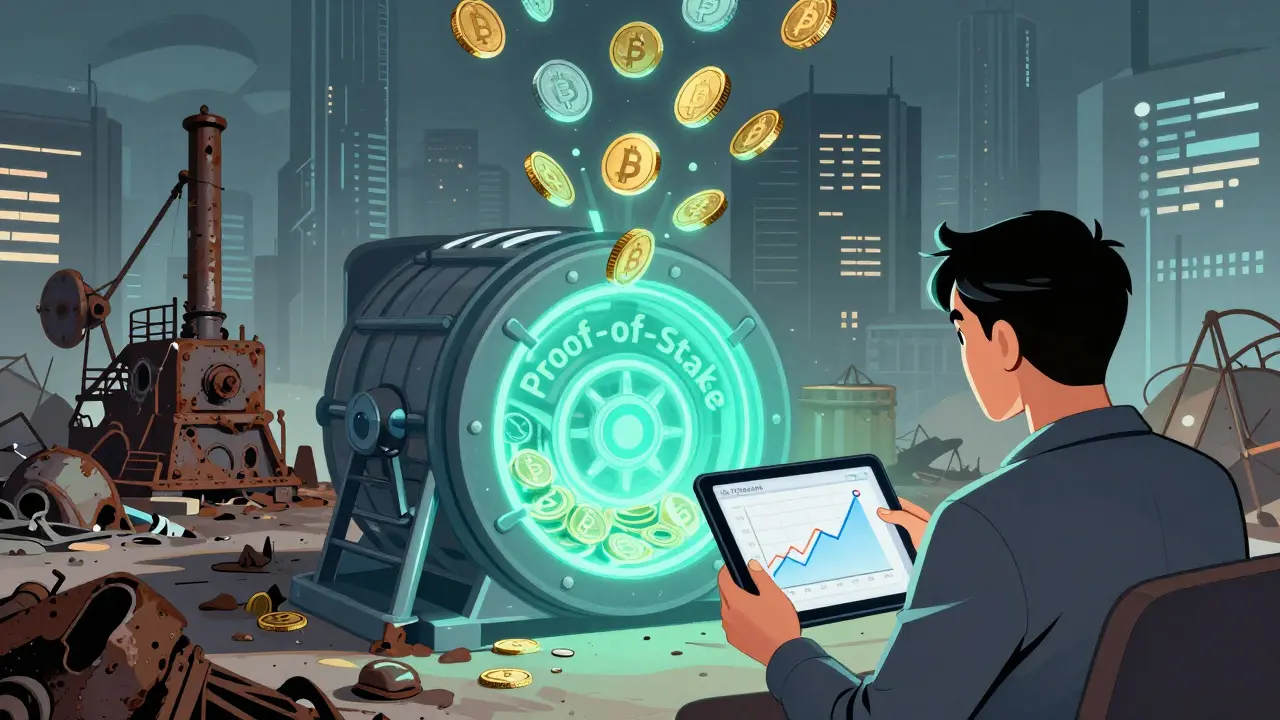
In staking, the primary risk is "slashing." If you run a validator node incorrectly (for example, if your server goes offline for too long or you try to sign conflicting blocks), the protocol penalizes you by burning a portion of your staked funds. However, if you use a reputable staking pool or exchange, this risk is minimized because they manage the technical uptime for you. Another risk is liquidity; some networks lock your funds for a specific period, meaning you can’t sell during a crash.
In mining, the risk is obsolescence and regulatory pressure. Governments worldwide are cracking down on high-energy consumption activities. In regions like the EU and parts of the US, regulations are tightening around PoW mining due to environmental concerns. Additionally, if a new generation of miners releases with twice the efficiency, your current hardware becomes nearly worthless overnight. You are stuck with depreciating assets in a volatile market.
Which Should You Choose in 2026?
If you are an individual investor looking for steady, passive income, staking is the clear winner. It offers better risk-adjusted returns, lower entry costs, and zero maintenance. You sleep soundly knowing your assets are working for you without worrying about a blown fuse or a spike in energy bills.
Mining is only worth considering if you have access to extremely cheap renewable energy, significant capital for hardware upgrades, and technical expertise to manage the infrastructure. Even then, many professional miners are diversifying into staking services to hedge against volatility.
The trend is undeniable. As more blockchains move to Proof-of-Stake for sustainability and scalability, the window for profitable retail mining is closing. Staking is not just a temporary alternative; it is becoming the standard way to earn yield in the decentralized finance ecosystem.
Is staking safer than mining?
Yes, generally. Staking carries financial risks like price volatility and slashing penalties, but it lacks the operational risks of mining. Mining involves hardware failure, high electricity costs, and rapid equipment obsolescence, which can lead to significant losses if market conditions change.
Can I mine Bitcoin profitably at home in 2026?
It is highly unlikely. Bitcoin mining is dominated by large industrial farms with access to sub-$0.05/kWh electricity. Residential electricity rates are usually too high to compete with the network difficulty, meaning your electricity costs will likely exceed your Bitcoin rewards.
What is the minimum amount needed to start staking?
It depends on the method. Solo staking on Ethereum requires 32 ETH. However, through liquid staking protocols or centralized exchanges, you can start staking with as little as $10 to $50 worth of tokens, making it accessible to almost anyone.
Does staking affect the environment?
Minimal impact. Staking consumes negligible energy compared to mining. While mining operations can use as much electricity as small countries, staking nodes run on standard servers or laptops, reducing energy consumption by over 99%.
Are there taxes on staking and mining rewards?
In most jurisdictions, including New Zealand and the US, both staking and mining rewards are considered taxable income at the time they are received. You must report the fair market value of the coins earned on the day they are credited to your wallet.