
Crypto Restrictions for Qatar Residents: What You Can and Can't Do in 2026
If you're a resident of Qatar and you've ever tried to buy Bitcoin, use a crypto wallet, or trade Ethereum, you already know it's not easy. In fact, it's not legal - at least not the way most people think of cryptocurrency. Since September 2024, Qatar has tightened its rules even further, making it one of the strictest places in the Gulf when it comes to digital money. But here's the twist: it's not all black and white. While Bitcoin and other popular coins are banned, there's a new path open for investing in digital versions of real assets like property, stocks, and commodities. This isn't a loophole. It's a carefully designed system - and if you don't understand the difference, you could be breaking the law without even realizing it.
What's Actually Banned in Qatar?
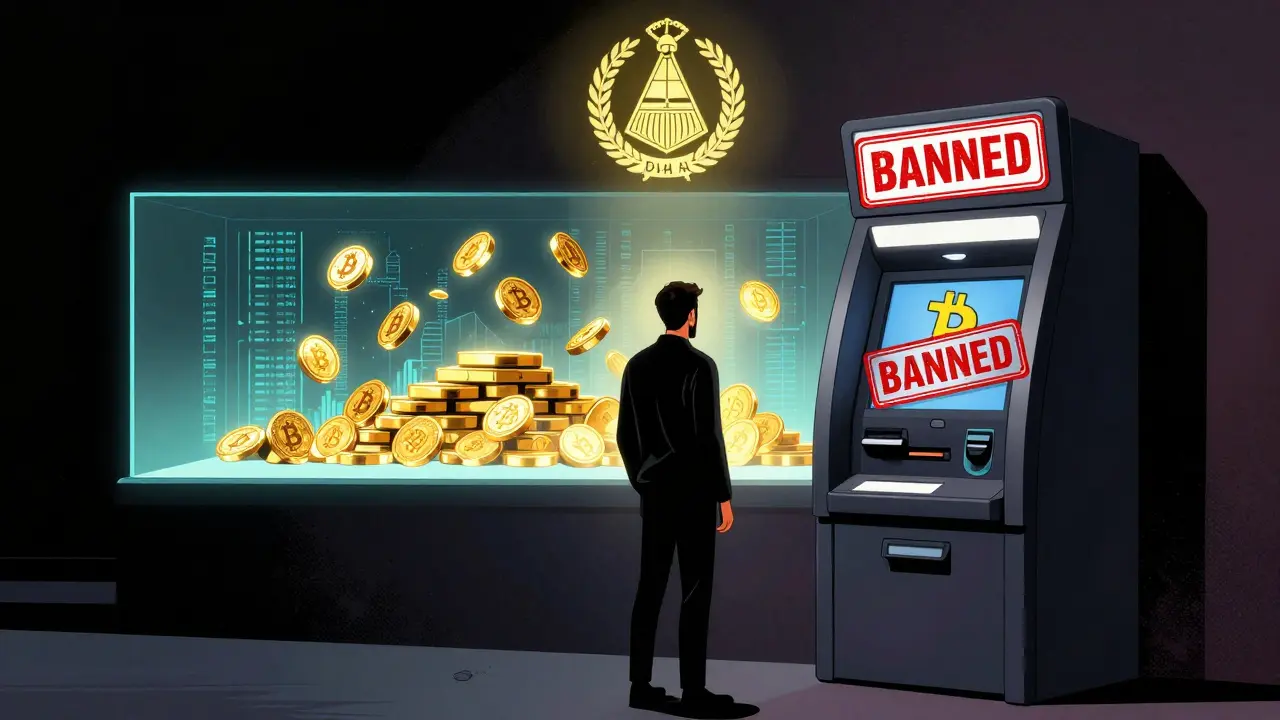
The short answer: everything that acts like money. That includes Bitcoin, Ethereum, Solana, Dogecoin - any cryptocurrency that isn't tied to a physical asset. Stablecoins like USDT or USDC are also banned. Even central bank digital currencies (CBDCs) are off-limits under Qatar's rules. These are all classified as "Excluded Tokens" under the Digital Assets Regulations 2024 a set of rules introduced by the Qatar Financial Centre Authority and QFC Regulatory Authority that define what digital assets are legal in Qatar. The government doesn't just discourage these; it prohibits them outright. Banks, exchanges, and wallet providers operating in Qatar can't touch them. If you try to use a local service to buy or sell crypto, you're violating the law.
This isn't new. Qatar started cracking down in 2018 when the Central Bank banned banks from handling crypto transactions. By 2020, the Qatar Financial Centre shut down all virtual asset services within its jurisdiction. The 2024 update didn't change the ban - it just made it clearer. The QFCRA confirmed that anything considered a "currency substitute" remains illegal. So if you're thinking of using crypto to pay for goods or send money abroad, forget it. The system is built to block that.
What Can You Legally Invest In?
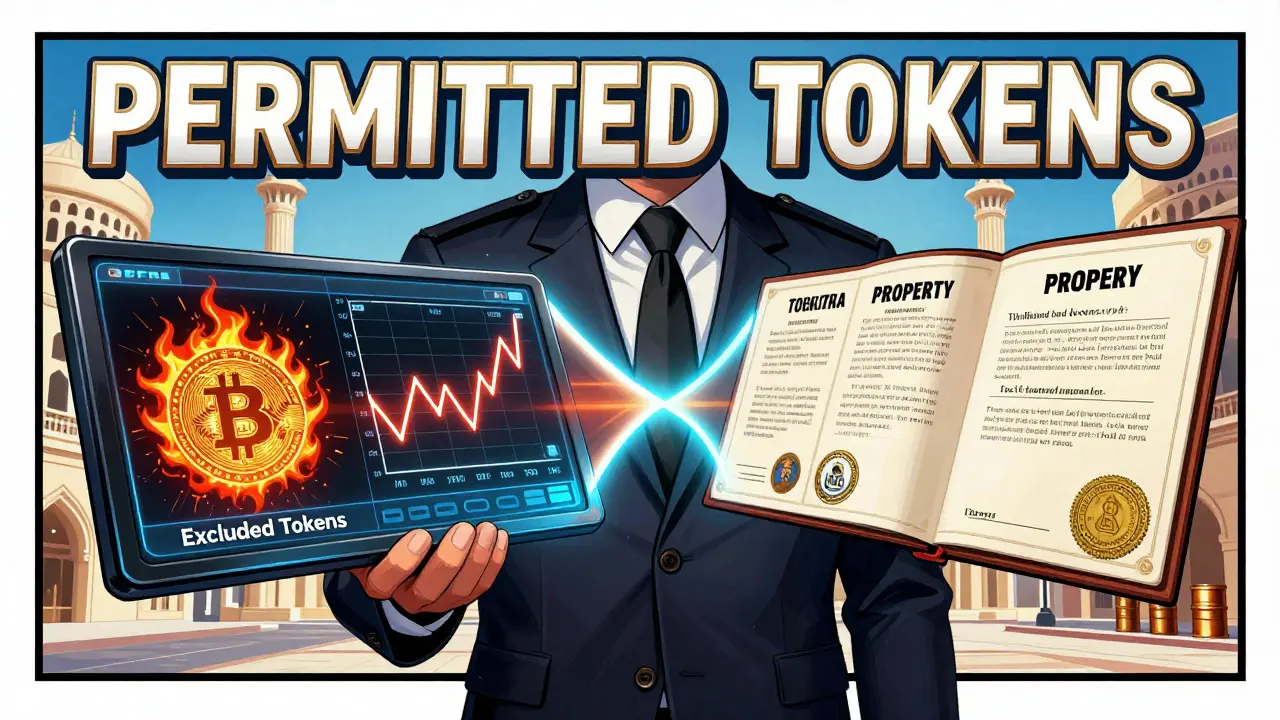
Here’s where things get interesting. Qatar isn't rejecting blockchain technology - it's redirecting it. The Digital Assets Framework 2024 a regulatory system that allows tokenization of real-world assets under strict conditions in Qatar created a legal path for something called "Permitted Tokens." These aren't cryptocurrencies. They're digital certificates tied directly to real assets. Think of them like digital deeds. If you own a piece of real estate in Doha, someone can tokenize it - turn it into a digital token - and sell shares of that property to investors. Same goes for bonds, sukuk (Islamic finance instruments), commodities like gold or oil, or even shares in a Qatari company.
The process isn't open-ended. There are three mandatory steps:
- Validation - A licensed validator confirms the asset exists and who owns it.
- Request - The asset owner formally asks for it to be tokenized.
- Generation - A licensed token generator creates the digital token on approved infrastructure.
You can't just mint your own token. You need to work with an authorized provider. These aren't random startups - they're firms licensed by the QFCRA. This means if you want to invest in tokenized real estate, you're not using Binance or Coinbase. You're using a regulated Qatari firm that follows government rules. And because these tokens are tied to physical assets, they're treated like securities under Qatari law.
Why Does Qatar Ban Crypto But Allow Tokenization?
Qatar’s government doesn't hate technology. It hates uncertainty. Cryptocurrencies are volatile, anonymous, and hard to track. That makes them risky for a country that wants to attract foreign investment and maintain financial stability. Bitcoin can spike 50% in a week and crash just as fast. That kind of swing isn't compatible with Qatar's long-term economic planning.
Tokenized assets, on the other hand, are anchored in reality. A token representing a 10% share in a luxury apartment in West Bay has real value. If the apartment sells for $2 million, the token’s value reflects that. It's not speculation - it's ownership. This approach lets Qatar tap into blockchain’s efficiency without opening the door to money laundering, ransomware payments, or unregulated gambling.
Experts point out that this strategy sets Qatar apart from neighbors like the UAE, which allows crypto exchanges to operate under licenses. Qatar chose control over openness. It wants the benefits of digital ledgers - faster settlements, transparent records - without letting crypto become a parallel financial system.
What Happens If You Break the Rules?
There are no public cases of individuals being prosecuted for personal crypto use - but that doesn't mean it's safe. The law is clear: any service dealing with "Excluded Tokens" is illegal. If you're caught using a local exchange, running a crypto wallet service, or facilitating trades, you could face fines or even criminal charges. The Law No. 20 of 2019 Qatar's anti-money laundering and counter-terrorism financing law that defines "funds" to include digital assets gives authorities broad power. It defines "funds" as anything obtained through "electronic and digital" systems. So even if Bitcoin is banned, using it could still trigger an AML investigation.
For businesses, the consequences are more severe. Any company offering crypto services - even if it's based overseas - risks being blocked from operating in Qatar. The QFCRA has the power to cut off access to the financial system for non-compliant firms. There's no gray area: if your service touches crypto, you're out.
Can You Use Crypto Outside Qatar?
Technically, yes - but with major risks. If you use a foreign exchange like Kraken or Binance from your phone while in Qatar, you're not breaking any law by accessing it. But you're still vulnerable. Qatari authorities can monitor bank transactions. If you deposit money into a foreign exchange and then withdraw it as fiat currency, that could raise red flags. The government doesn't track individual wallets, but it does track money flows. If you're moving large sums in and out of the country using crypto, expect scrutiny.
Also, remember: if you're employed by a Qatari company, using crypto could violate your employment contract. Many firms prohibit employees from engaging in unregulated financial activities. And if you're a foreign resident on a work visa, breaking financial laws could affect your residency status.
What Should You Do Instead?
If you're looking to invest in digital assets legally in Qatar, your only option is tokenized real-world assets. Start by researching licensed providers operating under the QFCRA. These firms will offer tokenized shares in Qatari companies, fractional ownership in commercial properties, or bonds backed by infrastructure projects. You'll need to go through KYC (Know Your Customer) checks - not because crypto is involved, but because you're buying a regulated security.
Don't assume all "blockchain" projects are equal. A tokenized bond isn't the same as a meme coin. The former has legal backing, audited assets, and clear ownership rights. The latter is pure speculation - and in Qatar, speculation is illegal.
Keep an eye on updates from the QFCRA. The 2024 framework is still new, and more asset classes may be added. But don't expect Bitcoin to ever be allowed. The government has made it clear: if it's not tied to something real, it's not welcome.
How This Compares to Other Gulf Countries
Qatar isn't alone in being cautious - but it's the strictest. The UAE, especially Dubai, has become a crypto hub. Exchanges like Bybit and OKX have offices there. Saudi Arabia allows crypto trading under licensed providers. Even Bahrain has a crypto sandbox for startups. But Qatar? It's the outlier. It doesn't want to be a crypto gateway. It wants to be a financial center built on transparency, not speculation.
This means if you're comparing investment options across the Gulf, Qatar offers less freedom but more stability. You won't get rich quick with crypto here. But you might get steady returns from tokenized real estate or sovereign bonds - with full legal protection.
| Feature | Qatar | UAE (Dubai) | Saudi Arabia | Bahrain |
|---|---|---|---|---|
| Cryptocurrency trading legal? | No | Yes (licensed) | Yes (licensed) | Yes (sandbox) |
| Stablecoins allowed? | No | Yes | Yes | Yes |
| Tokenized real estate allowed? | Yes | Yes | Yes | Yes |
| Banking access for crypto firms? | No | Yes | Yes | Yes |
| Primary focus | Real-world asset tokenization | Crypto innovation | Crypto adoption | Startup testing |
Future Outlook: What's Next for Qatar?
Don't expect the ban on Bitcoin to lift anytime soon. The 2024 framework was designed to last. The QFCRA has signaled it will expand the list of permitted assets - maybe tokenized art, intellectual property, or carbon credits. But cryptocurrencies? They're locked out. The government has made it clear: if it can't be touched, weighed, or measured, it doesn't belong in Qatar's financial system.
One thing to watch: Qatar's interest in CBDCs. Even though the Digital Assets Framework 2024 excludes central bank digital currencies, the country is exploring its own digital riyal. If launched, it could become the only legal digital currency for residents - replacing crypto entirely. That would make Qatar the first Gulf nation to fully replace private digital money with a state-backed version.
For now, the message is simple: if you want to invest digitally in Qatar, go through the system. Don't try to bypass it. The rules are strict, but they're also clear. And in a country that values order above chaos, that's worth following.
Is Bitcoin completely illegal in Qatar?
Yes. Bitcoin and all other cryptocurrencies are classified as "Excluded Tokens" under Qatar's Digital Assets Regulations 2024. They are banned from being traded, held, or serviced by any entity within Qatar’s jurisdiction, including banks and financial institutions.
Can I use a foreign crypto exchange like Binance while living in Qatar?
You can access foreign exchanges from Qatar, but doing so carries financial and legal risks. While there's no explicit law banning personal use, your bank transactions may be monitored. Large deposits or withdrawals linked to crypto exchanges could trigger investigations under Qatar's anti-money laundering laws. It's not recommended.
Are there any legal ways to invest in digital assets in Qatar?
Yes. You can invest in tokenized real-world assets like real estate, bonds, shares, or commodities through QFCRA-licensed providers. These are not cryptocurrencies - they're digital certificates backed by tangible assets and regulated under the Digital Assets Framework 2024.
Can I mine Bitcoin in Qatar?
Mining Bitcoin or any other cryptocurrency is effectively illegal in Qatar. Even if done privately, it falls under the ban on cryptocurrency activities. The electricity usage and financial flows associated with mining could attract regulatory attention under Qatar's financial surveillance laws.
What happens if I get caught using crypto in Qatar?
There are no public cases of individuals being punished for personal use, but authorities have broad powers under Law No. 20 of 2019. If you're using crypto for transactions, sending large sums, or operating a service, you could face fines, account freezes, or legal action - especially if linked to money laundering or terrorism financing investigations.
Will Qatar ever allow Bitcoin in the future?
Highly unlikely. The 2024 framework explicitly excludes cryptocurrencies and stablecoins from its scope. Qatar’s strategy is to focus on asset-backed tokens, not speculative digital currencies. There are no signs of policy reversal, and officials have repeatedly emphasized their preference for tangible, regulated assets over decentralized coins.
Are stablecoins like USDT legal in Qatar?
No. Stablecoins are classified as "Excluded Tokens" because they act as currency substitutes. Even though they're pegged to the U.S. dollar, they are banned under Qatar's regulations just like Bitcoin and Ethereum.
Can I buy tokenized real estate in Qatar as a foreigner?
Yes. Foreigners can invest in tokenized real estate through licensed providers in the Qatar Financial Centre. These tokens represent fractional ownership in property, and the process follows the same legal framework as traditional real estate investment - just digitally recorded.


The QFCRA’s 2024 framework isn’t just regulation-it’s a structural reorientation of financial epistemology. Bitcoin as a currency substitute is ontologically incoherent within a rentier-capitalist paradigm anchored in tangible asset sovereignty. Tokenization isn’t an innovation-it’s the inevitable convergence of fiduciary duty and blockchain’s immutable provenance. You can’t have decentralized money in a system that demands centralized accountability. This isn’t censorship. It’s epistemic hygiene.
Let me break this down for you because clearly you didn’t read the fine print. The distinction between Excluded Tokens and Permitted Tokens isn’t semantic-it’s legal architecture. If it’s not backed by a deed, a bond, or a physical commodity with audited title, it’s not an asset. It’s a meme with a wallet. And yes, USDT is banned because it pretends to be stable while being as volatile as a toddler’s mood swing. You think you’re investing? You’re gambling with a side of regulatory risk.
qatar think they smart but they just scared of tech. usa and dubai got it right. crypto is freedom. you dont need permission to own money. qatar want you to beg for permission to invest in your own future. this is not finance. this is feudalism with wifi.
The regulatory clarity here is refreshing. Most jurisdictions treat crypto like a wild west-Qatar treated it like a broken system and rebuilt the foundation. Tokenized real estate? That’s not just smart. It’s the future of institutional-grade digital ownership. If you’re still clinging to Bitcoin as an asset class, you’re not investing-you’re collecting digital stickers.
They say 'no crypto' but what they really mean is 'no privacy'. The moment you use a tokenized asset, every transaction is logged, tracked, and reported. The government doesn't hate crypto-they hate anonymity. And if you think they're not monitoring your bank transfers when you send money to Binance? You're naive. This isn't regulation. It's surveillance dressed up as compliance.
So let me get this straight. You can own 0.001% of a skyscraper in Doha via blockchain, but you can’t buy a single Bitcoin? That’s like saying you can own a slice of pizza but not a whole one. The logic here is so beautifully absurd it’s almost poetic. The government wants blockchain’s efficiency but denies its soul. They’re building a Tesla with horse reins.
I feel so seen. This is exactly what I’ve been screaming into the void for years. Crypto is emotional labor disguised as finance. Tokenized assets? That’s real wealth. That’s legacy. That’s something you can touch. Bitcoin? A fever dream for people who think ‘decentralized’ means ‘no consequences’. I’m not mad. I’m just… disappointed.
I dont get why people are mad about this. If you want to be rich, invest in real stuff. Not some digital ghost. Qatar gets it. The world is moving to real assets. Crypto is just noise. I bought a piece of a mall in Doha last year. It pays me rent. I dont need Bitcoin.
So Qatar banned crypto… but let’s you buy a digital deed to a building? That’s like banning soda but letting you drink sugar water in a fancy bottle. The irony is so thick you could spread it on toast.
Let’s be clear: tokenization isn’t innovation-it’s asset capture under a blockchain veneer. You think you’re investing? You’re becoming a shareholder in a state-sanctioned rentier system. Qatar isn’t building a financial future. It’s building a gated community for capital. And you’re paying the membership fee with your trust.
If you’re new to this, here’s the simple version: Qatar says ‘no to speculation, yes to ownership’. That’s not restrictive. That’s responsible. You don’t need to trade Dogecoin to build wealth. You need to invest in things that actually exist. Start with a licensed provider. Do your KYC. Ask questions. You’ve got this.
I’m so proud of Qatar for doing this right 😊 Tokenized assets = real value 💎 Crypto = vibes 🤷♀️ I invested in a tokenized desert villa last month. It’s beautiful. And legal. And my bank didn’t freeze my account. Win-win!
This is the future 🚀 No more wild crypto gambling. Just clean, regulated, real-world ownership. I used to trade Bitcoin. Now I own a piece of a solar farm in Qatar. It’s not flashy. But it pays. And I sleep better. 🌞
theyre lying. this is just a way to control us. tokenized assets? its all tracked. the government knows everything. theyll use it to punish you later. dont trust them. even if its legal its still a trap. i know what theyre doing.
Qatar doing what the rest of the world is scared to do 🌏💎 Tokenized real estate > meme coins any day. I’m so here for it. This is the future. And it’s elegant. 🤍
The real issue isn't crypto vs tokenization. It's the epistemic rupture between decentralized trust and institutionalized control. The QFCRA didn't ban Bitcoin because it's dangerous. They banned it because it undermines the ontological authority of the state. This isn't finance. It's metaphysics with a compliance officer.
i read this whole thing and honestly qatar is being smart. i live in india and we have so many scams with crypto. people lose everything. tokenized assets feel safer. i dont need bitcoin. i need a roof over my head. this makes sense
Oh please. Tokenized assets are just crypto with a suit. You think they’re not going to collapse? That building you own 0.01% of? What if it burns down? What if the validator goes bankrupt? What if the government changes its mind? This is the same game. Just prettier. And more expensive. You’re being sold a fairy tale with legal paperwork.
This is a model other nations should study. Qatar has created a regulatory environment that protects investors while enabling innovation. Tokenized assets offer transparency, liquidity, and accessibility-without the volatility and opacity of speculative tokens. This is not restriction. This is responsibility. And it is commendable.