

Crypto Taxation in India: What You Must Know in 2025
If you’re trading Bitcoin, Ethereum, or even NFTs in India, you’re not just dealing with price swings-you’re dealing with one of the strictest crypto tax systems in the world. Since April 2022, the Indian government has treated all cryptocurrencies as Virtual Digital Assets (VDAs), and the rules are not just complex-they’re punishing. There’s no long-term vs short-term distinction. No deductions for fees. No indexation to beat inflation. Just a flat 30% tax on every profit, plus a 1% tax deducted at source on every trade. And now, in 2025, you’re also paying 18% GST on exchange fees.
How Crypto Gains Are Taxed in India
Every time you sell Bitcoin for INR, trade it for another coin, or even swap one token for another, it’s a taxable event. The government doesn’t care if you held it for a day or a year. Profit? 30% gone. That’s it.
Here’s how it works: your taxable gain is the difference between what you sold it for and what you paid for it. You can’t deduct anything else-not the gas fees, not the exchange fees, not even the cost of buying a hardware wallet. Only the original purchase price counts. So if you bought 0.1 BTC for ₹3,50,000 and sold it for ₹5,00,000, your gain is ₹1,50,000. Tax? ₹45,000. Plus, the 4% health and education cess adds another ₹1,800. Total tax: ₹46,800. That’s 31.2% of your profit.
And if you got crypto for free? Like through staking rewards, airdrops, or mining? That’s treated as income. The fair market value on the day you received it gets added to your taxable income and taxed at your normal slab rate-up to 30% or even higher if you’re in the top bracket.
The 1% TDS That’s Eating Into Your Profits
On top of the 30% capital gains tax, there’s a 1% Tax Deducted at Source (TDS) on every crypto transaction over ₹10,000. For high-net-worth individuals, the threshold is ₹50,000. This isn’t an advance tax-it’s a deduction taken by the exchange before you even see your money.
Let’s say you sell ₹2,00,000 worth of Ethereum. The exchange takes ₹2,000 as TDS and gives you ₹1,98,000. You think you’ll get this back when you file your return. But here’s the catch: TDS credit reconciliation is a nightmare. Many users report mismatches between what the exchange reports and what shows up in their Annual Information Statement (AIS). ClearTax found that 32.7% of taxpayers in FY 2023-24 had trouble claiming their TDS credits. If you don’t fix it, that ₹2,000 is just gone.
18% GST on Exchange Fees (New in 2025)
Starting July 7, 2025, every fee you pay to a crypto exchange-whether it’s for trading, withdrawing, depositing, or even staking rewards processing-is now subject to 18% GST. This isn’t optional. Platforms like WazirX, CoinDCX, and ZebPay are now required to register for GST regardless of their turnover, issue proper invoices, and collect this tax from every Indian user.
What does this mean for you? If you pay ₹500 in trading fees, you’re now paying ₹90 in GST on top of it. That’s an extra 18% cost on every transaction. Industry analysts estimate this will push exchange fees up by 15-20%, and those costs will trickle down to retail traders. You’re not just paying tax on your gains-you’re paying tax on the tools you use to trade.

What Counts as a Virtual Digital Asset?
The law defines VDAs broadly. Bitcoin, Ethereum, Solana, Dogecoin, Polkadot, Cardano-all covered. NFTs? Yes. Tokenized real estate? Yes. Even DeFi tokens like UNI or AAVE fall under this. The government doesn’t care if it’s a meme coin or a utility token. If it’s digital, non-fungible, or blockchain-based, it’s taxed.
But here’s what’s not included: gift cards, loyalty points, vouchers, or digital coupons. Those are treated as regular goods or services under GST, not as VDAs.
Why This System Is Criticized
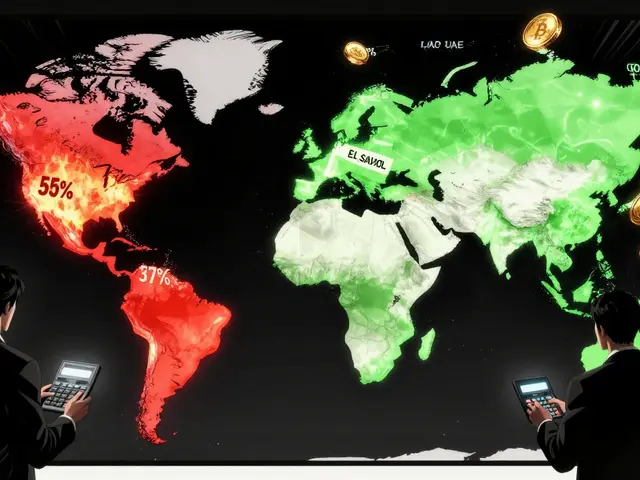
India’s crypto tax model is unique-and controversial. No other major economy combines a 30% flat tax with mandatory TDS on every transaction. The U.S. taxes crypto gains at 0-20% if held over a year. Portugal doesn’t tax crypto gains at all for individuals. Singapore has no capital gains tax. India’s approach is not about encouraging adoption-it’s about controlling it.
Experts like Dr. Indranil Bhattacharya from IIM Ahmedabad point out that the 30% rate without indexation means you’re taxed on nominal gains that might just cover inflation. If you bought Bitcoin in 2020 for ₹5 lakh and sold in 2025 for ₹8 lakh, your real gain after inflation might be zero-or even negative. Yet you still pay ₹2.4 lakh in tax.
The Blockchain and Crypto Assets Council (BACC) argues this structure kills innovation. Retail participation in crypto trading dropped from 82% in 2021 to 57% in 2024. A WazirX survey of 12,500 traders found 68.7% called the tax system “excessively punitive.” Many have stopped trading altogether.
What You Need to Track
To file your crypto taxes correctly, you need:
- Complete transaction history: buys, sells, swaps, staking rewards, airdrops
- Exact timestamps for every transaction
- INR value at the time of each transaction (based on Indian exchange rates)
- Wallet addresses involved
- Proof of acquisition cost (screenshots, exchange receipts)
Manually tracking this takes 8-12 hours per quarter. But tools like KoinX, CoinTracker, and CryptoTaxCalculator India have cut that down to 2-3 hours. These platforms auto-sync with exchanges, calculate gains, generate reports, and even help reconcile TDS credits.
DeFi, Cross-Border, and the Gray Areas
Here’s where things get messy. What if you used Uniswap to swap tokens? Or earned yield on Aave? Or received crypto from a foreign exchange? The government hasn’t clarified how to treat DeFi protocols, liquidity mining, or cross-border transfers. TaxGuru’s Pallavi Patel says this is the biggest compliance gap right now.
Some users report paying tax on DeFi rewards as income, while others argue it’s not realized until withdrawal. There’s no official guidance. That means you’re on your own-and if the tax department audits you, you’ll need to justify every move.
What’s Coming in 2026?
A Joint Committee on Virtual Digital Assets was formed in November 2024. It’s expected to submit recommendations by March 2026. Early signs suggest they might tweak the TDS threshold or clarify DeFi rules. But don’t expect the 30% tax rate to change. The government’s stance hasn’t budged: “We don’t encourage or discourage. We only tax it.”
Meanwhile, the e-Rupee-the central bank’s digital currency-is rolling out. It’s backed by the RBI, regulated like cash, and exempt from VDA taxes. The message is clear: the government wants digital money, but only if it controls it.
Final Reality Check
If you’re making money on crypto in India, you’re paying more in taxes than almost anywhere else. The system is designed to make trading unprofitable for small investors. It’s not about fairness-it’s about control. But if you’re going to trade, you need to do it right.
Use tax software. Keep clean records. Reconcile your TDS. Don’t ignore airdrops or staking rewards. And understand: the tax man isn’t going away. The only question is whether you’ll be ready when he comes knocking.
Is crypto legal in India?
Yes, crypto is legal in India. The Supreme Court lifted the RBI’s banking ban in 2020, and the government has chosen to regulate rather than ban. You can buy, sell, and hold crypto without legal risk. But you must pay taxes on all gains and comply with TDS and reporting rules.
Do I pay tax if I lose money on crypto?
No. You only pay tax on profits. If you sold crypto at a loss, you don’t owe any capital gains tax. But you also can’t use that loss to offset gains from other crypto trades or other assets. Losses in crypto are not deductible under current rules.
What happens if I don’t report my crypto income?
The Income Tax Department now receives transaction data directly from exchanges through AIS. If your crypto activity shows up but you didn’t report it, you’ll get a notice. Penalties can include 50-200% of the tax evaded, plus interest. In extreme cases, it could lead to prosecution under the Income Tax Act. It’s not worth the risk.
Do I pay tax on crypto-to-crypto trades?
Yes. Swapping Bitcoin for Ethereum, or Dogecoin for Solana, is considered a taxable event. The value of the crypto you received is treated as your sale consideration. You must calculate the gain based on your original purchase cost of the crypto you traded away. This is one of the most commonly missed tax obligations.
How do I file crypto taxes in India?
You file crypto income under the head “Income from Other Sources” in your ITR-2 or ITR-3 form. Use tax software to generate a detailed gain/loss report. Attach your transaction history, TDS certificates, and any exchange statements. Make sure your AIS matches your filings. If there are mismatches, explain them in a note.
Are NFTs taxed the same as crypto?
Yes. NFTs are classified as Virtual Digital Assets under the same rules. Buying, selling, or trading NFTs triggers capital gains tax. If you mint an NFT and sell it, the sale price minus your minting cost (if any) is taxable. If you received an NFT as a gift, its fair market value at receipt is taxable as income.
Can I claim TDS credit for crypto transactions?
Yes, you can claim TDS credit, but only if the amount matches what’s shown in your AIS. Many users face mismatches because exchanges report under different PANs or fail to update records. Always download your TDS certificate from the exchange and cross-check with your AIS on the income tax portal before filing. If there’s a mismatch, contact the exchange for correction.
What if I bought crypto on a foreign exchange?
You still owe tax in India. Indian tax law applies to all residents on global income. Even if the exchange doesn’t deduct TDS or report to Indian authorities, you must report the transaction. Use historical exchange rates to convert your purchase and sale prices to INR. Failure to report can lead to penalties under the Black Money Act or Income Tax Act.








Bro, India's crypto tax is just the government saying 'we don't trust you, but we'll take your money anyway.' 😅
30% tax on every trade? That's not taxation, that's extortion. And the 1% TDS on every single transaction? Who designed this, a bureaucrat with a vendetta? This isn't regulation, it's financial sabotage.
I know it sucks but hey at least crypto is LEGAL here! 🙌 Stay strong, keep stacking sats, and use KoinX to survive this madness 💪
This is all part of the deep state's plan to control your money. They don't want you to be rich off crypto. They want you dependent on the e-Rupee. Wake up people!
I don't care what the law says. If I make a profit on crypto, it's mine. The government doesn't get to take 30% just because I'm smart enough to invest. This is theft dressed up as policy.
Just a heads-up: make sure your wallet addresses are correctly linked to your PAN in all platforms. A lot of people get TDS mismatches because they used different wallets under the same account. Also, save screenshots of every trade - even if it's a swap. The tax department doesn't care about your memory.
The tax structure is indeed harsh, but one must acknowledge that the government has taken a clear stance: no ambiguity. While the 30% rate is punitive, the clarity in classification of VDAs helps avoid the chaos seen in other jurisdictions. Compliance, though burdensome, is now predictable.
The 18% GST on exchange fees is the real kicker. It's not just a tax on capital gains - it's a tax on liquidity. This isn't about revenue; it's about throttling market participation. You're essentially penalizing people for using the infrastructure that enables the market to exist. This is anti-economic policy disguised as fiscal responsibility.
People who trade crypto are just gambling addicts. You think you're investing? Nah. You're chasing dopamine hits. And now you're mad the government taxes your bad decisions? Grow up. Pay your taxes like a responsible adult and stop whining.
This is all a setup. The government knows crypto is the future, but they don't want you to own it. That's why they're taxing it into oblivion. Meanwhile, the e-Rupee is coming - a digital currency they control completely. They're forcing you to use their version of crypto while crushing yours. This isn't taxation. It's a power grab.
i just bought some solana last week and forgot to track the cost basis 😅 oops. now i have to spend my weekend on koinx instead of chilling. but hey at least im not in the us where they ask for your crypto wallet history on your tax form 🤡
If you're new to crypto taxes in India, don't panic. Start by exporting your full transaction history from your exchange - even if you traded on Binance or Kraken. Use CoinTracker or KoinX to auto-calculate gains. Then cross-check with your AIS on the income tax portal. If TDS doesn't match, email the exchange support with your transaction IDs. Most will fix it within 3-5 days. You got this.
India is not America. We don't need to encourage crypto. We need stability. 30% tax is fair. If you can't handle it, don't trade. 🇮🇳
I feel you. I used to trade daily until the TDS mismatches started eating my profits. Took me 3 months to reconcile everything. Now I only trade once a month and use a tax bot. Life's better. You don't need to be active to be profitable.
The government's crypto tax is like a vampire sucking the life out of every trade. It's not just 30% - it's the soul-crushing bureaucracy that comes after. You're not just paying money. You're paying your sanity.
It is imperative to note, however, that the current framework, while austere, does provide a clear legal structure - unlike the regulatory grey zones present in many other jurisdictions. The burden of compliance is significant, but the alternative - legal uncertainty - is far more perilous for the average investor.
You know what's wild? The fact that we're all here, arguing about crypto taxes in 2025, while the real revolution is happening in DeFi and AI agents trading for us. We're still manually tracking trades like it's 2017. The system is rigged, but not because of the tax - because we're still human in a machine world. The 30% tax? It's just the visible tip of the iceberg. The real tax is the time, the stress, the sleepless nights trying to reconcile TDS credits. The government didn't just tax your profits - they taxed your peace. And you know what? They won. Because now, every time you open your exchange app, you feel guilty. That's not finance. That's psychological warfare. And we're all still playing their game. 😔
I've been in crypto since 2017, and honestly, India's tax system is brutal - but it's also the most honest one I've seen. No hiding, no loopholes, no 'if you don't report, we won't find you.' If you're making money, you pay. No drama. I used to hate it, but now I respect it. The real problem isn't the tax - it's that we were never taught how to manage money. This system forces you to learn. And that’s not a bad thing.
It is with profound regret that I must observe the current fiscal paradigm governing Virtual Digital Assets in the Republic of India. The imposition of a flat thirty percent capital gains tax, coupled with an unyielding one percent tax deducted at source and the newly instituted eighteen percent goods and services tax on transactional fees, constitutes a demonstrable impediment to financial innovation and economic liberty. Such a structure, while administratively straightforward, is fundamentally antithetical to the principles of progressive taxation and market efficiency. I implore the Joint Committee on Virtual Digital Assets, when submitting its recommendations in March of 2026, to consider not merely revenue generation, but the preservation of individual economic agency.