
Uniswap v3 on Base: A Practical Review for Crypto Traders
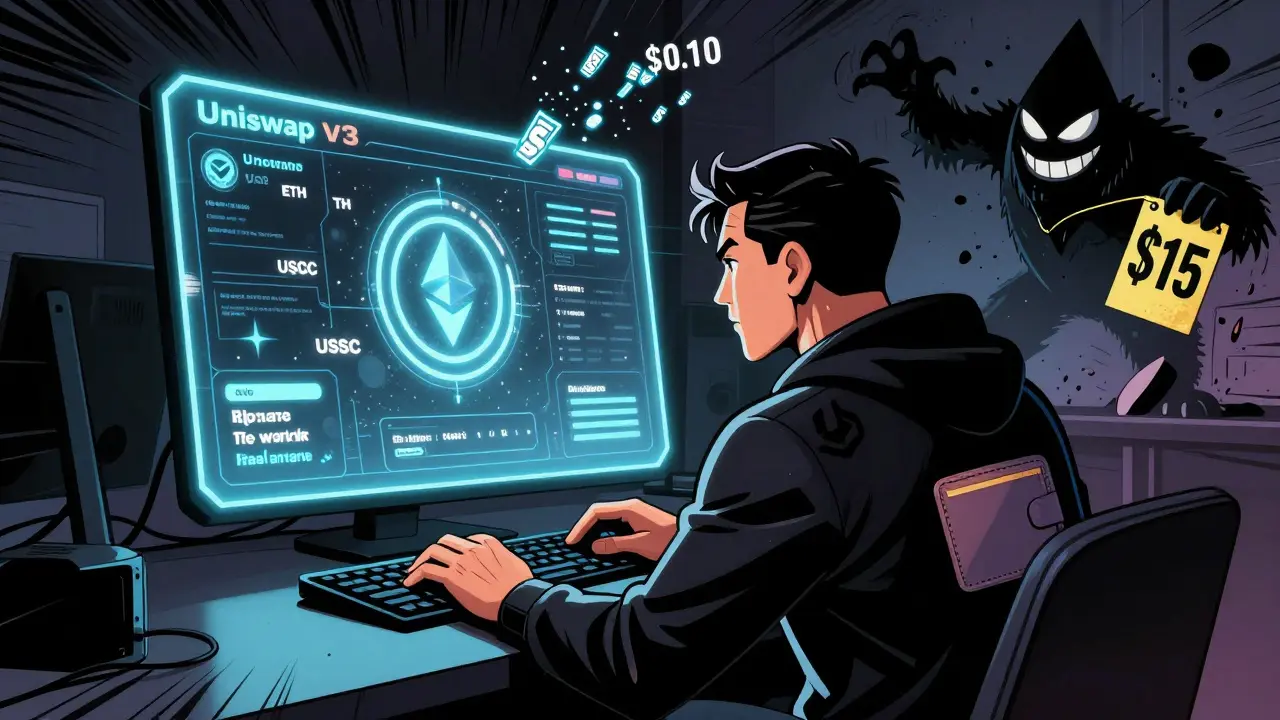
Uniswap v3 on Base isn’t just another crypto exchange. It’s a direct bridge between your wallet and thousands of tokens - no bank, no ID, no waiting. If you’ve ever paid $50 in gas to swap $200 worth of ETH for USDC, you know why this matters. Uniswap v3 on Base fixes that. It keeps the power of decentralized trading but cuts the cost and speed issues that made earlier versions frustrating.
How Uniswap v3 on Base Works
Uniswap v3 runs on smart contracts. That means there’s no company behind it. No CEO. No customer service line. Just code. When you swap tokens, your wallet talks directly to the contract on the Base network. Base is a layer-2 blockchain built on Ethereum, created by Coinbase. It’s fast, cheap, and growing fast. As of 2025, Base handles over 1.2 million daily active users - and Uniswap v3 is its most-used DEX.
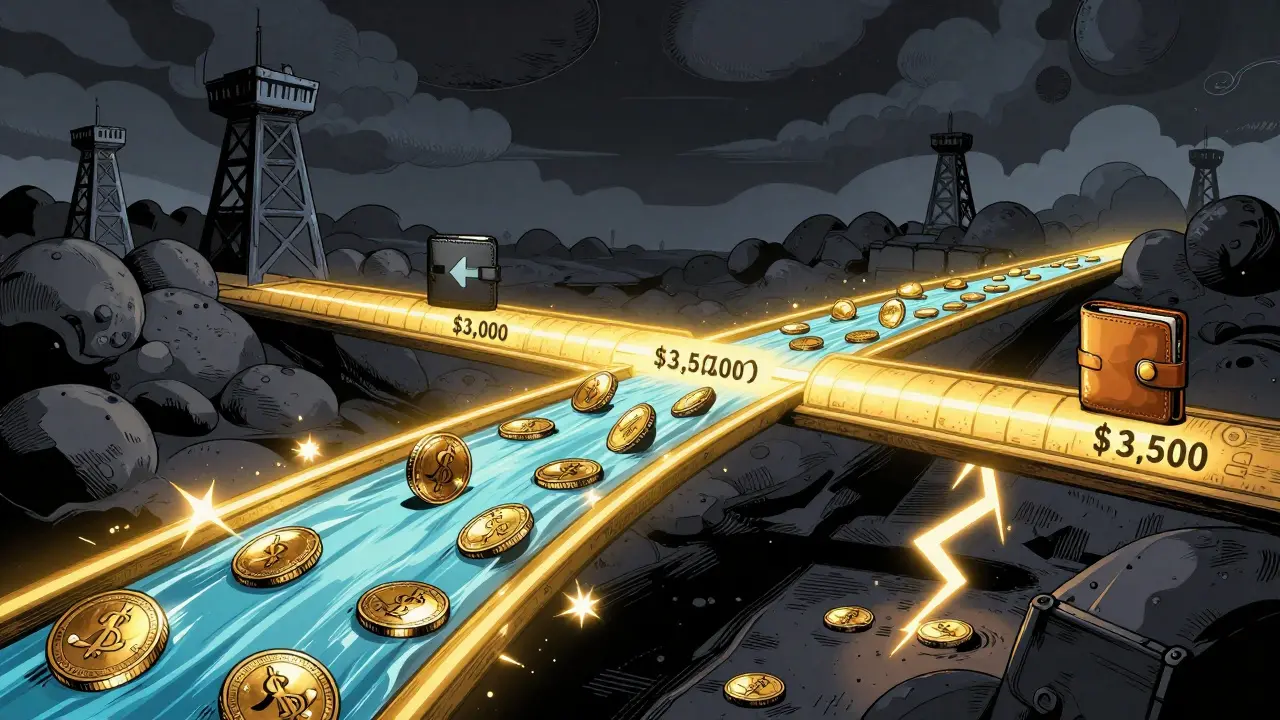
Unlike older versions of Uniswap, v3 doesn’t spread your liquidity evenly across all prices. It lets you pick a price range - say, $3,000 to $3,500 for ETH/USDC. If the price stays in that range, your money earns fees. If it moves outside? You stop earning until it comes back. This is called concentrated liquidity. It’s like parking your car in a high-traffic zone instead of leaving it on the edge of town.
Fee tiers are another upgrade. You can choose 0.05%, 0.3%, or 1% per trade. Low-fee pools (0.05%) are for stablecoins like USDC and DAI. High-fee pools (1%) are for wilder tokens like meme coins. This lets liquidity providers match their risk to their reward.
Why Base Makes a Difference
Uniswap v3 on Ethereum? Transaction fees can hit $15 during peak hours. On Base? You’re looking at $0.10 to $0.50. That’s not a tweak - it’s a game-changer. For small traders, this means you can swap $50 without losing 30% to gas. For liquidity providers, it means you can rebalance positions daily without burning through profits.
Base also settles transactions in under 2 seconds. Compare that to Ethereum’s 12-15 seconds. Faster settlement = less slippage. Less slippage = better prices. If you’re swapping large amounts of WBTC or LINK, this matters. You won’t get ripped off because the market moved while your transaction queued.
And because Base is backed by Coinbase, it has strong infrastructure. Wallet integrations work smoothly. Mobile apps load fast. The network doesn’t crash during hype cycles. That’s rare in DeFi.
What You Can Trade
Uniswap v3 on Base supports over 1,800 tokens. Top ones include:
- Ethereum (ETH) - the backbone
- USDC - stable, liquid, trusted
- DAI - decentralized stablecoin
- WBTC - Bitcoin on Ethereum
- LINK - Chainlink’s oracle token
- UNI - Uniswap’s own governance token
- BASE - Base’s native token (used for gas and governance)
You won’t find obscure memecoins here? Actually, you will. Because Uniswap is permissionless, anyone can list a token. That’s both a strength and a risk. Some tokens are scams. Others are legitimate projects with no marketing budget. Always check the contract address. Never trust a token just because it’s on Uniswap.
Trading Fees vs. Centralized Exchanges
Here’s the real comparison:
| Platform | Swap Fee | Gas Fee (Base) | Typical Total Cost (for $500 trade) |
|---|---|---|---|
| Uniswap v3 (Base) | 0.05%-1% | $0.10-$0.50 | $0.35-$5.50 |
| Coinbase (Standard) | 0.5%-1.5% | N/A | $2.50-$7.50 |
| Coinbase Advanced | 0.4% | N/A | $2.00 |
| Kraken | 0.16%-0.26% | N/A | $0.80-$1.30 |
Uniswap v3 on Base wins on low-value trades. If you’re swapping $100 or less, centralized exchanges often cost more. But if you’re trading $5,000+, Kraken or Coinbase Advanced might still be cheaper - because they don’t charge gas. The trade-off? You’re giving up control. On Uniswap, you own your keys. On Coinbase, you own an account.
Who Should Use It
Uniswap v3 on Base is perfect for:
- Traders who swap small amounts often
- Liquidity providers who want to maximize yield
- People who hate KYC
- Users who want access to tokens not listed on Coinbase or Kraken
It’s not ideal if:
- You’re new to crypto and scared of wallet mistakes
- You don’t want to learn how price ranges work
- You expect customer support when something goes wrong
The interface is clean - Google-like, as many users say. But the power is hidden. If you just want to swap ETH for USDC? Done in 3 clicks. If you want to provide liquidity with a 10% price range? You’ll need to read the docs. Or watch a tutorial. Or ask in Discord. There’s no phone number. No chatbot. Just you and the contract.
Real Risks You Can’t Ignore
People think DeFi is safe because it’s “decentralized.” It’s not. Here’s what can go wrong:
- Impermanent loss - If you provide liquidity in ETH/USDC and ETH drops 30%, you’ll lose money compared to just holding ETH. This isn’t theoretical. It’s happened to thousands.
- Wrong price range - Set your range too narrow? You’ll stop earning fees. Set it too wide? You’ll act like v2 - wasting capital.
- Scam tokens - A token called “DOGE2” with a fake contract? It’s on Base. You can lose everything in one click.
- Smart contract bugs - No one’s perfect. In 2024, a minor exploit on Base caused $2.3M in losses across three DEXs. Uniswap wasn’t hit, but it’s a reminder: code can break.
You can’t insure against these. There’s no FDIC. No insurance fund. Just your own due diligence.
What’s Next for Uniswap v3 on Base
Uniswap’s roadmap is quiet but steady. They’re optimizing gas usage even further. They’re testing batch swaps - where you swap multiple tokens in one transaction. They’re also working on better price oracle feeds to reduce manipulation.
Base is adding more integrations. Soon, you’ll be able to stake your LP tokens directly on Base and earn rewards in BASE token. That’s huge. It means you can earn twice: from trading fees and from staking rewards.
The UNI token? It’s still the governance token. Holders vote on fee changes, new chains, and protocol upgrades. But UNI’s value isn’t tied to Uniswap’s success. It’s tied to community trust. And right now, trust is high.
How to Get Started
Here’s the fastest way to start:
- Get a wallet: MetaMask or Coinbase Wallet (both support Base)
- Buy some ETH or USDC on a centralized exchange
- Send it to your wallet on the Base network
- Go to app.uniswap.org - it auto-detects Base
- Connect your wallet
- Swap, or add liquidity
No sign-up. No email. No waiting. You’re in.
Frequently Asked Questions
Is Uniswap v3 on Base safer than centralized exchanges?
It’s safer in one way: you control your keys. No exchange can freeze your funds. But it’s riskier in others: you’re responsible for every action. A wrong click, a phishing link, or a bad token can wipe you out. Centralized exchanges have fraud protection. Uniswap doesn’t. You get freedom - but no safety net.
Can I lose money just by providing liquidity?
Yes. If you provide liquidity in a volatile pair - say, ETH and a new DeFi token - and the price moves sharply, you’ll end up with more of the losing asset. That’s impermanent loss. It’s not a bug. It’s how AMMs work. The key is to use narrow price ranges only for stable pairs, and always monitor your positions.
Why use Base instead of Ethereum for Uniswap v3?
Base is faster and cheaper. Ethereum transactions cost $5-$20 during busy times. Base costs under $0.50. If you’re swapping daily, that’s $100+ in gas fees saved per month. Base also has better mobile performance. For most users, it’s the clear choice - unless you specifically need Ethereum’s network effect.
Does Uniswap v3 on Base support NFTs?
No. Uniswap v3 is only for token swaps. You can’t buy or sell NFTs here. For that, you need a marketplace like OpenSea or Blur. But you can use ETH or USDC from Uniswap to fund your NFT purchases elsewhere.
What’s the minimum amount I can trade on Uniswap v3 on Base?
Technically, there’s no minimum. You can swap as little as 0.0001 ETH. But practically, you need enough to cover gas. On Base, that’s about $0.10. So if you’re swapping $5, you’ll spend 2% in gas. Not efficient. Aim for $50+ per trade to make sense.
Are there any alternatives to Uniswap v3 on Base?
Yes. Curve Finance is better for stablecoin swaps. SushiSwap offers more reward programs. Balancer lets you build custom pools. But none match Uniswap’s liquidity depth on Base. For most users, Uniswap v3 on Base is still the default choice - simply because there’s more money in it, and that means better prices.





Man, I’ve been using Uniswap v3 on Base for like 8 months now and it’s honestly changed how I interact with crypto. Before this, I was stuck on Ethereum and paying $10 just to swap USDC for DAI-like, what even is that? Base cut that down to like 20 cents. I’m not even joking. I do micro-trades now-like $20 here, $30 there-because it’s not a financial sacrifice anymore. I’ve started providing liquidity in ETH-USDC with a 5% range and it’s been steady. No impermanent loss yet, knock on wood. The interface is clean too. No clutter. Just you, your wallet, and the market. I’ve even convinced my buddy who hates crypto to try it. He’s now swapping his Dogecoin for Shiba Inu like it’s a Sunday morning coffee run.
How quaint 😅 I mean, really, a layer-2 on Ethereum? How very… 2022. The real innovation is when you can trade without even needing a blockchain. Imagine a world where your wallet is just a biometrically authenticated API endpoint-no gas fees, no contracts, no chaos. Base is cute, but it’s still just a glorified sidechain with a Coinbase logo. And don’t get me started on ‘concentrated liquidity’-it’s just leverage with extra steps. I’m waiting for the day when DeFi becomes… well, useful. Until then, I’ll stick with my Swiss private bank. 💸✨
BASE? COINBASE? LOL. YOU THINK THIS ISN’T A BACKDOOR FOR THE FED? THEY OWN THE NODES. THEY OWN THE L1. THEY OWN THE WALLET INTEGRATIONS. THEY’RE WATCHING YOUR SWAPS. THEY’RE TRACKING YOUR PRICE RANGES. THEY’RE PRE-LOADING THE ORACLES. THIS ISN’T DECENTRALIZED-IT’S ‘DECENTRALIZED’ IN QUOTES. I’VE SEEN THE PAPERWORK. THE ‘OPEN-SOURCE’ CODE? IT’S GOT A BACKDOOR IN THE ERC-20 TRANSFER HOOK. THEY’LL FREEZE YOUR ASSETS IF YOU BUY THE ‘WRONG’ TOKEN. I’M NOT JUST PARANOID-I’M INVESTIGATIVE. THEY’RE USING BASE TO MAP EVERY SINGLE WALLET ON THE PLANET. YOU THINK YOU’RE FREE? YOU’RE A DATA POINT IN A COINBASE SPREADSHEET. 🤡
I think what’s beautiful about this is how it strips away the illusion of financial authority. No bank manager. No approval process. Just a transaction that happens because the math says so. I used to think DeFi was chaotic. Now I see it as… elegant. Like a forest. Trees don’t ask permission to grow. They just do. Same here. You don’t need a license to swap. You don’t need to prove you’re ‘creditworthy.’ You just need to know what you’re doing. And honestly? That’s kind of liberating. I’ve lost money on bad trades. But I’ve also learned more in six months than I did in six years working in traditional finance. There’s dignity in self-reliance-even if it’s messy.
Concentrated liquidity is the real innovation here-not the gas fees. The fee tiers are just window dressing. What matters is the ability to deploy capital precisely where the price action is happening. That’s institutional-grade efficiency on a retail scale. And let’s not sleep on the fact that Base’s infrastructure is built by Coinbase’s engineering team-the same people who built the most reliable crypto exchange on earth. That’s not an accident. This isn’t some DAO experiment. It’s enterprise-grade DeFi, wrapped in a user-friendly UI. If you’re still using v2 or Ethereum mainnet for swaps, you’re not just paying more-you’re missing the architecture shift.
For anyone new: if you’re trying to provide liquidity, start with USDC/ETH on the 0.05% pool with a 10% range. Don’t go wild with meme coins. I’ve seen too many people lose their entire position because they set a 2% range on a token that pumps 300% in 4 hours. Also, use the Uniswap analytics dashboard-it shows you how much you’re earning vs. HODLing. I started with $500, now I’m earning $15/week just sitting there. Not life-changing, but passive income with zero work? Yes please. And if you’re worried about slippage, always use limit orders. Even on DEXs, you can set price thresholds. No need to panic-swap.
Base? Pfft. I traded on Arbitrum before it was cool. This is just Coinbase’s way of keeping you in their walled garden. They want you to think you’re free. You’re not. You’re just on a nicer leash. Also, ‘over 1.2M daily users’? That’s like 3% of Coinbase’s total users. This isn’t adoption. It’s a marketing stunt. 🤷♀️
Hey, just wanted to say thanks to the OP for this. I’m new to DeFi and was terrified of messing up. This breakdown made it feel approachable. I did my first swap yesterday-ETH to USDC-and it took 12 seconds. Felt like magic. No form to fill out. No ‘verify your identity’ pop-up. Just… done. I cried a little. Not because it was emotional, but because I realized I didn’t need permission to participate in the economy anymore. That’s powerful. 🙏
USA built this. Europe? Still stuck in 2015. India? Still asking for Aadhaar. This is American innovation. No EU regulation. No Indian bureaucracy. Just code. That’s why it works. We don’t need permission. We just build. And if you’re not on Base? You’re not just late-you’re obsolete.
Base is just CBDC testing ground. They’re collecting behavioral data through every swap. You think you’re trading? You’re being profiled. UNI token? A distraction. The real game is mapping retail traders’ habits. This isn’t DeFi. It’s surveillance with a blockchain logo. And India? We don’t need this. We have UPI. Faster. Cheaper. Real.
I tried it. I lost $80 on a bad price range. I felt so stupid. I just wanted to swap ETH for USDC. Why did I have to learn about liquidity pools? Why couldn’t it just work like PayPal? I miss when crypto was simple. I miss when I didn’t have to read 10 articles just to send $50. Now I’m just holding BTC and hiding under my blanket. 😭
Gas fees on Base are a red herring. The real cost is opportunity cost. If you’re swapping $500, you’re still getting worse price impact than on Kraken. And let’s not forget-Base’s liquidity is fragmented. You think you’re getting ‘deep’ pools? Half the volume is fake. Wash trading. Bot pairs. I’ve run the numbers. The spreads are wider than they appear. This isn’t innovation. It’s a liquidity mirage. 📉
Uniswap v3 on Base? More like Uniswap v3 on ‘Trust Coinbase and Hope for the Best.’ The fact that they’re pushing this as ‘decentralized’ while being backed by the same company that got fined $500M for lying to regulators? I’m not buying it. This isn’t freedom. It’s a Trojan horse. And if you’re smart enough to use it, you’re dumb enough to believe the hype. 🤡
Impermanent loss? Yeah right. I did a 1% range on WBTC/USDC and got rekt when BTC dropped 15%. Now I’m stuck with 80% WBTC and 20% USDC. I didn’t even know this could happen. I thought it was like a bank. You deposit. You earn. You withdraw. No. This is Russian roulette with a DeFi sticker on it. I’m done. I’m going back to Coinbase. At least they refund you when you mess up. Here? You’re on your own. Good luck.
Why are we even talking about this? No one cares. It’s just another crypto fad. I tried it once. It was slow. I didn’t like it. Done.
Base is not the future. It’s the last gasp of American crypto arrogance. India has UPI. China has digital yuan. We don’t need your decentralized fantasy. This is just another way for Americans to feel superior while their wallets bleed gas fees. You think you’re pioneering? You’re just late to the party.
lol i tried this and ended up swapping my doge for a token called ‘$POTATO’ and now my wallet is just 2000 $POTATO and a single eth. thanks base. i’m rich. 🥔
For anyone considering liquidity provision: always check the 24-hour volume and token contract audit status. I use DeFiLlama and Etherscan. Also, don’t over-concentrate-start with 10-15% of your portfolio. And if you’re unsure, just swap. Don’t provide. Learn first. I’ve been doing this since 2021. Base is the best layer-2 for beginners. Just don’t rush. Slow wins.
Wait-so you guys are saying Base is centralized? Bro, it’s built on Ethereum. The contracts are open. The code is audited. Coinbase doesn’t control the network. They just run a node. So do 500 others. I’ve checked the validators. It’s permissionless. If you think Coinbase can freeze your funds, you’ve never looked at the actual smart contract. They’re not the owner. They’re not the admin. They’re just… a participant. Like you. Like me. You’re scared of the wrong thing.