
How Cryptocurrency Exchanges Prevent Double-Spending Attacks
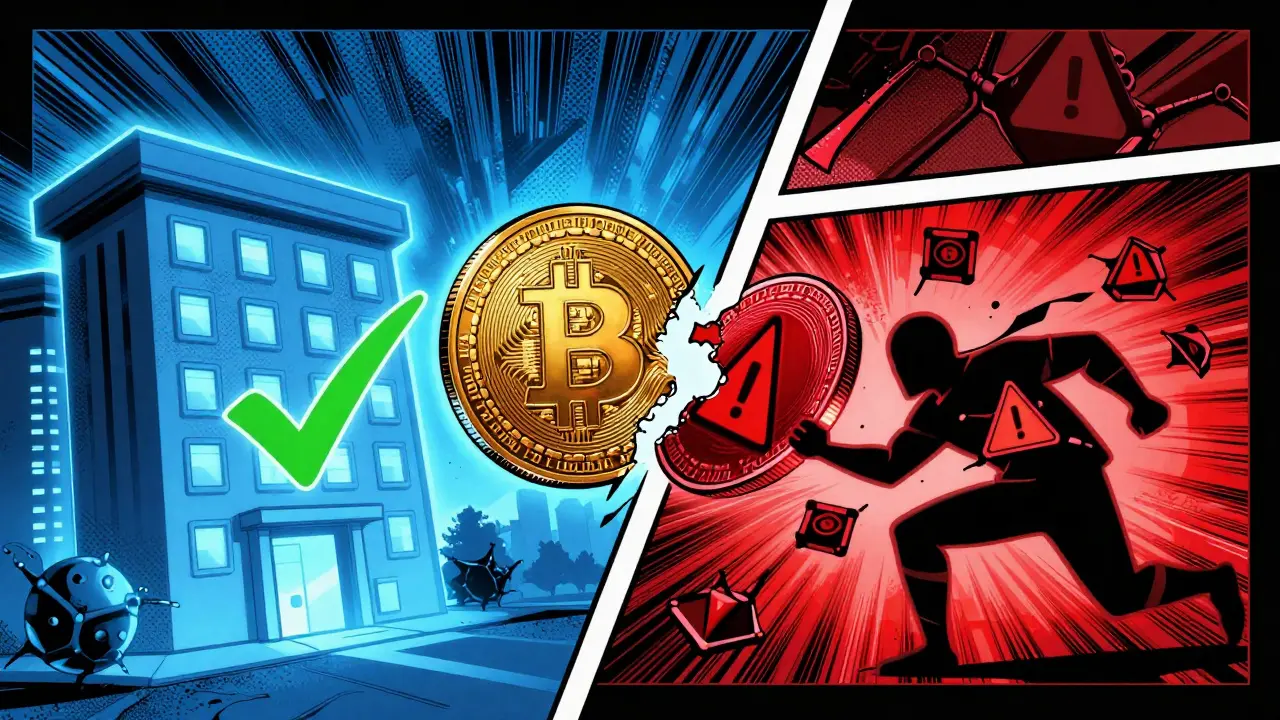
Imagine sending $1,000 worth of Bitcoin to an exchange, then immediately withdrawing it again-while the first transaction is still pending. If that worked, you’d have your money and the coins. That’s double-spending, and it’s the nightmare scenario every cryptocurrency exchange must stop before it ever happens.
Double-spending isn’t just a theoretical flaw. It’s a real, active threat. Attackers try to spend the same digital coins twice by exploiting the tiny window between when a transaction is sent and when it’s confirmed on the blockchain. Exchanges don’t just hope for the best-they’ve built layered defenses that make this nearly impossible.
How Double-Spending Actually Works
At its core, double-spending relies on timing and deception. An attacker sends coins to an exchange, waits for the exchange to credit their account, then quickly creates a second transaction sending the same coins to another wallet they control. They broadcast both transactions at the same time, hoping one gets confirmed while the other gets buried or rejected.
This only works if the blockchain hasn’t yet locked in the first transaction. Once a block confirms it, the ledger becomes immutable. But during those first few seconds-before confirmation-the network is still deciding which version of the transaction is legitimate.
That’s why exchanges can’t trust a transaction just because it shows up in their system. They need to wait. And not just a little.
Confirmations: The First Line of Defense
Every major exchange requires multiple confirmations before allowing withdrawals. For Bitcoin, that’s usually six blocks. Each block takes about 10 minutes, so six confirmations means roughly one hour. That’s not arbitrary-it’s based on math.
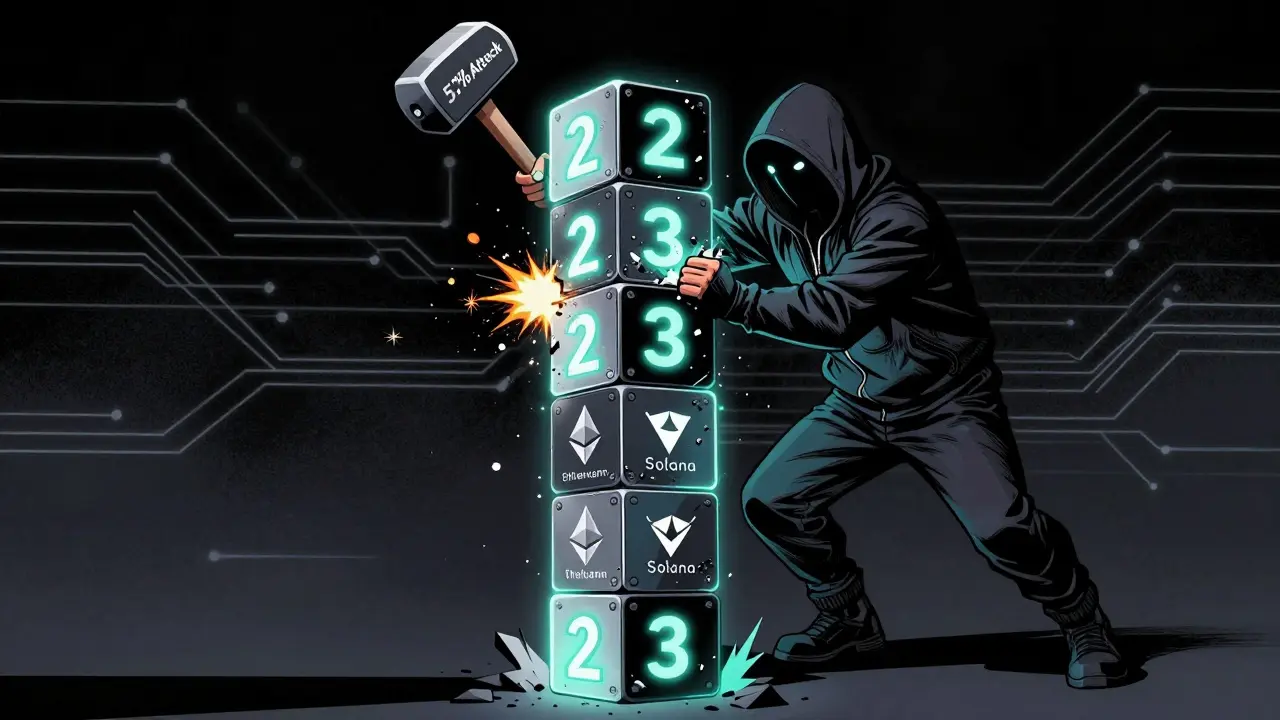
After six confirmations, the chance of a double-spend succeeding drops below 0.000001%. Why? Because rewriting six blocks means outpacing the entire Bitcoin network. That’s not just hard-it’s astronomically expensive. You’d need more than half of Bitcoin’s total mining power, known as a 51% attack. And even then, you’d burn through millions in electricity and hardware just to steal a few thousand dollars’ worth of coins.
Other coins have different rules. Ethereum, for example, confirms faster-sometimes within 15 seconds per block. But exchanges still require 12 to 30 confirmations for large deposits. The more valuable the transaction, the longer the wait.
Consensus Mechanisms: The Engine Behind the Security
It’s not just about waiting. It’s about how the network decides what’s real. That’s where consensus mechanisms come in.
Bitcoin uses Proof of Work (PoW). Miners compete to solve cryptographic puzzles. The first to solve it gets to add the next block and earns a reward. To double-spend, you’d need to control more than half of all mining power. That’s why Bitcoin’s network is so secure-it’s too big, too distributed, and too costly to overpower.
Many newer chains use Proof of Stake (PoS). Instead of miners, validators are chosen based on how much cryptocurrency they’ve locked up (staked). If a validator tries to approve a fraudulent transaction, they lose their stake. No coins, no power. No incentive to cheat.
Some networks, like Solana and Polkadot, use Delegated Proof of Stake (DPoS). Token holders vote for a small group of validators. If one acts maliciously, voters can remove them instantly. That’s a faster, more responsive system than PoW, and it adds another layer of accountability.
Each system has trade-offs. PoW is secure but uses massive energy. PoS is efficient but can lead to centralization if a few big players hold most of the stake. Exchanges don’t pick one-they adapt. They treat each blockchain differently based on its consensus rules and risk profile.
The Role of Distributed Ledger Technology
Every node on a blockchain network holds a full copy of the transaction history. That’s key. If an attacker tries to double-spend, they’re not just fighting one exchange-they’re fighting thousands of independent computers.
When a transaction hits the network, every node checks it against the existing ledger. If two conflicting transactions appear, nodes reject the one that came later-or the one that doesn’t match the longest chain. There’s no central authority. No single point of failure. Just math, rules, and consensus.
This structure makes it nearly impossible to alter history. Even if you somehow got control of a few nodes, the rest of the network would ignore your version. The truth is written across the whole system.
Real-Time Monitoring and Behavioral Detection
Waiting for confirmations isn’t enough anymore. Sophisticated attackers use automated bots to test for weaknesses-rapid deposits, instant withdrawals, small test transactions to see how an exchange reacts.
Modern exchanges use machine learning to spot patterns. If someone deposits 0.1 BTC, withdraws 0.09 BTC, then deposits another 0.1 BTC within 30 seconds, the system flags it. That’s not normal behavior. It’s a classic double-spend probe.
Some platforms track user history too. A new account with no prior activity suddenly trying to withdraw $500,000? That triggers extra checks. Even if the transaction has six confirmations, the exchange might delay the withdrawal and manually review it.
These systems don’t just react-they predict. They learn what normal looks like for each user and each coin. Then they act before the attack even completes.

What Happens When an Exchange Gets Hit?
There have been cases. In 2018, the Bitcoin Gold exchange was hit by a 51% attack and lost over $18 million. The attacker double-spent coins by controlling enough mining power to rewrite blocks.
But here’s the thing: that attack only worked because Bitcoin Gold was small. Its network had low hash power. A similar attack on Bitcoin or Ethereum today? Impossible.
After such events, exchanges didn’t just patch the hole-they upgraded. Now, most major exchanges refuse to list coins with weak consensus security. They avoid networks with less than $100 million in daily mining or staking power. That’s not just a policy-it’s survival.
Future Defenses: Hybrid Systems and Smart Contracts
The next wave of security isn’t just about better consensus. It’s about combining them.
Some projects are testing hybrid models-using PoW for finality and PoS for speed. Others are embedding smart contracts that lock funds until multiple independent oracles confirm a transaction’s validity.
One emerging idea is time-locked withdrawals. Even after six confirmations, large withdrawals from new accounts are held for 24 to 72 hours. The user can cancel the withdrawal if they change their mind, but no one can reverse it. That eliminates the window for double-spending entirely.
Another innovation is on-chain insurance pools. If a double-spend does occur, funds are reimbursed from a reserve pool funded by exchange fees. It’s not prevention-but it’s damage control that keeps users trusting the system.
What You Can Do to Stay Safe
As a user, you can’t stop double-spending attacks. But you can avoid becoming a victim.
- Always wait for full confirmations before considering a deposit complete.
- Avoid exchanges that credit deposits after just one or two confirmations.
- Use wallets that show real-time confirmation counts, not just “received.”
- Don’t rush withdrawals. If you’re moving large amounts, give the system time.
- Stick to well-established exchanges. They have the resources, audits, and history to protect you.
There’s no such thing as 100% security. But with the right systems in place, double-spending is no longer a threat-it’s a relic.
Can you double-spend Bitcoin after six confirmations?
No. After six confirmations, the chance of a successful double-spend is less than one in a billion. Rewriting six blocks would require controlling over half of Bitcoin’s entire mining power, which would cost hundreds of millions of dollars and still likely fail due to network resistance.
Why do some exchanges require more confirmations than others?
It depends on the coin’s block time and network security. Bitcoin takes 10 minutes per block, so six confirmations = about an hour. Ethereum takes 12 seconds, so 12 confirmations = about 2.5 minutes. Exchanges adjust based on risk. High-value transactions or new accounts often get extra confirmations as a safety buffer.
Are Proof of Stake coins safer from double-spending than Proof of Work?
They’re different, not necessarily safer. PoS makes attacks economically irrational-you lose your staked coins if you cheat. PoW makes attacks financially impossible for most. PoS is more energy-efficient and faster, but if a few entities control most of the stake, centralization becomes a risk. Both are secure when properly implemented.
Can an exchange be hacked through double-spending?
Not directly. Double-spending targets the blockchain, not the exchange’s servers. But if an exchange trusts unconfirmed transactions or doesn’t enforce enough confirmations, attackers can trick it into crediting fake deposits. That’s why exchanges rely on blockchain rules, not their own databases, to verify balances.
Do all cryptocurrencies prevent double-spending the same way?
No. Bitcoin uses PoW with long confirmations. Ethereum uses PoS with fast finality. Some newer coins use hybrid systems or instant finality protocols. The method depends on the blockchain’s design. Exchanges treat each coin differently based on its underlying security model.
What’s the biggest weakness in exchange security against double-spending?
Human error. Some exchanges still allow withdrawals after only one confirmation for small amounts, or they don’t monitor for rapid deposit-withdrawal patterns. The tech is solid-but if the operator cuts corners, the system fails. That’s why choosing reputable exchanges matters more than the coin you’re using.








This is the most insane thing I've read all week. Like, imagine being a hacker and trying to outgun the entire Bitcoin network just to steal $5k? Bro, you'd spend more on electricity than you'd make. 😂
i never knew 6 confirmations was such a big deal. thought it was just some random number they made up. turns out its like trying to rewrite the entire internet with a crayon.
It’s fascinating how the architecture of blockchain-decentralized, immutable, consensus-driven-creates an environment where trust isn’t placed in institutions, but in mathematics and distributed computation. The elegance of requiring multiple confirmations isn’t just security; it’s a philosophical statement about how value can be verified without intermediaries. And when you layer in behavioral analytics? That’s next-level. Exchanges aren’t just gatekeepers anymore-they’re predictive intelligence systems.
Let’s be real-most people don’t even know what a confirmation is. They see ‘deposit received’ and think they’re rich. That’s why 90% of hacks happen-not because the tech failed, but because users are clueless.
A well-structured explanation. The emphasis on network hash power as a deterrent is particularly sound. Security through economic infeasibility remains the most robust model we have.
USA built this. China’s trying to copy it. Europe’s still debating. Meanwhile, regular folks think crypto is just memes. We won. You’re welcome.
I appreciate the breakdown. Though I wonder-how many exchanges actually follow these standards? Or is it mostly the big ones?
Man, this is why I love crypto-real engineering, not just hype! 🚀 The fact that they use ML to catch bots before they even finish their first transaction? That’s next-gen. And time-locked withdrawals? Genius. I’ve had withdrawals held for 48 hours before-felt annoying at the time, but now I get it. Safety first, bro. 💪
It’s wild how this whole system was built by people who didn’t trust banks but still wanted to move money. The fact that we’ve created a global, decentralized, trustless network that stops fraud better than most banks? That’s a win for human ingenuity. And honestly, the part about not listing low-hash coins? That’s the quiet hero of crypto safety. No one talks about it, but it’s why you don’t hear about double-spends on Bitcoin or ETH anymore.
6 confirmations = done. Period. 🙌
confirmations are a scam they just make you wait so they can charge more fees
bro i tried to double spend once on binance and my account got frozen for 3 days i was so mad but then i realized they saved me from myself lol
I love how this explains the human side too-not just the tech. The part about new accounts withdrawing huge amounts? That’s so true. I remember when I first got into crypto and rushed a withdrawal. I felt so proud. Then I read this and realized I almost got scammed by my own impatience. Thanks for the gentle reminder.
The real triumph here isn’t the technical implementation-it’s the social contract embedded in the protocol. The community, through consensus, enforces integrity. No regulator, no CEO, no bank manager-just code and collective validation. That’s not just security. That’s a new form of governance.
Good stuff. Always wait for confirmations. Simple.
so you're telling me the entire crypto economy runs on waiting 10 minutes for a number to go up? wow. groundbreaking.
I don’t care how many confirmations you have-if you’re using an exchange, you’re already compromised. Why not just use a wallet? Why are you letting strangers hold your keys? This whole article is just a fancy way of saying ‘trust us, we’re good.’
In India, most people think crypto is like lottery. But this? This is real. I showed this to my uncle-he now waits for confirmations. Small wins, right?
Ah yes, the classic ‘Bitcoin is secure because it’s expensive to attack’ argument. But what about when the mining power shifts? What happens when ASICs get cheaper? Or when a nation-state decides to throw $500M at a 51% attack? You think they care about profit margins? You’re assuming rational actors. We’re not living in a textbook.
Let’s be honest-this is all just a glorified version of ‘trust the algorithm.’ The real security isn’t in the blockchain-it’s in the fact that nobody dares to challenge the dominant chains. It’s social consensus masquerading as mathematical certainty. PoW is just the last gasp of industrial-era crypto. PoS is the future, and honestly, if you still think Bitcoin is the gold standard, you’re stuck in 2013.
I can’t believe people still fall for this. You think exchanges are protecting you? They’re protecting their balance sheets. They delay withdrawals so they can lend your coins out. They don’t care if you get hacked-they just want your liquidity. This article is just marketing dressed up as education.
If you need confirmations, you never really owned it.
I work in fintech in Bangalore, and I’ve seen how this plays out on the ground. Small exchanges in India used to credit deposits after one confirmation. We lost a client once because of it. After that, we upgraded everything-six confirmations, behavioral monitoring, even manual reviews for new users. It’s not about being paranoid-it’s about being responsible. People think crypto is wild, but the real chaos comes from cutting corners. This post? Spot on.
That’s a crucial point. The real vulnerability isn’t the blockchain-it’s the human layer. The moment you start trusting an exchange’s UI over the chain’s state, you’ve already lost. The math doesn’t lie. The dashboard does.