
How Digital Signatures Verify Blockchain Transactions
Imagine sending money to a friend in another country. You don’t need a bank to check your ID or call them to confirm you’re really you. In the world of blockchain, this trust is built on math, not middlemen. The engine behind this trustless security is the digital signature. It’s the cryptographic fingerprint that proves you own the assets you’re trying to move and that no one has tampered with the transaction details along the way.
If you’ve ever wondered how Bitcoin or Ethereum knows you didn’t just type in someone else’s address and claim it was yours, the answer lies in asymmetric cryptography. This isn’t magic; it’s a precise mathematical relationship between two keys. Understanding how these signatures work demystifies why blockchain is considered secure by design, even without a central authority watching over every trade.
The Core Mechanism: Private and Public Keys
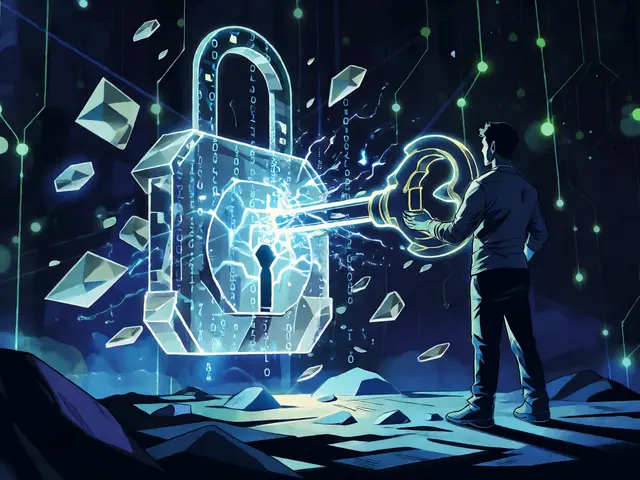
Every user on a blockchain network starts with a pair of keys. Think of them as a lock and a key that are mathematically linked but functionally distinct. The private key is like your personal password. It stays hidden on your device and is used to sign transactions. The public key is derived from the private key and can be shared with anyone. It acts as your account address or identity on the network.
Here’s the critical rule: you use the private key to create a signature, and anyone uses the public key to verify it. You never send your private key over the internet. If you did, anyone could steal your funds. Instead, you send the signed transaction and the public key (or an address derived from it). The network nodes take those two pieces of information and run a verification algorithm. If the math checks out, the transaction is valid. If it doesn’t, the node rejects it instantly.
Step-by-Step: How a Signature Is Created
The process of signing a transaction isn’t just slapping a digital stamp on a file. It involves specific cryptographic steps that ensure integrity and authenticity. Most major blockchains, including Bitcoin and Ethereum, rely on the Elliptic Curve Digital Signature Algorithm, commonly known as ECDSA.
- Transaction Hashing: First, the transaction data-sender, receiver, amount, and fees-is run through a hash function (like SHA-256 for Bitcoin). This creates a fixed-length string of characters, a unique "fingerprint" of that specific transaction. Even changing one decimal point changes the entire hash.
- Signing with the Private Key: Your wallet software takes this hash and combines it with your private key using the ECDSA algorithm. This generates a unique digital signature. This signature is random-looking but deterministic; the same inputs always produce the same signature.
- Broadcasting: The wallet sends the original transaction data, the digital signature, and your public key to the blockchain network.
- Verification by Nodes: Every node that receives this packet performs the reverse operation. They hash the transaction data again to get the expected fingerprint. Then, they use your public key and the provided signature to see if they can reconstruct that same fingerprint. If the reconstructed hash matches the calculated hash, the signature is valid.

Why ECDSA Dominates Blockchain Networks
You might ask, why ECDSA? Why not older methods like RSA? The answer comes down to efficiency and size. Blockchains store massive amounts of data. Using RSA would require significantly larger key sizes and signature lengths, bloating the blockchain and slowing down processing times.
| Feature | ECDSA (Bitcoin/Ethereum) | RSA (Traditional Web) | EdDSA (Newer Chains) |
|---|---|---|---|
| Key Size | Small (256-bit curve) | Large (2048+ bits) | Very Small |
| Signature Size | Compact (~71 bytes) | Bulky (~256 bytes) | Fixed & Compact |
| Speed | Fast | Slower | Very Fast |
| Security Basis | Discrete Log Problem | Integer Factorization | Twisted Edwards Curves |
Bitcoin specifically uses ECDSA over the secp256k1 elliptic curve. This choice provides 256-bit security strength, which is currently considered unbreakable by classical computers, while keeping signatures small enough to fit efficiently into blocks. Ethereum also uses ECDSA, though its implementation differs slightly in how addresses are derived. Newer networks often look at EdDSA because it offers faster verification speeds and simpler implementations, reducing the risk of bugs in the code.
Integrity and Non-Repudiation
Digital signatures do more than just prove who sent the money. They guarantee that the message hasn’t been altered. This property is called integrity. Because the signature is generated from the hash of the transaction data, any change to that data-even adding a single zero to the amount-results in a completely different hash. When the node verifies the signature against this new hash, the math fails. The signature becomes invalid.
This also provides non-repudiation. Once you sign a transaction and broadcast it, you cannot deny having made it. The mathematical link between your private key and the signature is undeniable. Unless someone stole your private key, there is no technical way to argue that you didn’t authorize the transfer. This is crucial for legal and audit trails in enterprise blockchain applications.

Common Pitfalls and Security Risks
While the math is solid, human error remains the biggest threat. The most common issue is poor key management. If you lose your private key, you lose access to your funds forever. There is no "forgot password" button in decentralized systems. Conversely, if you expose your private key, anyone can sign transactions on your behalf. They don’t need to guess your password; they just need the key.
Another subtle risk involves weak randomness. Early versions of some wallets had flaws in how they generated the random number required for ECDSA signing. If that random number was predictable, attackers could derive the private key from the signature itself. Modern wallets use cryptographically secure random number generators to prevent this, but it’s a reminder that implementation details matter as much as the underlying theory.
The Future: Quantum Resistance and Aggregation
Technology evolves, and so does cryptography. Current ECDSA relies on problems that quantum computers could theoretically solve efficiently in the future. While large-scale quantum computers aren’t here yet, developers are already preparing. Post-quantum signature schemes like CRYSTALS-Dilithium are being tested to replace or supplement current methods.
We are also seeing innovations like Schnorr signatures, which Bitcoin adopted recently. These allow multiple signatures to be aggregated into one. Imagine ten people signing a multi-sig transaction. Instead of storing ten separate signatures, the network stores one combined signature. This saves space and speeds up verification, making complex smart contracts more efficient.
Can I recover my private key from my public key?
No. The mathematical relationship between the private and public keys is one-way. You can easily generate a public key from a private key, but deriving the private key from the public key requires solving the discrete logarithm problem, which is computationally infeasible with current technology.
What happens if I send a transaction with an invalid signature?
The transaction will be rejected by the network nodes. It will not be included in a block, and the transaction fee (gas) paid for the attempt may still be consumed depending on the network's rules, but the funds remain in your wallet.
Do all blockchains use the same digital signature algorithm?
Most major chains like Bitcoin and Ethereum use ECDSA. However, newer chains like Solana and Cardano use EdDSA (specifically Ed25519) for better performance and security properties. Some experimental chains are testing post-quantum algorithms.
Is a digital signature the same as a digital certificate?
No. A digital signature is a cryptographic proof attached to data. A digital certificate is a document issued by a trusted third party (Certificate Authority) that binds a public key to an identity. Blockchains generally avoid certificates to maintain decentralization, relying instead on the cryptographic proof itself.
Why is the private key kept off-chain?
If the private key were on-chain, anyone could read it and spend your funds. It must remain secret and stored locally on your hardware or software wallet. Only the resulting signature and public key are broadcast to the network.