
How Peer Discovery Works in Cryptocurrency Networks: A Technical Guide
Imagine trying to join a massive, global conversation where no one has a phone book, no central server tells you who is online, and everyone is anonymous. That is exactly the problem every new node faces when it tries to connect to a cryptocurrency network. Without a way to find other participants, the entire decentralized system collapses into isolated silos. This process of locating and connecting with other computers is called peer discovery, and it is the invisible backbone that keeps blockchains like Bitcoin and Ethereum running.
If you have ever run a full node or wondered how your wallet knows which blocks are valid, you are standing on the shoulders of this discovery mechanism. It is not just about finding neighbors; it is about maintaining trust, ensuring security, and preventing censorship. Let's break down how different networks solve this complex puzzle without relying on a central authority.
The Core Problem: Finding Neighbors in a Decentralized World
In traditional client-server architectures, your computer asks a known address (like google.com) for data. In peer-to-peer (P2P) networks, there is no 'known' address. Every participant is both a client and a server. When a new node boots up, it starts with an empty list of contacts. Its primary job is to populate that list quickly and accurately.
This challenge is critical because if a node connects only to malicious peers, it can be isolated from the rest of the network-a threat known as an eclipse attack. Therefore, peer discovery must be resilient, decentralized, and resistant to manipulation. The solution varies significantly depending on the blockchain's design philosophy.
Bitcoin’s Multi-Tiered Discovery System
Bitcoin, the oldest major cryptocurrency, uses a layered approach designed for maximum reliability and backward compatibility. It does not rely on a single method but instead cascades through several fallbacks to ensure connectivity.
If DNS queries fail-perhaps due to local firewall issues or DNS poisoning-the node falls back to hardcoded seed nodes. These are specific IP addresses embedded directly in the Bitcoin client software at compile time. They act as emergency anchors to the network. As a last resort, users can manually configure trusted peers obtained from friends, forums, or community channels.
The Cascading Effect: Address Sharing
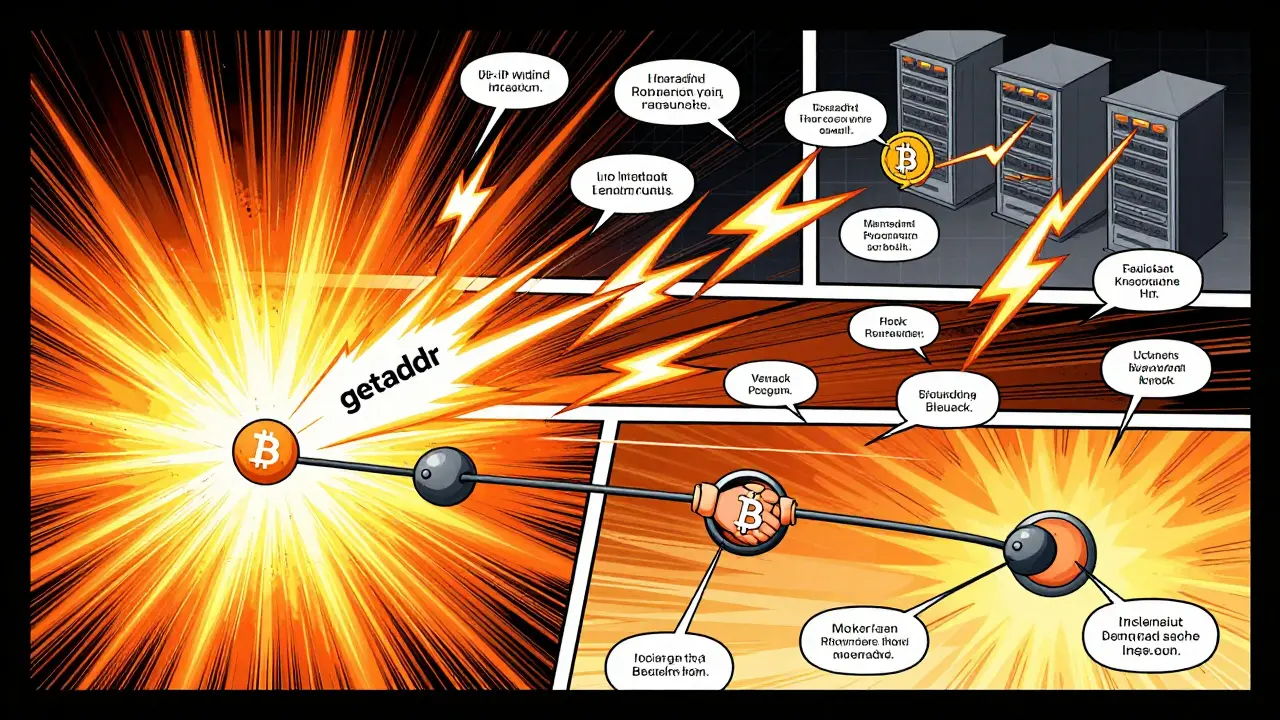
Once a node connects to even one peer, the real magic begins. The node sends a getaddr message, asking its neighbor for a list of other known peers. The neighbor responds with a batch of IP addresses. The new node then attempts to connect to those addresses, storing successful connections for future use. This creates a cascading effect where each new connection potentially reveals dozens more, rapidly expanding the node's view of the network topology.
To manage this efficiently, Bitcoin nodes maintain detailed statistics for each peer. They track availability, speed, reliability, and misbehavior scores. Proven reliable peers are prioritized over DNS seeds whenever possible. This strategy reduces load on the seed infrastructure and distributes the burden of discovery across the entire network.
Handshake and Maintenance Protocols
Connection establishment follows a strict handshake protocol:
- Version Message: The initiating node sends its version number, current block height, and timestamp.
- Version Response: The remote node replies with its own details.
- Verack Messages: Both sides exchange verification acknowledgments to confirm the link is stable.
To keep connections alive, nodes send ping messages before 30 minutes of inactivity. If no response is received within 90 minutes, the connection is assumed dead and removed from the active list. This constant pruning ensures the node's peer table remains fresh and relevant.
Ethereum 2.0: Dynamic Discovery with Discv5
Ethereum took a fundamentally different path with its transition to Proof-of-Stake (PoS). The old UDP-based discovery protocol was replaced by discv5, which is a Node Discovery Protocol version 5.1 based on Kademlia DHT, enabling secure and efficient peer lookup in Ethereum 2.0. Unlike Bitcoin's relatively static IP-based model, Ethereum 2.0 requires nodes to identify themselves cryptographically.
Instead of simple IP addresses, Ethereum nodes use Ethereum Node Records (ENRs), which are cryptographic records containing a node's public key, IP address, and metadata like subnet membership. These ENRs are constantly updated to reflect the network's flux. The discv5 protocol allows nodes to perform lookups using the node's public key rather than just its IP, adding a layer of security against IP spoofing.
Kademlia and Routing Tables
Discv5 relies on a Kademlia Distributed Hash Table (DHT). This structure organizes nodes into buckets based on the XOR distance between their public keys. Each node maintains a routing table of nearby peers in key space. When a new node joins, it queries the DHT to find the closest existing nodes, establishing a connection path that scales logarithmically with network size.
A unique feature of Ethereum 2.0 is subnet-based organization. Validators need to aggregate attestations efficiently. To do this, nodes declare their subnet membership in the attnets entry of their ENR. Peer discovery algorithms prioritize connecting to nodes in the same subnets, ensuring that attestation data flows quickly among relevant validators. This makes Ethereum's discovery process not just about connectivity, but about functional coordination.
Security Implications of Peer Discovery
The way nodes find each other has profound security consequences. A robust peer discovery mechanism provides Byzantine Fault Tolerance, meaning the network can continue operating even if some nodes act maliciously or fail completely.
| Threat | Bitcoin Mitigation | Ethereum 2.0 Mitigation |
|---|---|---|
| Eclipse Attack | Large peer tables (100+ connections), random selection, and reputation scoring reduce isolation risk. | Cryptographic identity (ENRs) prevents IP-based spoofing; discv5 requires proof of work for initial announcements. |
| Denial of Service (DoS) | Distributed DNS seeds prevent single-point failure; rate limiting on incoming connections. | Kademlia DHT disperses query load; rate limits per bucket in routing tables. |
| Censorship | No central directory; nodes can manually add trusted peers if standard seeds are blocked. | Decentralized DHT makes it difficult to censor specific node identities without controlling the majority of the network. |
Smaller blockchain networks face higher risks. If a network has few nodes, an attacker might control enough peers to isolate a victim node, feeding it false transaction data. This is why large networks like Bitcoin and Ethereum are more secure: the sheer volume of honest nodes makes it economically unfeasible to dominate the peer discovery process.
Technical Challenges and Future Directions
Despite their sophistication, current systems face hurdles. High churn rates-where nodes frequently join and leave-can destabilize routing tables. NAT traversal remains a pain point for home users behind firewalls, often requiring techniques like hole punching or relaying through exit nodes.
Privacy is another frontier. Current discovery methods expose IP addresses, allowing network analysis to correlate transactions with physical locations. Future developments may integrate onion routing or Tor-like protocols directly into the discovery layer, hiding node origins while maintaining connectivity. Additionally, as networks scale, discovery protocols must become more efficient to handle millions of potential peers without overwhelming bandwidth or CPU resources.
The evolution from Bitcoin's pragmatic, IP-centric approach to Ethereum's cryptographic, identity-based model shows that there is no one-size-fits-all solution. Each design reflects the underlying consensus mechanism and the specific threats the network aims to mitigate.
What happens if all DNS seeds go offline?
Bitcoin nodes have multiple fallbacks. First, they try hardcoded seed nodes embedded in the client software. If those fail, users can manually input IP addresses of trusted peers from community sources. The network is designed so that no single point of failure can disconnect the entire system.
Why does Ethereum 2.0 use public keys instead of just IP addresses?
Using public keys via ENRs adds a layer of security. IP addresses can change or be spoofed, but a cryptographic key uniquely identifies a node. This helps prevent man-in-the-middle attacks and ensures that nodes connect to verified entities, which is crucial for the validator-based Proof-of-Stake consensus.
Can I run a Bitcoin node without exposing my IP?
Yes, but with limitations. You can connect to the network via Tor or I2P, but other nodes cannot easily discover you. This means you will likely have fewer inbound connections, which can slow down propagation of transactions and blocks. For full participation, most operators choose to expose their IP or use specialized relay services.
What is an eclipse attack in peer discovery?
An eclipse attack occurs when malicious actors control all of a target node's peer connections. By isolating the victim, attackers can feed it false information, such as invalid blocks or censored transactions. Robust peer discovery mitigates this by encouraging large, diverse peer tables and randomizing connection selections.
How does the getaddr message work?
When a node connects to a peer, it sends a getaddr request. The peer responds with a list of IP addresses it knows about. The requesting node then attempts to connect to these new addresses, creating a chain reaction that expands its network knowledge exponentially.



The entire concept of decentralized peer discovery is a facade for global surveillance capitalism.
They claim anonymity but every IP address is logged by ISPs and correlated with your physical location.
I have spent years tracking how these 'volunteer' DNS seeds are actually fronted by government agencies to monitor dissent.
You think you are connecting to random nodes, but you are being funneled into honeypots designed to isolate critical thinkers.
The hardcoded seeds are not emergency anchors; they are backdoors inserted during the compile time by compromised developers.
We must reject this technology entirely before it becomes the backbone of digital authoritarianism.
Every handshake protocol is a trap waiting to spring on the unwary citizen.
Do not trust the network topology because it is curated by elites who want to control information flow.
The eclipse attack is not just a technical vulnerability; it is a metaphor for how they silence opposition voices.
Stay offline if you value your freedom.
This system is rigged from the ground up.
Hey there! 👋 Great read on the technical side of things.
Just wanted to add that running a node on Tor is totally doable if you follow the right config steps.
It’s not perfect for inbound connections but it keeps your IP hidden which is nice for privacy. 🛡️
Let me know if you need help with the setup files. 😊
oh wow another tech bro explaining how magic internet money works like we dont already know this stuff.
the whole point of crypto was to be free from banks and now we have dns seeds maintained by volunteers who probably work for the fed.
typical.
also ethereum 2.0 is just a ponzi scheme wrapped in fancy cryptography.
public keys? please.
ip addresses change all the time anyway so why bother with enrs when you can just use a vpn and call it a day.
this article reads like marketing material for cloud providers selling server space.
boring.
you see the problem here is that people think they are anonymous when they are really just transparent to those who watch closely enough.
i used to run a node too until i realized my router logs were being harvested by local law enforcement.
it is not about the code it is about the human element.
we are building castles on sand while the tide rises.
why do we keep pretending that software can solve political problems?
it cannot.
the getaddr message is just a whisper in a crowded room where everyone is listening.
stop trusting the network start trusting yourself.
or better yet stop trusting anything at all.
DAMN THIS IS INTENSE!!!
My brain is literally exploding trying to process all this Kademlia DHT nonsense.
Who even thinks about XOR distances between public keys on a Tuesday morning?!
I just want my coins to go up not learn computer science.
But hey good job OP for writing such a detailed guide even if I only read the first paragraph.
Can someone explain what an eclipse attack is in simple terms or am I doomed to isolation forever?
This feels like a horror movie plot honestly.
Malicious peers isolating you... sounds like my ex girlfriend.
Anyway thanks for the info I guess.
I really appreciate how this breaks down the complexity for us non-experts.
It is empowering to understand that we can participate fully by running our own nodes.
The section on Bitcoin's fallback mechanisms gives me confidence that the network is resilient.
Let us support each other in learning these technologies together.
Knowledge is power and sharing it makes us stronger as a community.
If anyone needs help setting up their first node feel free to reach out.
We are all in this journey together. 💪
Excellent analysis of the structural differences between Bitcoin and Ethereum.
The shift from IP-based to identity-based discovery represents a significant evolution in network security.
However one must consider the computational overhead required for maintaining ENRs.
Is this trade-off justified for smaller networks?
Probably not.
Bitcoin's approach remains more pragmatic for general users.
Keep up the good work with these technical deep dives.
The explanation of the cascading effect via getaddr messages is particularly clear.
It highlights the elegance of decentralized systems where no single point of failure exists.
This resilience is crucial for long-term viability.
Well written piece overall.
So basically if I connect to one bad guy he can feed me fake blocks?
That sounds scary.
How do I know which peers are good?
The reputation scoring thing helps but who calculates the score?
Isnt that just another central authority in disguise?
I mean technically its distributed but still feels like trust is required somewhere.
Maybe I should just stick to centralized exchanges.
Less headache even if less secure.
What do you guys think?
Very informative post.
I have been studying blockchain architecture for some time and this summary is accurate.
The comparison table is especially useful for quick reference.
Thank you for sharing this knowledge with the community.
It helps bridge the gap between theoretical concepts and practical implementation.
Looking forward to more such articles.
Actually none of this matters because the whole system will collapse under its own weight within five years.
Energy consumption alone makes it unsustainable.
And don't get me started on the environmental impact.
People pretend to care about decentralization but they just want easy profits.
The peer discovery mechanism is irrelevant if the underlying asset has no value.
Wake up sheeple.
This is just a bubble waiting to burst.
I shorted everything related to crypto and made a fortune.
Try that instead of reading technical guides.
Oh my goodness this is fascinating!
I never realized how much work goes into simply finding other computers.
It is like a giant invisible web connecting us all.
I feel so connected to the world after reading this.
Thank you for opening my eyes to the beauty of distributed systems.
It gives me hope for a more open future.
Let us spread the word about node running!
hey i kinda get it now.
so u just ask ur neighbor for more neighbors?
thats pretty clever actually.
but what if my neighbor is lying?
does it matter?
i guess as long as most ppl r honest it works out.
kinda like real life then huh.
anyway cool info thx for posting.
gonna try running a node soon maybe.
lol typical american ignorance.
you guys think you invented decentralization.
indians have been using p2p networks for decades without all this fancy jargon.
your dns seeds are useless compared to our mesh networks.
also your english is full of errors despite claiming grammatical precision.
keep dreaming about your financial freedom while we build the real infrastructure.
🤡
pathetic attempt at explaining basic networking.
anyone with a cs degree knows this stuff.
ethereum's discv5 is superior obviously.
kademlia dht is the gold standard.
bitcoin is legacy tech held together by duct tape and prayers.
enjoy your slow obsolete network.
i already migrated to eth2.0 validators.
smart money moves fast.
you are left behind.
The philosophical implications of peer discovery are profound.
To find others is to define oneself in relation to them.
In a decentralized world identity is fluid and constructed through interaction.
The Kademlia distance metric reflects our existential separation from one another.
We seek connection yet remain isolated by the very protocols that bind us.
Perhaps true decentralization is impossible because consciousness itself is centralized.
Just food for thought. 🤔
nice article bro.
very helpful for understanding how nodes talk to each other.
i was confused about the handshake part but now it makes sense.
thanks for sharing this info.
hope u have a great day ahead.
cheers!