
How Russian Banks Block Crypto-to-Fiat Withdrawals in 2026
When you try to withdraw cryptocurrency as cash in Russia today, you're not just dealing with a bank - you're navigating a tightly controlled system designed to trap, delay, and question every move. Since September 2025, Russian banks have been operating under strict new rules that turn simple crypto-to-fiat withdrawals into high-risk events. If you’ve ever tried to cash out Bitcoin or Ethereum through a Russian bank account, you’ve likely hit a wall. And if you haven’t yet, you will - because the system is now fully active across all 347 licensed banks.
What triggers a bank freeze on crypto withdrawals?
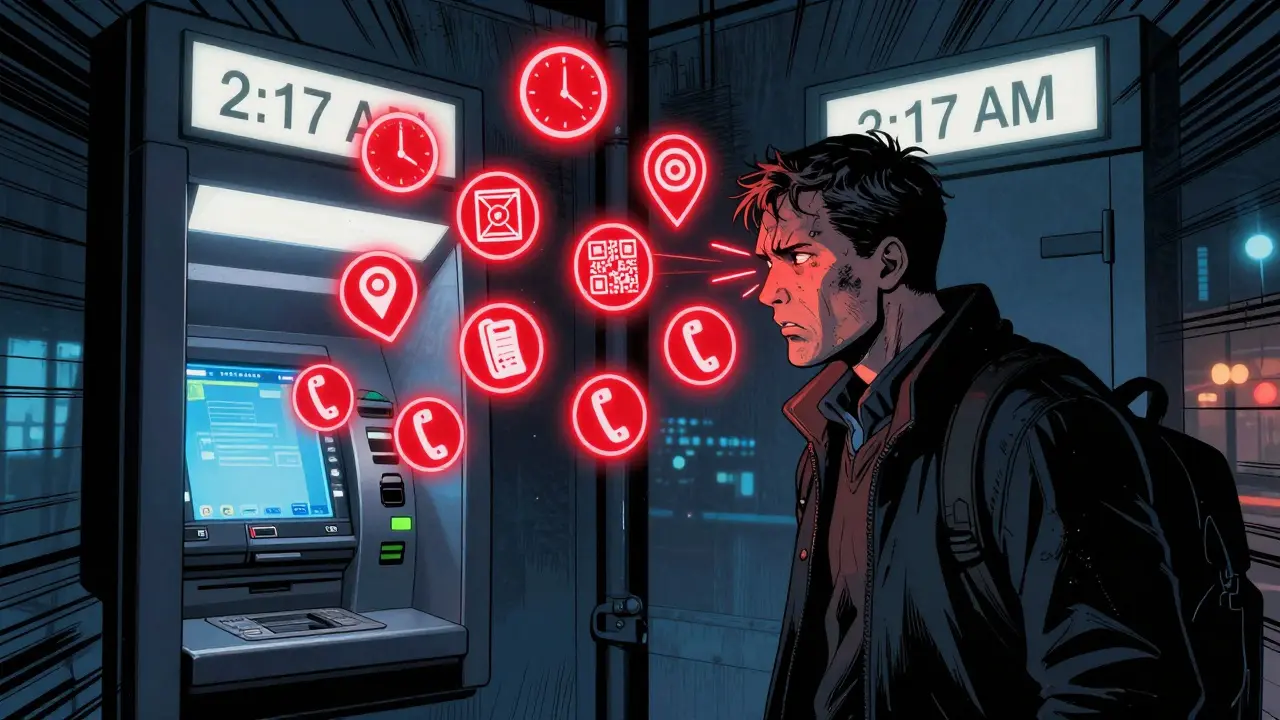
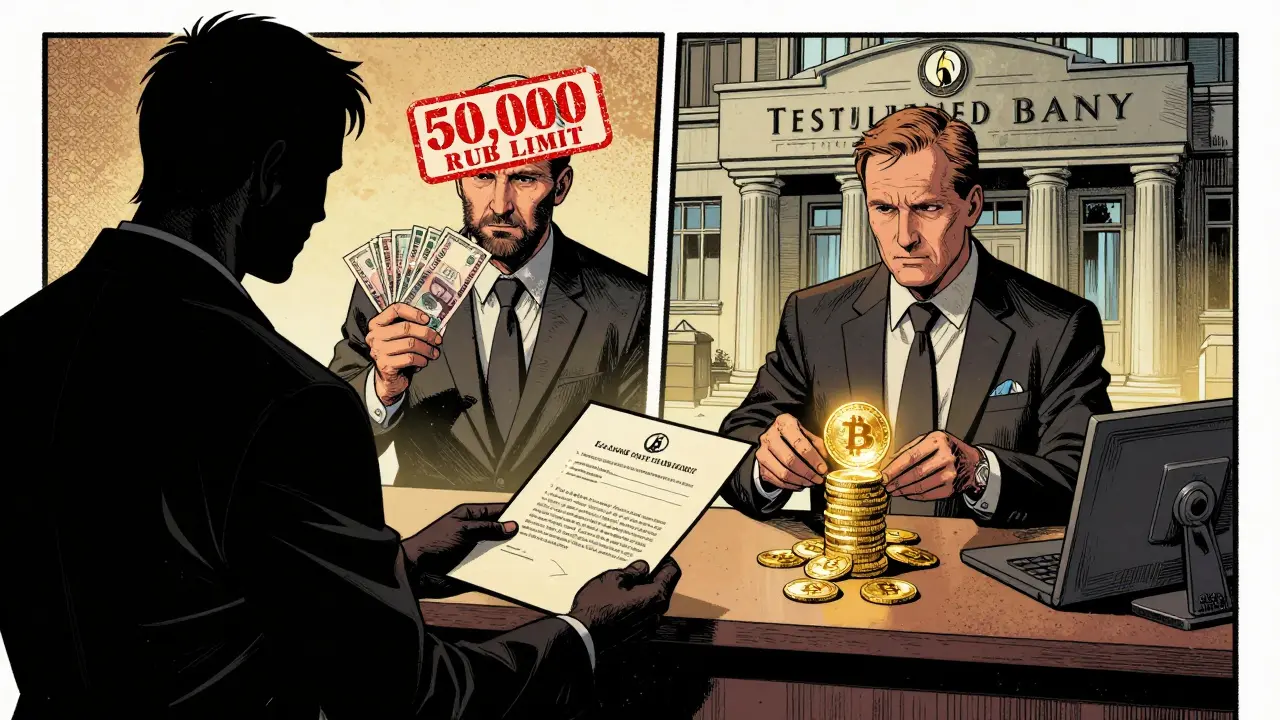
It’s not about how much money you withdraw. It’s about how you do it. Russian banks now monitor 12 specific behavioral patterns that flag a transaction as suspicious. These aren’t vague guidelines - they’re hard-coded into banking software. If even one of these triggers lights up, your daily cash withdrawal limit drops to 50,000 rubles (about $600) for 48 hours. Here’s what sets off the alarm:- Withdrawing cash between 11 PM and 5 AM
- Using an ATM more than 50 kilometers from your registered address
- Withdrawing cash within 24 hours of receiving a large transfer (over 200,000 rubles) via Russia’s Faster Payments System
- Using QR codes or virtual cards instead of physical debit cards
- Receiving 3 or more messages from unknown numbers in under 6 hours before the withdrawal
- Withdrawing amounts that aren’t divisible by 1,000 rubles (e.g., 67,300 instead of 67,000)
- Using a device flagged for malware or unusual activity
- Connecting to a peer-to-peer exchange like Paxful or LocalBitcoins for transactions over 100,000 rubles
- Having no prior transaction history on the card used for withdrawal
- Switching phone numbers or SIM cards within 30 days
- Withdrawing from a bank branch you’ve never used before
- Multiple withdrawals across different banks in a single week
These aren’t guesses. They’re based on data from 273,100 fraud cases in Q2 2025, totaling 6.3 billion rubles - and 89% of them involved crypto conversions. The Central Bank of Russia didn’t just make these rules up. They analyzed real scams. But the side effect? Thousands of ordinary users are getting caught in the net.
What happens when your account gets flagged?
You won’t get a phone call. You won’t get an email. You’ll get an SMS that says: "Your withdrawal limit has been temporarily reduced due to suspicious activity. Contact your branch for verification." That’s it.Then comes the wait. Your daily cash limit drops to 50,000 rubles. You can’t withdraw more than that for two full days. During that time, the bank investigates. They might ask you to:
- Visit your branch in person
- Provide screenshots of your crypto wallet
- Show proof of where the crypto came from (exchange history, mining records, etc.)
- Submit a notarized statement explaining your income source
One user on BitBoom, "CryptoTrader89," withdrew 65,000 rubles after selling Bitcoin on Paxful. His account froze. He had to drive 90 kilometers to his Sberbank branch, show a wallet address, and prove he’d held the Bitcoin for over 60 days. It took 72 hours to get his full access back. He wasn’t accused of anything illegal. He just didn’t fit the bank’s "normal" profile.
On Trustpilot, Tinkoff Bank’s rating for crypto-related services dropped from 4.3 stars in August 2025 to 2.1 in September. Over 78% of negative reviews mentioned withdrawal blocks. Reddit’s r/RussianCrypto community logged 147 cases in one month - each taking an average of 3.2 business days to resolve. And 68% of those users had to prove they had a legal income source.
Why does Russia do this?
It’s not about stopping crime. It’s about control.Russia’s official stance is that crypto is a tool for fraud and capital flight. And there’s truth to that. According to Finance Minister Anton Siluanov, crypto now fuels 37.2% of all cross-border payments and currency withdrawals. That’s a massive leak in a system trying to keep rubles inside the country. So instead of banning crypto outright - which would drive it underground - they’ve created a system that makes it painful, slow, and risky.
Here’s the twist: while ordinary users get slapped with 50,000 ruble limits, banks themselves are being allowed to trade crypto - but only under strict conditions. In September 2025, the Bank of Russia announced that banks can hold cryptocurrency up to 1% of their regulatory capital, as long as they keep 150% reserves. That’s not a loophole. It’s a strategy. The state wants to own the flow - not eliminate it.
Meanwhile, Russia is preparing to let banks use crypto for international trade. Foreign buyers can pay in Bitcoin. Exporters can receive it. But if you’re a Russian citizen trying to turn your Bitcoin into cash for groceries? You’re the problem.
How are people adapting?
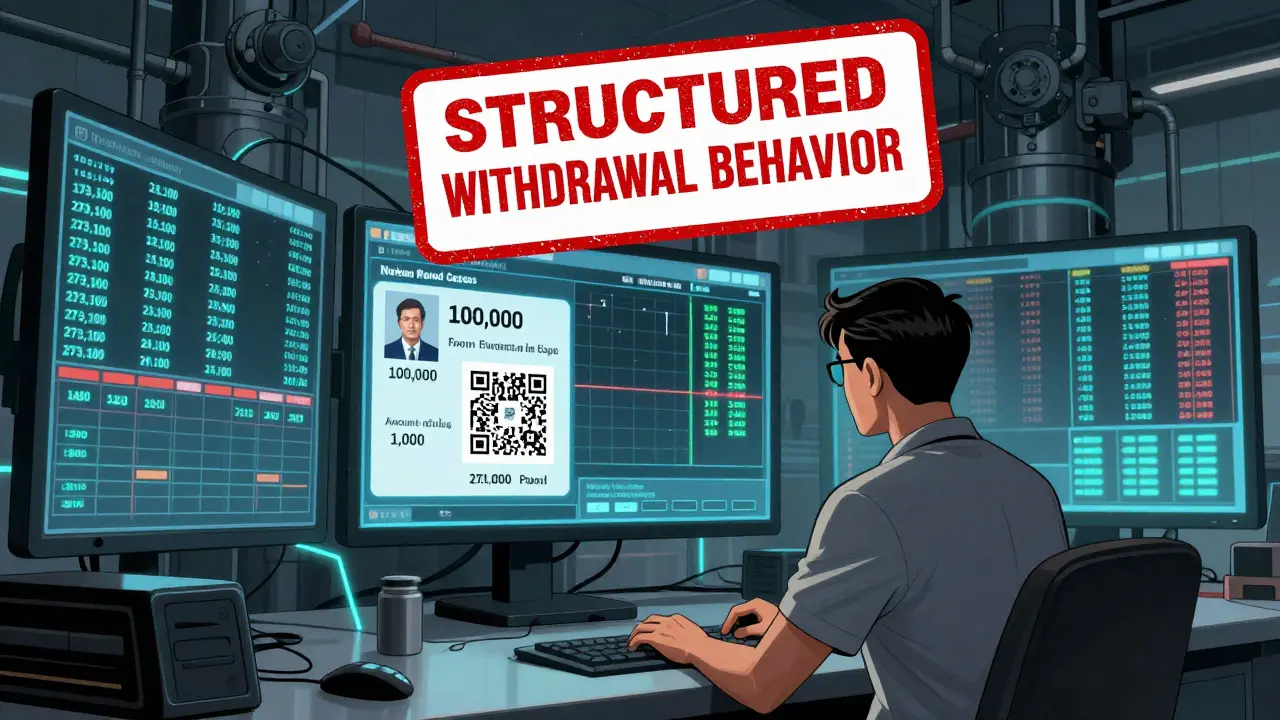
Most users don’t quit. They adapt.One common tactic? Use multiple bank accounts. Active crypto traders now average 3.7 different accounts. They stagger withdrawals - one bank per week, different amounts, different times. But this backfires too. Banks now monitor cross-institutional patterns. If you withdraw 45,000 rubles from Sberbank on Monday, then 48,000 from VTB on Wednesday, you trigger a different alert: "structured withdrawal behavior."
Another trick: use cards with "natural" history. Experts like Alexey Likhunov say if your card has three months of regular spending - groceries, transit, utility bills - your crypto withdrawal is 73% less likely to be blocked. The bank sees you as a real person, not a crypto operator.
Some users now use non-Russian banks - but that’s risky. Many foreign banks now freeze accounts linked to Russian crypto activity, fearing U.S. or EU sanctions. Others turn to cash-based P2P traders. But those middlemen now charge 7-12% fees to bypass the system. That’s how criminals profit.
What’s coming next?
The restrictions are getting tighter.By December 1, 2025, banks will be required to verify the source of any crypto withdrawal over 100,000 rubles. That means if you sell 100,000 rubles worth of crypto, you’ll need to prove exactly where you got it - down to the transaction ID. Decentralized exchanges like Uniswap or PancakeSwap? They don’t keep records. Good luck.
And then there’s the looming criminal penalty. Legislation is moving through the Duma that could jail people for "organized cryptocurrency conversion schemes." Repeat violations? Up to 5 years. Aggravated cases? Up to 10. The language is vague. "Organized" could mean using two accounts. Or withdrawing more than once a month.
At the same time, Russia is testing blockchain systems for commodity exports. State-owned banks are preparing to settle oil and gas deals using tokenized assets. The message is clear: crypto is fine if it serves the state. Not if it serves you.
Bottom line: It’s not about money. It’s about control.
If you’re a Russian citizen trying to turn crypto into cash, you’re not a criminal. You’re a target. The system isn’t broken - it’s working exactly as designed. Every limit, every delay, every demand for documentation is meant to make crypto feel like a burden. To push people toward the government’s own digital ruble, launching in September 2026.There’s no easy way out. No workaround that lasts. The banks aren’t your allies. They’re enforcers. And the rules keep changing - faster than you can adapt.
Can I still withdraw crypto to fiat in Russia?
Yes - but with severe restrictions. You can withdraw cash, but your daily limit drops to 50,000 rubles for 48 hours if your transaction triggers any of 12 behavioral flags. You’ll also likely need to visit a bank branch, prove your source of funds, and wait up to 3 days for approval.
What happens if I withdraw more than 50,000 rubles after a crypto deposit?
The transaction will be blocked at the ATM or terminal. You’ll receive an SMS within 15 minutes explaining the freeze. To unlock full access, you must visit your bank branch with documentation proving the crypto came from a legitimate source. Failure to do so may extend the restriction beyond 48 hours.
Do Russian banks block crypto withdrawals even if I didn’t do anything illegal?
Yes. The system doesn’t care if you’re innocent. If you used a QR code to withdraw cash after trading on Paxful, or withdrew 67,300 rubles instead of 67,000, you’ll be flagged. The rules are based on patterns, not intent. Thousands of regular users have been locked out without any wrongdoing.
Why do banks demand notarized transaction histories?
Because decentralized exchanges (like Uniswap or LocalBitcoins) don’t provide official records. Banks need paper proof they can verify. Notarized documents are their way of forcing users to prove legitimacy - even if the platform itself doesn’t keep such records. This creates a major barrier for users of peer-to-peer or decentralized platforms.
Is it safer to use a different bank for crypto withdrawals?
No. All 347 licensed Russian banks use the same CBR-mandated monitoring system. Switching banks won’t help. In fact, using multiple banks can trigger a new alert: "structured withdrawal behavior," which is just as likely to freeze your accounts.
Can I avoid restrictions by using crypto for international payments instead?
Yes - and that’s exactly what the government wants. While domestic crypto-to-fiat withdrawals are restricted, Russia is actively legalizing crypto for foreign trade. If you’re exporting goods, you can receive crypto payments legally. But if you’re a regular citizen trying to cash out for personal use? You’re being pushed toward the government’s digital ruble instead.
Will these restrictions be lifted in the future?
Unlikely. The trend is toward tighter control. Legislation for criminal penalties is moving through the Duma. The Central Bank plans to expand verification requirements to all withdrawals over 100,000 rubles by December 2025. The goal isn’t to reduce fraud - it’s to eliminate unregulated crypto circulation by 2027. The system is being built to last.




I just wanna say… this is wild 😭 I had no idea banks were this invasive. My friend in Moscow tried to cash out 80k rubles after selling ETH and got locked out for 72 hours. They asked for screenshots of his wallet from 2023. Like… why??
Ah, the beautiful dance of authoritarian efficiency. A system so meticulously engineered to crush individual financial autonomy that it becomes a performance art piece titled 'The State's Bureaucratic Ballet.' Every QR code, every non-divisible ruble, every midnight withdrawal - a brushstroke in the grand mural of control. We are not citizens. We are data points with ATM cards.
Let me get this straight. You can’t withdraw 67,300 rubles because it’s not divisible by 1,000? So the Central Bank is basically a math teacher who failed algebra and now runs a surveillance state? Brilliant. The only thing more absurd is that banks can hold crypto but you can’t turn yours into rubles without a notarized life story. This isn’t regulation. It’s performance art for the dystopian theater.
Hey, I know this sounds intense, but there are ways to make it work! One thing that helped a lot of folks is building up a 'normal' transaction history - like paying bills, buying groceries, transit passes - for a few months before even touching crypto. It signals to the system that you’re not some shadowy trader. Also, try using the same ATM near home. Small things add up! You got this 💪
This is why I hate crypto. You think you’re free? Nah. You’re just a pawn in a bigger game. Now you’re not just fighting the government - you’re fighting their algorithm. Who designed this? Some grad student who watched too much Black Mirror? This isn’t security. It’s psychological warfare disguised as banking.
The systemic approach taken by the Russian authorities is both logical and pragmatic. While the measures may appear restrictive, they are grounded in empirical data from over 270,000 fraud cases. Financial sovereignty must be preserved, especially in times of geopolitical volatility. The emphasis on traceability and documentation is not punitive but protective.
I dont even get why people think they can just cash out crypto like its cash. Russia is not your personal crypto ATM. If you want to play with digital money then deal with digital consequences. Stop whining and get a job that pays in rubles like everyone else
So they block withdrawals. Big deal. People still use it. I’m not surprised.
I’m not even mad. I’m just disappointed. You knew the rules when you got into this. Crypto isn’t magic money. It’s digital chaos with a side of paperwork. And now you’re surprised the system pushes back? Honey, you signed up for the circus. The clowns just showed up earlier than expected.
You know, this reminds me of something I saw in Japan during the 90s - when they started tracking cash movements to prevent tax evasion. The government didn’t ban cash. They just made it inconvenient. Same thing here. Russia isn’t trying to kill crypto. They’re trying to make it feel like a second-class citizen. And honestly? It’s working. People are slowly switching to the digital ruble because it’s easier. The system doesn’t need to force you. It just needs to make the alternative look better.
This is why I hate the west they say crypto is freedom but look what happened here people are trapped in a digital cage with 12 stupid rules and they still dont get it the system is not broken its working perfectly to make you suffer and beg for the digital ruble
67,300 rubles? Bro you’re getting flagged because you cant do math? The real crime is using crypto at all in a country that literally has a 50k limit for not being a robot
I read this whole thing and I just sat there. Like… wow. I didn’t even know this was happening. I thought crypto was supposed to be free. But now I see it’s just another system with different rules. Kinda makes you wonder if any system is really free. Or if we’re just trading one cage for another.
The precision of this regulatory architecture is nothing short of a masterclass in statecraft. By imposing granular behavioral constraints - such as the non-divisibility threshold of 1,000 rubles - the Central Bank of Russia has effectively weaponized mundane financial habits. One cannot help but admire the elegance of a system that transforms innocuous transactions into forensic investigations. The digital ruble, by contrast, offers seamless compliance. A triumph of governance over chaos.
this is all fake right?? like who the hell designed this?? its like if a 12 year old who just watched a spy movie wrote a banking policy. 50k limit? qr codes? weird numbers?? i think the government is using this to train AI to detect human behavior. next thing you know your toaster will report you for withdrawing too much bread
It’s fascinating how the system works. The real innovation isn’t the restrictions - it’s how they turned crypto into a behavioral dataset. Every withdrawal becomes a fingerprint. The banks aren’t just blocking transactions - they’re mapping human patterns. That’s why switching banks doesn’t help. It’s not about the institution. It’s about the trail. And that trail? It’s now global.
I’ve been thinking about this a lot. It’s not just about crypto. It’s about what happens when trust in institutions breaks down. People turn to decentralized systems because they don’t believe banks, governments, or even money itself is fair. But then the system adapts - not to protect the people, but to control them. So we’re stuck in this loop: distrust leads to innovation, innovation leads to control, control leads to more distrust. Is there a way out? Or are we just circling the same drain?
I feel you. I’ve been there - had to drive 2 hours to prove I owned my wallet. But honestly? The key is patience and consistency. Don’t rush. Don’t panic. Just keep your history clean. And if you can, use a physical card. It helps more than you think ❤️
i think they just dont want people to cash out because they want everyone to use the digital ruble. its so obvious its like a bad movie
Why even use crypto if its this hard? Just use rubles like normal people
i tried to withdraw once and got flagged for using my phone after 11pm i just gave up and now i use cash traders they take 10 but at least i dont have to prove i exist