
Is Crypto Regulated in India? Tax Rules, Legal Status, and What You Can Do in 2026
Is crypto regulated in India? The short answer: yes - but not the way most people expect. You can buy, sell, and hold Bitcoin, Ethereum, and other digital assets without breaking the law. But the government isn’t giving you a green light. Instead, it’s treating crypto like a high-risk investment you must report - and pay heavy taxes on.
What’s Legal and What’s Not
There’s no outright ban on cryptocurrency in India as of 2026. You won’t go to jail for owning Bitcoin. You can use Indian exchanges like CoinDCX, WazirX, or ZebPay to trade. But here’s the catch: cryptocurrencies are not legal tender. That means you can’t walk into a store in Mumbai or Delhi and pay for chai with Dogecoin. The Indian rupee is still the only money the government accepts for everyday transactions.
The real framework came into effect in April 2025 with the Income Tax (No. 2) Bill, 2025. It officially defines all digital assets - including Bitcoin, NFTs, and tokens - as Virtual Digital Assets (VDAs). This isn’t a license to operate freely. It’s a rulebook for taxation and tracking. The government doesn’t care if you’re mining, staking, or trading. If you make money from it, they want their cut.
The Tax Bomb: 30% + 1% TDS
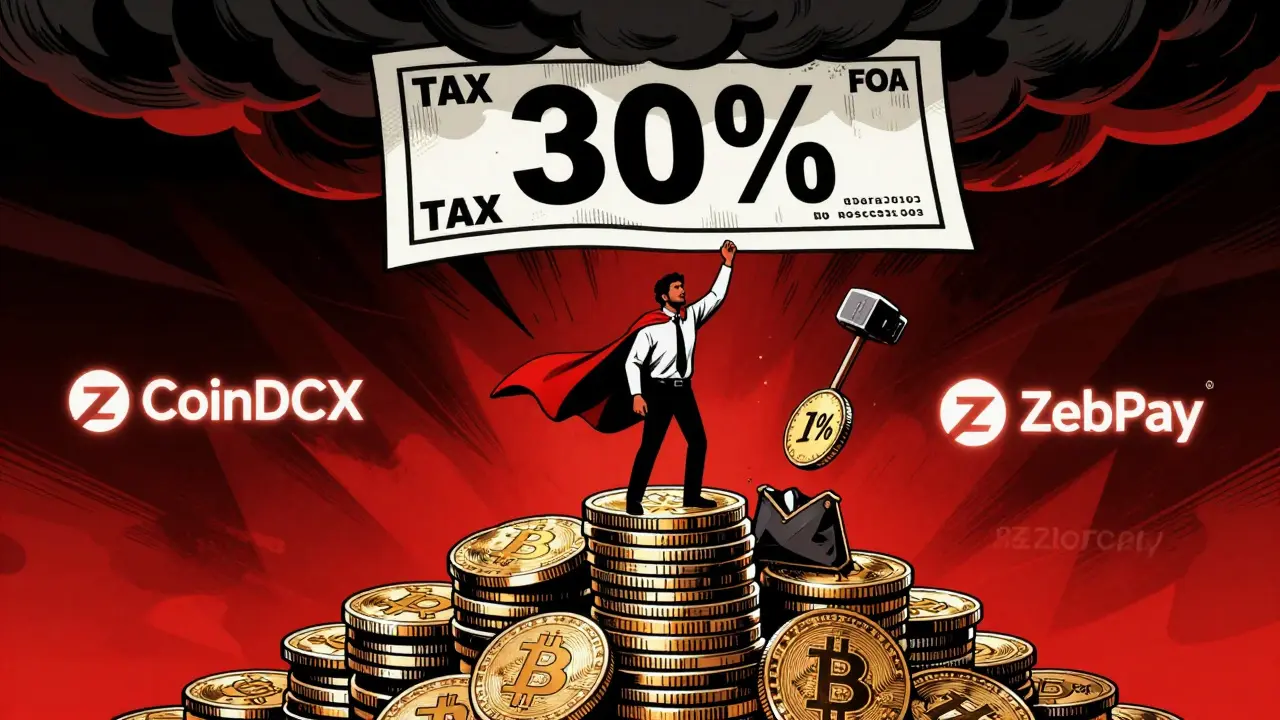
India has one of the strictest crypto tax regimes in the world. If you sell Bitcoin for a profit, you pay 30% tax on your gains. No deductions. No loss offsets. Even if you lost money on Ethereum last year, you can’t use that loss to reduce your Bitcoin tax bill. That’s unlike stocks or mutual funds, where losses can balance out profits.
On top of that, there’s a 1% Tax Deducted at Source (TDS) on every crypto transaction. That means if you sell ₹100,000 worth of crypto, ₹1,000 gets taken out before you even see your money. The exchange handles this automatically - no paperwork needed from you. But it still cuts into your returns.
Here’s a real example: You bought 0.5 BTC for ₹20,00,000 in 2023. In 2025, you sell it for ₹35,00,000. Your profit? ₹15,00,000. You owe ₹4,50,000 in tax (30% of ₹15L). Plus, ₹10,000 was deducted as TDS during the sale. So you walk away with ₹30,40,000 - not ₹35,00,000. And you still have to declare this in your annual tax return.
Who’s Watching You?
It’s not just the Income Tax Department. Multiple agencies are keeping tabs:
- Income Tax Department - Tracks every trade, transfer, and wallet address linked to your PAN number.
- Financial Intelligence Unit (FIU-IND) - Monitors large or suspicious transactions for money laundering. Exchanges must report anything over ₹10 lakh in a single year.
- Reserve Bank of India (RBI) - Still opposes crypto as a financial threat. It’s pushing its own digital rupee (CBDC) and discourages banks from supporting crypto firms.
- SEBI - Has quietly suggested crypto trading should be regulated like stock markets. No official move yet, but the signals are there.
The government has already sent out hundreds of thousands of tax notices since 2019 to people who didn’t report crypto income. If you ignored crypto on your tax return before 2025, you’re already on their radar.

The Legal Grey Zone
There’s no law that says “crypto is legal.” There’s no law that says “crypto is illegal.” That’s why experts call it a grey zone. The Supreme Court killed the RBI’s 2018 banking ban in 2020, but that didn’t create a legal right to use crypto. It just removed one barrier.
The government tried to ban crypto outright with the Banning of Cryptocurrency & Regulation of Official Digital Currency Bill, 2019. It never passed. But it didn’t disappear either. It’s still sitting on the shelf - a reminder that the rules could change overnight.
Right now, the government’s strategy is simple: tax everything, monitor everything, discourage speculation, and wait to see what global standards emerge. If the EU or U.S. sets a new rule, India will likely follow - but with its own twist.
What Happens If You Don’t Report?
Don’t think you can hide. The government has access to global data sharing agreements. Thanks to the G20’s Crypto-Asset Reporting Framework (CARF), India now automatically receives transaction data from exchanges in the U.S., UK, Singapore, and other major crypto hubs. If you traded on Binance or Coinbase and didn’t declare it, they already know.
Penalties are harsh. Failure to report can lead to:
- Up to 200% of the tax owed as a penalty
- Prosecution for tax evasion (criminal charge)
- Freezing of bank accounts linked to crypto activity
There’s no grace period. No amnesty. If you didn’t file, start now. Even if you lost money, you still need to report the transaction.

What About NFTs and Other Tokens?
Yes, NFTs are included. Buying a digital artwork, a gaming item, or a tokenized real estate deed - if it’s on a blockchain - it counts as a VDA. The same 30% tax applies. Even if you trade one NFT for another, that’s a taxable event. Swapping a Bored Ape for a CryptoPunk? You owe tax on the difference in value.
Staking rewards? Taxable. Airdrops? Taxable. Mining income? Taxable. Every time you receive crypto as income - whether from a job, a reward, or a fork - it’s treated as ordinary income and taxed at your regular slab rate.
What’s Next for Crypto in India?
Expect more clarity - but not freedom. The government is watching how the U.S. and EU handle regulation. If those regions adopt clear licensing for exchanges or investor protections, India might follow. But don’t expect legalization like in the U.S. or Switzerland.
The future looks like this:
- More integration between crypto platforms and the tax system
- Stricter KYC rules - maybe even facial recognition for large trades
- Push for CBDC (digital rupee) as the official alternative
- Increased cooperation with global tax authorities
For now, crypto in India isn’t banned. It’s just being heavily monitored and taxed. The message is clear: you can play, but you’re not in control. The government is.
Is it legal to buy Bitcoin in India in 2026?
Yes, it is legal to buy, sell, and hold Bitcoin and other cryptocurrencies in India. There is no ban on owning or trading digital assets. However, they are not recognized as legal tender, meaning you can’t use them to pay for goods or services the same way you use rupees.
Do I have to pay tax on crypto profits in India?
Yes. All profits from selling or trading cryptocurrencies are taxed at a flat 30%, with no deductions allowed for losses. Additionally, a 1% Tax Deducted at Source (TDS) is automatically withheld on every transaction. This applies regardless of whether you made a profit or loss overall in the year.
Can I use crypto to pay for things in India?
No. The Indian government does not recognize any cryptocurrency as legal tender. You cannot use Bitcoin, Ethereum, or any other digital asset to pay for groceries, rent, or services. Only the Indian rupee has this status. Some private businesses may accept crypto voluntarily, but they do so at their own risk.
What happens if I don’t report my crypto income?
If you fail to report crypto income, the Income Tax Department can issue notices, freeze your bank accounts, and impose penalties of up to 200% of the tax owed. In serious cases, you could face criminal charges for tax evasion. The government now receives automatic transaction data from international exchanges through global reporting agreements.
Are NFTs and staking rewards taxed in India?
Yes. NFTs, staking rewards, airdrops, and mining income are all classified as Virtual Digital Assets (VDAs) under Indian tax law. Any income received from these activities is taxable. Even swapping one NFT for another counts as a taxable event. The 30% tax rate and 1% TDS apply to all such transactions.







lol so crypto in india is basically 'you can own it but we're gonna tax you into oblivion' 😅
1% TDS on every trade? That's like a micro-tax vampire. I'm already feeling the pinch just reading this.
30% on gains with no loss offset is brutal. No other asset class gets this treatment. Stocks get deductions. Crypto? Nope.
The irony is palpable. India refuses to recognize crypto as legal tender, yet it has created one of the most sophisticated tax infrastructures for it in the world. A regulatory paradox wrapped in bureaucracy.
TDS on every trade is wild. Imagine having to pay 1% just to swap ETH for BTC. That's a liquidity killer right there. No wonder retail traders are fleeing to P2P.
Also, NFT swaps being taxable? Bro, I just traded my ape for a punk and now I owe 40k in taxes? What even is this?
Oh please. You're telling me a country that can't even get its own digital currency right is now policing blockchain transactions like the IRS on espresso? This isn't regulation. It's performance art.
People who don't report crypto are just asking for trouble. I've seen guys get their accounts frozen. They think they're smart hiding it? The government has global data sharing now. You're not hiding. You're just delaying the inevitable.
I know it sounds harsh but this is actually smart policy. Taxing crypto like income prevents it from becoming a tax shelter. And the 1% TDS? That’s just friction to keep the system honest. No one’s forcing you to trade - but if you do, play by the rules.
I just realized I forgot to report my staking rewards from last year 😳
Like… 30% on airdrops? I got 0.2 SOL from a token launch and now I owe 6k? That’s more than my rent. Help. I’m not a tax expert.
The real story here isn’t the tax - it’s the data sharing. G20’s CARF means even if you use Binance, India gets your transaction history. No anonymity left. You’re being tracked whether you like it or not.
In India, we've always had this weird love-hate with new tech. We adopt it fast but regulate it harder than anyone. Crypto? Same story. We'll let you trade - but we'll watch every move. It’s not about control. It’s about not being left behind.
Taxation without representation is oppression. But here, we have representation - and still we are taxed. The government must decide: is crypto a financial instrument or a threat?
You people act like this is the end of the world. I’ve seen worse. Remember when banks started charging ₹50 for ATM withdrawals? This is just the next step. Adapt or get left behind.
For anyone worried about reporting: use a crypto tax tool. Koinly or CoinTracker auto-syncs with Indian exchanges. Saves hours. I filed my 2024 return in 45 mins. No stress. Just upload, click, done.
Also - yes, NFT swaps are taxable. I swapped a pixel art for a profile pic. Paid tax. It sucked. But I’m compliant.
I’m an Indian living in the US and I can tell you - this tax system is actually more transparent than what we have here. At least in India, you know exactly what you owe. No gray areas. Just pay and move on.
This whole thing is a scam. They don’t want crypto regulated - they want it dead. Taxing at 30% with no loss offset? That’s not policy. That’s sabotage. And they call it 'clarity'? More like coercion.