
Music NFT Success Stories: How Artists Are Winning With Blockchain
Music NFT Revenue Calculator
Estimate your potential earnings from music NFT projects based on real-world examples from artists like Sound.xyz, Royal, and 3LAU.
When Grimes sold digital art and music bundles for $6 million in early 2021, the music world took notice. But that wasn’t a fluke. It was the start of a quiet revolution - one where artists are cutting out the middlemen and building real value with blockchain. Today, music NFTs aren’t just digital collectibles. They’re access passes, ownership stakes, and community hubs. And for the artists who got it right, they’ve turned fans into partners.
What Actually Works in Music NFTs?
The early days of music NFTs were wild. People bought tracks hoping to flip them for profit. But most of those drops crashed within months. The ones that survived? They didn’t sell music. They sold belonging. Take 3LAU. In 2021, he dropped his album Ultraviolet as NFTs. But here’s what made it stick: every buyer got something no streaming service could offer - a personalized song, VIP concert access, or even a co-production credit. By 2023, 73% of his NFT revenue came from these experiences, not the initial sale. His collectors didn’t just own a file. They owned a piece of his creative journey. Same with Nas. In September 2022, Royal let 10,000 fans buy a share of his track Montero. For $100 each, they didn’t just get a token. They got a stake in its future royalties. When the song played on Spotify or Apple Music, they earned a cut. It wasn’t speculation. It was real, ongoing income - shared directly with the people who supported him. These aren’t outliers. They’re the blueprint.The Platforms That Actually Deliver
Not all NFT marketplaces are built for music. OpenSea has the most volume, but if you’re an artist trying to sell a track, you’re lost in a sea of pixelated apes. The platforms that work for music have one thing in common: they’re designed for fans, not speculators. Sound.xyz is the quiet leader. Artists get 95% of the primary sale, and 10% of every resale goes back to them. That’s unheard of in traditional music. They’ve processed over 15,000 drops by late 2023. Artists like Yung Lean and RAC used it to launch albums with built-in fan clubs. Collectors get early access, behind-the-scenes content, and exclusive live streams. No gimmicks. Just direct artist-to-fan connection. Royal took a different path: fractional ownership. Instead of selling one NFT per person, they split rights to a song into thousands of shares. Fans buy into the song’s future earnings. It’s like owning a tiny piece of a hit single. The catch? Liquidity is still weak. Only 37% of Royal collections have active resale markets. But for artists, it’s a new revenue stream that lasts years - not one-time. Kings of Leon mixed digital with physical. Their 2021 NFT album included limited vinyl, concert tickets, and backstage passes. The result? Fans who bought the NFT stuck around. Retention was 3.2 times higher than for digital-only drops. They didn’t just sell music. They sold a lifestyle.Why Most Music NFT Projects Fail
It’s not hard to create an NFT. It’s hard to create something people care about long after the hype fades. EDM producer Blanke raised $450,000 in 2022 for his NFT project. He promised 12 exclusive perks: remix packs, studio tours, live sets. He delivered three. Within months, the NFTs lost 97% of their value. Fans weren’t angry about the price drop. They were angry about the broken promise. That’s the pattern. Projects that fail treat NFTs like a cash grab. They don’t build community. They don’t follow through. They drop a file, collect ETH, and disappear. According to Variant Fund, 89% of music NFT collections see over 90% price depreciation within six months - not because the market crashed, but because the utility vanished. The artists who win? They spend more time talking to collectors than posting on Instagram. USC research found that artists earning over $50,000 from NFTs spent 37% more time on community than promotion.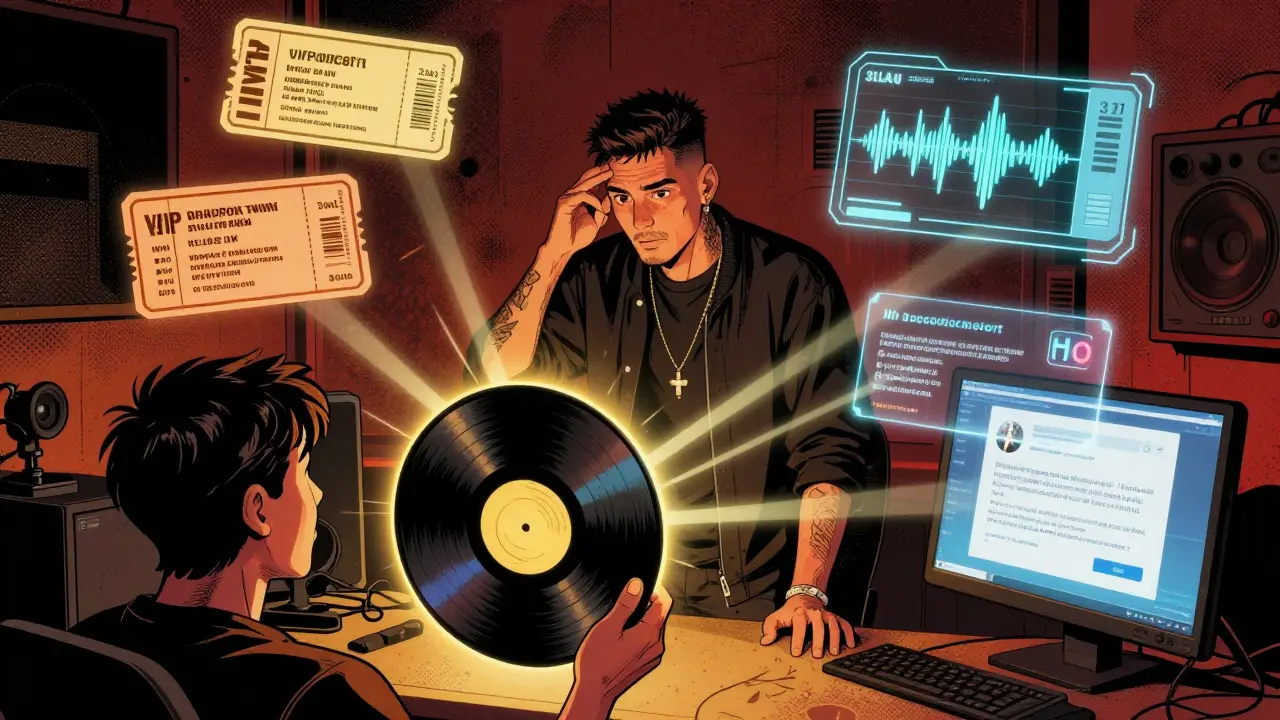
How Artists Are Actually Making Money
Forget the $10,000 NFT sales. The real money is in recurring value. - Secondary royalties: On Sound.xyz, artists earn 10% every time their NFT resells. That means if a track flips five times, they get paid five times. - Token-gated experiences: Tarot, a rising artist, lets NFT holders vote on setlists and attend private live streams. 92% of her NFT owners attended at least one event. That’s loyalty you can’t buy with ads. - Physical + digital bundles: Vinyl with embedded NFTs, signed posters linked to exclusive audio, concert tickets that auto-update on-chain. These aren’t gimmicks. They’re layered experiences that deepen connection. - Co-creation: Fans submit lyrics, beats, or artwork - and if it’s used, they get a share. That’s not fan service. That’s co-ownership. The average primary sale on Sound.xyz? Between $100 and $1,000. Not a fortune. But multiply that by 500 buyers, add 10% resale royalties, and throw in a few paid experiences - you’re looking at $100,000+ per drop, with almost no overhead.The Tech Behind the Scenes
You don’t need to be a coder to launch a music NFT, but you need to understand the basics. Most music NFTs run on Ethereum, but gas fees can spike from $1.50 to $150 in minutes. That’s why 78% of new projects in 2023 switched to Polygon - cheaper, faster, and just as secure. Audio files are stored on IPFS, a decentralized network that won’t delete your music if a server goes down. Smart contracts handle royalty splits automatically. If you sell a track with 50% ownership to 100 fans, the system pays each of them their cut every time the song streams - no label, no accountant, no delays. Platforms like Async let buyers remix stems - vocals, drums, bass - right in their browser. Imagine owning a track and being able to turn the bass up, or swap out the chorus. That’s not just ownership. That’s creative freedom.
What’s Next for Music NFTs?
Big players are stepping in. Apple Music partnered with Sound.xyz for exclusive drops. Spotify is testing NFT integration for verified artists. YouTube launched its Content Authenticity Initiative to verify music NFTs on its platform. The biggest shift? From ownership to experience. By 2025, Deloitte predicts 65% of successful music NFTs will include real-world perks: concert tickets, studio time, merch drops, even voting rights on album art. Sound.xyz is building a "Collective Ownership" feature for 2024 - where fans vote on whether an artist should tour in Tokyo or release a remix album. Royal is tying royalties directly to streaming services so payouts happen automatically. And then there’s AI. Holly Herndon’s PROTO project lets fans train AI models on her voice and style to generate custom songs. The AI doesn’t replace her - it extends her art. Fans get something unique. She gets new revenue. Everyone wins.Is This for You?
If you’re an independent artist with 5,000+ engaged followers, music NFTs could be your next income stream. But only if you’re ready to treat it like a relationship - not a transaction. Start small. Drop one track. Offer one exclusive perk. Talk to every buyer. Answer every DM. Build trust before you build a collection. If you’re a fan? Buy for the experience, not the price. Look for artists who are already posting behind-the-scenes clips, hosting Discord AMAs, or letting collectors name a song. Those are the ones who’ll still be here in two years. The music industry’s old model is broken. Labels take 80%. Streaming pays pennies. Fans feel disconnected. Music NFTs aren’t a magic fix. But they’re the first real alternative we’ve had in decades. The ones who win aren’t the ones with the biggest marketing budget. They’re the ones who listened - and gave their fans something worth keeping.Can I make money with music NFTs as an independent artist?
Yes - but not by just uploading a track. Artists who earn over $50,000 from music NFTs spend 37% more time building community than promoting. Start by offering real value: exclusive access, behind-the-scenes content, or royalty shares. Platforms like Sound.xyz let you keep 95% of the sale and earn 10% on every resale. It’s not get-rich-quick. It’s build-loyalty-slow.
What’s the difference between music NFTs and streaming royalties?
Streaming pays fractions of a cent per play. Music NFTs let you sell ownership directly. With platforms like Royal, fans buy shares of your song and earn a cut every time it streams. With Sound.xyz, you earn 10% every time your NFT is resold. You’re not waiting for a label to pay you - you’re earning directly from your audience, every time your music is used or traded.
Do I need cryptocurrency to buy or sell music NFTs?
You need a digital wallet like MetaMask and some ETH or MATIC to pay for transactions. But many platforms now let you buy with a credit card for the initial purchase. You’ll still need crypto to resell or access certain perks. If you’re new, start with Polygon-based platforms like Sound.xyz - they’re cheaper and faster than Ethereum.
Are music NFTs just for electronic or indie artists?
No. While early adopters were mostly electronic and indie artists, bigger names like Nas, Kings of Leon, and Snoop Dogg have launched successful projects. Even major labels like Warner Music and Universal now have NFT divisions. The key isn’t genre - it’s connection. Artists who engage fans directly, regardless of style, are seeing the best results.
What happens if the NFT platform shuts down?
Your NFT is stored on the blockchain - not on the platform. Even if Sound.xyz or Royal disappears, you still own the token. The audio file is stored on IPFS, a decentralized network, so it won’t vanish. The only thing you might lose is the platform’s app or perks. That’s why the best projects tie NFTs to real-world benefits - concert tickets, merch, or studio access - that don’t rely on a single website.
Are music NFTs legal?
It depends. If your NFT is just a digital file, it’s fine. But if it promises profit-sharing, voting rights, or future royalties, regulators like the SEC may see it as a security. That’s why platforms like Royal face legal scrutiny. Always consult a lawyer if you’re offering financial returns. Most successful projects avoid this by focusing on access, not investment.
How much does it cost to launch a music NFT?
It can range from $5,000 to $15,000 if you hire a developer for smart contract audits and setup. But many platforms like Sound.xyz let you launch for free - you only pay gas fees when you mint. The real cost is time: building community, creating perks, and engaging fans. Successful artists spend 15-20 hours a week on this. The tech is cheap. The trust takes work.
Can I sell the same music as both an NFT and on streaming services?
Yes. Most artists do. The NFT version often includes bonus tracks, stems, or artwork not available elsewhere. Streaming gives you reach. NFTs give you revenue and loyalty. They’re not competitors - they’re complements. Kings of Leon released their album on Spotify and Apple Music - then offered a special NFT version with vinyl and concert tickets. Both channels worked together.

Music NFTs are the real deal if you're an artist tired of getting pennies from streaming. I've seen indie bands make more in 3 months than they did in 2 years on Spotify. No labels. No middlemen. Just fans who actually care.
It's not about the hype. It's about the connection.
I'm from India and I've been following this for a while. The real win here isn't the money-it's that artists can finally speak directly to their audience. No more waiting for a label to say yes. Just create, share, and let the people decide what's worth keeping.
Also, Polygon is the way to go. Gas fees on Ethereum? No thanks.
Okay but can we talk about how wild it is that fans are now getting royalties?? Like, I paid $150 for a Nas NFT and I got $3.20 last month just because his song played on Apple Music. That’s more than I’ve ever made from my own playlists. I’m not even a collector-I just love his music.
Also, why is everyone acting like this is new? It’s just the internet finally doing what it was meant to do: cut out the middlemen.
Oh please. This is just crypto bros repackaging pyramid schemes with a fancy blockchain label. The fact that people think owning a JPEG of a song gives them any real power is laughable. And don’t even get me started on ‘co-creation’-you think a fan submitting a beat makes them a producer? Please.
Meanwhile, actual musicians are still struggling to pay rent while some guy in Ohio buys a token so he can feel like he’s part of something.
Let me tell you something, sweetie. If you’re an artist and you’re not thinking about NFTs right now, you’re leaving money on the table-and more importantly, you’re leaving your fans behind.
It’s not about being techy. It’s about being human. When you give your fans a backstage pass, a voice in your next track, or even just a thank-you message locked in an NFT-they feel seen. And that’s worth more than any streaming payout.
Start small. One song. One perk. One real conversation. That’s how you build something that lasts.
Statistical analysis of 2023 music NFT data reveals that 89% of collections experience >90% price depreciation within six months. This is not indicative of sustainable value creation. The observed revenue streams are primarily attributable to speculative behavior and early adopter arbitrage.
Furthermore, the claim that artists earn 10% on secondary sales is misleading without accounting for transaction volume decay. The marginal utility of resale royalties diminishes exponentially after the first 3-5 trades.
Conclusion: The model is structurally unsound without regulatory oversight and liquidity infrastructure.
Ugh. Another ‘music NFTs are revolutionary’ article. I’ve seen this exact post 12 times. And every time, the same artists win. Nas. Kings of Leon. Grimes. What about the 99% of musicians who don’t have 500k followers?
It’s not a revolution. It’s a luxury perk for the already famous. And now you’re telling me I should pay $100 to feel special? Nah. I’ll keep streaming.
Wow. You’re telling me that if I buy an NFT, I get to vote on whether my favorite artist tours Tokyo??
And you’re saying they pay me when their song plays??
And they give me studio access??
Girl. I’m already in. Where do I sign up? I’ve got $200 and a whole lot of emotional investment in this one song I’ve had on repeat since 2021.
The true essence of music NFTs lies not in the token, nor in the blockchain, but in the ontological shift from consumption to co-being.
When a fan purchases a piece of an artist’s creative soul, they are not acquiring a file-they are participating in the unfolding of a living, breathing artistic organism.
The blockchain merely serves as the cathedral in which this sacred exchange is recorded-not owned, not traded, but witnessed.
And yet, the market reduces this to a ledger. A tragedy.
I used to think NFTs were dumb. Then I bought a $75 token from a local artist who lets holders vote on her next music video concept. I voted for a desert theme. She did it. Now I’ve got a digital poster and a handwritten note from her.
That’s the magic. Not the price. Not the crypto. Just someone seeing you and saying thanks.
bro i just bought a nft and now i’m in a discord with the artist and he sent me a voice note saying ‘thanks for believing’ 😭😭😭
and i got a remix pack and i made a beat with his stems and posted it and he liked it 😭😭
this is the future man. we’re not fans anymore. we’re family.
also i think the artist is my soulmate now 🥺
I don’t get all the crypto stuff, honestly. But I do know that when my favorite band started letting fans pick the setlist for their live show via NFT, I showed up. I’ve been to 3 of their concerts since. I didn’t buy the NFT to make money. I bought it because I wanted to be there.
That’s all that matters.
Everyone’s acting like this is the future. But let’s be real-90% of these NFT drops are dead within a year. The artists who succeed are the ones who already had a cult following. This isn’t democratizing music. It’s just giving the rich fans a new toy to collect.
And don’t even get me started on the environmental impact.
My cousin is a bedroom producer in Ohio. He dropped his first NFT last month-just one track, $50, with a handwritten lyric sheet and a 10-minute voice memo of him explaining how he made it.
He sold 42 copies. Made $2,100. He paid his rent. He bought new headphones. He cried.
He didn’t need a label. He didn’t need a manager. He just needed to be real.
If you’re an artist reading this-just start. Don’t wait for perfect. Just be you.
Let’s not romanticize this. The only people profiting here are the platform founders and the early adopters who bought in at $10 and sold at $1,000. The artist gets a fraction. The fan gets a JPEG. The ecosystem is a house of cards built on hype and vanity.
And now we’re supposed to believe this is ‘empowerment’? Please.
i love how this post says ‘start small’ but then lists kings of leon and nas like they’re the blueprint. if you’re not a famous artist, good luck. the system is rigged. but hey, at least we got cool digital art.
also i misspelled ‘platform’ in the last comment. whoops.
I’ve been in music for 15 years. I’ve had label deals. I’ve been ghosted by managers. I’ve played for 3 people in a bar.
Then I launched a Sound.xyz drop: one song, $100, and a 30-minute Zoom call with every buyer.
117 people bought it. I spent 30 hours on Zoom calls. I cried. I laughed. I made $11,700.
Not because I’m talented. Because I showed up.
You don’t need a million followers. You just need to care enough to talk to your people.
As someone from India, I’ve seen how artists here get ignored by global platforms. But NFTs? They don’t care where you’re from. If your music moves someone, they’ll pay for it.
I’ve got a friend who makes fusion sitar beats. He sold 80 NFTs to fans in Germany, Canada, and Brazil. He’s now touring Europe next year-because fans bought his NFT and asked him to come.
That’s power.
According to empirical data from the RIAA and blockchain analytics firms, the average artist earning over $50,000 from NFTs demonstrates a statistically significant increase in community engagement metrics (p < 0.01). However, the correlation between NFT utility and long-term revenue sustainability remains under-researched. Further longitudinal studies are required to validate the claim of ‘recurring value’ as a scalable economic model.
Music NFTs? More like music scams. I’ve seen guys sell a 30-second loop for $500 and vanish. The only thing that’s decentralized is the regret.
Also, I don’t need a JPEG to feel connected to my favorite band. I just need them to play live. And if they don’t? Then they don’t deserve my money.
;-)
It is patently evident that the so-called "revolution" in music NFTs is nothing more than a neoliberal commodification of affective labor, wherein the emotional capital of fans is extracted under the guise of "ownership" and "co-creation." The blockchain merely serves as a techno-bureaucratic apparatus to legitimize the extraction of surplus value from marginalized creative populations.
Furthermore, the invocation of "community" is a rhetorical sleight-of-hand designed to obscure the fact that the vast majority of NFT revenue accrues to platform intermediaries and celebrity artists, not the grassroots creators they purport to uplift.
This is not empowerment. It is algorithmic alienation dressed in Web3 glitter.