
Real Estate RWA Tokenization: How Blockchain Is Changing Property Ownership
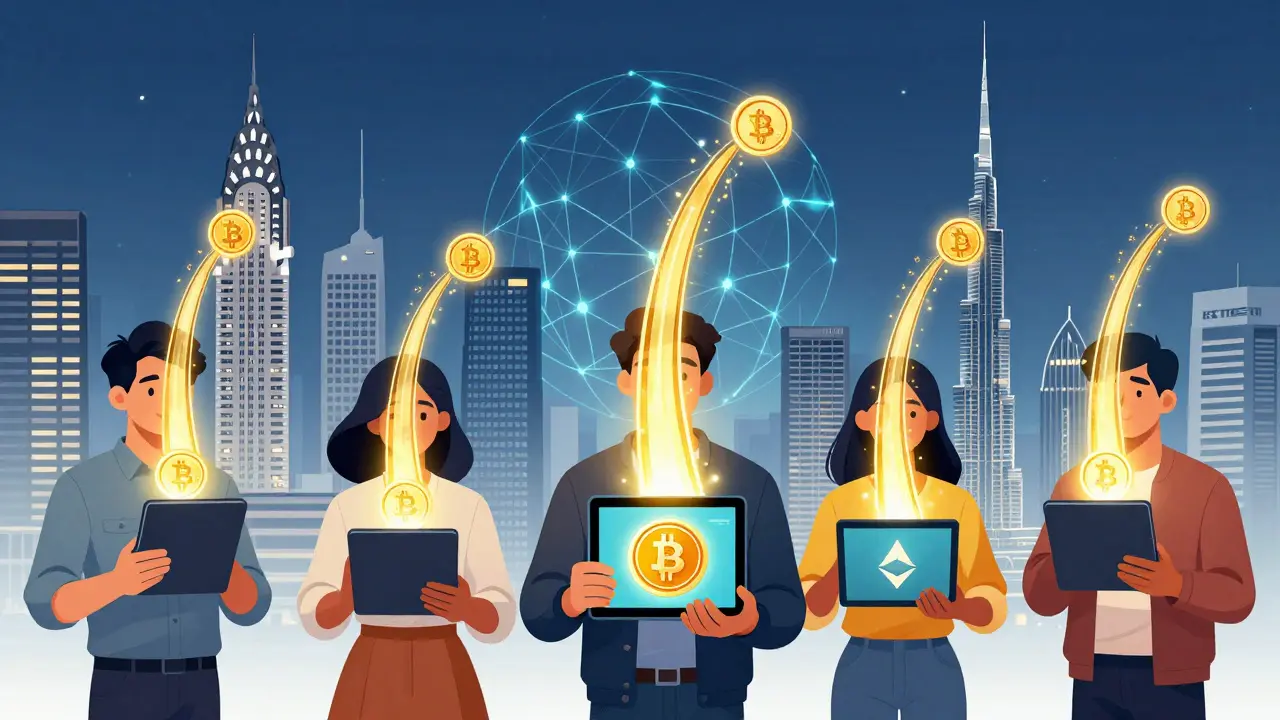
Imagine owning a piece of a skyscraper in New York or a shopping mall in Tokyo without needing $1 million upfront. That’s the reality real estate RWA tokenization is making possible today. It’s not science fiction. It’s happening now, with billions already moving into tokenized property assets. At its core, real estate RWA tokenization turns physical buildings into digital shares you can buy, sell, and trade like crypto - but backed by real walls, floors, and rent checks.
How Real Estate RWA Tokenization Actually Works
Tokenizing real estate means breaking a property into digital tokens, each representing a fraction of ownership. These tokens live on a blockchain, usually Ethereum, using standards like ERC-20. Every token holder gets proportional rights: a share of rental income, voting power on major decisions, and the ability to sell their portion anytime.
The process isn’t just coding. It’s a five-step legal and technical pipeline:
- Asset selection: Pick the property - commercial, residential, or development project. Commercial buildings are the most common because they generate steady cash flow.
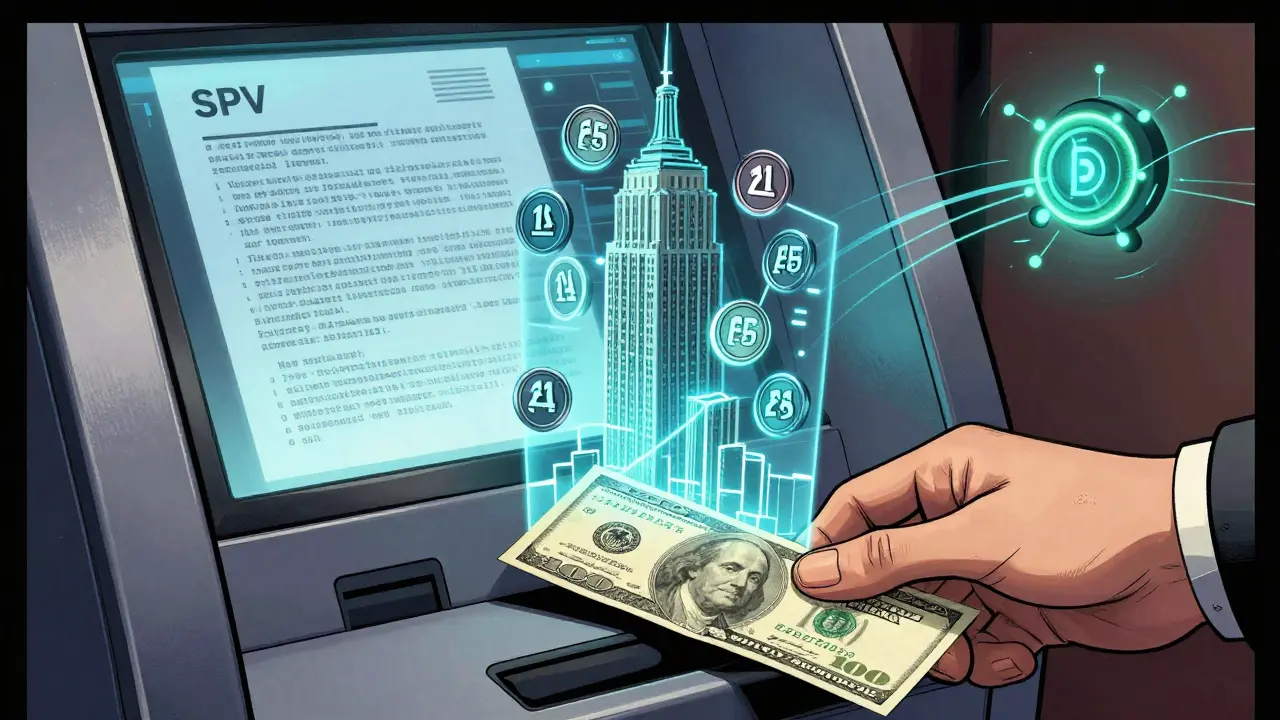
- Legal structure: Create a Special Purpose Vehicle (SPV), a legal entity that owns the property. Tokens are tied to this SPV, not directly to the land. This keeps ownership enforceable under real estate law.
- Token minting: Generate the digital tokens. Each token is assigned a value based on the property’s appraised worth. A $10 million building might be split into 10,000 tokens worth $1,000 each.
- Smart contracts: Code rules into the blockchain: automatic rent distribution, investor verification (KYC), transfer restrictions, and dividend schedules.
- Marketplace listing: List tokens on regulated platforms like Brickken or Securitize where buyers can trade them 24/7.
Behind the scenes, oracle networks like Chainlink pull real-world data - rental payments, property taxes, maintenance costs - into the smart contracts. Without this, the blockchain wouldn’t know when rent is collected or if a tenant paid late.
Why This Is a Game-Changer for Investors
Traditional real estate investing has three big problems: you need a lot of money, it’s hard to sell, and you’re stuck with one location. Tokenization fixes all three.
Take a $5 million office building. Normally, only wealthy investors or funds can buy it. With tokenization, you can buy $1,000 worth of tokens. That’s it. No need for a mortgage, no need to find partners. Elliptic’s 2024 analysis showed minimum investments dropping from $500,000 to as low as $1,000.
Liquidity is the next win. Selling a house takes months. Selling a token takes minutes on a blockchain exchange. You’re not locked in. If you need cash, you can trade your share. Venly.io reports tokenized real estate trades 24/7 across global markets - no more waiting for business hours or local buyers.
Transparency matters too. Every transaction, dividend payment, and ownership change is recorded on the blockchain. No hidden fees. No paper trails that get lost. Compare that to REITs, where you rely on quarterly reports and third-party managers. With tokenized assets, you can check your holdings and earnings in real time using a blockchain explorer.
Costs drop too. Traditional real estate deals chew up 3-6% in broker commissions. Tokenization cuts that out. Platforms charge 0.5-2.5% annually for management - a fraction of the old model.
The Hidden Risks Nobody Talks About
It’s not all smooth sailing. The biggest roadblock? Regulation. Only 37% of countries have clear rules for tokenized real estate. In the U.S., the SEC is watching closely. In Europe, MiCA (Markets in Crypto-Assets) became law in December 2024 - the first comprehensive framework. But in most places, if something goes wrong - say, a platform disappears or the SPV gets sued - your token might not hold up in court.
Then there’s liquidity. Just because you can trade tokens doesn’t mean people are buying. Many platforms have thin markets. A user on Reddit’s r/RealEstateTokenization reported being stuck in a 90-day lockup during a market dip. No one wanted to buy, and they couldn’t sell.
Technical limits matter too. Ethereum handles only 15-30 transactions per second. Visa does 24,000. During high demand, gas fees spike and trades slow. That’s why platforms like Securitize use hybrid systems: blockchain for ownership records, traditional banking for settlement.
And valuation? There’s no standard. One platform might value a building based on rental income. Another uses recent sales. PwC found 42% of early tokenized projects used different methods - making it hard to compare investments.
Who’s Already Doing It?
Big players aren’t waiting. BlackRock launched BUIDL in late 2023, starting with U.S. Treasury bonds - then expanded into tokenized commercial real estate in July 2024. JPMorgan piloted tokenized mortgages in Q4 2023. Fidelity filed for a tokenized real estate fund in March 2024.
On the ground, Securitize tokenized a $50 million New York office tower in 2023, splitting it into 50,000 tokens. Investors got 6.2% annual returns. In Los Angeles, a $22 million office building was tokenized with JLL handling property management - proving you don’t need to replace traditional expertise, just enhance it with blockchain.
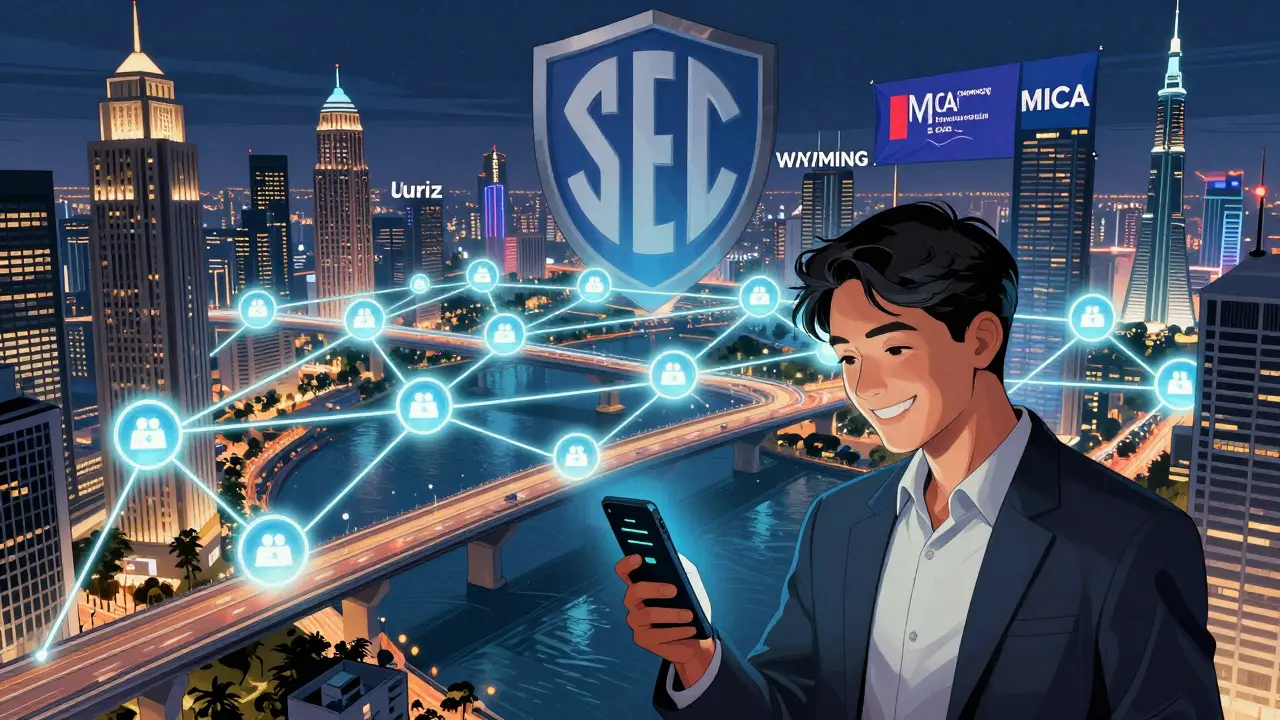
Geographically, adoption is clustered. Switzerland, Liechtenstein, UAE, Singapore, and U.S. states like Wyoming and Colorado lead the way. Why? They passed laws specifically allowing blockchain-based property ownership. In these places, tokens have legal standing. Elsewhere? It’s a gray zone.
What It Means for Everyday Investors
If you’re not a billionaire, this is your first real shot at owning part of high-value property. You can diversify: own a piece of a warehouse in Dallas, a retail center in London, and an apartment complex in Miami - all with $5,000.
But there’s a learning curve. A CoinDesk survey found 63% of early adopters didn’t understand if their tokens meant direct ownership or just shares in an SPV. That’s critical. You’re not buying land. You’re buying a share in a company that owns the land. If that company fails, your tokens lose value.
Experienced crypto users needed 8-12 hours to get up to speed. Traditional real estate investors? 20-30 hours. That’s because it’s not just tech - it’s finance, law, and property management mashed together.
Platforms like Brickken and Mintology offer educational dashboards, but the best advice is simple: start small. Put $1,000 into one tokenized property. Watch how dividends flow. Check how the platform reports data. See how easy it is to sell. Then scale.
The Road Ahead: What’s Next?
2025 is the turning point. SIX Digital Exchange plans to launch the first regulated secondary market for real estate tokens in Q2. That means real price discovery - not just platform-specific trading.
Central bank digital currencies (CBDCs) from 14 countries will soon settle tokenized real estate trades. Imagine buying a token with a digital euro or digital dollar - instant, zero-fee settlement.
The Real Estate Tokenization Standard (RETS), launched in May 2024, is pushing for uniform valuation and reporting. That’s huge. Without standards, the market stays fragmented.
Deloitte predicts that by 2027, 25% of new commercial real estate deals will use tokenization to onboard investors - cutting fundraising time from 6-12 months to 30-60 days.
But the real question isn’t whether it works. It’s whether regulators, markets, and investors can align fast enough. If they do, $330 trillion in global real estate could become liquid, transparent, and open to anyone with an internet connection.
For now, it’s still early. But the shift is real. Real estate RWA tokenization isn’t just changing how we invest. It’s changing who gets to invest.
What exactly is a real estate RWA token?
A real estate RWA token is a digital asset created on a blockchain that represents fractional ownership of a physical property. Each token gives the holder a proportional share of the property’s income (like rent) and value. It’s not a claim on the land itself, but on a legal entity - usually a Special Purpose Vehicle (SPV) - that owns the property. Tokens are typically built using Ethereum’s ERC-20 standard.
Can I really own part of a building with $1,000?
Yes. A $10 million building can be split into 10,000 tokens worth $1,000 each. You buy one or more tokens, and you become a partial owner. You’ll receive a share of rental income and can sell your tokens on secondary markets. This was impossible before tokenization, where buying even a small part of commercial property required $500,000 or more.
Are tokenized real estate investments safe?
Safety depends on the platform and jurisdiction. The blockchain itself is secure, but legal enforceability varies. In places like Switzerland or Wyoming, tokens have legal standing. Elsewhere, if the SPV fails or the platform shuts down, recovering your investment is uncertain. Always check if the platform partners with established property managers and uses regulated SPVs. Avoid platforms that don’t disclose legal structure.
How do I get paid from tokenized real estate?
Rent payments are collected by the property manager and sent to the SPV’s bank account. Smart contracts automatically distribute your share - usually quarterly - directly to your crypto wallet. You’ll see the transaction on the blockchain. Platforms like Brickken and Securitize provide dashboards showing exactly how much you earned and when it was sent.
Is real estate RWA tokenization legal everywhere?
No. Only a few jurisdictions have clear rules: Switzerland, Liechtenstein, UAE, Singapore, and U.S. states like Wyoming and Colorado. In most countries, it exists in a legal gray area. The EU’s MiCA regulation (effective Dec 2024) is the first major framework. The U.S. SEC treats most real estate tokens as securities, requiring registration. Always confirm local regulations before investing.
What’s the difference between tokenized real estate and REITs?
REITs are publicly traded companies that own real estate. You buy shares in the company, not the property. Tokenized real estate gives you direct fractional ownership of specific assets, tracked on a blockchain. REITs have higher fees, less transparency, and no 24/7 trading. Tokenization offers lower costs, real-time reporting, and global liquidity - but less regulatory protection in many regions.
Can I use crypto to buy real estate tokens?
Most platforms require fiat currency (USD, EUR) for purchases to comply with anti-money laundering rules. However, some allow crypto deposits that are immediately converted to fiat. Settlements are usually in fiat or soon-to-be-integrated central bank digital currencies (CBDCs), not in Bitcoin or Ethereum. The blockchain tracks ownership, but money moves through regulated financial channels.


Tokenizing real estate is wild but the real win is liquidity
Used to take months to sell a property now you flip a token in minutes
Game changer for small investors
Just don’t forget the legal structure
Token isn’t ownership of the building-it’s ownership of the SPV that owns the building
Big difference if things go sideways
This is the future and I’m all in 😍
Got my first $1k token in a Dallas warehouse last week
Received my first rent payout yesterday-straight to my wallet
Feels like magic but it’s just smart tech
Anyone else started small like this?
Trust me-it’s not sci-fi anymore
Even my grandma gets it now 🤓
Why wait for the rich kids to hoard property?
Tokenization is the great equalizer
Do the math-$1k vs $500k
It’s not even a choice anymore
Get in now before the gates close
PS: Brickken’s dashboard is stupidly clean
PPS: I cried when I saw the payout notification
Oh wow so now we’re all landlords?
Next thing you know we’ll be tokenizing our exes and charging rent for emotional support
Blockchain doesn’t fix bad law
It just makes bad law look fancy
Also-who approved this as an investment class?
Did someone forget that real estate is about location, location, location?
Or did we just replace ‘location’ with ‘smart contract’?
…I’m just here for the drama
India is way behind but we’re catching up
Regulation is the bottleneck
But once RBI wakes up, this will explode here
Think of millions of small investors finally owning part of a mall
Not just through REITs-with real assets
It’s about financial inclusion
Not just tech
Everyone’s hyping this like it’s crypto 2021
But you’re buying shares in a shell company
That’s tied to a building
That’s managed by a third party
That’s reporting to a blockchain
That’s regulated nowhere
And you think this is ‘ownership’?
It’s a derivative of a derivative
With zero enforcement
And you’re paying fees to watch it all happen
…cool
I JUST BOUGHT MY FIRST TOKEN AND I’M CRYING 😭
It’s not about the money
It’s about the SYSTEM
For the first time in my life
I’m not just a renter
I’m PART OF THE BUILDING
Like… actually
My name is on the ledger
Not just a lease
Not just a bank statement
But A DIGITAL TITLE
TO A PIECE OF AMERICA
AND I’M 24 AND I DID IT
WITH $1200
AND I’M SO PROUD
TO MY FUTURE SELF: YOU DID THIS
TO THE WORLD: WATCH OUT
Real estate tokenization is just REITs with blockchain branding
Same risks
Same managers
Same fees
Just more crypto jargon
And worse legal protection
Don’t be fooled
So… we’re letting people invest in buildings now?
What’s next
Tokenized air?
Tokenized sunlight?
Tokenized my ex’s apology?
At this point I just want to know
Who’s really making money here
And who’s just buying hope
There’s a quiet revolution happening
Not in boardrooms
Not in DC
But in bedrooms
Where someone in Ohio buys a $500 token
And gets a notification that rent came in
And suddenly they’re not just a worker
They’re a stakeholder
That’s not finance
That’s philosophy
That’s democracy with code
And it’s beautiful
Even if it’s messy
Even if it’s risky
Even if it’s unregulated
It’s the first time in history
That ownership wasn’t reserved for the powerful
And that… matters
just bought my first token!! so excited!!
the dashboard is so easy to use
and i got my first dividend in 3 weeks!!
thank you for this post!!
ps: i spelled 'dividend' wrong the first time but you get the point lol
can't wait to buy more!!
Y’all are overthinking this
It’s not about the tech
It’s about access
My cousin in Detroit used to work two jobs just to save for a down payment
Now? He owns 0.02% of a building in Atlanta
That’s not a token
That’s dignity
And that’s worth more than any whitepaper
Keep going
We’re building something real
Smart comment from Brad above
SPV is everything
Token without a solid legal wrapper is just a fancy NFT
Look for platforms that use regulated SPVs with audited cash flow
And avoid anything that says 'decentralized ownership'
That’s a red flag
Real estate needs lawyers
Not just smart contracts