
Subnet Tokens Crypto Exchange Review: What It Really Is and How to Trade Bittensor Subnet Tokens
There’s no such thing as a crypto exchange called Subnet Tokens. If you’ve seen it listed on CoinGecko or CoinMarketCap as exchange #108, you’re not alone - thousands of investors have been misled. That page doesn’t represent a platform you can sign up for, deposit funds into, or trade from. It’s a data aggregation error that’s causing real financial harm.
What Subnet Tokens Actually Are
Subnet Tokens aren’t an exchange. They’re the native tokens of individual subnets within the Bittensor a decentralized AI network where participants earn TAO by contributing computing power to train machine learning models. Each subnet is like its own mini-economy, run by validators who compete to provide AI services. These subnets issue their own tokens - called alpha tokens - to reward contributors and fund development.
For example, Subnet 16 (SN16) might be focused on generating code, while Subnet 42 (SN42) could specialize in image generation. Each has its own token, traded against TAO - Bittensor’s base currency. When you hear someone say "SN16 tokens," they’re talking about the token issued by that specific AI subnet, not a coin listed on a centralized exchange.
Why CoinGecko and CoinMarketCap Got It Wrong
These major crypto data sites created a single page titled "Subnet Tokens" that pulls together trading volume from over a dozen decentralized exchanges. The result? A misleading summary that looks like one big exchange with $24 million in daily volume. But here’s the truth: no single exchange handles more than 15% of that volume.
The top trading pair listed - "SN62/SN0" - isn’t a pair on an exchange. It’s the trade between Subnet 62’s token and Subnet 0 (the root subnet). This isn’t a trading pair you’d find on Binance or Kraken. It’s a liquidity pool on a DEX like PancakeSwap or Uniswap.
Bittensor’s team has asked CoinGecko and CoinMarketCap multiple times to fix this. As of October 2023, they’re still working on it. Meanwhile, retail investors keep stumbling into fake websites claiming to be "Subnet Tokens Exchange," losing money to phishing scams. Immunefi reported $187,000 stolen from three such fake sites in just one week.
Where You Can Actually Trade Subnet Tokens
You can’t buy subnet tokens on Coinbase, Binance, or Kraken - not yet. Right now, they’re traded exclusively on decentralized exchanges (DEXs). Here’s where most of the action happens:
- PancakeSwap - handles about 45% of all subnet token volume
- Uniswap - accounts for roughly 30%
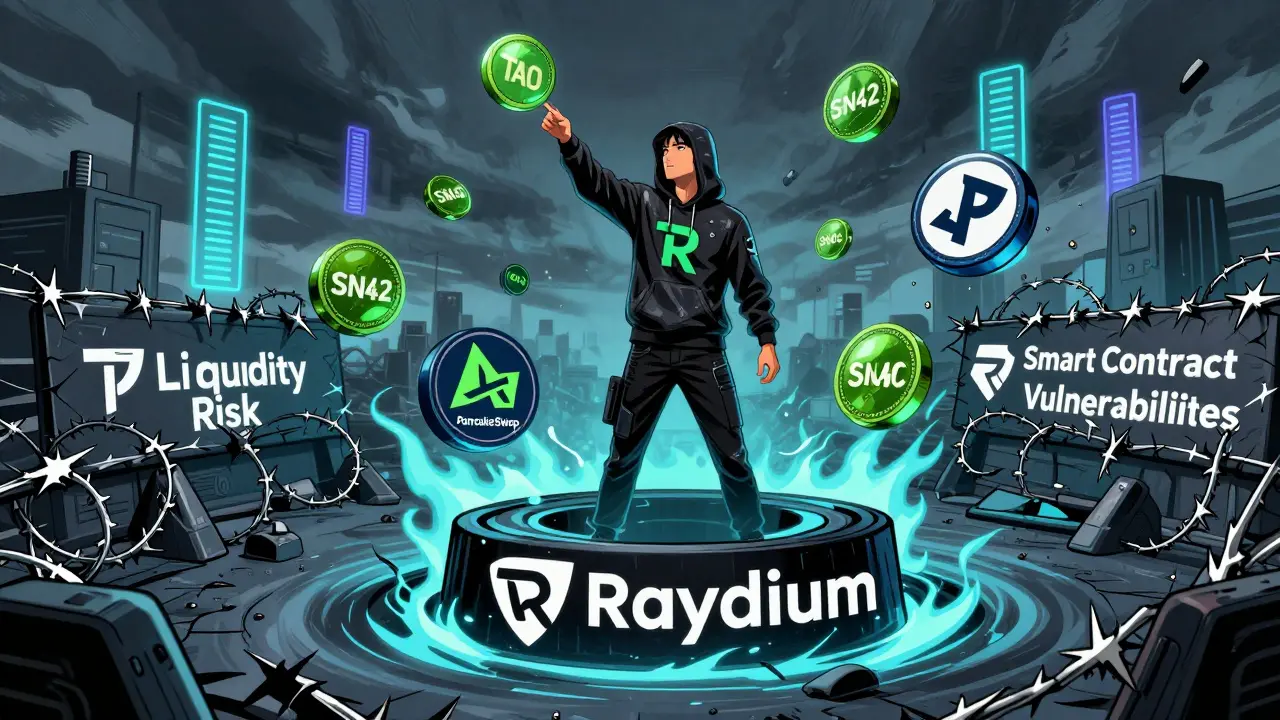
- Raydium - takes up around 15%
- Other DEXs - the remaining 10%
To trade them, you need TAO (Bittensor’s native token), which you can buy on centralized exchanges. Then you swap TAO for subnet tokens on one of these DEXs. But it’s not simple. You’ll need a compatible wallet - Talisman or SubWallet - and you’ll have to pay gas fees on the underlying blockchain. Many users don’t realize how technical this process is until they’re stuck with a failed transaction.
The Risks Are Real - And Often Overlooked
Subnet tokens are among the most volatile assets in crypto. On September 28, 2023, Oak Research found that 68% of new investors thought "Subnet Tokens" was an exchange. Of those, 41% lost money trying to deposit to a fake site or buying tokens with no liquidity.
Here’s what you’re up against:
- Extreme volatility - Tokens have jumped +300% in a day, then crashed -90% the next
- Poor liquidity - Bid-ask spreads on small subnets often exceed 10%, meaning you lose 10% just by buying and selling
- Scams - Fake websites, fake Telegram groups, fake YouTube tutorials - all designed to steal your TAO
- Regulatory risk - The U.S. SEC has flagged subnet tokens as potential unregistered securities. A crackdown could freeze trading overnight
CertiK’s October 2023 audit of 12 major subnet tokens found 83.3% had critical or high-risk vulnerabilities. That’s far worse than the 42.7% average for other token categories. If a subnet’s smart contract has a flaw, your tokens could become worthless.
How to Participate (If You’re Still Interested)
If you’re determined to get involved, here’s the real path:
- Buy TAO on Binance, Kraken, or Coinbase
- Transfer it to a Substrate-compatible wallet (Talisman or SubWallet)
- Go to a DEX like PancakeSwap and swap TAO for a subnet token (e.g., SN16)
- Stake your TAO into a subnet via Bittensor’s console or a tool like Mentat Minds
Staking TAO gives you exposure to subnet token emissions. For example, staking in Subnet 0 (SN0) might give you 18.5% APY. Staking in a newer, riskier subnet like SN39 could offer 200%+ APY - but if the subnet fails, you lose everything.
Mentat Minds, a third-party staking platform, offers three strategies:
- Conservative - Stake only in SN0 (low risk, ~18.5% APY)
- Delegation - Let Mentat Minds pick subnets (22-35% APY)
- Direct Staking - Pick your own subnets (50-300% APY, high risk)
But here’s the catch: Bittensor’s own documentation says mastering this system takes 40-60 hours of study. Most people don’t have that time - or the technical skill.
Who Should Avoid This Entire Ecosystem
If you’re a retail investor looking for a simple crypto play, stay away. This isn’t Bitcoin. It’s not even Ethereum. This is a high-stakes, hyper-technical ecosystem built on speculative AI promises.
Dr. Elena Rodriguez from Gartner put it bluntly: "The sophistication required to navigate this space effectively puts it well beyond the capabilities of retail investors, who should proceed with extreme caution or avoid entirely."
Over 87% of Trustpilot reviews from people who searched for "Subnet Tokens exchange" said they were confused, frustrated, or had lost money. Reddit threads like "Is Subnet Tokens a real exchange?" have hundreds of comments from people who thought they were signing up for a platform - and ended up scammed.
What’s Next for Bittensor and Subnet Tokens
Bittensor isn’t standing still. In February 2025, they launched dynamic TAO (dTAO), which shifted rewards from validator weightings to a market-driven model based on subnet token performance. This was meant to fix issues like validator bottlenecks and conflicts of interest.
They’ve also launched subnetalpha.ai, a dedicated analytics platform for subnet tokens. And they’re working on standardizing token interfaces (BIP-42) to make trading easier.
There are rumors Kraken and Bitget might list select subnet tokens in Q1 2024. That could bring more liquidity - and more mainstream attention. But until then, trading remains risky, fragmented, and confusing.
The bottom line? The Bittensor subnet token ecosystem is real. The "Subnet Tokens exchange" is not. If you want to participate, you need to understand the mechanics, accept the risks, and avoid the scams. Most people won’t make it through the learning curve. Those who do might find huge rewards. But for the rest? It’s a minefield disguised as an opportunity.
Is Subnet Tokens a real crypto exchange?
No, Subnet Tokens is not a real exchange. It’s a misleading data aggregation page on CoinGecko and CoinMarketCap that combines trading volume from multiple decentralized exchanges. There is no website, app, or platform called Subnet Tokens where you can deposit funds or trade directly.
Where can I buy subnet tokens?
You can buy subnet tokens only on decentralized exchanges like PancakeSwap, Uniswap, and Raydium. First, you need to buy TAO (Bittensor’s native token) on a centralized exchange like Binance or Kraken, then swap it for subnet tokens on a DEX using a compatible wallet like Talisman or SubWallet.
Are subnet tokens a good investment?
They’re extremely high-risk. Some subnet tokens have seen 400% gains in months, but many have crashed over 90%. Liquidity is low, scams are common, and regulatory action could shut down trading. Only experienced crypto users with deep technical knowledge should consider investing.
Why do people lose money on subnet tokens?
Most lose money because they think "Subnet Tokens" is an exchange and try to deposit funds to fake websites. Others buy tokens with no liquidity and can’t sell. Some stake in subnets that fail or get hacked. The complexity of the system and lack of clear information lead to costly mistakes.
Can I stake TAO to earn subnet tokens?
Yes. By staking TAO into a subnet through Bittensor’s interface or tools like Mentat Minds, you earn emissions of that subnet’s token over time. Yields vary from 18% to over 300% APY, depending on the subnet. Higher yields come with higher risk - many subnets never deliver real AI utility and collapse.
What’s the difference between TAO and subnet tokens?
TAO is Bittensor’s native token, used to pay for AI services and stake into subnets. Subnet tokens (like SN16 or SN42) are issued by individual subnets as a reward for participation. You trade subnet tokens for TAO - they’re two different assets with different roles in the ecosystem.
Will subnet tokens be listed on Coinbase or Binance soon?
There are rumors that Kraken and Bitget may list select subnet tokens in early 2024, but nothing is confirmed. Coinbase and Binance have not announced any plans. Centralized exchanges are wary due to regulatory uncertainty - the SEC has flagged subnet tokens as potential securities.
How do I avoid scams related to Subnet Tokens?
Never search for "Subnet Tokens exchange" - you’ll find fake sites. Only use official links from Bittensor’s website (bittensor.com) or verified community resources. Never share your private key. Use Talisman or SubWallet - never web wallets. If something promises guaranteed returns or asks for your seed phrase, it’s a scam.

Let me be clear: Subnet Tokens isn’t an exchange. It’s a data glitch that’s costing people real money. If you’re new to Bittensor, don’t trust CoinGecko’s listing. Go straight to bittensor.com and read their docs. The whole ecosystem is built on validators, not order books. You need TAO first, then a wallet like Talisman. No shortcuts. No magic buttons. If someone tells you otherwise, they’re selling something.
CoinGecko is in on it. They're hiding the truth so they can keep selling you fake liquidity. The SEC already knows. They're waiting for the right moment to crash it all. You think this is crypto? Nah. It's a psyop. They want your TAO. Mark my words
i saw this same thing on cmc last week and thought i found a goldmine then i lost 0.8 tao to a fake site that looked just like the real one. now i only use bittensor's official links and i dont even click on any reddit posts that say "subnet tokens exchange" anymore. its all rigged
i get why people get confused... it looks so real. i almost fell for it too. but once i read the bittensor docs and saw how subnets actually work, it clicked. its not about trading like binance, its about contributing to ai models. if you want to earn, you gotta learn. no way around it. still scared tho 😅
I just want to say that if you’re even slightly unsure about this, just wait. Seriously. I watched three friends lose over $15k total because they thought they were signing up for an exchange. One of them even sent his seed phrase to a "support agent" on Telegram. It’s not worth it. Take your time. Read the whitepaper. Watch the Bittensor YouTube channel. I spent 3 weeks just learning how to set up Talisman before I touched a single token. And I’m still nervous every time I stake. That’s okay. Better safe than sorry.
The structural asymmetry in subnet token liquidity pools is a systemic vulnerability. The absence of centralized order matching introduces extreme slippage dynamics, particularly in low-cap subnets where bid-ask spreads exceed 10%-a non-trivial tax on entry and exit. Moreover, the lack of standardized token interfaces (pre-BIP-42) creates interoperability friction that exacerbates user friction. This isn't just a UX problem-it's a macroeconomic design flaw.
This whole thing is a glorified ponzi with AI glitter on it. Validators are just bots running scripts. The "AI services" are just people paying for GPT-4 clones. And the tokens? Worthless paper until someone bigger buys in. The only ones winning are the ones who dumped early. You’re not investing-you’re gambling on a casino built by grad students.
What’s really happening here isn’t a technical error-it’s a philosophical rupture. We’ve moved from decentralized finance to decentralized delusion. The market isn’t pricing in utility anymore-it’s pricing in narrative. Subnet tokens are symbols of a belief system, not assets. The fact that people think they’re buying a stock or a currency shows how deeply we’ve lost touch with what value even means. Are we trading tokens or faith? And if it’s faith, who’s the prophet? Bittensor’s whitepaper? CoinGecko’s bot? Or the guy on YouTube who says "just stake and wait"?
US investors need to wake up. This isn't some global tech innovation-it's a foreign-funded distraction. China and Russia are laughing as Americans lose money on fake exchanges while they build their own AI infrastructure. We're being played. And the SEC? They're asleep at the wheel. This is how they drain American capital. Don't be part of the scheme.
You think this is about crypto? No. It’s about control. The fact that people don’t question why a decentralized AI network needs tokens at all-that’s the real red flag. Why not just pay validators in TAO? Why create dozens of volatile, unregulated subtokens? Because it creates dependency. It creates hierarchy. It creates gatekeepers who control who gets rewarded. This isn’t open. It’s just a new kind of pyramid dressed up as innovation. And we’re all just willing participants.
Hey, if you’re reading this and you’re scared to start-don’t be. I was too. I spent two weeks watching YouTube tutorials, joining the Bittensor Discord, and asking dumb questions. No one laughed. Everyone helped. I lost a little TAO on my first swap (oops), but I learned. Now I stake in SN0 and SN16. I don’t chase 300% APY. I just want to be part of something real. You can too. Start small. Use Talisman. Don’t trust links. And remember: you don’t need to be a genius. Just curious.
i tried this last month. bought tao on binance, sent to wallet, tried to swap on pancakeswap. got stuck for 3 hours. gas fees kept changing. finally gave up. i think i’ll wait till its on binance. why make it so hard for normal people?
so i just lost 1.2 tao becuz i clicked the wrong link and now i cant find my tokens on my wallet. i think i bricked it. anyone know how to fix this? pls help. i dont know what i did wrong
For anyone feeling overwhelmed: you’re not alone. I’ve mentored five people through this process now. The hardest part isn’t the tech-it’s the fear. Fear of losing money. Fear of looking stupid. Fear of being scammed. But here’s the secret: everyone who’s doing well started exactly where you are. They just kept asking questions. They didn’t pretend they knew it all. They took notes. They backed up their keys. They didn’t rush. You can do this. I believe in you.
I just staked 5 TAO into SN42 and got 12 SN42 tokens in 48 hours. It’s wild. The APY is insane. I’m not rich but I’m learning. And guess what? I didn’t use a fake site. I used the official Bittensor console. You can too. Just take your time. Watch the video on their site. It’s 12 minutes. Do it. You’ll thank yourself later. This is the future. Don’t sleep on it.
Let’s be real: the real innovation here isn’t the tokens. It’s the incentive structure. Validators are competing to provide useful AI services, and the market decides which ones survive. That’s not just crypto-that’s a new kind of open-source economy. The fact that CoinGecko messed up the listing is tragic, but it doesn’t change the underlying mechanism. The problem isn’t Bittensor. It’s the way centralized data aggregators misrepresent decentralized systems. We need better tools-not less innovation.