
The Future of DAO Governance Models: AI, Reputation, and Cross-Chain Evolution
The landscape changed drastically between 2024 and 2025. We are seeing a shift toward hybrid models that mix human judgment with algorithmic efficiency. This isn't just about technology; it's about making collective decision-making actually work. In this article, we will break down the new tools, the legal shifts, and the real-world data showing how DAOs are evolving.
The Core Problem: Why Old Models Failed
To understand where DAO governance is going, you need to see what broke first. The traditional model was "one token, one vote." It sounded fair on paper but failed in practice. According to CoinLaw's 2025 statistics, average voter participation across all DAOs sits at a dismal 17%. Even in leading projects, engagement rarely hits 30% without incentives.
Why do people stop voting? Two main reasons: fatigue and irrelevance. A Reddit thread titled 'Voting Fatigue in DAOs' collected 387 comments in March 2025 alone. One user noted they held tokens in 12 different DAOs but only voted in three because they simply didn't have the time. Another pointed out that in pure token-weighted systems, their small contribution felt meaningless compared to holders with millions of dollars in stake.
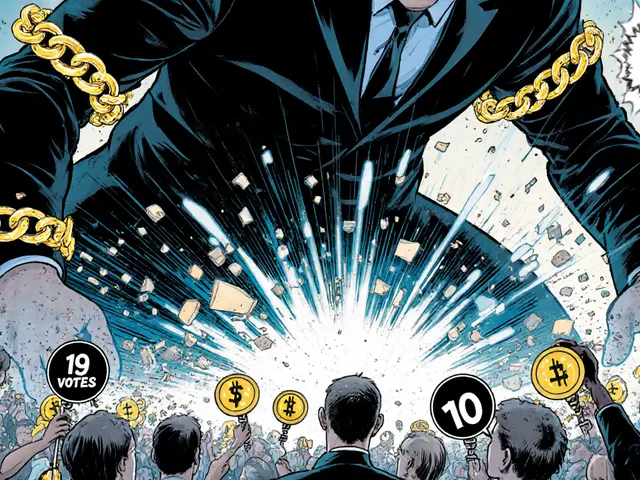
This leads to the "whale problem." Research from ECGI Global shows that 73% of contentious votes in 2024 were influenced by holders controlling over 30% of the governance tokens. When a few large holders dictate the outcome, smaller members disengage. The system becomes plutocratic, not democratic. The future of DAO governance lies in solving these specific pain points through better mechanics and smarter tech.
New Voting Mechanisms That Actually Work
The industry is moving away from simple majority rule toward more nuanced systems. Here are the top models gaining traction in 2025:
- Quadratic Voting: This method limits whale influence by making each additional vote exponentially more expensive. If the first vote costs 1 token, the second costs 4, the third costs 9, and so on (n²). Adoption of quadratic voting jumped 30% in 2024-2025. Gitcoin DAO uses this, and users report that it makes their smaller contributions feel impactful. Vitalik Buterin highlighted this in his 2024 Ethereum Magicians presentation, noting a 22% reduction in whale influence in DAOs using this model.
- Liquid Democracy: This allows you to vote directly on issues you care about or delegate your vote to someone you trust on topics you don’t. Karma’s implementation saw 42% of voters delegating at least some power in 2024. It balances inclusivity with expertise.
- Reputation-Based Systems: Used by 29% of DAOs, these reward contributors based on activity rather than just wealth. Colony tracks 27 different contribution metrics. In task-based DAOs, reputation scores account for 65% of voting power. A CoinDesk survey found 63% of participants preferred this over pure token voting, saying their expertise should count more than their wallet size.
- Holographic Consensus: Pioneered by DAOstack, this uses prediction markets to filter proposals before voting. If a proposal is unlikely to pass, it gets filtered out early. This reduced governance overhead by 38% in case studies from MITosis University.
These mechanisms address the core flaw of early DAOs: they assume all stakeholders have equal interest and knowledge. They don’t. New models acknowledge that complexity requires specialized input.
| Governance Model | Primary Benefit | Main Risk | Adoption Rate (2025) |
|---|---|---|---|
| Token-Based Voting | Simplicity | Whale dominance | 58% |
| Quadratic Voting | Fairer representation | Complex cost calculation | ~15% (growing) |
| Liquid Democracy | Delegation flexibility | Trust concentration | ~20% |
| Reputation-Based | Rewards expertise | Gaming the metric | 29% |
| Holographic Consensus | Reduces noise | High setup complexity | ~5% |
AI Integration: The Silent Co-Governor
You cannot talk about the future of DAOs without mentioning Artificial Intelligence. By 2025, AI is no longer optional-it’s standard infrastructure. Gate.com’s analysis of '69 trends in 2025-era DAO design' reports that 43% of DAOs now use AI tools for treasury management, proposal analysis, and member engagement scoring.
Here is how it works in practice. AI agents handle routine decisions like stablecoin rebalancing. In mature DAOs, AI handles 35% of these routine treasury tasks. This frees up humans to focus on strategic choices. Messari predicted in Q4 2024 that by 2027, over 80% of DAOs will integrate AI assistance.
But there are risks. Who controls the AI? To prevent rogue algorithms, DAOs are implementing "circuit breakers." These are governance-controlled limits that automatically pause AI operations if predefined triggers are hit. As of early 2025, 28% of DAOs with AI integration use these safeguards. Dr. Sarah Chen from MIT Digital Currency Initiative calls modular governance frameworks-the ability to mix AI tools with human oversight-the most significant advancement in DAO design since 2020.

Cross-Chain Reality and Technical Upgrades
DAOs are no longer confined to a single blockchain. The fragmentation of the crypto market forced them to adapt. As of Q1 2025, 68% of DAOs operate across at least two blockchain networks, according to MITosis University. Polkadot, Cosmos, and zk-powered bridges are the key enablers here.
This cross-chain capability brings efficiency. Ethereum Layer-2 solutions like Optimism, Arbitrum, and Base have reduced DAO gas fees by up to 90%. This makes participation economically viable for smaller stakeholders who previously couldn't afford transaction costs.
On the technical side, Solidity v0.9 introduced in 2024 added expanded support for Rust and Move languages. This boosted DAO security and performance by 35%, per CoinLaw’s 2025 report. Security is critical because a single bug can drain a treasury. With 6.5 million governance token holders worldwide, the stakes have never been higher.
The Legal Landscape: Still a Minefield
Technology moves fast; law moves slow. This mismatch remains the biggest barrier to mainstream adoption. The World Economic Forum’s 2025 Global Blockchain Report states that legal recognition is the single greatest hurdle. Only 7 jurisdictions had established clear DAO legal frameworks as of January 2025.
Wyoming, Tennessee, and the Marshall Islands lead the way with clear statutes. However, the SEC’s February 2025 enforcement action against unregistered security offerings created uncertainty for 62% of DAOs operating in the United States. NADCAB’s compliance analysis highlights this tension. Meanwhile, the EU’s 2025 Digital Governance Act created a provisional framework that 17 European DAOs have already adopted.
For builders, this means structuring matters. You can no longer launch a DAO without considering jurisdiction. Hybrid structures-combining a traditional LLC with a DAO wrapper-are becoming common to protect founders and members from personal liability.

Market Growth and Real-World Use Cases
Despite the challenges, the money talks. The DAO ecosystem managed over $22.3 billion in treasury assets as of Q1 2025, growing 67% year-over-year (Messari). This growth is driven by diverse sectors:
- Real Estate: CityDAO owns 40 acres of land in Wyoming, proving physical asset ownership via blockchain is possible.
- Philanthropy: Gitcoin DAO has funded $47 million for open-source projects, demonstrating efficient collective giving.
- Creator Economy: PleasrDAO acquires high-value digital art, pooling resources for cultural preservation.
- Enterprise: Gartner’s 2025 CIO Survey found 34% of Fortune 500 companies are experimenting with DAO structures for specific internal projects.
User demographics are also shifting. CoinLaw reports that 68% of DAO participants are aged 25-44, and 22% identify as full-time DAO contributors-a 300% increase from 2022. This suggests DAOs are becoming viable careers, not just hobbyist experiments.
How to Build or Join a Successful DAO in 2026
If you are looking to engage with DAOs, the bar for quality has risen. Here is what successful participation looks like today:
- Start Small: Don’t join every DAO. Focus on communities where you can contribute meaningfully. Reputation systems value consistent effort over sporadic presence.
- Use Delegation: If you lack time, use liquid democracy features to delegate your vote to trusted experts. This keeps your stake active without requiring constant monitoring.
- Understand the Stack: Familiarize yourself with tools like Snapshot for voting, Tally for analytics, and Aragon for infrastructure. Onboarding time has dropped from 45 minutes in 2022 to 8 minutes in 2025 thanks to better UX.
- Check Legal Status: Before contributing significant capital, verify the DAO’s legal structure. Look for jurisdictions with clear frameworks or hybrid legal wrappers.
- Monitor AI Oversight: Ensure the DAO has circuit breakers and transparent AI policies. Blindly trusting automated treasury management is risky.
Establishing a sophisticated DAO still takes time. NADCAB’s 2025 guide notes an average setup time of 120 hours for implementations incorporating AI delegates and cross-chain capabilities. But the payoff is a resilient, scalable organization that doesn’t rely on a single leader.
What is the biggest challenge facing DAO governance in 2026?
The primary challenge remains legal uncertainty. While technology has advanced rapidly, only a handful of jurisdictions offer clear legal recognition for DAOs. This creates liability risks for members and limits institutional adoption.
How does quadratic voting prevent whale dominance?
Quadratic voting increases the cost of each additional vote exponentially. Instead of linear spending, the nth vote costs n² tokens. This makes it prohibitively expensive for large holders to buy disproportionate influence, leveling the playing field for smaller stakeholders.
Is AI replacing human decision-makers in DAOs?
No, AI is augmenting human decision-makers. It handles routine tasks like treasury rebalancing and proposal summarization. Strategic decisions remain with the community, often guided by AI-generated insights and safeguards like circuit breakers.
Which blockchains are best for cross-chain DAOs?
Polkadot and Cosmos are leading due to their native interoperability protocols. Additionally, Ethereum Layer-2 solutions like Arbitrum and Optimism are popular for reducing gas fees while maintaining security and compatibility with existing tooling.
Can I earn income from participating in a DAO?
Yes. 22% of DAO participants in 2025 identified as full-time contributors. Income comes from grants, bounties, salary payments from the treasury, and appreciation of governance tokens. Reputation-based systems often tie compensation directly to verified contributions.