
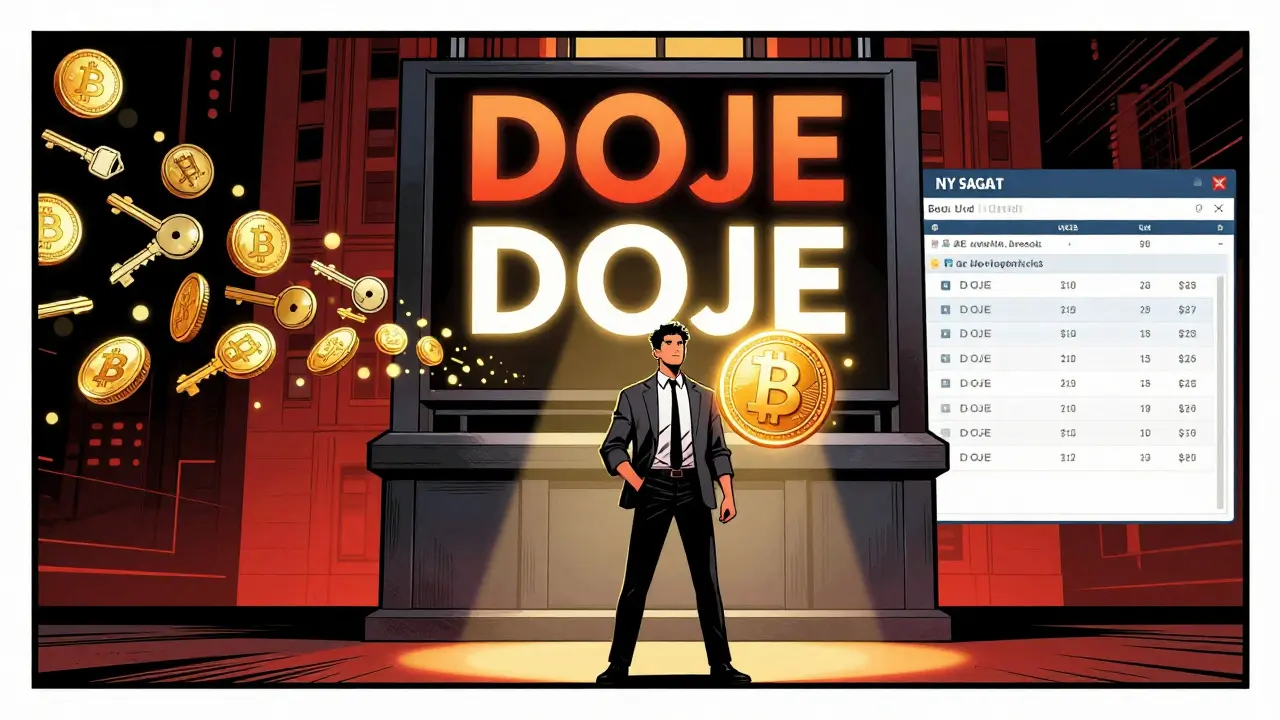
What is Doge ETF (DOJE) Crypto Coin? The First Regulated Dogecoin Investment Fund
Before September 2025, buying Dogecoin meant logging into a crypto exchange, setting up a digital wallet, and worrying about private keys. Now, you can buy Dogecoin exposure just like you buy Apple or Tesla stock - through your regular brokerage account. That’s the power of the Doge ETF (DOJE).
What Exactly Is DOJE?
DOJE is the ticker symbol for the REX-Osprey Dogecoin ETF, the first exchange-traded fund in the U.S. that lets investors buy and sell exposure to Dogecoin (DOGE) without ever touching a crypto wallet. Launched on September 18, 2025, and listed on NYSE Arca, DOJE isn’t a coin. It’s a fund. And it’s backed by real Dogecoin held in secure custody.Think of DOJE like a mutual fund, but instead of holding stocks or bonds, it holds Dogecoin. Each share of DOJE represents a fraction of the total Dogecoin the fund owns. When Dogecoin’s price goes up, DOJE’s price generally goes up too. When it drops, DOJE drops. Simple as that.
How Does DOJE Work?
Unlike direct Dogecoin purchases, DOJE doesn’t require you to manage private keys, remember seed phrases, or worry about exchange hacks. You don’t need a crypto account at all. You just log into your brokerage - Fidelity, Schwab, Robinhood, etc. - and buy DOJE shares like any other ETF.The fund is managed by REX Shares and Osprey Funds, two established financial firms. They handle everything: buying Dogecoin, storing it securely, and updating the fund’s value daily based on Dogecoin’s spot price. This daily update is called the Net Asset Value (NAV). It’s transparent, regulated, and tracked in real time.
The fund holds Dogecoin directly - not through futures or derivatives. That means DOJE tracks Dogecoin’s price more accurately than synthetic products. If Dogecoin is trading at $0.23, DOJE’s NAV reflects that. No middlemen. No leverage. Just the real thing.
Why Was DOJE Approved Under the '40 Act?
Most crypto ETFs, like Bitcoin’s, are registered under the Securities Act of 1933. DOJE took a different path. It was approved under the Investment Company Act of 1940 - the same law that governs mutual funds and traditional ETFs. This was a strategic move.The '40 Act brings stricter rules around transparency, custody, and investor protection. It requires daily pricing, limits on leverage, and mandatory disclosures. For Dogecoin - a coin once seen as a joke - this approval was huge. It meant regulators saw DOGE as serious enough to be held in a product designed for retirement accounts, 401(k)s, and conservative investors.
The fund uses a Cayman Islands subsidiary to hold the Dogecoin. This isn’t a loophole - it’s standard practice for crypto ETFs. It helps with tax efficiency and regulatory compliance. The structure is fully disclosed in SEC filings.
What’s the Expense Ratio? And Why Is It So High?
DOJE charges a 1.5% annual expense ratio. That’s more than double the fee of Bitcoin ETFs, which hover around 0.3%.Why? Because Dogecoin custody is expensive. Bitcoin is held by a handful of trusted custodians with enterprise-grade security. Dogecoin? Its network is decentralized, with no central authority. Custodians have to manage thousands of wallets, each with unique private keys. There’s no single point of control. That means higher operational costs, more audits, and more insurance.
It also reflects the novelty. DOJE is the first of its kind. As more meme coin ETFs launch, fees will likely drop. But for now, you’re paying for pioneering infrastructure.
Security Risks - What Could Go Wrong?
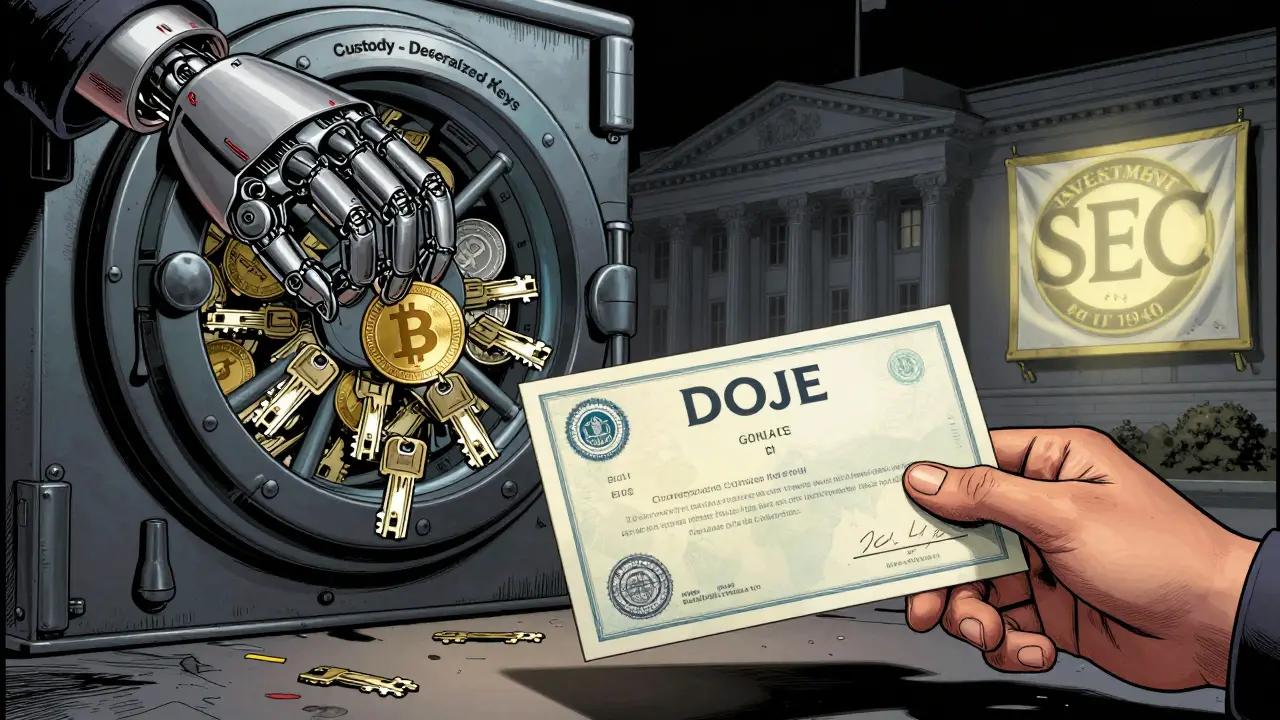
DOJE isn’t risk-free. In fact, it carries unique risks that traditional ETFs don’t.The fund’s Dogecoin is held by third-party custodians. If one of those custodians suffers a cyberattack and loses the private keys to a wallet, that Dogecoin is gone - permanently. There’s no recovery. No central bank to reverse the transaction. No insurance pool like FDIC for crypto.
REX Shares openly states this risk in its prospectus. It’s not hidden. Investors need to understand: you’re not buying a stock. You’re buying exposure to a digital asset with no physical backup. If the keys are lost, the value vanishes.
This is why DOJE isn’t for everyone. It’s for people who want regulated access to Dogecoin - but still accept the underlying crypto risk.
Market Impact: What Happened After Launch?
When DOJE got SEC approval on September 18, 2025, Dogecoin’s price jumped 12.2% in a single day - from $0.21 to $0.245. That wasn’t just hype. It was institutional validation.Analysts like Eric Balchunas from Bloomberg called it a turning point. "The SEC approved an ETF for a coin made as a joke," he said. "That says more about finance than about Dogecoin."
Since launch, DOJE has attracted over $850 million in assets under management by March 2026. That’s not Bitcoin-level numbers - but for a meme coin? It’s massive. Retail investors poured in. Pension funds started considering it. Even some hedge funds added DOJE to their diversified portfolios.
How Is DOJE Different From Other Crypto ETFs?
Here’s how DOJE stacks up against Bitcoin and Ethereum ETFs:| Feature | DOJE (Dogecoin ETF) | Bitcoin ETF (e.g., IBIT) |
|---|---|---|
| Underlying Asset | Dogecoin (DOGE) | Bitcoin (BTC) |
| Regulatory Framework | Investment Company Act of 1940 | Securities Act of 1933 |
| Expense Ratio | 1.5% | 0.2% - 0.3% |
| Custody Model | Multiple third-party custodians, decentralized key management | Fewer custodians, enterprise-grade security |
| Investor Base | Primarily retail, meme coin enthusiasts | Institutional, long-term holders |
| Price Tracking | Spot price only (no futures) | Spot price only |
DOJE’s structure is more complex and riskier than Bitcoin ETFs - but it’s also more groundbreaking. It’s the first time a meme coin has been given the same regulatory treatment as a mainstream asset.
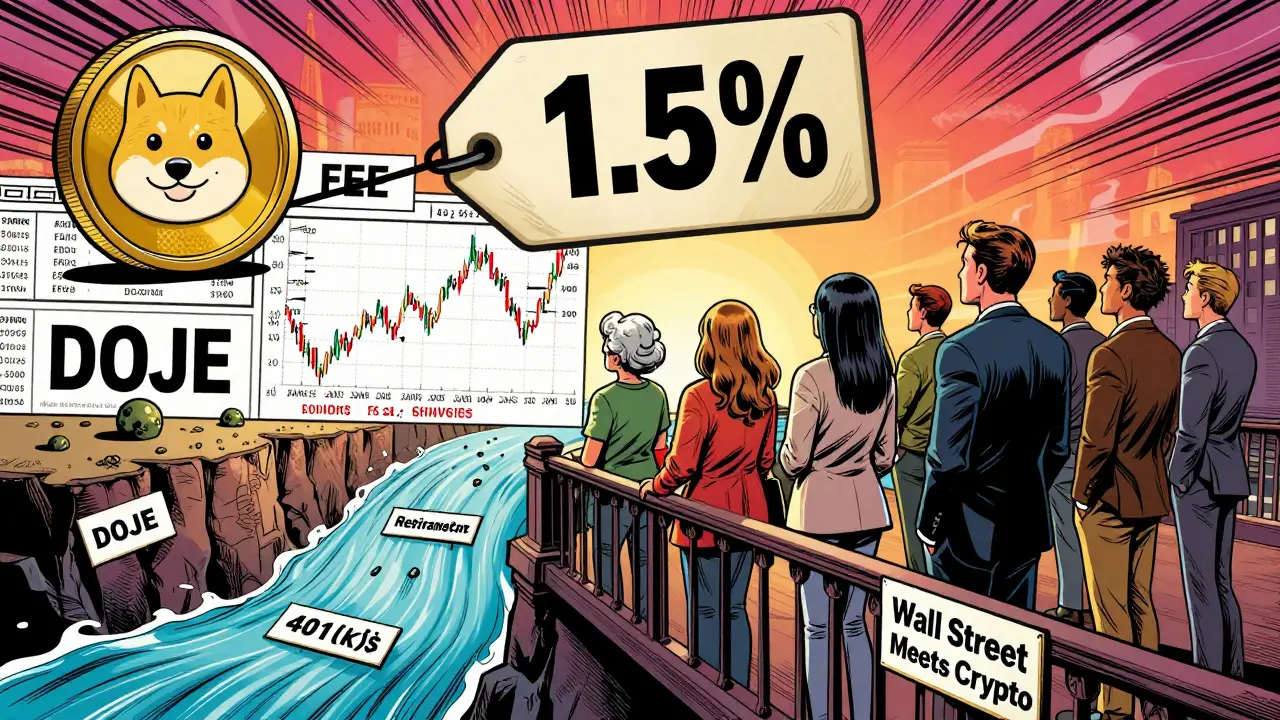
Who Should Buy DOJE?
DOJE isn’t for crypto maximalists who want to "HODL" Dogecoin. It’s for people who:- Want exposure to Dogecoin but don’t want to manage wallets
- Prefer regulated, brokerage-accessible assets
- Are building a diversified portfolio and want to include meme coins
- Have retirement accounts (IRA, 401(k)) and want to add DOGE
- Believe in the cultural and community power of Dogecoin
If you’re new to crypto and just want to dip your toes in - DOJE is the safest, simplest path. If you’re already holding Dogecoin on Binance or Coinbase - you’re not missing much. But if you’ve been scared off by the complexity, DOJE opens the door.
What’s Next for DOJE?
DOJE didn’t just launch a product. It launched a new category. If Dogecoin - a coin born from a meme - can get an ETF, what’s stopping Shiba Inu? What about PepeCoin? Or Floki?Analysts expect at least two more meme coin ETFs to file for approval by mid-2026. DOJE’s success proves there’s demand. Regulators now have a working model. The path is paved.
More importantly, DOJE signals that Wall Street is no longer ignoring crypto. It’s adapting to it. The line between traditional finance and digital assets is fading. And DOJE? It’s the first real bridge.
Final Thoughts
DOJE isn’t about making you rich overnight. It’s about making Dogecoin accessible. It’s about bringing a coin that started as a joke into the same system that holds your 401(k). That’s the real story.Whether you love Dogecoin or think it’s silly, DOJE changes everything. It’s not just an ETF. It’s a statement: that even the most unlikely assets can find a place in the mainstream financial world - if they have enough people behind them.
Is DOJE the same as Dogecoin?
No. DOJE is an ETF that tracks Dogecoin’s price. You own shares in a fund that holds Dogecoin - not the actual cryptocurrency. Buying DOJE is like buying shares in a company that owns gold bars. You’re not holding the gold. You’re holding a claim to it.
Can I buy DOJE on Coinbase or Binance?
No. DOJE trades on traditional U.S. stock exchanges like NYSE Arca. You need a brokerage account - like Fidelity, Schwab, or Robinhood - to buy it. You can’t buy DOJE on crypto exchanges. That’s the whole point: it’s a stock-market product, not a crypto one.
Is DOJE a good long-term investment?
It depends. Dogecoin has no utility, no roadmap, and no team. Its value comes from community and hype. DOJE gives you regulated access to that volatility. It’s not a stable asset. It’s a speculative bet wrapped in a regulated wrapper. Only invest what you can afford to lose.
Why does DOJE have a 1.5% fee?
Because Dogecoin custody is expensive. Unlike Bitcoin, which has a few centralized custodians, Dogecoin’s network is decentralized. Custodians must manage thousands of wallets with unique private keys. This requires more security, audits, and insurance - all driving up costs.
Is DOJE safe from hacks?
It’s safer than holding Dogecoin on an exchange - but not risk-free. DOJE uses institutional custodians with cold storage and multi-signature wallets. But if a custodian loses private keys due to a cyberattack, the Dogecoin is permanently lost. There’s no recovery. This risk is clearly stated in the fund’s prospectus.
Can I hold DOJE in my IRA or 401(k)?
Yes. Because DOJE is a regulated ETF listed on U.S. exchanges, it qualifies for inclusion in retirement accounts. Many brokerage platforms now allow DOJE to be added to IRAs and 401(k)s - something impossible with direct Dogecoin purchases.
Will DOJE’s price always match Dogecoin’s price?
Almost always. DOJE holds actual Dogecoin and updates its Net Asset Value daily based on the real-time spot price. Any small deviation is due to trading volume, bid-ask spreads, or fund fees - not manipulation. It’s one of the most accurate ways to track Dogecoin without owning it directly.
What happens if Dogecoin gets banned?
If the U.S. government bans Dogecoin trading, DOJE would likely be suspended or liquidated. The fund’s value would collapse, since it holds the underlying asset. That’s a remote but real risk. Unlike stocks, crypto assets can be outlawed entirely. Investors should be aware of this regulatory vulnerability.

So let me get this straight - we’ve gone from a meme coin that started as a joke to a regulated ETF that’s now in 401(k)s? The system doesn’t just adapt to absurdity… it monetizes it. And we call this progress? I’m not mad. I’m just impressed at how brilliantly capitalism turns everything into a product, even our collective delusions.
They didn’t approve DOJE because Dogecoin has value. They approved it because people *believe* it does. And belief? That’s the only commodity that never runs out.
Next up: the Shiba Inu Retirement Fund. With optional NFTs in your Roth IRA.
This is actually kind of beautiful. People who never touched crypto before can now invest in Dogecoin through their Fidelity account. No seed phrases. No wallet hacks. Just simple, regulated exposure.
It’s not about the coin. It’s about access. And that’s huge.
1.5% expense ratio on a coin with no utility? That’s not innovation. That’s financial exploitation wrapped in SEC paperwork. This isn’t an ETF - it’s a fee extraction scheme for retail suckers.
It is imperative to note that the Investment Company Act of 1940 imposes stringent fiduciary obligations upon the fund’s trustees. Furthermore, the custodial structure, while decentralized, is subject to rigorous audit protocols as outlined in Form N-PORT. The 1.5% expense ratio is not anomalous; it reflects the marginal cost of managing a non-standardized, high-volume, multi-signature asset custody environment. One must not conflate regulatory legitimacy with investment merit.
YESSSS!!! 🙌 This is the moment we’ve been waiting for! Dogecoin in your 401(k)? YES PLEASE! No more worrying about private keys or exchange hacks - just buy DOJE like you buy Apple stock and let it ride!
Who else is adding this to their portfolio? Let’s gooo!! 🚀🐶
Let’s be clear - this isn’t innovation. This is a loophole. The SEC approved this under the ’40 Act because they didn’t want to deal with the political fallout of saying no - but they also didn’t want to admit that Dogecoin, a coin created by a joke, is now more legit than some publicly traded companies. And the 1.5% fee? That’s not a cost of custody - that’s a tax on hope. Custody is expensive? Please. Bitcoin’s custodians are handling billions in cold storage with fewer than five key sets. Dogecoin’s network is decentralized - yes - but that doesn’t mean you need a thousand wallets. It means you need one. And if you’re managing thousands? You’re doing it wrong. Or you’re inflating costs to justify your salary. Either way - this is a gold-plated money grab.
USA first. We don’t need meme coins in our retirement accounts. This is why our financial system is crumbling. You want to gamble? Go to Vegas. Don’t turn Dogecoin into a 401(k) asset. This isn’t finance - it’s a circus. And we’re paying for the tickets.
It’s fascinating how something so fundamentally unserious - a dog with a meme face - became the vehicle through which Wall Street legitimizes crypto. The irony is almost poetic.
Of course, the expense ratio is obscene. But that’s not the point. The point is that we’ve reached a cultural inflection point where the absurd is institutionalized. And we’re all just quietly lining up to pay for it.
I’m not buying. But I’m not surprised either.
1.5%?! Are you kidding me?! This is the most overpriced piece of financial theater since the dot-com bubble wrapped itself in a suit and tie. They’re not holding Dogecoin - they’re holding FOMO. And you? You’re holding the bag.
This isn’t an ETF. It’s a pyramid scheme with a Bloomberg terminal.
What does it say about our society when a coin created in 2013 as a parody of Bitcoin is now a regulated asset class? We don’t value utility. We don’t value innovation. We value narrative. And DOJE is the ultimate narrative product - a financialized meme.
It’s not about Dogecoin. It’s about what we’ve allowed ourselves to believe. And that’s the real tragedy.
So you’re telling me I can buy Dogecoin through my 401(k) now? That’s wild. I mean… I guess that’s fine? I don’t really get crypto. But if my employer offers it, I’ll put in a little. Not because I think it’ll grow. Just because… why not? It’s there.
Probably won’t even notice it’s there in five years.
OMG I JUST BOUGHT DOJE!! I’ve been waiting for this since 2021!! My cousin said it was a joke, but now it’s in my IRA!! I’m so emotional!! This is destiny!! 🥹🐶💎
Who else is crying right now?? I’m gonna post a TikTok about it. #DOJE #MemeCoinRevolution #CryptoIsTheFuture
This is actually a win for everyday people. If you’ve ever been scared off by crypto because of wallets, keys, or scams - DOJE gives you a safe way in. You don’t have to be a tech wizard. You don’t need to understand blockchain.
Just open your brokerage app. Buy a share. And if Dogecoin goes up? Cool. If it doesn’t? You didn’t lose your life savings.
That’s progress. And it’s beautiful.
It’s interesting how DOJE’s structure mirrors the very nature of Dogecoin itself - decentralized, community-driven, and slightly chaotic. The high fee? That’s the price of doing something no one thought possible. The first of its kind. The cost of pioneering.
And honestly? If this opens the door for more meme coin ETFs? Bring them on. The market will sort the wheat from the chaff. And maybe - just maybe - we’ll see crypto finally become part of the mainstream conversation.