What is Mining Difficulty in Blockchain? A Simple Guide
Imagine you're trying to guess a secret number between 1 and 10. Easy, right? Now imagine the range expands to 1 billion. Suddenly, your odds drop through the floor. You need more tries, more time, and more luck. That’s essentially what mining difficulty does in a blockchain network like Bitcoin. It adjusts how hard it is for miners to solve the cryptographic puzzle that validates transactions and creates new blocks.
If you’ve ever wondered why your home computer can’t mine Bitcoin anymore, or why some days blocks appear faster than others, this mechanism is the answer. It’s not just a technical detail; it’s the heartbeat of network security. Without it, blockchains would either grind to a halt or become too easy to hack. Let’s break down exactly how this self-regulating system works, why it changes, and what it means for you as a user or miner.
The Core Concept: Why Does Difficulty Exist?
At its heart, mining difficulty exists to keep the pace of the network steady. In Bitcoin, the goal is to produce a new block every 10 minutes on average. This timing isn't arbitrary. It balances two competing needs: fast transaction confirmation and network stability. If blocks were mined every second, forks (where two miners find a block simultaneously) would happen constantly, causing chaos. If they took an hour, users would wait forever for their payments to clear.
So, how does the network enforce this 10-minute rule when millions of computers are joining and leaving all the time? It uses difficulty. Think of it as a thermostat. If the network heats up-meaning more computing power joins-the difficulty rises to slow things down. If miners leave, the difficulty drops to make finding blocks easier again. This automatic adjustment ensures that regardless of whether one person or a million people are mining, the average time between blocks stays consistent.
This concept applies primarily to Proof-of-Work (PoW) blockchains. Networks like Ethereum Classic, Litecoin, and Dogecoin use similar mechanisms, though their specific rules vary. Proof-of-Stake networks, like modern Ethereum, don't use mining difficulty because they don't rely on energy-intensive guessing games to secure the chain.
How the Math Actually Works
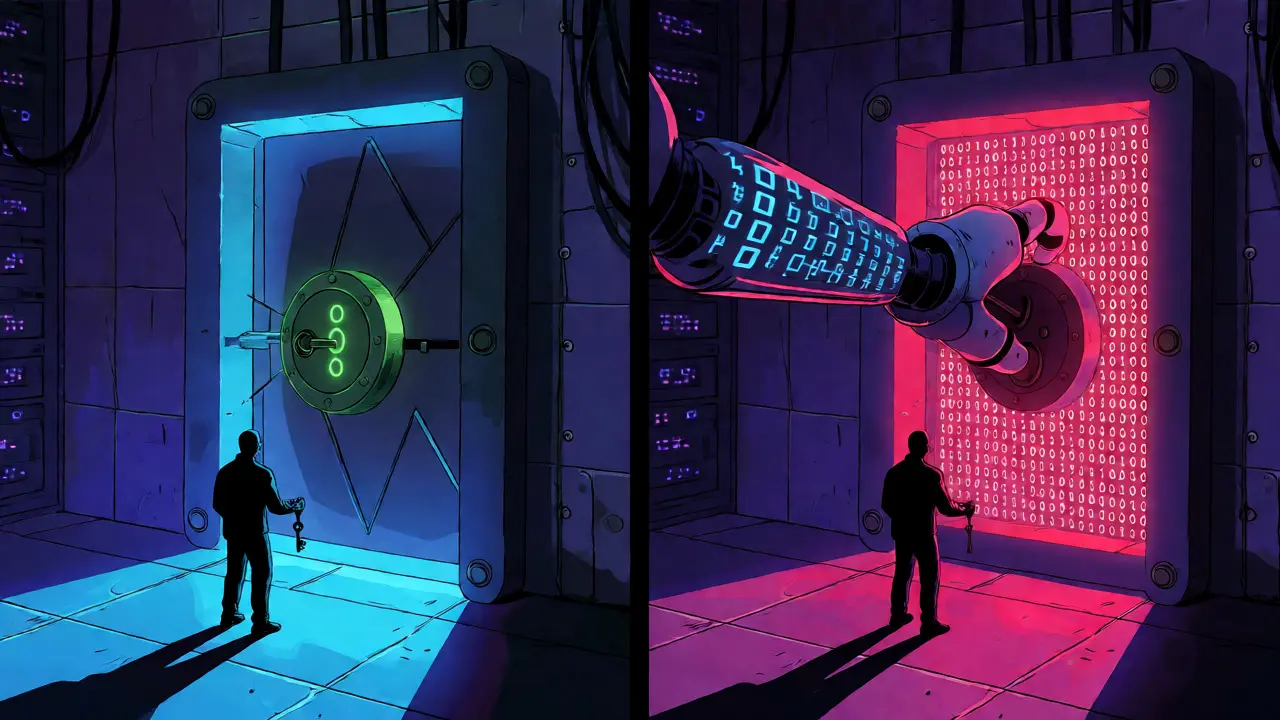
You don’t need a PhD in cryptography to get the gist, but understanding the basic math helps demystify the jargon. Miners aren't solving complex algebra problems. They are trying to find a random string of characters (a hash) that starts with a certain number of zeros. The more zeros required at the start of the hash, the harder it is to find.
Hash rate is the total computational power being used by all miners combined. It’s measured in hashes per second. When the hash rate goes up, the chance of finding a valid hash quickly increases. To counteract this, the protocol lowers the target value, requiring more leading zeros. This makes each individual guess less likely to succeed, forcing miners to try many more times before hitting a winner.
| Network Condition | Hash Rate Trend | Difficulty Adjustment | Impact on Miners |
|---|---|---|---|
| New miners join / Hardware upgrades | Increases | Rises | Lower revenue per unit of power |
| Miners shut down / Price crash | Decreases | Falls | Higher revenue per unit of power |
| Stable participation | Flat | No change | Predictable earnings |
In Bitcoin specifically, this adjustment happens every 2,016 blocks. Since the target is one block every 10 minutes, this period lasts roughly two weeks. The code looks at how long it actually took to mine those last 2,016 blocks. If it took less than 20,160 minutes (two weeks), the difficulty goes up. If it took longer, the difficulty goes down. There’s a safety cap, though: the difficulty can’t change by more than a factor of four in any single adjustment period. This prevents wild swings that could destabilize the network if a massive amount of hash rate vanished overnight.
Real-World Impact on Security and Profitability
Why should you care about these numbers? Because difficulty directly dictates who controls the network and how much it costs to attack it. High difficulty means high security. To perform a 51% attack-where one entity controls more than half the network's power-an attacker would need to buy billions of dollars worth of specialized hardware and pay massive electricity bills. As difficulty climbs, the barrier to entry becomes insurmountable for most attackers.
For miners, however, rising difficulty is often bad news. It means their existing machines are doing less useful work relative to the competition. If you have an older ASIC miner and the difficulty doubles while the price of Bitcoin stays flat, your profit margin gets cut in half. This dynamic drives consolidation in the mining industry. Small hobbyists often get pushed out, replaced by industrial-scale farms that can negotiate cheaper electricity rates.
Consider the history of Bitcoin. When Satoshi Nakamoto launched the network in 2009, the difficulty was 1. You could mine blocks on a laptop CPU. Today, the difficulty is in the trillions. The jump from 1 to over 80 trillion represents a staggering increase in global computational investment. This growth reflects both technological advancement and increased belief in Bitcoin's value. But it also illustrates the brutal efficiency of the market: only the most efficient operations survive.

Different Networks, Different Rules
Not all blockchains handle difficulty the same way. While Bitcoin sticks to its rigid two-week schedule, other networks experiment with different approaches to balance responsiveness and stability.
- Bitcoin: Adjusts every 2,016 blocks (~2 weeks). Stable, predictable, but can lag during rapid hash rate shifts.
- Ethereum (pre-Merge): Used to adjust difficulty with every single block. Highly responsive, allowing quick adaptation to changing conditions, but prone to volatility.
- Litecoin: Similar to Bitcoin but uses a different hashing algorithm (Scrypt). Its difficulty adjusts every 3,360 blocks (~3.5 days).
- Monero: Uses a dynamic algorithm called RandomX that adjusts based on the median timestamp of the last 720 blocks, aiming for smoother transitions.
Some newer chains even remove difficulty adjustments entirely, relying on fixed targets or alternative consensus models. For example, Proof-of-Authority networks don't use mining difficulty because validators are known entities, not anonymous competitors. Understanding which model a coin uses tells you a lot about its philosophy regarding decentralization and security.
Common Misconceptions About Mining Difficulty
There’s a lot of noise around mining terms. Let’s clear up a few myths.
Misconception 1: Higher difficulty means higher prices.
Not necessarily. Difficulty reacts to hash rate, not price. However, they are correlated. When prices rise, more miners enter, increasing hash rate, which raises difficulty. But if prices crash, miners might stay online to cover sunk costs, keeping difficulty high even when profits vanish.
Misconception 2: I can mine Bitcoin on my phone.
You can technically run the software, but you’ll never earn anything. Your phone’s hash rate is negligible compared to industrial rigs. With current difficulty levels, a smartphone would statistically take centuries to mine a single block alone.
Misconception 3: Difficulty adjustments are instant.
In Bitcoin, no. If a major country bans mining today, the hash rate drops immediately, but the difficulty won’t adjust until the next checkpoint (up to two weeks away). During that gap, blocks might be mined slower than usual, delaying transactions slightly.

Practical Tips for Users and Miners
If you’re just using crypto, keep an eye on difficulty trends if you notice slower confirmations. A sudden drop in hash rate (often due to weather events or regulatory crackdowns) can lead to temporary congestion. If you’re mining, here’s what you need to track:
- Efficiency Ratio: Calculate joules per terahash. If your machine uses too much power per unit of work, rising difficulty will wipe you out.
- Break-even Analysis: Use online calculators that factor in current difficulty, future projections, and electricity costs. Don’t just look at today’s price.
- Pool Selection: Smaller pools offer better variance but lower liquidity. Larger pools provide steady payouts but charge higher fees. Choose based on your risk tolerance.
Remember, mining is a business of margins. Difficulty is the primary variable that erodes those margins over time. Successful miners plan for difficulty increases, assuming their hardware will become obsolete within 2-3 years.
Frequently Asked Questions
Does mining difficulty affect transaction speed?
Indirectly, yes. Difficulty itself doesn't speed up transactions, but it maintains the block time. If difficulty fails to adjust properly and blocks are mined too slowly, transaction confirmations delay. Conversely, if blocks come too fast, the network risks instability, which can also disrupt service.
Can mining difficulty go down?
Yes. If miners turn off their equipment due to low profitability or external factors like power outages, the total network hash rate drops. The protocol detects this slowdown and reduces the difficulty to ensure blocks continue to be found at the target interval.
Is high mining difficulty good or bad?
For security, high difficulty is excellent-it means the network is heavily protected against attacks. For individual miners, it can be bad because it reduces profitability unless cryptocurrency prices rise proportionally. It indicates a mature, competitive market.
How often does Bitcoin difficulty change?
Bitcoin difficulty adjusts every 2,016 blocks. Given the target of one block every 10 minutes, this equates to approximately every two weeks. Other cryptocurrencies may adjust more frequently, such as every block or every few hours.
Do all cryptocurrencies have mining difficulty?
No. Only Proof-of-Work (PoW) coins like Bitcoin, Litecoin, and Monero use mining difficulty. Proof-of-Stake (PoS) coins like Ethereum (post-2022) and Cardano do not have mining difficulty because they secure the network through staked capital rather than computational power.
Next Steps and Final Thoughts
Mining difficulty is more than just a number on a dashboard; it’s the invisible hand guiding the economy of a blockchain. It balances security with accessibility, ensuring that no single player dominates the network while rewarding those who contribute resources. As we move further into 2026, with energy concerns and technological shifts reshaping the landscape, understanding this mechanism gives you a clearer view of where digital assets are headed.
If you’re looking to dive deeper, explore how ASIC miners compare to GPUs in terms of efficiency ratios. Or investigate how layer-2 solutions like Lightning Network interact with base-layer difficulty by reducing the load on mainnet blocks. The interplay between these technologies defines the future of scalable, secure finance.