
Garantex Exchange Sanctions: Reality Check for Russian Crypto Traders in 2026
Sanctions did not kill Garantex; they just forced it into the shadows. If you are a Russian crypto trader trying to move value across borders today, the landscape looks nothing like it did in early 2022. The platform that was once a standard destination for ruble-to-stablecoin swaps has morphed into something far more complex, operating through a decentralized web of shell companies and darknet interfaces. While many expected the U.S. Treasury to choke off access completely, the infrastructure survived, albeit with higher costs and significantly more risk.
The current reality involves navigating a hybrid system where legacy branding meets new operational tactics. On one hand, you have the legal hammer of Washington striking repeatedly against its key personnel. On the other, you have a network of traders who refuse to stop using the system because the domestic options offer poor liquidity or non-existent anonymity. Understanding how this machine works is no longer just about tracking a price chart; it is about understanding the mechanics of illicit finance that have embedded themselves deep into the regional economy.
The Evolution of Sanctions Against Garantex
To understand where we stand today in late March 2026, we must look at how the regulatory narrative shifted over the last two years. The first wave of pressure arrived in April 2022 when OFAC, part of the U.S. Department of the Treasury, listed Garantex under Executive Order 14024. At that time, the logic was straightforward: block a major centralized exchange to disrupt capital flight and military funding tied to the Russian Federation.
However, the second wave that hit in August 2025 changed the nature of the threat entirely. OFAC re-designated the entity under Executive Order 13694, explicitly citing its role in facilitating cybercrime rather than just general economic support. The accusation was specific and damning: Garantex had allegedly processed over $100 million linked to ransomware attacks and darknet markets since 2019. This shift marked a turning point. It wasn't enough to cut off bank accounts anymore; the Treasury wanted to dismantle the entire financial clearinghouse.
| Sanction Date | Executive Order | Primary Justification | Operational Status Post-Sanction |
|---|---|---|---|
| April 5, 2022 | E.O. 14024 | Economic Support | Continued via mirrors |
| August 14, 2025 | E.O. 13694 | Cybercrime Facilitation | Migrated to Decentralized Network |
| March 2025 Ops | N/A (Law Enforcement) | Traffic Seizure | Partial Domain Seizure ($26M frozen) |
This timeline shows a persistent battle. Despite a massive international law enforcement operation on March 6, 2025-where U.S., German, and Finnish authorities seized servers and froze roughly $26 million in digital assets-the core functionality remained intact. The arrest of Aleksej Besciokov in India on March 7, 2025, was a significant blow, yet the leadership structure appeared resilient, likely due to the distributed nature of the remaining operations.
The Rise of Successor Platforms and the Ecosystem Shift
The most critical change for traders in 2026 is the realization that Garantex is no longer a single website or app. Since the heavy sanctions began, the operators have successfully pivoted toward what researchers call "successor platforms." The primary vehicles for this survival are Grinex and Exved. These platforms were not merely launched as clones; they represent the technical evolution of the network designed specifically to evade detection.
Grinex, for instance, emerged directly after the domain seizures in early 2025. It was created by former Garantex employees specifically to support sanctions evasion efforts. Unlike the original site which maintained a recognizable interface, Grinex operates through encrypted channels and often requires invite-only access. This effectively creates a walled garden where vetting happens before entry, theoretically filtering out casual observers or bad actors looking to trace funds.
Exved serves a different function within this stack. Rather than a simple exchange, it functions as a cross-border payment processor. Its role is crucial for the import side of the equation, handling dual-use goods entering Russia. By separating the trading interface from the settlement layer, these platforms create layers of obfuscation. They rely on third-party agents to manage the flow of funds, making it difficult for regulators to draw a direct line from a sanctioned entity to a specific transaction on a ledger.
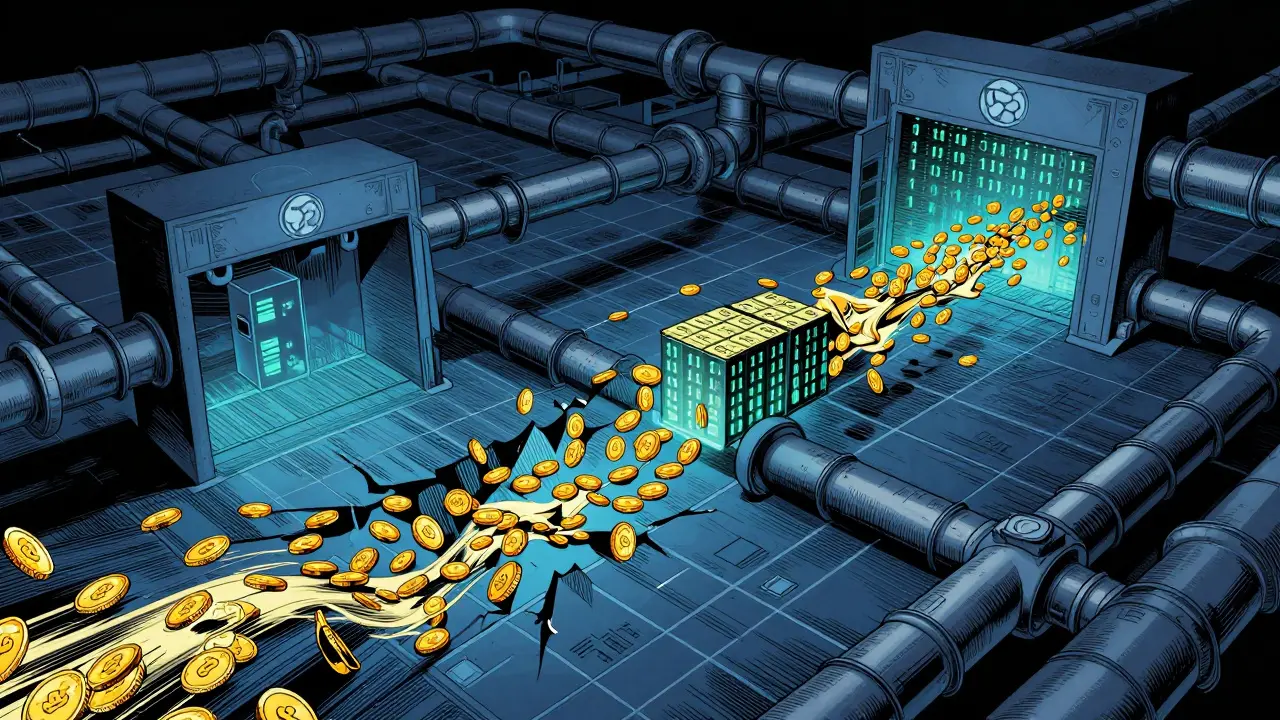
How the Money Moves Now: The Underground Pipeline
For a user sitting in Moscow or Saint Petersburg today, getting USDT (Tether) is not as simple as clicking a "swap" button. The mechanics of the trade have become dangerously intricate. Based on investigations published by Transparency International Russia in September 2025, the process resembles a multi-stage money laundering operation more than a standard retail exchange interaction.
The typical flow starts with a Russian client transferring rubles to a registered foreign entity, often named something like Feilian Company Limited. This company is registered in Hong Kong but maintains an active account with a major Russian lender like Alfa-Bank. This step keeps the cryptocurrency element invisible to local banking compliance officers initially.
Once the rubles reach the Hong Kong entity, the funds are converted. The foreign entity then sends the equivalent value in dollars, yuan, or USDT to the recipient's designated account abroad. This creates a legitimate-looking trade record between two corporations while the crypto element remains in the background. For the average user, this means their money leaves the Russian banking system as a "payment for services" or "investment," bypassing the usual capital control filters.
Risks and Costs for Russian Crypto Traders
You cannot ignore the fact that using these systems carries profound risk. The learning curve has steepened dramatically. In the pre-sanction era, a novice could set up an account in minutes. Today, community reports from late 2025 suggest it takes 3 to 4 weeks for new users to navigate the verification requirements. You aren't just trusting software anymore; you are trusting a human broker whose identity may be obscured.
The cost of doing business has also inflated. Before the clampdown, fees hovered around 0.1%. By late 2025, users on forums like BitBrothers reported paying upwards of 1.5% per transaction. This premium isn't just profit for the exchange; it represents the cost of intermediaries, the cost of security against takedowns, and the spread required to keep the offshore liquidity pools funded.
- Asset Seizure Risk: If a transaction gets flagged by Western counterparties, the stability of your holdings drops precipitously. With the recent $26 million freeze, there is proof that funds can be immobilized mid-transfer if the wrong jurisdiction intercepts the server traffic.
- Legal Liability: While OFAC targets the exchange, participating users face potential secondary sanctions. U.S. prosecutors have been increasingly vocal about the "willful blindness" defense being rejected.
- Lack of Recourse: There is no customer support hotline anymore. Communication is relegated to Telegram bots that offer minimal assistance. If funds go missing, the odds of recovery are near zero.
Regulatory Pressure and Global Cooperation
The United States has not stopped pushing. In August 2025, the Department of State announced reward offers totaling up to $6 million for information leading to the arrest of key figures. Aleksandr Mira Serda faces a $5 million bounty, signaling a serious commitment to dismantling the leadership core. However, the effectiveness of these moves is debated among analysts at firms like Chainalysis.
Michael Gronager, CEO of Chainalysis, noted in a September 2025 interview that sanctions are paradoxically creating more sophisticated systems. The cat-and-mouse game has shifted towards resilience rather than elimination. The global crackdown includes coordination with the European Union and regional partners, targeting not just the tech stack but the financial plumbing in jurisdictions like the UAE, Georgia, and Kyrgyzstan where these entities try to establish a foothold.
FBI data supports the gravity of the situation. Their 2024 Internet Crime Report highlighted a 66% surge in cryptocurrency fraud, reaching nearly $10 billion in losses. Assistant Director Michael Nordwall explicitly warned Congress that platforms serving as infrastructure for criminal enterprises pose a national security threat. This rhetoric explains why the enforcement is so aggressive; the view in Washington is that these exchanges are not just money changers but enablers of transnational crime.
Future Outlook: Viability and Adaptation
Looking forward from our current date of March 2026, the consensus is that the Garantex model will persist in some form. The demand for bypassing capital controls is too high for Russian traders to abandon the channel completely. Estimates from Transparency International suggest the ecosystem still processes approximately $300 million monthly. That is a staggering volume for an illegal operation, indicating that it covers roughly 15% of all crypto-based international transfers from Russia.
The adaptation strategy moving into the rest of 2026 will likely involve further decentralization. We should expect a move away from centralized domains entirely toward peer-to-peer protocols facilitated by bot networks. As regulatory technology improves, the criminals will adapt their obfuscation techniques. It is a dynamic environment where the barrier to entry shifts constantly.
Is using Garantex or Grinex legal for residents outside of Russia?
It is highly risky and potentially illegal. OFAC sanctions prohibit U.S. persons and anyone subject to U.S. jurisdiction from engaging with blocked entities. Using successors like Grinex could trigger secondary sanctions if the entity is deemed owned or controlled by a sanctioned person.
Did the March 2025 raids shut down Garantex permanently?
No. While 3 domains were seized and servers confiscated in Hamburg, Munich, and Helsinki, the core operations simply migrated to mirror sites and alternative infrastructure. The functional capacity of the network remained intact shortly after the raids.
What are the hidden costs of using these sanctioned exchanges in 2026?
Beyond standard fees, there is a significant "sanctions premium." Users often lose 1-1.5% in spreads and pay for intermediary services. There is also the implicit risk of fund freezing or total loss if an entity is arrested during a raid, with zero insurance protection.
How does Exved differ from standard payment processors?
Unlike Visa or traditional SWIFT transfers, Exved acts as a bridge between fiat currencies in sanctioned jurisdictions and stablecoins. It is specifically designed to handle the conversion of restricted funds without triggering banking alerts on dual-use goods imports.
Will OFAC eventually succeed in shutting this down?
Success is uncertain. Experts like those at Chainalysis predict the network will evolve rather than disappear. While the government can freeze assets and arrest leaders, the underlying demand for capital flight ensures the business model adapts to new environments.




The reality of trading through these shadow channels is genuinely daunting for anyone living within the affected regions. We need to understand that the infrastructure is designed to fail silently when caught by regulators. Many people ignore the legal consequences until their funds are frozen mid-transaction.
It is interesting how Grinex manages to stay operational despite the aggressive takedowns by international authorities.
It feels like we are walking on eggshells every single time we attempt to move money. The stress levels involved in keeping assets hidden from the prying eyes of Western agencies are absolutely unbearable for normal citizens. I keep wondering if the next raid will be targeting individual accounts instead of just servers.
I think the technical setup is pretty clever but the security is still flawed in some areas
I tried using the new platform last week and honestly it was such a headache to get verified through the Telegram bot. The process takes forever and you have to jump through hoops just to get a basic account opened for trading purposes. Most of the staff seem unresponsive when you have issues with your wallet balance or withdrawal limits set by the backend. The fees are way higher than what they used to charge before all the sanctions really started hitting hard. You basically lose almost two percent on every swap which adds up fast if you are doing volume daily. There is also the constant fear that the server gets seized while your transaction is actually pending completion. It feels like playing a game where the rules change every single day without warning from anyone official. The support channels are basically broken links now and bots just send canned responses to everyone. If you are planning to store significant wealth here you need to accept that you might not see those funds again someday. Trusting a decentralized network run by anonymous handlers is a gamble that nobody really wins long term. The cost of safety is getting prohibitively expensive for average users who just want to save value. I do not recommend putting more than a small portion of savings into this ecosystem right now.
You sound really worried but remember that these systems adapt faster than the regulators sometimes. There are always new paths opening up for people who need to move capital securely. Staying calm and informed is half the battle against panic selling.
The architecture of illicit finance has become increasingly sophisticated over the years yet remains fundamentally vulnerable to coordinated state action. Legal frameworks continue to expand their reach into previously unregulated digital territories. Participation carries inherent liability regardless of local jurisdiction. One must exercise extreme caution when engaging with entities flagged by federal authorities abroad. The economic incentives driving this behavior are understandable but the penalties are severe.
this makes me so sad :( why does it always have to be so complicated for us
We are observing a fundamental shift in how sovereignty intersects with digital asset custody protocols. The traditional concept of border control is being rewritten by blockchain technology that knows no geography. Regulators attempt to impose fiat boundaries on decentralized networks but the friction causes inefficiencies rather than stoppage. History suggests that prohibition drives innovation toward resilience rather than destruction. These exchanges are simply mirrors reflecting the demand for liquidity in sanctioned economies.
That is a really deep way to look at the whole situation honestly. I think most regular users just want to know if their money is safe today though
I am scared to touch these sites anymore.
Fear is natural but avoidance is not always possible when domestic options are nonexistent. Balance is key.
In many developing nations the reliance on informal value transfer mechanisms is common practice outside of banking norms. The narrative changes depending on whether you view this through a lens of compliance or survival. Local communities often build their own trust networks to bypass external restrictions entirely. Understanding the cultural context helps explain why volume remains high despite the legal risks.
The statistical evidence regarding seizure rates supports the hypothesis that risk management is critical for participants operating in gray markets. Data indicates a correlation between regulatory attention and platform migration patterns.
Too much effort for too little reward honestly just watch the market from afar instead
The landscape looks like a fractured mosaic of old tools and new shadows blending together seamlessly for the initiated. Navigating this requires a navigator with nerves of steel and a good map of the dark web terrain. Every step taken forward is another gamble placed on the table of geopolitical tension.