

India's 30% Crypto Tax: What Bitcoin Traders Must Know in 2025
India Crypto Tax Calculator
Calculate Your Crypto Tax Liability
Determine your tax obligation under India's 30% crypto tax system. Enter your transaction details below.
Tax Summary
Important: Under Indian law, you owe 30% tax on all crypto gains with no deductions for expenses or losses.
Understanding Your Tax
India imposes a flat 30% tax on all cryptocurrency gains. You cannot deduct expenses like exchange fees or gas fees, and you cannot offset losses from one cryptocurrency against gains from another.
If your sale exceeds ₹50,000, a 1% TDS will be deducted automatically by the exchange. This tax is separate from your 30% tax liability.
Example: If you bought Bitcoin for ₹30,00,000 and sold it for ₹40,00,000, your profit is ₹10,00,000. Your tax would be ₹3,00,000 (30% of profit) plus ₹4,000 (1% TDS on ₹40,00,000 sale), totaling ₹3,04,000.
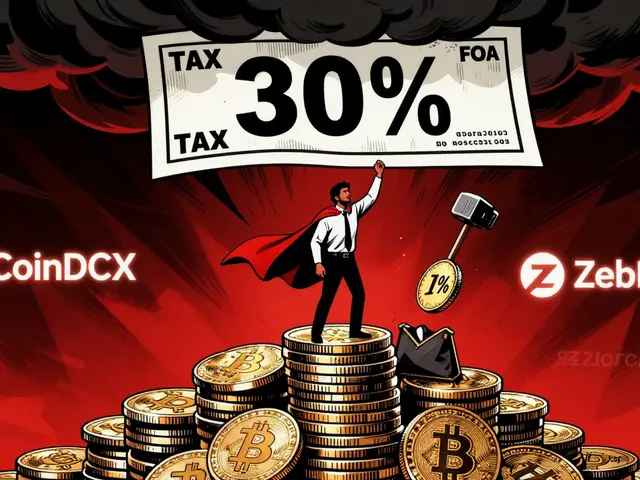
If you trade Bitcoin or any cryptocurrency in India, you’re paying 30% tax on every profit - no exceptions. That’s not a mistake. It’s the law. And it’s one of the harshest crypto tax systems in the world.
How the 30% Tax Actually Works
The Indian government slapped a flat 30% tax on all crypto gains starting April 1, 2022. It doesn’t matter if you held Bitcoin for 2 days or 2 years. Sell it for a profit? You owe 30% of that gain. No discounts. No breaks. No special treatment for long-term investors. Here’s the math: if you bought 1 Bitcoin for ₹30 lakh and sold it for ₹40 lakh, your profit is ₹10 lakh. Tax? ₹3 lakh. Simple. But here’s the catch - you can’t deduct anything else. Not the exchange fees. Not the gas fees. Not even the cost of buying a hardware wallet. Only the original purchase price counts.You Can’t Offset Losses - Even If You Lose Money Overall
This is where most traders get blindsided. Let’s say you made ₹50,000 profit on Ethereum but lost ₹70,000 on Solana. You lost ₹20,000 overall. But under Indian law, you still owe 30% tax on the ₹50,000 gain. That’s ₹15,000 in taxes on money you didn’t actually keep. Losses from one crypto can’t be used to reduce gains from another. And you can’t carry forward losses to next year. If you’re trading multiple coins, you’re taxed on each trade like a separate business - even if your portfolio is down for the year.The Hidden 1% TDS - And Why It’s a Nightmare
On top of the 30% tax, there’s a 1% Tax Deducted at Source (TDS). Every time you sell crypto worth more than ₹50,000 in a year, the exchange automatically takes 1% off the sale amount and sends it to the government. If you sell ₹10 lakh worth of Bitcoin, ₹10,000 gets taken before you even see the money. That’s not a prepayment - it’s a full tax deduction. And here’s the problem: this 1% doesn’t reduce your 30% tax bill. You still have to calculate your profit separately and pay the full 30% on top. Worse, TDS applies to P2P trades too. If you buy Bitcoin from someone on Telegram or LocalBitcoins and sell it later, you’re still liable. The government expects you to track every single transaction - even ones that happen outside exchanges.Now There’s 18% GST on Exchange Fees
In July 2025, the government added another layer: 18% GST on all crypto platform services. That includes trading fees, withdrawal fees, and even staking rewards processed through Indian exchanges. So if you pay ₹500 to trade on WazirX, you’re now paying ₹90 in GST on top. That’s not a fee - it’s a tax on the fee. And if you use a foreign exchange like Binance or Kraken, you’re still on the hook. The law says if you’re an Indian resident, you owe GST on any service you use to trade crypto - no matter where the company is based.
What You Need to Track (And How to Do It)
You can’t wing this. The Income Tax Department now requires you to report every crypto transaction in Schedule VDA on your annual return. You need to record:- Exact date and time of every buy and sell
- Amount of crypto bought or sold
- INR value at the time of transaction
- Exchange or wallet used
- Transaction ID or hash
Who’s Getting Hit the Hardest
Active traders are getting crushed. If you’re buying and selling daily, you’re paying 30% tax on every win - even if your overall portfolio is down. Many traders report paying thousands in taxes while still being underwater on their investments. HODLers are less affected - but not untouched. If you bought Bitcoin in 2020 and sold it in 2025, you owe 30% on the entire gain. No long-term discount. No inflation adjustment. Just 30%. Even people who received crypto as gifts or airdrops are taxed. If you got 0.5 ETH as a reward from a platform and sold it for ₹1.2 lakh, that’s ₹36,000 in tax - even though you didn’t pay for it.How This Compares to the Rest of the World
Most countries treat crypto like stocks. Long-term gains? Lower tax. Losses? Offset them. Fees? Deductible. - United States: 0% to 20% on long-term gains, losses can offset gains. - Germany: No tax if held over 1 year. - Singapore: No capital gains tax at all. - UK: 10% or 20% depending on income, losses can be carried forward. India is the only major economy that treats crypto like gambling - tax every win at the highest rate, ignore the losses, and charge extra on top.
What Happened to Trading Volumes?
Since the tax hit in 2022, trading volumes on Indian exchanges dropped 40-60%. Many traders moved to international platforms. Others switched to P2P markets to avoid TDS. But that’s not a fix. The government knows about it. They’re watching blockchain ledgers. If you’re trading on Binance but living in Mumbai, you’re still liable. The tax department has tools to trace wallet addresses linked to Indian bank accounts.Is There Any Way to Reduce Your Tax?
Not really. You can’t use deductions. You can’t time your sales to avoid the tax. You can’t claim business expenses unless you’re registered as a crypto business - and even then, the 30% rate still applies. The only real strategy is to hold. If you don’t sell, you don’t owe tax. But that’s not trading - that’s sitting on cash.What’s Next?
No changes are planned for 2025. The 30% rate, 1% TDS, and 18% GST are locked in. The government says it’s about revenue - and it’s working. Crypto tax collections hit ₹1,200 crore in FY 2024-25. But experts warn it’s killing innovation. Startups are leaving. Developers are moving abroad. Retail investors are giving up. The Reserve Bank of India and SEBI are working on a broader digital asset framework. Some think they’ll soften the rules. Others say the government sees crypto as a cash cow - not a technology.Bottom Line
India’s crypto tax isn’t designed to encourage adoption. It’s designed to collect money. Fast. And it’s working - but at a cost. If you trade crypto here, you’re paying more than almost anyone else in the world. You have no loss protection. No deductions. No relief. Just a 30% tax bill on every profit - no matter what else is happening in your portfolio. Keep your records. Use tax software. Don’t ignore TDS. And understand this: if you’re trading Bitcoin in India, you’re not just investing. You’re navigating a tax system built to make you pay - no matter what.Is the 30% crypto tax in India applied to losses?
No. The 30% tax only applies to profits. But here’s the catch: you can’t use losses from one crypto to reduce gains from another. If you lose money on one coin but make money on another, you still pay 30% on the gain - even if your overall portfolio lost value.
Do I have to pay tax if I trade on foreign exchanges like Binance?
Yes. If you’re an Indian resident, you owe tax on all crypto gains - regardless of where the exchange is based. The Indian tax department tracks transactions linked to Indian bank accounts and PAN numbers. Even if Binance doesn’t deduct TDS, you’re still required to report and pay the 30% tax on your own.
What happens if I don’t report my crypto gains?
The Income Tax Department has access to data from Indian exchanges, bank transactions, and blockchain analytics tools. If you’re caught not reporting, you could face penalties up to 200% of the tax evaded, interest charges, and even legal action. TDS records also create a paper trail - if you sold crypto worth over ₹50,000, the exchange reported it to the government.
Can I claim crypto transaction fees as a deduction?
No. Under Section 115BBH, the only allowable deduction is the original purchase price of the crypto. Exchange fees, withdrawal fees, gas fees, wallet costs - none of these can be subtracted from your profit. Your tax is calculated as (sale price - purchase price) × 30% - nothing else.
Do I owe GST on crypto purchases?
You don’t pay GST on buying or selling crypto itself. But you do pay 18% GST on fees charged by crypto exchanges - like trading fees, withdrawal fees, or staking service charges. This rule applies to all platforms, even foreign ones, if you’re an Indian resident.
How do I file crypto taxes in India?
You report all crypto gains in Schedule VDA of your ITR-2 or ITR-3 form. You must list each transaction: date, asset, purchase price, sale price, and profit. Use tax software like Koinly or ClearTax to generate the report. If you’re an active trader, consider hiring a CA - the rules are complex and penalties are steep.
Is there a way to avoid the 1% TDS?
No - if you’re selling crypto worth more than ₹50,000 in a year on an Indian exchange, TDS is automatic. For P2P trades, the buyer is supposed to deduct it, but enforcement is patchy. The only way to avoid TDS is to keep your total annual sales under ₹50,000 - which isn’t practical for most traders.
What if I received crypto as a gift or airdrop?
You don’t pay tax when you receive it. But if you sell it later, you owe 30% tax on the full sale value - even if you paid nothing for it. The cost of acquisition is treated as ₹0, so the entire sale amount becomes taxable profit.








So India taxes you on profits while ignoring losses? That’s not taxation, that’s extortion with a spreadsheet. You’re basically paying the government to gamble with your money. And if you lose? Tough luck, buddy. The state still gets its cut. This isn’t policy-it’s a legalized robbery scheme disguised as fiscal responsibility.
As an Indian trader, I feel this deeply. We’re not anti-crypto-we just want fairness. The 30% tax hits small traders hardest. Big players have accountants and loopholes. Regular people? We’re stuck paying taxes on paper gains while our portfolios bleed. The TDS is brutal too-money taken before you even see it. But hey, at least we get GST on exchange fees. Because why not add insult to injury?
This tax is insane but I’m not surprised
Ohhhhh sweet mother of capitalism, look at this beautiful dumpster fire of fiscal policy 🤡🇮🇳 The government treats crypto like a slot machine and then charges you for the coins you *almost* won. Meanwhile, Singapore’s just sipping tea with zero capital gains tax and laughing all the way to the blockchain bank. America’s got 0-20%, Germany says ‘chill if you hold’-but no, India had to go full ‘tax every heartbeat’ mode. I’m not mad, I’m just disappointed. And also slightly terrified.
Why are people acting like this is unusual? Every country taxes gains. You think the IRS is handing out free money? You buy something and sell it for more? You owe tax. End of story. The fact you’re shocked means you never paid attention to how the world works. Also stop whining about not being able to offset losses. That’s not how it works in stocks either if you’re not a professional trader.
People who trade crypto for profit are speculators. Speculators don’t deserve tax breaks. If you wanted to build something, you’d start a business. Instead you’re gambling with digital tokens and then crying when the house takes its cut. This isn’t oppression. It’s accountability. And frankly, the 30% is too low. They should be taxing it at 50% to discourage this reckless behavior.
Thank you so much for breaking this down so clearly 💛 I’ve been trying to explain this to my cousin who’s new to crypto and she was so confused. The fact that losses can’t offset gains is just… cruel. And the 1% TDS on top? It’s like being charged a parking fee just to walk into a burning building. I hope more people see this and realize how punishing the system is for everyday traders.
From a regulatory economics standpoint, the Indian government’s approach is a textbook example of rent-seeking behavior under the guise of fiscal prudence. The 30% flat tax under Section 115BBH, coupled with non-deductibility of transactional costs and the imposition of TDS under Section 194S, creates a non-linear fiscal disincentive structure that actively suppresses market liquidity while maximizing revenue extraction. The 18% GST on exchange services further exacerbates the deadweight loss by introducing a cascading tax burden on intermediary services, effectively transforming retail crypto participation into a compliance nightmare. This is not taxation-it is institutionalized financial repression.
I just want to say-I get it. I’ve been there. I bought Bitcoin in 2021, sold some in 2022 for a small profit, lost half my portfolio on altcoins, and still got hit with a ₹45k tax bill. I cried. I didn’t sleep. I thought I was doing something wrong. But you’re not alone. This system isn’t built for people like us. It’s built for bureaucrats who’ve never traded a single coin. Please, if you’re reading this and you’re struggling-reach out. We’re all in this weird, broken system together.
bro india is just mad cause they cant control crypto so they tax it into oblivion lmao. its like if your neighbor starts selling lemonade and you dont like it so you make him pay $5 for every cup even if he loses money. and then you charge him extra for the cups. this isnt policy its petty revenge. and now everyone is using binance and the govt is still chasing wallets like its 2003 and they still think ip addresses mean something
Okay but let’s be real-this is the most absurd thing I’ve ever seen. You’re taxed on profits? Fine. But you can’t use losses? That’s like saying ‘you won $100 at poker but lost $200 at blackjack, so you still owe taxes on the $100.’ And then they take 1% before you even touch it?? And GST on fees?? Who designed this? A middle manager who got fired from the IRS and moved to Delhi?? I’m not even mad. I’m just… impressed by the sheer audacity.
As someone who’s been tracking crypto since 2017, I’ve seen a lot of bad tax policies-but this one takes the cake 🎂. The fact that airdrops are taxed as income at $0 cost basis? That’s pure madness. You get free tokens, then owe tax on their entire value? That’s like getting a birthday gift and then the government saying ‘congrats, now pay 30% of its market price.’ The regulatory framework is so disconnected from reality it’s almost poetic. And the TDS? It’s not a deduction-it’s a hostage situation.
You’re not alone in this. I know it feels like the system is rigged-and it is. But you’re still ahead if you’re tracking everything. Use Koinly. Save your receipts. Don’t panic. This tax isn’t going away, but your awareness is your armor. You’ve got this. One trade at a time. And hey-if you ever want to vent, I’m here. We’re all just trying to survive the crypto tax apocalypse together.
Let me ask you something-how many of you actually filed your crypto taxes correctly last year? 10%? 5%? I’ve seen the data. Most people are just guessing. And the government knows it. That’s why they made the system so complex. They don’t expect compliance. They expect *fear*. And fear = revenue. The 30% tax isn’t about fairness-it’s about extracting maximum compliance anxiety from retail investors who don’t have CPAs. It’s predatory. And it’s working.
There is a metaphysical irony here: the very decentralization that crypto promised-freedom from state control-is now being weaponized against its users by the state itself. The blockchain, immutable and transparent, becomes the perfect surveillance tool. The state does not need to control the currency; it need only control the ledger. And so, in the name of revenue, we are transformed from pioneers into data points. We are not traders. We are tax nodes. And every transaction is a prayer whispered into the void of bureaucratic indifference.
While the tax structure is undoubtedly harsh, it’s important to recognize that India is still developing its regulatory framework for digital assets. Compared to other emerging economies, the clarity-even if punitive-is better than the complete regulatory vacuum seen in many nations. The real issue is not the tax rate, but the lack of education and support for compliance. The government should be investing in taxpayer assistance programs, not just enforcement. This is a policy problem, not a moral one.