
What is BUILD (BUILD) Crypto Coin? Starfish Topology & DeFi Role Explained
Have you ever stumbled upon a cryptocurrency with a name as generic as "BUILD" and wondered if it was just another copycat project or something genuinely different? In the crowded world of decentralized finance (DeFi), names can be misleading. BUILD is not a standalone blockchain like Ethereum or a meme coin chasing viral trends. Instead, it operates as a specific utility token within a highly specialized DeFi architecture known as Starfish Topology, which aims to solve one of the biggest headaches in crypto: inefficient liquidity.
If you are looking at the charts right now, you might be confused. The price is hovering around $0.00004394 USD, and trading volume often sits at $0. This looks like a dead project, doesn't it? Not necessarily. It suggests that BUILD is a niche instrument designed for sophisticated yield strategies rather than day-trading speculation. To understand what BUILD actually does, we have to look past the ticker symbol and examine the mechanical role it plays in the Multi-Tier Starfish Topology (MTST) system.
The Core Problem: Liquidity Fragmentation
Most automated market makers (AMMs) work by creating separate pools for every pair of tokens. If you want to swap Token A for Token B, there needs to be a pool containing both. As new tokens launch, protocols need more capital to create these pairs. This leads to liquidity fragmentation-money is spread too thin across hundreds of tiny pools, resulting in high slippage and poor prices for users.
Traditional AMMs require collateral, usually stablecoins like USDC or DAI, to back every new token listing. This creates a barrier to entry for new projects and ties up capital that could be used elsewhere. The protocol behind BUILD argues that this model is broken. They propose a topology where liquidity is shared dynamically across tiers, reducing the need for massive amounts of external collateral for every single new asset.
Understanding Starfish Topology
Starfish Topology is the underlying technology that powers the BUILD ecosystem. Think of it as a centralized hub-and-spoke model but applied to decentralized liquidity. Instead of isolated pools, assets are connected through a central structure that optimizes how value flows between them.
This architecture offers two main advantages:
- Improved TVL Utilization: By sharing liquidity across related assets, the Total Value Locked (TVL) works harder. You don't need deep liquidity in every single pair because the topology routes swaps efficiently through the network.
- Zero-Collateral Onboarding: New tokens can be added to the system without requiring fresh injections of USDC or other stablecoins. The protocol uses its own internal tokens to facilitate these connections, lowering the friction for new projects to gain liquidity access.
This approach is significant because it addresses the "cold start" problem many DeFi protocols face. Getting enough liquidity into a new pool is expensive and risky. Starfish Topology attempts to mitigate this risk by leveraging existing protocol tokens.
The Four Tiers of Multi-Tier Starfish Topology (MTST)
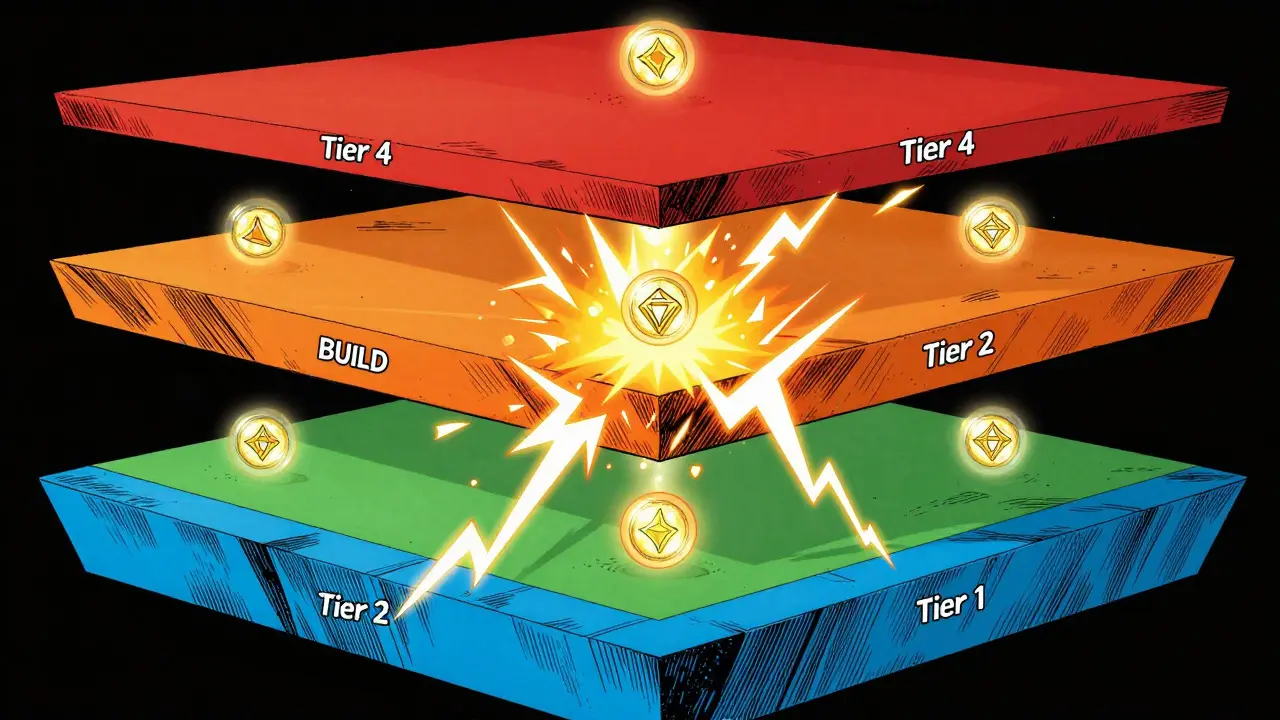
The MTST system divides assets into four distinct tiers based on volatility and maturity. Each tier has a designated protocol token that acts as the anchor for that level of risk. Understanding where BUILD fits here is crucial to understanding its value proposition.
| Tier | Protocol Token | Risk Profile | Paired Assets | Volatility |
|---|---|---|---|---|
| Tier 1 | RADIO | Lowest Risk | Stablecoins (USDC, DAI), Native Chains (ETH, MATIC) | Very Low |
| Tier 2 | SHACK | Medium-Low Risk | Blue-Chip Cryptos (LINK, LUNA, AAVE) | Low-Medium |
| Tier 3 | BUILD | Medium Risk | Mid-Stage Protocols (MANA, GRT, ENJ) | High |
| Tier 4 | DREAM | Highest Risk | Startup Tokens | Very High |
BUILD operates specifically in Tier 3. This tier is designed for mid-stage protocol tokens. These are projects that have moved past the initial startup phase but haven't yet achieved the stability and market cap of blue-chip assets. Examples include MANA (Decentraland), GRT (The Graph), and ENJ (Enjin Coin).
Why does this matter? Because Tier 3 is described as "quite volatile over time." If you hold BUILD, you are essentially taking on the volatility risk of mid-cap altcoins. The token serves as the bridge or anchor for swaps involving these specific types of assets. It allows traders to move in and out of mid-stage tokens without needing direct liquidity pairs for every single combination, relying instead on the BUILD token as an intermediary.
Market Reality: Price, Volume, and Availability
Let's talk about the numbers, because they tell a stark story. As of July 2026, BUILD trades at approximately $0.00004394 USD. More concerning is the 24-hour trading volume, which frequently reports as $0 USD.
In the crypto world, zero volume usually means one of three things:
- Dormancy: The project is inactive, and development has stalled.
- Niche Usage: The token is only used internally by a small group of advanced users for specific yield farming strategies, meaning retail traders rarely buy or sell it on open markets.
- Data Reporting Issues: The exchanges listing the token may not be reporting data accurately to aggregators.
Unlike major coins such as Bitcoin or Ethereum, BUILD lacks widespread exchange listings. You won't find it on Coinbase or Binance. This limits accessibility and increases the difficulty of entering or exiting positions. For a regular investor, this lack of liquidity is a significant red flag. If you buy BUILD, selling it quickly without impacting the price heavily might be impossible due to the shallow order books.
Missing Information: The Transparency Gap
A critical aspect of evaluating any crypto asset is transparency. Unfortunately, BUILD suffers from a severe information gap. Comprehensive details regarding the following are scarce or non-existent in public sources:
- Total Supply: How many BUILD tokens exist? Is there inflation?
- Governance Structure: Who controls the protocol? Are decisions made by token holders?
- Development Team: Who built this? Are they doxxed (publicly identified)?
- Roadmap: What are the future plans beyond the current MTST implementation?
Without a whitepaper or official documentation easily accessible, investors are left guessing. In the DeFi space, code is law, but so is trust. If you cannot verify who is behind the technology, the risk of smart contract bugs or rug pulls increases. The absence of expert analyses and user reviews further isolates BUILD from the mainstream crypto narrative.

Who Is BUILD For?
Given its low liquidity, high volatility classification, and complex technical role, BUILD is not for everyone. It is likely irrelevant for:
- Casual Investors: Those looking for easy buy/sell options on major exchanges.
- Long-Term Holders: Without clear governance or staking rewards detailed publicly, holding a low-volume token carries opportunity cost risks.
However, BUILD might appeal to:
- DeFi Degens: Experienced users who understand liquidity provision and are willing to take high risks for potentially higher yields in mid-tier asset swaps.
- Protocol Researchers: Individuals interested in alternative AMM designs and Starfish Topology mechanics.
Risks and Considerations
Before interacting with BUILD, consider these specific risks:
- Liquidity Risk: With near-zero volume, you might get stuck with tokens you cannot sell.
- Smart Contract Risk: As a newer architectural model, the Starfish Topology contracts may contain undiscovered vulnerabilities.
- Opacity Risk: The lack of team info and detailed tokenomics makes due diligence difficult.
- Volatility Risk: Being in Tier 3 means exposure to the erratic price movements of mid-cap altcoins like MANA or GRT.
The innovative nature of the Multi-Tier Starfish Topology is intriguing from a theoretical standpoint. It solves real problems in liquidity efficiency. However, theory does not always translate to market success. BUILD currently appears to be a niche component of a specialized system rather than a widely adopted financial instrument.
Is BUILD a good investment?
Currently, BUILD presents high risk due to extremely low trading volume ($0 USD reported) and limited availability on major exchanges. It is better suited for experienced DeFi users who understand the Starfish Topology mechanics rather than casual investors. Always conduct your own research before investing in low-liquidity assets.
What is the difference between BUILD and RADIO?
Both are tokens within the same Multi-Tier Starfish Topology system, but they serve different risk tiers. RADIO is in Tier 1, paired with stablecoins and native chains like ETH, making it lower risk. BUILD is in Tier 3, paired with mid-stage volatile tokens like MANA and GRT, making it higher risk.
Where can I buy BUILD token?
BUILD is not listed on major centralized exchanges like Coinbase or Binance. It is likely available only on specific decentralized exchanges (DEXs) integrated with the Starfish Topology protocol. Due to low liquidity, buying large amounts may result in significant slippage.
What is Starfish Topology?
Starfish Topology is a decentralized finance architecture designed to optimize liquidity utilization. It allows for the onboarding of new tokens without requiring additional stablecoin collateral, using a multi-tier system to manage risk and volatility across different asset classes.
Who created the BUILD token?
Public information regarding the founding team and developers behind BUILD is scarce. This lack of transparency is a common risk factor in niche DeFi projects. Potential users should exercise caution and look for any available whitepapers or GitHub repositories to verify the team's identity.