
Celestia and Modular Blockchain Projects: How Data Availability Is Changing the Game
Blockchain Architecture Decision Tool
This tool helps developers determine which blockchain architecture is best suited for their project by analyzing key requirements like scalability, security, cost, and development complexity.
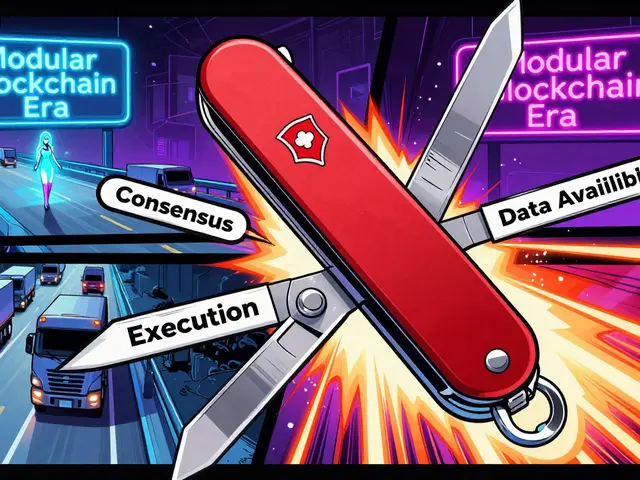
Most blockchains today are like Swiss Army knives - they try to do everything: process transactions, confirm them, store data, and keep everything secure. But what if you could break that knife into separate tools, each doing one thing really well? That’s exactly what Celestia is doing - and it’s changing how blockchains are built.
Before Celestia, if you wanted to launch a new blockchain, you had to build everything from scratch. Consensus? You built it. Transaction execution? You built it. Data storage? You built it. That’s expensive, slow, and hard to scale. Celestia flips that model. It doesn’t try to do execution or settlement. It only does one thing: makes sure transaction data is available and verified. Everything else? That’s up to you.
What Is Celestia, Really?
Celestia isn’t another Ethereum killer. It’s not even a Layer 1 blockchain in the traditional sense. It’s a data availability layer. Think of it like a highway system that only cares whether your truck’s cargo is actually on the road - not what’s inside the truck, where it’s going, or who’s driving it. The trucks? Those are rollups. Celestia just makes sure no one’s hiding cargo or tampering with the shipment.
Launched in October 2023, Celestia was built by a team with deep roots in blockchain infrastructure - including Mustafa Al-Bassam, co-founder of Chainspace, and former Tendermint engineers. They raised $55 million from top VCs like Coinbase Ventures, Jump Crypto, and Galaxy. By early 2024, it hit a $1 billion valuation. That’s not hype. It’s proof that the industry sees a real problem - and Celestia has a real solution.
The Blockchain Trilemma, Solved Differently
Ethereum’s Vitalik Buterin coined the term “blockchain trilemma” - the idea that you can only pick two out of three: decentralization, security, and scalability. Bitcoin chose security and decentralization but sacrificed speed. Ethereum tried to do all three and ended up with high gas fees and slow blocks.
Celestia doesn’t try to solve the trilemma on one chain. It solves it by splitting the problem. Instead of one chain doing everything, Celestia takes care of consensus and data availability. Rollups - like Arbitrum, Optimism, or custom ones - handle execution. This means:
- Rollups can be optimized for speed, cost, or specific use cases
- Celestia’s network stays light and fast because it doesn’t process transactions
- Security isn’t diluted - rollups inherit Celestia’s data availability guarantees
This separation is the key. You’re not forcing every dApp to use the same rules. You’re giving them freedom to choose their own execution environment - whether it’s EVM, WASM, or something entirely new.
Data Availability Sampling: How Celestia Keeps Things Trustless
Here’s the magic trick: Celestia lets lightweight nodes - even phones or laptops - verify that data is available without downloading entire blocks. That’s called Data Availability Sampling (DAS).
How? Each block is split into chunks using erasure coding. If a block is 1MB, Celestia expands it to 2MB by adding redundant data. Even if half the block is lost or hidden, you can still reconstruct it. Nodes don’t download the whole thing. They ask for a few random pieces. One random sample gives you 50% confidence the data is there. Seven samples? Over 99% confidence. No need to be a full node. No need for terabytes of storage.
This is huge. On Ethereum, running a full node requires constant syncing and massive storage. On Celestia, you can verify data with a phone. That makes the network far more decentralized. More participants = more security.

Namespace Merkle Trees: Your Data, Only Your Data
Imagine a giant book where every chapter is written by a different author. You only care about your chapter. But you’re forced to read the whole book to make sure no one cheated. That’s how traditional blockchains work.
Celestia fixes this with Namespace Merkle Trees (NMT). Each dApp or rollup gets its own namespace - like a labeled drawer in a filing cabinet. When a block is created, data is sorted by namespace. Your node only downloads the part labeled for your app. No extra data. No wasted bandwidth. No processing irrelevant transactions.
This means:
- A gaming rollup doesn’t waste time verifying DeFi trades
- A social media chain doesn’t need to store token swap data
- Developers can build specialized chains without bloating the network
NMTs turn a shared, noisy public ledger into a personalized, efficient data feed.
Who’s Building on Celestia?
Celestia isn’t trying to be a consumer-facing blockchain. It’s infrastructure. The real users are developers building rollups. Here are some real projects already live or in development:
- Bobae - A modular gaming chain using Celestia for data availability, with custom execution for real-time multiplayer interactions.
- Avail - A modular blockchain framework from Polygon that uses Celestia as its data layer.
- Chainlink CCIP - Testing Celestia for cross-chain message verification, leveraging its data availability for trustless interoperability.
- zkSync and Starknet - While currently on Ethereum, both teams have publicly explored using Celestia to reduce fees and increase throughput.
These aren’t prototypes. They’re production-ready systems choosing Celestia because it’s cheaper, faster, and more scalable than trying to run everything on Ethereum or Solana.
How Does Celestia Compare to Other Modular Chains?
Celestia isn’t the only player in modular blockchain. But it’s the only one focused purely on data availability. Others, like EigenLayer or Arbitrum Nova, still handle execution or settlement. Here’s how Celestia stacks up:
| Project | Primary Role | Data Availability | Execution | Programming Support |
|---|---|---|---|---|
| Celestia | Data Availability Layer | Yes (DAS + NMT) | No - only provides data | Any (EVM, Cosmos SDK, WASM, etc.) |
| EigenLayer | Restaking Layer | No - relies on Ethereum | Yes - via AVS | Primarily EVM |
| Avail | Data Availability + Execution | Yes | Yes - built-in | Rust, Cosmos SDK |
| Arbitrum Nova | Optimistic Rollup | No - uses Ethereum | Yes - Optimistic VM | EVM only |
Celestia’s advantage? It’s the only one that doesn’t force you into a specific execution model. You’re not locked into EVM. You’re not stuck with optimistic fraud proofs. You can build your own virtual machine, your own rules, and just plug into Celestia’s data layer.

The Ginger Upgrade: Speeding Things Up
In December 2024, Celestia rolled out the Ginger upgrade. It cut block times from 12 seconds to 6 seconds - a 50% improvement. That’s not a minor tweak. It means rollups can finalize transactions twice as fast. For applications like gaming, DeFi, or real-time messaging, that’s a game-changer.
The upgrade didn’t touch consensus or security. It just made the data layer faster. That’s the beauty of modular design: you can optimize one piece without breaking the whole system.
What You Need to Know as a Developer
If you’re building on Celestia, you need to think differently. Forget “deploy on Ethereum.” Think “deploy on Celestia with a custom rollup.”
- You’ll need to understand data availability sampling - how light nodes verify data
- You’ll need to design your rollup’s execution environment - EVM? WASM? Something custom?
- You’ll need to use the Celestia SDK to publish data to the network
- You’ll need to handle your own fraud proofs or validity proofs - Celestia doesn’t do that for you
Support for languages is wide: Solidity for EVM rollups, Rust and Go for Cosmos-based chains, and even custom VMs written in C++ or JavaScript. There’s no lock-in. You’re not tied to one stack.
Tools like the Celestia Node CLI, TIA CLI, and the Celestia Explorer are mature enough for production use. Documentation is clear, and the developer community is growing fast - especially in Asia and Eastern Europe, where low-cost infrastructure is a priority.
Why This Matters for the Future of Web3
Celestia isn’t just another blockchain. It’s a new architecture. It’s the foundation for a future where:
- Every app has its own blockchain - fast, cheap, and tailored
- Users don’t pay for other apps’ traffic
- Developers aren’t stuck with Ethereum’s gas fees or Solana’s outages
- Decentralization isn’t sacrificed for speed
Right now, most Layer 2s are still tethered to Ethereum. They’re borrowing its security and paying its fees. Celestia breaks that tether. It gives rollups their own independent, scalable, and secure data layer. That’s the next evolution.
The modular blockchain era isn’t coming. It’s already here. And Celestia is leading it.
Is Celestia a cryptocurrency?
Celestia has a native token called TIA, which is used for staking and securing the network. But Celestia itself isn’t a cryptocurrency in the way Bitcoin or Ethereum is. It’s a data availability layer. TIA is the fuel for the network’s security, not a currency for payments or DeFi.
Can I use Celestia to build a DeFi app?
Yes, but not directly. You’d build a rollup - like an Optimistic or ZK rollup - on top of Celestia. That rollup would handle all DeFi logic: swaps, lending, liquidity pools. Celestia just ensures the transaction data is available and verified. Many DeFi teams are already testing this setup to cut costs and improve speed.
Do I need to run a full node to use Celestia?
No. One of Celestia’s biggest advantages is that you don’t need to download the entire blockchain. With Data Availability Sampling, you can verify data with just a few random samples. That means phones, laptops, and even IoT devices can participate in network security without heavy hardware.
How is Celestia different from Ethereum 2.0?
Ethereum 2.0 still combines execution and data availability on the same chain - even with rollups, they all post data back to Ethereum. Celestia separates those functions entirely. It doesn’t do execution at all. That means rollups on Celestia aren’t competing for space or gas fees. They’re independent, scalable, and cheaper.
Is Celestia secure?
Yes. It uses Proof-of-Stake with over 200 validators as of late 2025. Data Availability Sampling ensures that even light nodes can detect malicious behavior. If a validator hides data, other nodes will catch it. Fraud proofs and economic penalties make attacks expensive and unlikely. Security isn’t theoretical - it’s mathematically enforced.
What programming languages can I use with Celestia?
You can use any language that can compile to a virtual machine. For EVM-compatible rollups, use Solidity. For custom rollups, use Rust or Go with the Cosmos SDK. There are also experimental tools for WebAssembly (WASM), C++, and even JavaScript-based VMs. Celestia doesn’t lock you into one stack - it lets you choose.
Will Celestia replace Ethereum?
No. It complements it. Ethereum remains the most secure and widely used settlement layer. Celestia gives developers an alternative - one that’s cheaper and more scalable for apps that don’t need Ethereum’s level of settlement security. Many projects will use both: Celestia for execution and Ethereum for final settlement. It’s not replacement - it’s evolution.
Modular blockchains aren’t a trend. They’re the future. And Celestia is the most focused, technically sound, and investor-backed project making it real. If you’re building in Web3, you need to understand this shift - because the chains of tomorrow won’t be monolithic. They’ll be modular. And they’ll run on data availability layers like Celestia.