

Crypto Startup Compliance Costs: The Real Price of Regulation in 2026
Remember when launching a crypto project meant just writing code and deploying a smart contract? Those days are gone. Today, the biggest hurdle isn't technical-it's legal. In 2025, compliance spending for cryptocurrency startups jumped by 25%, turning regulatory adherence into a primary business determinant rather than a back-office checkbox. If you are building a digital asset platform today, you need to understand that compliance is no longer optional; it is the price of admission to the global market.
The stakes have never been higher. Global penalties for non-compliance hit $1.8 billion in 2024 alone. For early-stage companies with limited capital reserves, these costs can be existential. This guide breaks down exactly where your money goes, how different jurisdictions compare, and practical strategies to manage these expenses without stifling innovation.
The Anatomy of Crypto Compliance Expenses
To control costs, you first need to see them clearly. Compliance isn't a single line item; it’s a bundle of licensing, technology, personnel, and operational adjustments. Understanding this breakdown helps you forecast cash flow accurately.
| Cost Category | Estimated Range (USD) | Key Drivers |
|---|---|---|
| Licensing & Registration | $5,000 - $25,000 per state/license | Money Transmitter Licenses (MTLs), FinCEN registration, surety bonds |
| Technology (AML/KYC) | $1,500 - $15,000+ monthly | Transaction monitoring software, identity verification APIs, data storage |
| Personnel | $120,000 - $250,000 annually (CCO salary) | Scarcity of qualified experts, high turnover, specialized training needs |
| Legal Counsel | $300 - $750 per hour | Contract drafting, regulatory interpretation, audit preparation |
| Travel Rule Implementation | $250,000 - $750,000 one-time | System integration for VASP-to-VASP data sharing for transactions >$3,000 |
Notice that technology implementation for Anti-Money Laundering (AML) and Know Your Customer (KYC) systems consumes about 35% of total compliance budgets. Basic solutions start at $1,500 a month, but enterprise-grade platforms easily exceed $15,000. Meanwhile, personnel costs have surged because finding a Chief Compliance Officer who understands both blockchain mechanics and financial regulations is incredibly difficult. Salaries for these roles range from $120,000 to $250,000 annually in the U.S., with consultants charging up to $600 an hour.
Global Regulatory Landscapes: Where Should You Incorporate?
Your choice of jurisdiction dictates your cost structure. There is no "free" option, but some paths are more efficient than others depending on your target market. The landscape has shifted dramatically with the full enforcement of the European Union's Markets in Crypto-Assets (MiCA) regulation and new frameworks in the U.S. and Asia.
In the United States, the system remains fragmented. You might need Money Transmitter Licenses (MTLs) in multiple states, costing between $5,000 and $25,000 per state, plus annual renewals. FinCEN registration as a Money Services Business (MSB) adds another layer, requiring a $500 application fee and surety bonds ranging from $10,000 to $1,000,000 based on transaction volume. While initial setup might seem cheaper than Europe, the long-term administrative burden of managing 17 different state frameworks creates hidden costs.
Conversely, operating under the EU's MiCA framework costs approximately 18-22% more initially than U.S. operations. However, MiCA offers a "passporting" right across 27 member states. Once you are compliant in one country, you can operate throughout the EU. This harmonization saves significant money in the long run compared to navigating disparate national laws. PwC's 2025 report highlights that while the upfront investment is higher, the predictability reduces legal risk premiums.
For those looking outside these two giants, Singapore and Switzerland offer distinct trade-offs. Singapore's Monetary Authority (MAS) framework costs about 15% less than U.S. compliance but requires heavy localization efforts to enter the Asian market. Switzerland's FINMA regulations add roughly 30% to compliance budgets due to stringent capital requirements, yet they provide excellent credibility and access to European institutional investors.

The Hidden Cost of Non-Compliance
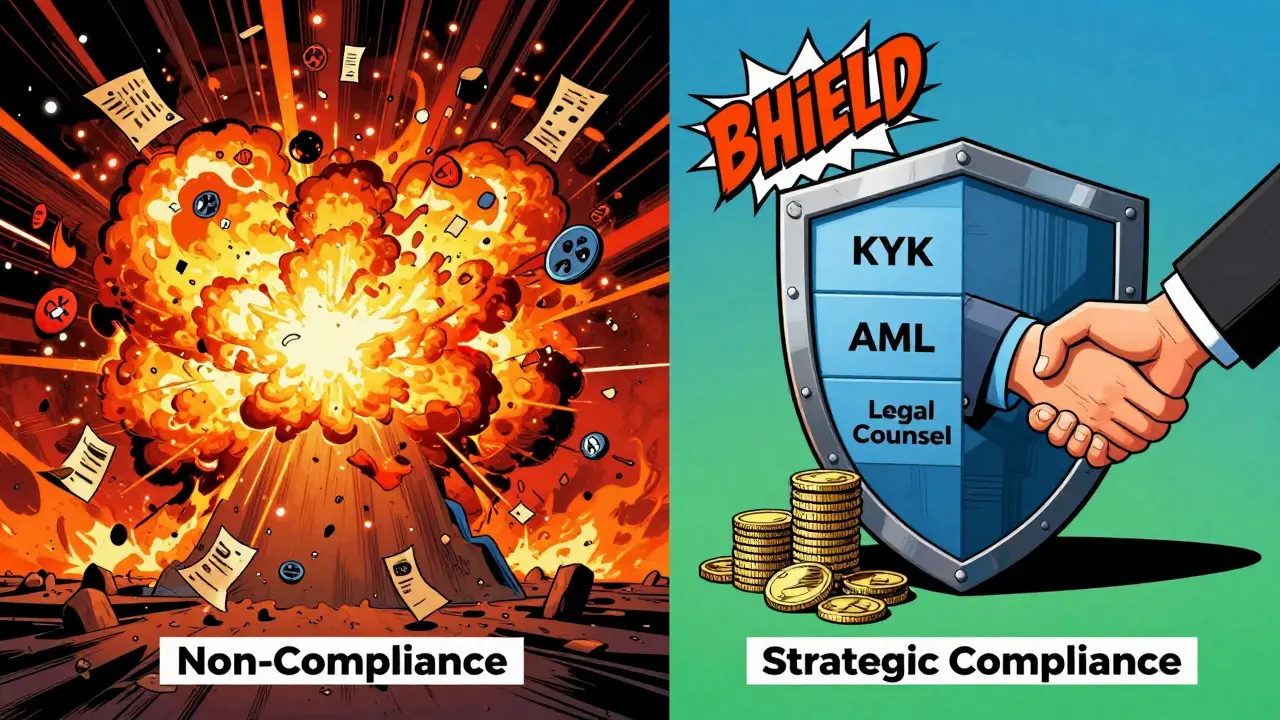
It is tempting to cut corners on compliance to preserve runway, but the math rarely works out. Underinvestment creates far greater financial risks than proper implementation. Consider the data: the global average cost of a data breach in the crypto sector reached $5.3 million in 2025, a 15% increase from 2023. Furthermore, 55% of digital asset platforms faced at least one regulatory investigation in the past 18 months, with investigation-related costs averaging $187,000 per incident.
Giorgio Cafiero from the Financial Action Task Force (FATF) noted in a February 2025 interview that these breach and penalty figures demonstrate why compliance must be viewed as risk mitigation, not just expense. When you factor in the reputational damage-investors now demand mature compliance programs before funding-the cost of being "non-compliant" includes lost revenue opportunities. In fact, compliant startups secured funding rounds 22% faster than their non-compliant counterparts in Q1 2025.
Strategies to Reduce Compliance Burdens
You cannot eliminate compliance costs, but you can optimize them. Successful startups treat compliance as part of product design, not an afterthought. Here are four actionable strategies to lower your total cost of ownership:
- Build Compliance Into Architecture Early: InnReg research shows that startups integrating regulatory requirements during the product design phase reduce total compliance costs by 34-41%. If your smart contracts or user onboarding flows are designed with KYC/AML in mind from day one, you avoid expensive retrofits later.
- Leverage Regulatory Sandboxes: As of 2025, there are 47 jurisdictions offering regulatory sandboxes. These programs allow you to test products under relaxed supervision, reducing compliance costs by 18-25% during the testing phase. Wyoming and Singapore remain top choices for favorable sandbox environments.
- Use Modular Technology Solutions: Avoid monolithic enterprise suites if you are small. Start with modular tools like Salamantex or ComplyAdvantage that scale with your growth. Open-source legal templates can also save $15,000-$40,000 in initial legal fees, provided you still consult specialized counsel for final review.
- Focus on Single-Market Entry First: Operating across five or more jurisdictions increases compliance costs by 63%. Pick one primary market (e.g., MiCA for Europe or a specific U.S. state like Wyoming) and dominate it before expanding. This focused approach keeps overhead manageable.
Future Outlook: What Comes Next in 2026?
The trajectory suggests costs will continue to rise before stabilizing. Gartner predicts that by 2026, compliance costs will exceed customer acquisition costs for 65% of crypto startups. New pressures include the SEC's proposed Digital Asset Compliance Framework, which could add $75,000-$120,000 annually per token offering for continuous classification assessments. Additionally, MiCA Phase 2, effective December 2025, will introduce stricter rules for DeFi products, adding approximately €200,000 in annual costs for relevant startups.
However, standardization is improving. Analysts expect compliance costs to plateau at 18-22% of operational expenses by late 2026 as global standards align. Initiatives like the Global Compliance Network, launched in February 2025, aim to reduce common costs by 30-40% through resource sharing among smaller firms. The key takeaway is that while the absolute dollar amount may rise, the relative burden should decrease as the industry matures and tools become more standardized.
How much does it cost to get a Money Transmitter License (MTL) for a crypto startup?
In the U.S., MTL costs vary significantly by state, typically ranging from $5,000 to $25,000 per state for the initial application. You must also budget for annual renewal fees, which usually fall between $1,000 and $10,000. Additionally, most states require surety bonds, which can range from $10,000 to $1,000,000 depending on your projected transaction volume and business size.
Is it cheaper to comply with MiCA in Europe or U.S. regulations?
Initially, complying with the EU's MiCA regulation costs about 18-22% more than setting up in the U.S. However, MiCA provides a "passporting" right across 27 member states, meaning you only need one license to operate throughout the EU. In contrast, the U.S. has a fragmented system with 17 different state frameworks, leading to higher long-term administrative and legal costs if you plan to serve a nationwide audience.
What is the FATF Travel Rule and how much does it cost to implement?
The FATF Travel Rule requires Virtual Asset Service Providers (VASPs) to collect and transmit personally identifiable information for transactions of $3,000 or more. Implementing this requires significant technology upgrades to enable secure data exchange between providers. For mid-sized startups, OneSafe estimates the implementation cost to be between $250,000 and $750,000, covering software integration, legal review, and staff training.
Can using open-source legal templates save money on compliance?
Yes, leveraging open-source legal templates can save approximately $15,000 to $40,000 in initial legal fees. However, this should be done cautiously. It is recommended to use these templates as a starting point and then have them reviewed by specialized crypto attorneys who charge $450-$750 per hour. This hybrid approach prevents costly missteps that average $185,000 per incident according to legal analysis firms.
How do compliance costs affect fundraising for crypto startups?
Compliance is increasingly seen as a strategic differentiator rather than just a cost center. Data from Q1 2025 shows that 41% of institutional investors require startups to demonstrate mature compliance programs before providing funding. Consequently, compliant startups secured funding rounds 22% faster than non-compliant counterparts, suggesting that investing in compliance can accelerate revenue generation.